Categories
Aesthetics Startups

Day 2022 and Let’s Dance Quince

I have complained in the past about the slow degradation of quality standards in contemporary fashion and the negative consequences it has had on quality for consumers who are not in the top half of the K-shaped economy.

The shrinkflation and reformulation that’s rampant in food has hit clothing quite hard. And has made much easier to justify simply buying fast fashion that’s disposable simply because the quality bar for even beloved basics like L.L Bean has gone down.

I actually sent a note to the Chief Merchandising Officer of Gap, who, of course, did not email me back, about the loss of a particular pair of basic straight-leg black cotton sweatpants. I asked if it was possible to bring it back, as I had discovered a number of other internet complaints about its discontinuation.

The sweatpants had cost somewhere in the realm of $30 for a decade, I owned at least a dozen, and have now worn them all out entirely. They were cotton with just a hint of elastane, very lightweight, and the ideal pant for sleeping and home wear.

Now you find pants that are 30-40% plastics of various blends that promise super soft or super drape-y silhouettes consumers don’t know or even mind that the clever branding of “scuba” pants is just marketing for thick polyester knits.

I’m not against some of it. Somewhere between 2% and 5% works just fine for most fabrics, but I’m up to 10% for some garments as I’ve got boobs to work around. However when things are close to your body, particularly in the intimates category, 100% cotton is absolutely my standard.

To be clear, I have no problem with technical fabrics and am a great fan of innovators in that space, from Uniqlo to Norma Kamali, both of whom I wear. I do care about using the best possible quality in any given category. I also look for that in my wool, silk and leather goods.

This is all a somewhat elaborate setup for the fact that, having been sick in bed for the last week or so, I spent a lot of time browsing Quince.

I have not successfully found garments from them to work, though as a regular reader of things like Wirecutter and The Strategist, I notice when their items get put on lists. Or when people are skeptical of its promise.

The idea that you should be able to get something high quality and tasteful is, alas, becoming a luxury. Even when you spend full freight. A Substack called Magasin today seemed excited when most pieces were “under a thousand” when despite doing alright, I am entirely an under $300 shopper for most items. Coats and bags I’ll go higher but I’m not crossing a thousand. I’m from the industry I know what this costs thanks.

I am also no stranger to the direct-to-consumer world. I was a long-time shopper of Everlane as their founding team was close to me. I’m also a big fan of previous attempts in the category, like Italic, to bring the factories that we in the fashion industry know so well closer to the consumer.

However, I don’t think any of us expected the category winner Quince. That we would get one giant sourcing machine whose entire philosophy appears to be that merchandising is unnecessary. They will allow whatever the market pulls forward. On to the website and take customer demand pulls from there.

Which I suppose I’m going to have to get used to, because why hire a merchandising team when you can just make the market do it for you? Unfortunately, the market isn’t always as good at the job as somebody who is actually a capable market editor or a top merchandising manager. It’s maddening for many consumers to have no sense of quality, fit, style, color or other characteristics we might like from an online retailer. And yet here we are.

So I did something insane. I went through the entire women’s section of Quince. I scrolled through shirts, skirts, pants, dresses, sweaters, blazers and layers, accessories, hand bags and shoes. I didn’t set out to do it as I just added on what I thought might work for me to see if this was part of the appeal. The sense of hope was always there but it was easy to spot where corners had been cut and the reviews are often hit or miss unless it’s a definite best seller.

I ended up selecting what I thought would be a comprehensive capsule wardrobe for what fashion calls pre-fall. It’s the maddening middle season where you have to layer but it also can get very hot.
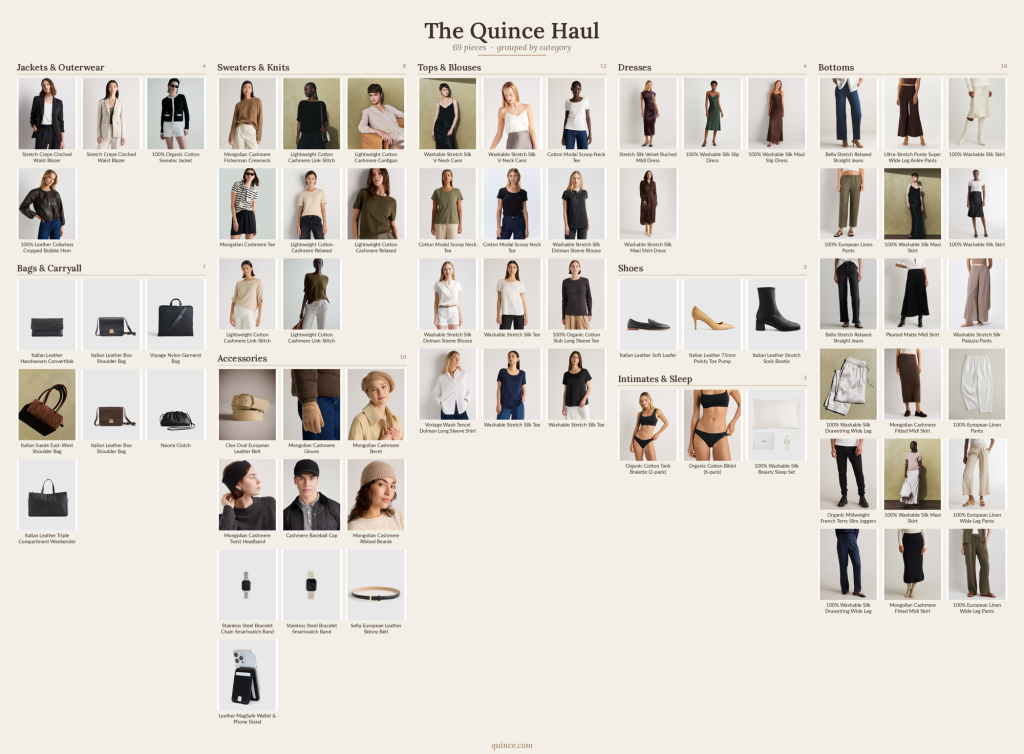
Sixty nine items culled from mid July Quince I could see being useful in the next quarter.

We will see if I can reconstruct a capsule wardrobe from what is merchandising that has no sense of what will fit, what will flatter, how consistent their sizing will be, how consistent the quality will be, or if entire categories will fail me.

Now some categories are heavier weighted as I’m trying a lot of bags and travel. Some are light like shoes as I have basics from actual functional fashion lines from my past but I’ll try these out. I don’t know what fabrics will flatter in what cuts so I got multiple colors but if it doesn’t fit I am likely a full pass as I don’t want to double the order with sizes so if it fits I sits.

Categories
Community Culture Finance Travel

Day 2012 and World Maps and Network Nodes

A long block of travel to sync in person with diverse nodes in my network has been invigorating but also exhausting. I’m sure some of the travel looks quite glamorous, but it is always in service of furthering my longterm goals.

Venkatesh Rao published an essay today suggesting that the dark forest theory of the Internet is over. Our digital public commons has been in retreat

For a decade, we have explained the retreat from the public internet using Yancey Strickler’s Dark Forest Theory. People withdrew into smaller, quieter spaces because speaking in public became dangerous…

The resulting cozyweb—private group chats, Discords, Slacks, newsletters, encrypted messaging groups, invite-only communities—was understood as a strategic adaptation. The public remained a single connected univers

Dead Forest Theory

The ecosystem of private spaces were connected, but as they accreted power these cozy web communities saw their gravity increase. Eventually some collapsed in on themselves. And thus we have black holes of public collapse in the dark forest; out of which none of us are able to escape.

What Rao calls “inaccessible interiority” traps some of us. We may have visibility to other communities through the byproducts of our niches but that does not mean a shared reality where we can reach consensus with others outside of our space.

My strong fear is that without a possible consensus reality for larger groups like nation states citizens, we lose the basic capacity for productive interactions that move us forward. Only inside a community that has swallowed us whole can we progress. And if we find something novel inside those gravity sinks we have no way of sharing it. Only some of us enjoy progress.

Which might be fine for those who wish to live lives quietly out of sight. But it isn’t a world that enables strangers coming together through public global communication in a shared commons.

And this has serious consequences for investing, and especially so in venture capital where a diversity of worldviews is precisely what allows for uncorrelated returns.

Novel worldviews emerge from genuinely new observations of reality. If we all live in disconnected realities of collapsed worldviews what happens?

This is why, as an industry, venture capital is uniquely vulnerable to the seductive coherence of simple ideas, rather than complex truths. That’s unfortunate, because venture capital is also uniquely dependent on intellectual diversity, as evident in the damage done by group-think versus the extreme profitability of contrarianism

This stacks on existing research which illustrates how social media creates echo chambers that amplify consensus ideas while filtering out unconventional or contrarian views — which in turn builds on existing theory that describes how individuals self-censor opinions when they suspect they are in the minority.

Dan Grey “The Venture Capitalist Worldview” in Odin Times

When the dark forest was scary but still possible to traverse, we still had a chance to explore and find reality, even if we lived in a consensus bubble most of the times. Dead forest theory means we are past the event horizon, from which we cannot escape. We are locked in whatever consensus reality emerged inside the event horizon.

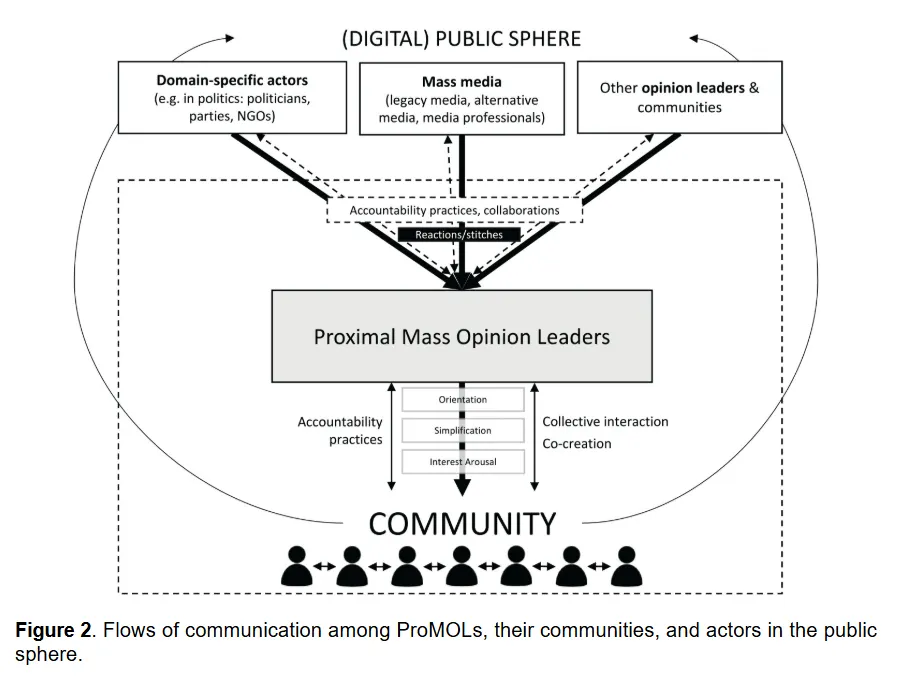
Digital Public Sphere and the gravity of mass opinion leaders from Odin Times

And so despite its expense, its troubles and its costs, I still push my work into the public commons with the hope that I’ll circle the accretion disks but can fight against falling into one forever with a steady acceleration to preserve a visible orbit.

What both Venkatesh Rao and Dan Grey posit in different ways, is that it is worth understanding where we might be cut off from reality.

Further, who knows what new kinds of horrors we will endure as we lead separate lives online without any contact with real life and real people. We crave community with those whom we can maintain consistent context and contact. That’s why I still get on the airplane, or get in the car, or hop on the bus and show up. I want us to share reality.

Categories
Aesthetics Culture Travel

Day 2005 and The PMC Olympics Or Transcontinental Logistics: Couples Event

If professional class workers thin out as a function of artificial intelligence taking some of the work done by the professional management or PMC class, I suspect we will see nostalgia for the time they were seen as aspirational. I’d like to explore that near-future science fiction today with the PMC Olympics.

After the initial decade or two of upset (possibly even rage) at the power shifts & new status dynamics subside, we fondly remember business class types like lawyers & consultants with the same wistful fondness as we recall switchboard operators or the stenography pool.

I’d bet in the nostalgia wave, we see competitions, cosplaying and an equivalent of Renaissance Fairs or reenactments pop up where former PMCs and thr youth pretending to be them, compete in a cargo cult display of its cultural identity markers.

And when this does inevitably emerge as a cultural touchstone, I want to compete in the PMC Olympics with my husband in transcontinental logistics events. Think of it as figure skating but for married business partners.

I’m confident we would medal in the transcontinental travel logistics category. I’d get gold in the individual “cosmetic and liquids” category. Think of it as “uneven-bars” of the transcontinental logistics travel competition.

As part of this mirthful sci-fi exercise, I input a prompt to ChatGPT’s current image model and it gave me a very amusing montage of who might compete and win in just such an event.

Naturally the shining blonde California affluence worker (subcategory creative class) took the gold but let’s not forget the New York finance couple nor the European directorate class.

ChatGPT image prompted with:
Make me an image of three sets of couples who are professional management class knowledge workers. They are on an Olympics podium receiving gold, silver and bronze medals for medalling in the “Transcontinental Logistics: Couples” event. I’d like two American couples (one New Yorker finance style and one California Hollywood style) as well as a European couple (Swiss) in the style of a Brussels bureaucrat. There should be suitcases, travel bags for laptops, a 1L cosmetics bag, a medication cold tube, and other travel essentials in the image 

I know this sounds a little goofy, but the work that goes into managing what a couple need when constantly switching between personal life and work on the road involves a surprising amount of logistical support work. And that’s without children. I’d add a category with a toddler as the most extreme form of this event.

Just check this prompt I made for my own PDF for an event involving both industrial site visits and formal galas that I am attending after flying west from London. Some details are changed or redacted for modest privacy. Anyone can easily guess what I’m going to be doing.

Build a 8-10 day travel itinerary for a business trip departing from Heathrow London and arriving to Salt Lake City and a remote desert town in Utah, from June XX to July 2, 2026. Include a day-off rest plan for Salt Lake City, a Department of Redacted event logistics flow chart, transport coordination for a bus to small town and return back to the city on July X of event, and recommendations for high-quality food near event venues.

Include transitioning time and necessary grooming required for a facility floor tour with safety gear and a change for a formalwear gala with an hour buffer assuming an event mid afternoon, there hours transit and evening formal event at 7pm.

July 2-5th include a secondary itinerary for a follow on mountain social event at 8,000 feet Utah mountains with outdoorsman activities.

Format as a structured PDF briefing with time-stamped logistics, travel maps, and weather-appropriate clothing advice for the city to desert climate shift as well as mountain elevation needs. Include medications, standard pharmacy and first aid needs, cooled medications for peptide regimen, sun safety, facility floor safety gear, day event makeup, formalwear makeup, possible television ready makeup as well as hairstyle needs based on 3 day warning cycle.

Make sure personal preferences for all clothing, sleeping, cosmetic, medication and other gear is accommodated in a carry on suitcase, personal bag and one checked baggage.

Pretty fun right? And I might add that it’s relatively easy to spit these itineraries out once you’ve harnessed your preferences and all necessary items in one’s personal stock keeping. Always take inventory regularly when on the road and unpack and repack quickly for fast turn arounds. Oh and use the three pack cascade system. To my fellow flying logistic Olympians I wish you safe travels while we still enjoy global transportation for capitalism.

Categories
Chronicle Emotional Work

Day 1994 and Wondering if 2000 Days Should Be The End? Or A New Beginning

I am getting closer and closer to a big milestone on here. Day 2000! I’ve been writing for two thousand days in a row and hitting publish. Five years and five months (almost six at 5.7 months) or 285 weeks of daily journaling in public.

I began in the height of the pandemic, and one can hardly recall just how bizarre those years were now. The great weirdening which began long before the pandemic arrived for almost everyone sometime in those long years.

Static and yet unstable. A long horizon of the long now, keeping us in semi-stasis as the institutional bulwarks cracked, and then crumbled, and then began accelerating into change. Everyone is holding on tight and pretending like it’s not a white knuckle era.

We are over the vibe shift, the Vibecession, and another vibe change after that and who knows what is coming next. I feel the same sense of being unmoored as I did when I started.

This despite having built a stable and thriving family and investing career. The biggest problems I had when I started (children, visas, family abroad) remains the same problems I have now. The temptation to simply change how we live is ever present. We escaped from some of flatland but more can be done to build communities and nations that are capable of thriving in the ceaseless change.

I still feel like I don’t know what’s coming, even as the future I sensed has come into being at an alarming right. But the perpetual not knowing can drain hope and energy if you are not careful to replenish. It’s exhausting physically too. The energy to understand what’s coming gets harder day by day and so we must get stronger ourselves.

I’ve probably put over a thousand hours of writing into this (maybe closer to 1500 as it runs from 20-45 minutes of time on any given day) so I’m a better writer but I don’t know if I’ve become a more palatable or appealing one. I don’t care too much as this is for me more than it is for any audience.

Most humans seem to prefer smoothed algorithmic writing over hand crafted artisanal human writing. Which is fine by me, as I don’t necessarily want to change my personal spaces to pander to anyone.

I was on a podcast recently where I reiterated my hope for being a node in the future. I want us to hope for the best by seeing clearly about the worst. That focus on solving problems is replenishing for the soul.

I’ll remain a little under the radar as a specialty node broadcasting to my oddballs. I’ll feel better about broadcasting know that is the long. The longevity posting, the nuclear posting, the odd travels and strange people posting will continue. I will try to broadcast on the pirate wires of the human web.

Categories
Aesthetics Startups

Day 1866 and Never Escaping Veblen Goods

I love a good signaling and status competition. There are so many ways to to signal that at the far reaches of taste you will never fear to tread. Just don’t worry about how other people live.

I’ve worked in luxury fashion and venture capital and they run on the same rules. And it’s all snobbery up and down and it is a mixed bag when it comes to what works in reality.

I’ve known sneakerheads who seamlessly transitioned to private equity because they know in some fundamental way that rising price increases demand in strange markets. But the little signals can give away your whole game and you can’t always assume you are speaking their language.

Many an investor and fashionista has made good use of this basic understanding of a Veblen good. The more expensive it gets, the more it stokes demand. Everyone thinks they can become Hermes or Facebook but if you could well you would have.

This can fuck with actual performance as the thing being performed isn’t necessarily the thing that is getting done in reality. You can show your own displeasure with the pricing scheme by not participating. You can short a thing with a little creative and signaling of your own.

Many decided will continue to play along despite not needing to participate in status games. Outsourcing taste is actually something you can pay for and sometimes you should just get a realistic budget.

Often you really can’t afford to play the game and it’s better to cultivate your own taste and satisfactions in life so you are comfortable taking on the risk load of stepping out of unnecessary competition. You play your own game and win on your own terms.

Categories
Chronicle Finance

Day 33 and Psychological Safety

Creativity is scary. Any time you build something new fear lurks around the corner. Because even if it’s not rational, your perception of risk rises when your potential for failure is at its highest. Perhaps this is why when you take a conscious risk you unconsciously try to mitigate any unnecessary additional risks. This has a number of significant consequences for businesses. You want to feel safer when you take risks so you seek out psychological safety from your associates. The principle is simple. You will only take risks if you believe you don’t be punished for it. Psychological safety has been shown to be crucial for teamwork.

I’d wager this is a factor in why startup teams tend to be homogeneous as human nature makes it harder to trust what we don’t know well. Which is fascinating when you consider that diversity is also an important factor in financial performance. And as much as this principle of psychological safety been discussed for team performance, there is one area in startup land where feeling safe is rarely cultivated: venture capital.

Venture’s entire culture is steeped in cliches of competition and combativeness. Which seems odd for a group that theoretically prizes high performance. Wouldn’t they benefit from cultivating psychological safety the most? If entrepreneurs are solving entirely new problems with high chances of failure feeling like they can trust their financial partners should be a top priority. And surely plenty of ink has been spilled on picking good partners in the literature of startup advice. And yet the atmosphere of distrust is pervasive. Venture capitalist and entrepreneur are constantly managing the information flow between each other. Which is exactly the opposite of what creates the necessary safety to take creative risk. So why isn’t this discussed more?

Imagine a fund who instead of poking holes in your data or lobbing grenades in your plans instead showed it was sensitive to the parade of fear and doubt that pervades most decisions. You’d get more done by a mile. Ideas could be refined instead of defended. Plans could be buttressed and shored up rather than rationalized. Having safety will lower the kind of inhibiting social pressures to show “that you are always crushing it” perhaps enough to produce startups that actually do go on to crush it.

This strategy could shift the dynamics of a firm’s competitiveness too. In group dynamics of status and posturing prioritize deal flow among only in group group members which disadvantages everyone by increasing competitive deals and rising prices. Funds who who have psychological safe founder relations will then disproportionately control what deals get done as the creative risk takers will seek them out. That kind of deal flow would be a major leverage point. Rather than getting stuck fighting for the same deals everyone agrees on (which isn’t a sign of quality no matter how much we want it to be so) venture fund that sticks to prioritizing psychological safety will spend more time with productive risk taking that builds the future.

Developing emotional capacity isn’t a platitude. It’s grueling work that takes place over years, sometimes to little effect given our innate resistance to change. But it is truly transformative.