I am not a gambler. I don’t know how to play poker, or honestly any card game without a tutorial. I find the idea of playing the long odds where I have no advantage to be a bit crazy. Why would you involve yourself with a likely net negative outcome other than as entertainment?
People don’t do math though so I am sure I am overthinking the appeal. I am regularly amused by people who think that finance amounts to little more than legalized gambling
I chalk that attitude up to innumeracy and try to worry more about the challenges of introducing regular people to investing in assets where they can calculate the odds of a positive expected outcomes. People should be allowed to do as they please and I believe that self-interest has had positive outcomes here.
I am not for a nanny state. Quite the opposite. Regular people aren’t allowed to invest in private markets where I do most of my work and the accredited investor rules have significant downsides when companies stay private forever.
Companies used to be acquired or they would go public where anyone could invest in a new company they believed in. Thats how regular people like me would make money. Alas fewer companies make it to the IPO market (or are delaying the process) and have growth less in the public markets. So now I worry more about how anyone builds ownership in anything.
I myself am a boring public market investor. We can all work off the same numbers and animals spirits. Keep it simple with ETFs, some bonds and treasuries and the risky bits are contained to my specialities. It’s almost like I know the work is best done by professionals and computers.
Alas, finance and gambling both require having some grasp of the numbers. And this is getting to be a problem all around. I used to think well it’s not too hard to build a basic portfolio. There are books you can read.
Well, we’ve got a fun substitute for day trading now and it’s definitely more fun than owning some ETFs. Prediction markets have finally taken off. I hope for them to be liquid markets for information and exchange but it’s also fun for gamblers
II don’t know enough about how to place a decent bet though so I don’t use them. I’d rather take risk where I have the edge. And the data seems to bear that strategy out. The people who make money in Polymarket are the top 1 percent who know what they are doing
Martineau recently co-authored a paper that found that since 2022 around 69% of traders on Polymarket lost money, while the top 1% captured three-quarters of the profit
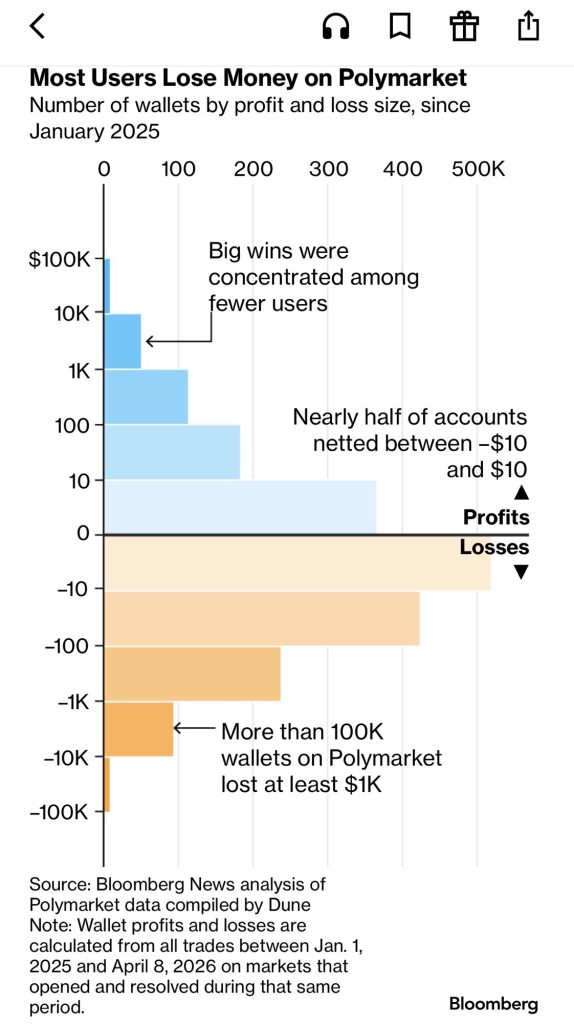
This didn’t strike me as particularly surprising, as presumably the people who lose money in any kind of trading situation are the ones who don’t actually understand the odds that they’re working with and the information that they have.
If you buy a random stock on a hot tip, that’s not really going to get you much further than placing a random bet on polymarket. Of course, the people who are making real money are sophisticated.
Automation seems like exactly what you would want if you knew the parameters of the market and the likelihood of payout, which is incidentally also how every other corner of finance works. So unless you’re the kind of idiot who trades on information they have on special forces actions, say, maybe it’s best to leave some of these things to the professionals.