Categories
Aesthetics Startups

Day 2022 and Let’s Dance Quince

I have complained in the past about the slow degradation of quality standards in contemporary fashion and the negative consequences it has had on quality for consumers who are not in the top half of the K-shaped economy.

The shrinkflation and reformulation that’s rampant in food has hit clothing quite hard. And has made much easier to justify simply buying fast fashion that’s disposable simply because the quality bar for even beloved basics like L.L Bean has gone down.

I actually sent a note to the Chief Merchandising Officer of Gap, who, of course, did not email me back, about the loss of a particular pair of basic straight-leg black cotton sweatpants. I asked if it was possible to bring it back, as I had discovered a number of other internet complaints about its discontinuation.

The sweatpants had cost somewhere in the realm of $30 for a decade, I owned at least a dozen, and have now worn them all out entirely. They were cotton with just a hint of elastane, very lightweight, and the ideal pant for sleeping and home wear.

Now you find pants that are 30-40% plastics of various blends that promise super soft or super drape-y silhouettes consumers don’t know or even mind that the clever branding of “scuba” pants is just marketing for thick polyester knits.

I’m not against some of it. Somewhere between 2% and 5% works just fine for most fabrics, but I’m up to 10% for some garments as I’ve got boobs to work around. However when things are close to your body, particularly in the intimates category, 100% cotton is absolutely my standard.

To be clear, I have no problem with technical fabrics and am a great fan of innovators in that space, from Uniqlo to Norma Kamali, both of whom I wear. I do care about using the best possible quality in any given category. I also look for that in my wool, silk and leather goods.

This is all a somewhat elaborate setup for the fact that, having been sick in bed for the last week or so, I spent a lot of time browsing Quince.

I have not successfully found garments from them to work, though as a regular reader of things like Wirecutter and The Strategist, I notice when their items get put on lists. Or when people are skeptical of its promise.

The idea that you should be able to get something high quality and tasteful is, alas, becoming a luxury. Even when you spend full freight. A Substack called Magasin today seemed excited when most pieces were “under a thousand” when despite doing alright, I am entirely an under $300 shopper for most items. Coats and bags I’ll go higher but I’m not crossing a thousand. I’m from the industry I know what this costs thanks.

I am also no stranger to the direct-to-consumer world. I was a long-time shopper of Everlane as their founding team was close to me. I’m also a big fan of previous attempts in the category, like Italic, to bring the factories that we in the fashion industry know so well closer to the consumer.

However, I don’t think any of us expected the category winner Quince. That we would get one giant sourcing machine whose entire philosophy appears to be that merchandising is unnecessary. They will allow whatever the market pulls forward. On to the website and take customer demand pulls from there.

Which I suppose I’m going to have to get used to, because why hire a merchandising team when you can just make the market do it for you? Unfortunately, the market isn’t always as good at the job as somebody who is actually a capable market editor or a top merchandising manager. It’s maddening for many consumers to have no sense of quality, fit, style, color or other characteristics we might like from an online retailer. And yet here we are.

So I did something insane. I went through the entire women’s section of Quince. I scrolled through shirts, skirts, pants, dresses, sweaters, blazers and layers, accessories, hand bags and shoes. I didn’t set out to do it as I just added on what I thought might work for me to see if this was part of the appeal. The sense of hope was always there but it was easy to spot where corners had been cut and the reviews are often hit or miss unless it’s a definite best seller.

I ended up selecting what I thought would be a comprehensive capsule wardrobe for what fashion calls pre-fall. It’s the maddening middle season where you have to layer but it also can get very hot.

Sixty nine items culled from mid July Quince I could see being useful in the next quarter.

We will see if I can reconstruct a capsule wardrobe from what is merchandising that has no sense of what will fit, what will flatter, how consistent their sizing will be, how consistent the quality will be, or if entire categories will fail me.

Now some categories are heavier weighted as I’m trying a lot of bags and travel. Some are light like shoes as I have basics from actual functional fashion lines from my past but I’ll try these out. I don’t know what fabrics will flatter in what cuts so I got multiple colors but if it doesn’t fit I am likely a full pass as I don’t want to double the order with sizes so if it fits I sits.

Categories
Community Culture Finance Travel

Day 2012 and World Maps and Network Nodes

A long block of travel to sync in person with diverse nodes in my network has been invigorating but also exhausting. I’m sure some of the travel looks quite glamorous, but it is always in service of furthering my longterm goals.

Venkatesh Rao published an essay today suggesting that the dark forest theory of the Internet is over. Our digital public commons has been in retreat

For a decade, we have explained the retreat from the public internet using Yancey Strickler’s Dark Forest Theory. People withdrew into smaller, quieter spaces because speaking in public became dangerous…

The resulting cozyweb—private group chats, Discords, Slacks, newsletters, encrypted messaging groups, invite-only communities—was understood as a strategic adaptation. The public remained a single connected univers

Dead Forest Theory

The ecosystem of private spaces were connected, but as they accreted power these cozy web communities saw their gravity increase. Eventually some collapsed in on themselves. And thus we have black holes of public collapse in the dark forest; out of which none of us are able to escape.

What Rao calls “inaccessible interiority” traps some of us. We may have visibility to other communities through the byproducts of our niches but that does not mean a shared reality where we can reach consensus with others outside of our space.

My strong fear is that without a possible consensus reality for larger groups like nation states citizens, we lose the basic capacity for productive interactions that move us forward. Only inside a community that has swallowed us whole can we progress. And if we find something novel inside those gravity sinks we have no way of sharing it. Only some of us enjoy progress.

Which might be fine for those who wish to live lives quietly out of sight. But it isn’t a world that enables strangers coming together through public global communication in a shared commons.

And this has serious consequences for investing, and especially so in venture capital where a diversity of worldviews is precisely what allows for uncorrelated returns.

Novel worldviews emerge from genuinely new observations of reality. If we all live in disconnected realities of collapsed worldviews what happens?

This is why, as an industry, venture capital is uniquely vulnerable to the seductive coherence of simple ideas, rather than complex truths. That’s unfortunate, because venture capital is also uniquely dependent on intellectual diversity, as evident in the damage done by group-think versus the extreme profitability of contrarianism

This stacks on existing research which illustrates how social media creates echo chambers that amplify consensus ideas while filtering out unconventional or contrarian views — which in turn builds on existing theory that describes how individuals self-censor opinions when they suspect they are in the minority.

Dan Grey “The Venture Capitalist Worldview” in Odin Times

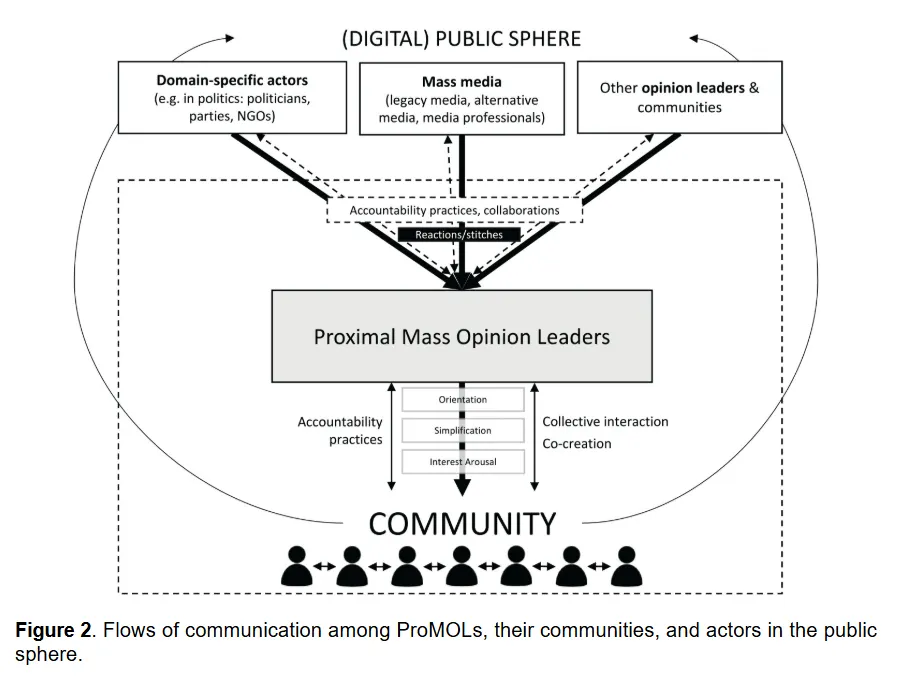
When the dark forest was scary but still possible to traverse, we still had a chance to explore and find reality, even if we lived in a consensus bubble most of the times. Dead forest theory means we are past the event horizon, from which we cannot escape. We are locked in whatever consensus reality emerged inside the event horizon.

Digital Public Sphere and the gravity of mass opinion leaders from Odin Times

And so despite its expense, its troubles and its costs, I still push my work into the public commons with the hope that I’ll circle the accretion disks but can fight against falling into one forever with a steady acceleration to preserve a visible orbit.

What both Venkatesh Rao and Dan Grey posit in different ways, is that it is worth understanding where we might be cut off from reality.

Further, who knows what new kinds of horrors we will endure as we lead separate lives online without any contact with real life and real people. We crave community with those whom we can maintain consistent context and contact. That’s why I still get on the airplane, or get in the car, or hop on the bus and show up. I want us to share reality.

Categories
Aesthetics Culture Travel

Day 2005 and The PMC Olympics Or Transcontinental Logistics: Couples Event

If professional class workers thin out as a function of artificial intelligence taking some of the work done by the professional management or PMC class, I suspect we will see nostalgia for the time they were seen as aspirational. I’d like to explore that near-future science fiction today with the PMC Olympics.

After the initial decade or two of upset (possibly even rage) at the power shifts & new status dynamics subside, we fondly remember business class types like lawyers & consultants with the same wistful fondness as we recall switchboard operators or the stenography pool.

I’d bet in the nostalgia wave, we see competitions, cosplaying and an equivalent of Renaissance Fairs or reenactments pop up where former PMCs and thr youth pretending to be them, compete in a cargo cult display of its cultural identity markers.

And when this does inevitably emerge as a cultural touchstone, I want to compete in the PMC Olympics with my husband in transcontinental logistics events. Think of it as figure skating but for married business partners.

I’m confident we would medal in the transcontinental travel logistics category. I’d get gold in the individual “cosmetic and liquids” category. Think of it as “uneven-bars” of the transcontinental logistics travel competition.

As part of this mirthful sci-fi exercise, I input a prompt to ChatGPT’s current image model and it gave me a very amusing montage of who might compete and win in just such an event.

Naturally the shining blonde California affluence worker (subcategory creative class) took the gold but let’s not forget the New York finance couple nor the European directorate class.

ChatGPT image prompted with:
Make me an image of three sets of couples who are professional management class knowledge workers. They are on an Olympics podium receiving gold, silver and bronze medals for medalling in the “Transcontinental Logistics: Couples” event. I’d like two American couples (one New Yorker finance style and one California Hollywood style) as well as a European couple (Swiss) in the style of a Brussels bureaucrat. There should be suitcases, travel bags for laptops, a 1L cosmetics bag, a medication cold tube, and other travel essentials in the image 

I know this sounds a little goofy, but the work that goes into managing what a couple need when constantly switching between personal life and work on the road involves a surprising amount of logistical support work. And that’s without children. I’d add a category with a toddler as the most extreme form of this event.

Just check this prompt I made for my own PDF for an event involving both industrial site visits and formal galas that I am attending after flying west from London. Some details are changed or redacted for modest privacy. Anyone can easily guess what I’m going to be doing.

Build a 8-10 day travel itinerary for a business trip departing from Heathrow London and arriving to Salt Lake City and a remote desert town in Utah, from June XX to July 2, 2026. Include a day-off rest plan for Salt Lake City, a Department of Redacted event logistics flow chart, transport coordination for a bus to small town and return back to the city on July X of event, and recommendations for high-quality food near event venues.

Include transitioning time and necessary grooming required for a facility floor tour with safety gear and a change for a formalwear gala with an hour buffer assuming an event mid afternoon, there hours transit and evening formal event at 7pm.

July 2-5th include a secondary itinerary for a follow on mountain social event at 8,000 feet Utah mountains with outdoorsman activities.

Format as a structured PDF briefing with time-stamped logistics, travel maps, and weather-appropriate clothing advice for the city to desert climate shift as well as mountain elevation needs. Include medications, standard pharmacy and first aid needs, cooled medications for peptide regimen, sun safety, facility floor safety gear, day event makeup, formalwear makeup, possible television ready makeup as well as hairstyle needs based on 3 day warning cycle.

Make sure personal preferences for all clothing, sleeping, cosmetic, medication and other gear is accommodated in a carry on suitcase, personal bag and one checked baggage.

Pretty fun right? And I might add that it’s relatively easy to spit these itineraries out once you’ve harnessed your preferences and all necessary items in one’s personal stock keeping. Always take inventory regularly when on the road and unpack and repack quickly for fast turn arounds. Oh and use the three pack cascade system. To my fellow flying logistic Olympians I wish you safe travels while we still enjoy global transportation for capitalism.

Categories
Finance Politics Startups

Day 1983 and Socialism is Bad

There is a lot of chatter as to the eventual ownership makeup of the frontier artificial intelligence labs and their economic surplus. One question that came up this weekend is whether equity in the companies should be owned in some portion at the nation state level. I am opposed to this for a host of reasons that I’ll try to get down in whatever garbled form.

I do not own a stake in any of the frontier labs other than owning ETFs that own Magnificent 7 exposure who own portions of the labs. I do invest in compute, nuclear energy and cryptography. I believe AI will change a lot about how we do business, my revealed preferences show I live remotely in Montana, I have a tendency toward emergency planning and Plan B scenarios. As a disclosure of my priors.

There are lots of competing interests in this and the self interests from the labs does no any favors. Especially after months, nay years, of overwhelmingly hyperbole about changing labor dynamics, the potential for mass layoffs due to automation as well as obfuscation and excuses about the reason for layoffs in existing companies. And that’s before we get the singularity which is a religious orientation toward making super intelligence that is Godlike in its framing.

I hate this entire conversation on nationalization and socialism. Part of it is that state actors desiring ownership of private companies reeks of the “you didn’t build that” malapropisms from Barack Obama’s presidency in which he attempted to articulate that America’s enormous wealth is built on generational compacts that no one individual could ever own outright. It triggers socialists and capitalists both.

We all contributed in our own ways to the shared infrastructure, institutions, education, cultural norms and the pluralism embedded in our governance systems that enabled the American Dream.

Unless you are a deep partisan, you understand Obama was trying to articulate that none of us made America alone. But the framing from liberals (and populists of all stripes) automatically make this conversation concerning.

Economics is complicated, central planning has a hell of a body count and your average American can only gesture towards the invisible hand and the benefits of self interested commerce. It’s easy to sell us bad policy from envy and fear.

So I must ask why are we acting like we have suddenly won a national level economic boom with clear winners whose spoils must be distributed by the nation state before we’ve even managed to understand how it will be used, at what level an AI model is a commodity and where the benefits will accrue?

Self interested pluralism with a system of checks and balances at the national federal level coupled with states exercising their own interests has been the bedrock of our national success. Changing this has not gone well for us as a nation nor do we have better examples in other nations.

Sure America has had a few twists and turns. The last time we made an attempt at a New Deal post Great Depression worked only thanks to a global world war industrial mobilization in which we won the war and all our other competitors were decimated on bombed our continents across massive geographical boundaries.

And that boom has been largely spent by the children of the generation that fought this war and their children are looking at a pretty significant bill. So why do labs suddenly want to “compensate” Americans and our collective contributions to the models?

And why are politicians taking this bait when we have so little insight into whether we should funnel cash into them in order to own them in trust for some nebulous future?

I have a few reasons in no particular order that I put on Twitter as to why I am opposed to this format of American state equity being the means through which we compensate the people who theoretically trained these models with our output on the wider open web and its content.

1) We don’t know who the winners will be or where the benefits will diffuse (as in post liquidity the current winners might not be the eventual winners) so compensation for model training when the eventual benefits disperse elsewhere isn’t ideal. Why aren’t taxes at state & federal level aren’t adequate enough here should be answered before we make moves

2) Existing IP law doesn’t account well for culture which is a shared co-creative process (i recommend Susan Scafidi of fashion law institute “who owns culture” ) so compensation is already not easy to track back

3) A state entity w the monopoly on violence can do a lot of damage on the margin by not fully understanding who created what and where it is applied especially in non deterministic systems

4) Much of what the models were trained on was open source licensing including the company where my own family made money Stack Overflow. We got paid sure, but none of this would exist without the effort of its users who contributed on those open license terms. But clearly the final value of the content created & company’s value itself were harvested much further down the line in enterprise contracts for coding models. It was not in the management of an open source license community product created by users or managed by engineers, so who should have been paid? The users who wanted their content to be open sourced? The volunteer moderators? The full time employees? The shareholders of the company, the buyer of the company or the users of that data set at Claude or Cursor or OpenAI? Or is it Americans that never even heard of SO? Where does value accrue over time versus point in time? It’s not an easy question to answer is it?

Categories
Community Politics Startups

Day 1968 and Abundant Optimism

I’m in Utah with some of the most optimistic people I’ve ever encountered. And it feels so good to be amongst others who believe our problems are tractable, it is our responsibility to solve them, and that we all win when we pursue a positive sum approach together.

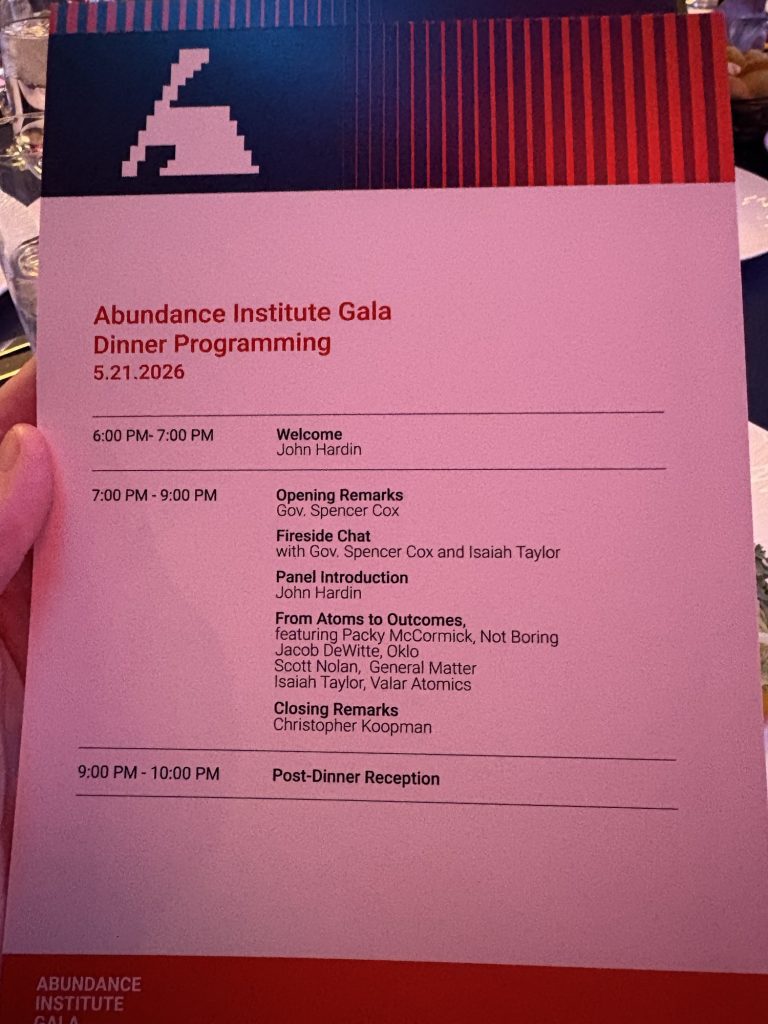
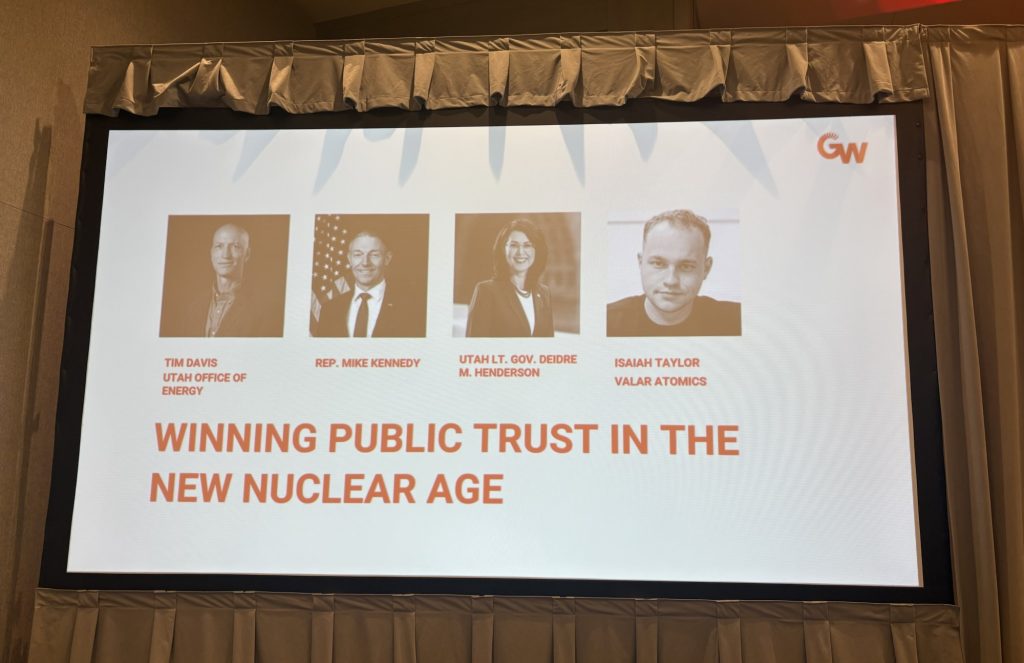
The Abundance Institute hosted the Operation GigaWatt Summit in Park City to bring together entrepreneurs, engineers, financiers, legislators and policy experts to discuss America’s energy needs.

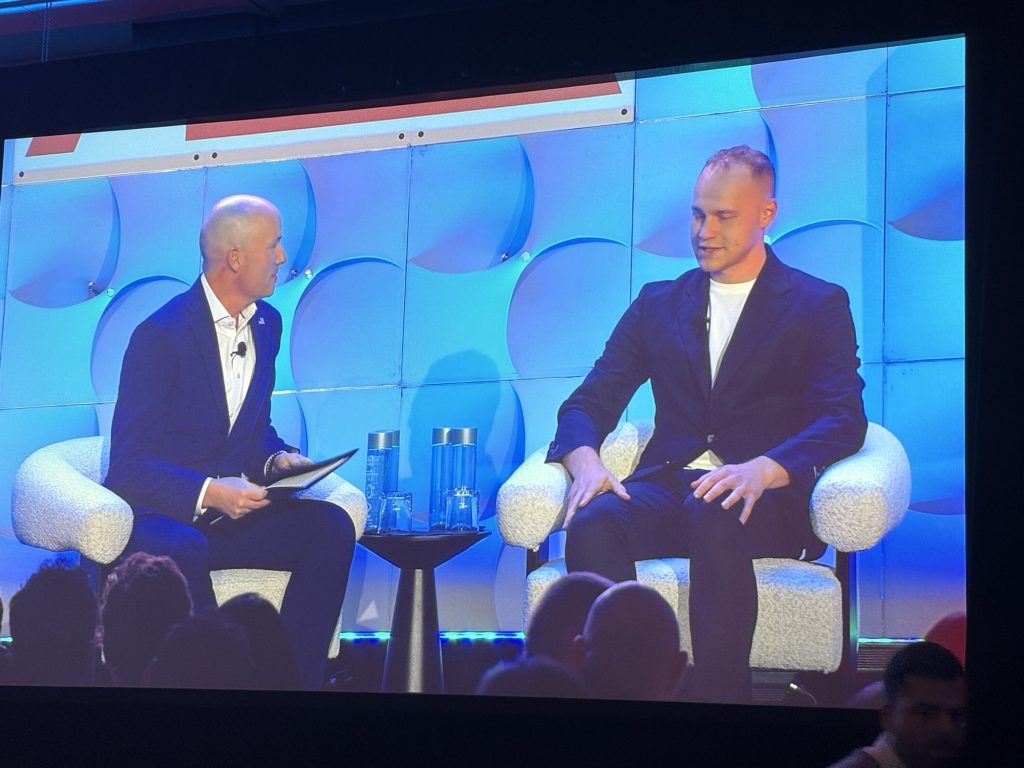
I was lucky enough to be invited to the gala where one of our founders Isaiah Taylor gave an incredibly uplifting fireside chat

As some of my longtime colleagues know, I was the first check into Valar Atomics. It was a leap of faith to invest. At the time, we were in the doldrums of negativity towards capital intensive industrial efforts, from both state and capital.

Yet I saw in Isaiah a force that neither leviathan nor fund manager would wish to hinder. I also happened to believe that every other technological trend that was booming rested on our capacity to power it. So I did everything I could to support him in his efforts, including write few more checks. And thank goodness I did as my what a difference a few years make.

Utah’s Governor Cox and Isaiah Taylor of Valar Atomics

To see Isaiah on stage with Utah’s Governor Cox amongst a crowd of hundreds speaking on a vision that a mere three years almost no one thought was a good idea (well except us) is testament to the work and faith of hundreds of men and women.

Many other amazing companies are pursuing a vision to produce abundant clean fuels and I myself believe we will need every one of them. I’m just glad that my crazy bet happens to be running full steam ahead in front.

From artificial intelligence & medical research to new home construction and industrialization, all our biggest opportunities will win on energy costs. Regular people need cheaper, cleaner, more sustainable energy. Our needs can’t be met with what we’ve got. We need nuclear in that mix.

And it is a choice to embrace abundance and not scarcity. A zero sum mentality will not get us where we need to go. Not in America, not on our home Earth, and certainly not in the stars. I believe with effort and ingenuity our best days are not behind us but can, indeed must, be ahead of us.

Utah is focused on delivering to the public by gaining its truth through transparency and accountability.

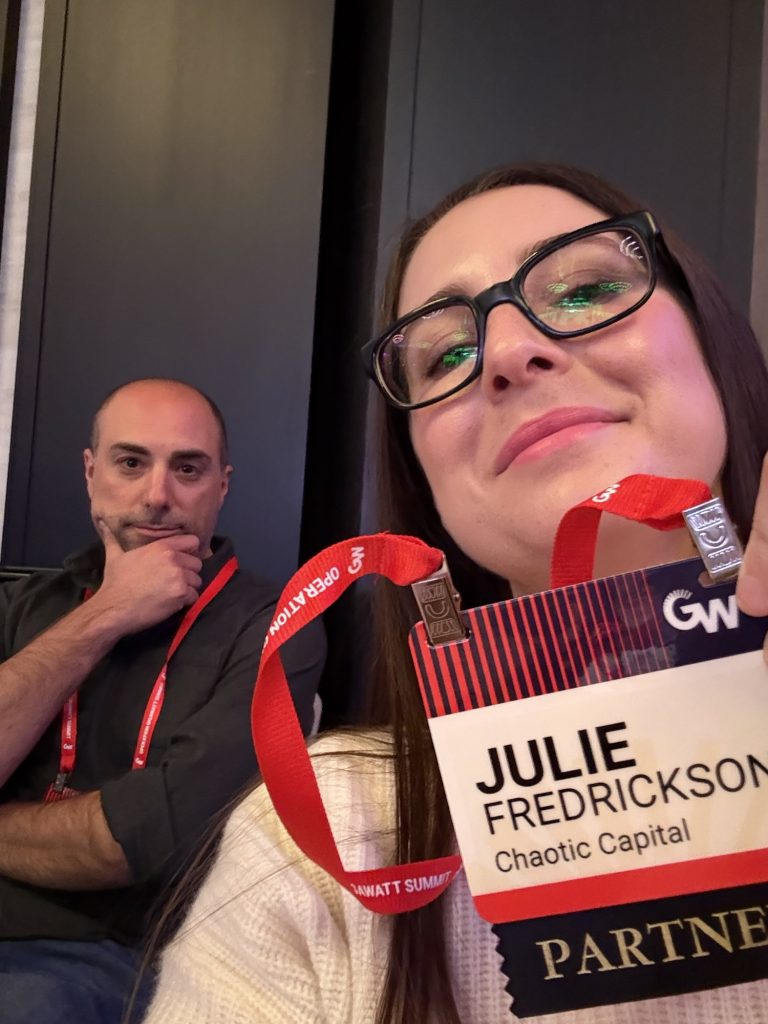
I’ve come out of the last two days refreshed and filled with positivity as I’ve seen sincere people dedicate themselves to finding solutions to our pressing problems. I was able to see much beloved friends, treasured colleagues, and it was family friendly so I brought along my husband too.

Here we are waiting for me to record an interview with MTS who very kindly asked me about Montana’s right to compute law.

If you care about a future that’s not fighting over what’s left, but building something that makes more for all of us, I hope you consider supporting the work of the Abundance Institute.

And also Montana’s right to compute law.

Oh and if you have a chance to invest in the future of nuclear energy I hope you pick Valar. As we are fond of saying in El Segundo circles, we are going to win.

Categories
Politics Preparedness

Day 1961 and The Thucydides Trap and Accelerating Chaos

Not so long ago (*gulp* five years or so) as I first began investing out of our chaotic.capital vehicle, I would discuss our thesis in terms like thriving in a world of increasingly accelerating complexity. That trajectory inevitably leads to chaos.

How does one make money and start fast growing businesses in a world where entropy must be fought at every turn and the rules are constantly changing?

There are a million metaphors and I’m sure all have been used by now. One must surf the chaos or risk being caught under wave after wave of punishing swells.

Next thing I know the world is talking about chaos constantly. And it’s always accelerating.

Keir Starmer in chaos! The Philippines in chaos! Even Xi Jipeng is hinting at the dangers of accelerating into clashes and where they might lead.

The implication? Chaos! China’s leader went so far as to invoke my beloved Thucydides, warning of the trap that arises between two powers. Yes, Xi mentioned the Thucydides Trap in the recent summit with Trump.

The term was popularized by Harvard political scientist Graham Allison in the early 2010s, drawing on the ancient Greek historian Thucydides. His argument: when a rising power challenges an established one, conflict inevitably follows.

Bloomberg – May 14 2006 (gift link)

Hulton Archives/Getty Images Thucydides

Americans may not like the presumptive idea of a rising power challenging our existing power, but these days it’s hard not to be skeptical of American power and its limits.

After all, the acceleration of chaos globally is partially in response to our inability to manage the complexity of our systems. We seem unable to plan ahead. But if we’d like to find a win-win scenario that doesn’t end in a Peloponnesian War we might wish to find a way to learn to live with the chaos lest the trap close its mouth on all of us.

Categories
Finance

Day 1944 and The Polymarket 1% Same As Any 1%

I am not a gambler. I don’t know how to play poker, or honestly any card game without a tutorial. I find the idea of playing the long odds where I have no advantage to be a bit crazy. Why would you involve yourself with a likely net negative outcome other than as entertainment?

People don’t do math though so I am sure I am overthinking the appeal. I am regularly amused by people who think that finance amounts to little more than legalized gambling

I chalk that attitude up to innumeracy and try to worry more about the challenges of introducing regular people to investing in assets where they can calculate the odds of a positive expected outcomes. People should be allowed to do as they please and I believe that self-interest has had positive outcomes here.

I am not for a nanny state. Quite the opposite. Regular people aren’t allowed to invest in private markets where I do most of my work and the accredited investor rules have significant downsides when companies stay private forever.

Companies used to be acquired or they would go public where anyone could invest in a new company they believed in. Thats how regular people like me would make money. Alas fewer companies make it to the IPO market (or are delaying the process) and have growth less in the public markets. So now I worry more about how anyone builds ownership in anything.

I myself am a boring public market investor. We can all work off the same numbers and animals spirits. Keep it simple with ETFs, some bonds and treasuries and the risky bits are contained to my specialities. It’s almost like I know the work is best done by professionals and computers.

Alas, finance and gambling both require having some grasp of the numbers. And this is getting to be a problem all around. I used to think well it’s not too hard to build a basic portfolio. There are books you can read.

Well, we’ve got a fun substitute for day trading now and it’s definitely more fun than owning some ETFs. Prediction markets have finally taken off. I hope for them to be liquid markets for information and exchange but it’s also fun for gamblers

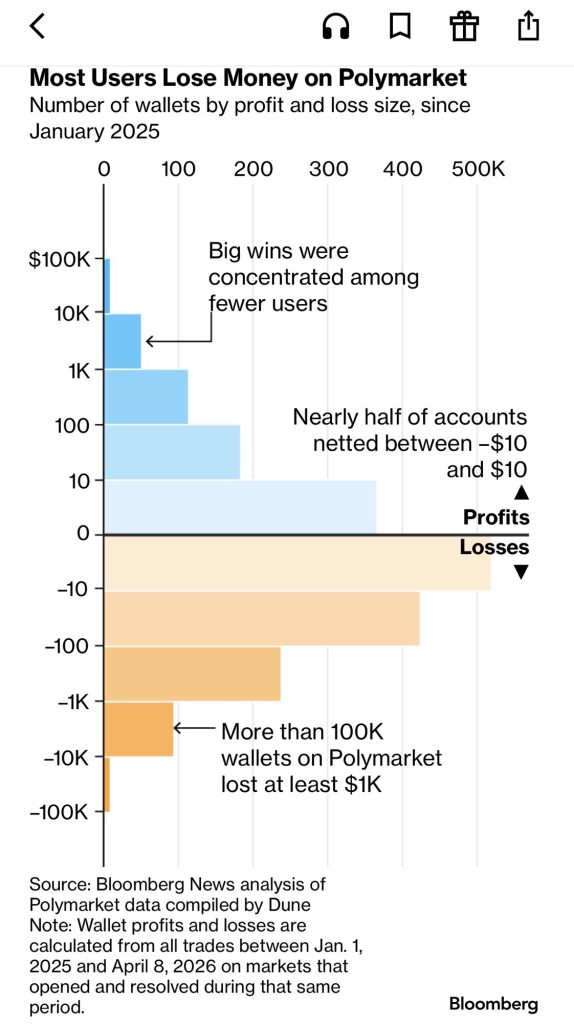
II don’t know enough about how to place a decent bet though so I don’t use them. I’d rather take risk where I have the edge. And the data seems to bear that strategy out. The people who make money in Polymarket are the top 1 percent who know what they are doing

Martineau recently co-authored a paper that found that since 2022 around 69% of traders on Polymarket lost money, while the top 1% captured three-quarters of the profit

This didn’t strike me as particularly surprising, as presumably the people who lose money in any kind of trading situation are the ones who don’t actually understand the odds that they’re working with and the information that they have.

If you buy a random stock on a hot tip, that’s not really going to get you much further than placing a random bet on polymarket. Of course, the people who are making real money are sophisticated.

Automation seems like exactly what you would want if you knew the parameters of the market and the likelihood of payout, which is incidentally also how every other corner of finance works. So unless you’re the kind of idiot who trades on information they have on special forces actions, say, maybe it’s best to leave some of these things to the professionals.

Categories
Community Internet Culture Politics

Day 1903 and Ranting About Bentham

The tyranny of small differences can be the most vicious. I love vendettas in fashion and venture as they are connoisseurs of grievance.

Small communities with insular structures simmer embittered for years. You always know where someone, who is otherwise quite close to you, has committed a venal sin which cannot be forgiven.

But many times these small differences are actually the stuff of the breach. Once crossed you can never return. The opening cannot be closed without a great sacrifice. And these sacrifices are your character.

I am as well versed in the ridiculous schisms of my own affinity groups. As libertarians I’ll go on about the Cato libertarians, I’ll support my an-caps but I I’ll blood feud with the rest.

I feel this way about rationalists and the way they have introduced utilitarianism to Silicon Valley. And I want to be sympathetic here because there are aspects of effective altruism that are perfectly reasonable at first. I like prudent spending and reducing suffering with effective allocation.

But utilitarianism, taken to its end, has issues that anyone who has read Jeremy Bentham has to grapple with. The means do not justify the ends. We are all struggling with the horrors of the problems this creates in a modern society.

I saw the value of the manufactured meme campaign of effective acceleration as it oddly ended up dragging us to the middle. That was the intention and it achieved it. One can have many disagreements in the details.

However I do not think that political actors as far apart as Steve Bannon and MIRI agree on anything philosophically except “we want control over artificial intelligence so the people who are lesser than me can have no say.”

I cannot see how opposing forms of populist control can travel together without fear for character.

Everyone tries to be agreeable right up until coercive violence from Leviathan is required. And I guess some of you don’t think too hard about hard power huh?

I happen to find the request to have so much control over your fellow Americans to be an offensive view.

You think so little of the citizens of your own country when our core constitutional values require us to have so much more responsibility for ourselves?

I do think it is actually a moderate viewpoint that I believe in all of us. I believe in Americans no matter how stupid we can be. Remember that whole being a libertarian thing. I think personal responsibility requires more and Americans have delivered more despite our many failures.

I recognize that my personal stance here is not the final stance, especially as something of an outlier but because we have checks and balances, I know my involved citizenship demands that I declare where I stand.

Which is why the right to compute law that Montana adopted was a largely uncontroversial and popular when it was a bill. Before politics got involved, regular citizens, who were not whipped into a froth or frenzy, could understand that participating in the digital economy is crucial to living in the modern world.

It impacts our first, second, and fourth amendment rights directly because it demands we answer questions about property.

The wider existential issues on artificial intelligence do not get to be more important than our existing jurisprudence nor the opinions of our citizens.

The way we legislate and the value of our system of government, both state and federal, have a part to play. It’s funny the libertarian is making this argument I know, but it is a good revealed values exercise. Don’t get trapped by charlatans who have already declared that the ends justify the means. We both know they don’t.

Categories
Aesthetics Politics Startups

Day 1898 and Please Copy Our Homework

Today has been a very gratifying day for a very strange intersecting set of reasons. You may know that I have spent several years working to pass a “right to compute” law in Montana. It was signed into law in August of 2025 by Governor Gianforte.

I was so grateful that a campaign I initiated became not only become a bipartisan policy but a law supported by many Montana citizens & legislators. Now to see it go national not only model policy for the American Legislative Exchange Council but now have a second state, New Hampshire, pass it in their house, gives me indescribable joy.

Just forty eight more states to go. Though I believe it’s going to be an uphill climb as the topic of artificial intelligence has well and truly become politicized which makes stating simple cases of shared values much harder.

Except this isn’t really about artificial intelligence. Compute is a much broader and bigger thing than AI. It’s the stuff of the modern world. But that doesn’t mean we can’t apply what we know to be core American values as the lens through which we see it. Indeed it’s crucial we do.

Last year people could easily see that this was a sensible law that reflected our American values. Because of this sensible approach “the right to compute” is a winning coalition. It was bipartisan. So naturally it became a culture war.

I urge you not to adopt that frame. The right to compute speaks to American’s most cherished beliefs. Recognizing that it is not a novel legal theory. It is the application of the Constitution’s oldest commitments—to expression, to property, to liberty against government coercion

Even if you do not understand how all of its parts work, most understand that the entire digital world, in its constituent parts, is mathematics executed on physical hardware.

When government restricts computation, it does not merely regulate an industry. It restricts the tools through which people think, express themselves, and make use of their own property. Through that lens it’s clear we as Americans decide ourselves how to use it.

I hope we can remember this as the world changes and political actors look to change your mind. I do expect this to become a very complicated and uncomfortable position to have staked out.

Yet I feel confident that we will be able to make the case that this is not only the most American way of handling our future challenges, but is also practically the best way to bring abundance in a chaotic world. America is a land of reinvention that changes material conditions. We need not seek doom.

I believe that I have articulated that vision over the last five years of writing and investing so you can see my revealed preferences. I called our fund chaotic.capital for a reason. It’s hard, weird, difficult and scary but it’s also possible to be a lot better in the digital world such that we can use those gains to make the material world better. We can be more than productive primates with jobs

From nuclear energy to compute, this is what I believe and where I have put my time and money. We are organizing our world of atoms through the power of compute. And that can bring about a materially better world for everyone. Which I want.

I have been thrilled to see so many different people come together around the basic premise that we are empowered to do things.

We can lean in to the accelerating changes, all while holding fast to the reins of the values that built America, so that we may steer ourselves to material success.

Travis Kalanick of Uber may be among the best founders to have ever played the venture startup game. Today he has espoused our thesis & reinforced the work of my friends & founders. To see a cultural program written by a big coalition be part of his return to startup life (though he was never gone) is validating. We’ve found a rallying call.

The way forward is through the application of math on real problems. We can dramatically reimagine outcomes and the pace at which we do it. It’s scary and will look different but our grandparents lived through a lot of change too. Their grandparents as well. It’s the human condition.

I believe all of this is grounded in a philosophical foundation that is a recommitment to America’s core constitutional values. We are free to make things. And sometimes, when we apply ourselves, the world really does change.

If you are a canny socialist thinking look at this useful idiot for capital, I am honestly surprised that dialectical materialism has become so disliked by its own movement. If states with conservative libertarians can see that culture only changes when material conditions improve why don’t you want to improve them? Please feel free to copy our work as we have studied yours. You can find model policy here.

Categories
Aesthetics Community Internet Culture

Day 1888 and Touch Sand

As the “monitoring of the situation” reached whole new levels, I took some time to touch grass today. I don’t think I opened more phone more than a dozen times before writing tonight.

So many mutuals are teaching themselves automation skills by building situation monitoring boards that maybe the Department of War doesn’t need Claude. It was charmingly easy to keep up. Which is a very distorted and dystopian way of living out the hard realism of kinetic power in real time.

If America is backstopping Loyld’s of London shipping insurance, then to repeat a Keanu Reeves meme style. Yeah I’m thinking that America is back. But I’m getting to old for this shit. It’s all TV tropes now as we unmoor in the propaganda. Which is run by an honest to goodness critical theorist who trained with Jurgen Habermas.

So instead I stared out over the horizon as the wind gently brought fresh air in from across a wide open vista. I enjoyed my friend’s company as we talked about jhanna meditation and compute pricing. We saw a seal winning along the shoreline. I put on sunscreen twice as we stayed out in the sun.

How luxurious is it I had long leisurely in-person time with a friend. Not all of my business is with friends but I cherish the ones with whom I do.

We walked and talked and broke for lunch and discussed problems from the most abstract to the most precise. Having given the world so much access to all of human creation and taste, did the market provide an original version of the driftwood horse decoration or has there only ever been the mass market design? Neal Stephenson fans get it. Baudrillard too.

Fashion people and technology people worry about these questions of taste because they are questions of control and tooling. The source culture of engineering culture shared context. How abstract is too abstract? What is enough to enable the builder to use your tool?

It was good to be outside in the sun with someone and talk. That activity needs no shared context beyond humanity. We have missed it in the hubbub.

Isn’t it funny how just as the internet is losing its humans, the humans who met only thanks to the marvels of the network are finding new offline systems? The network can reprogram itself.

I have dear friends and successful investments that I have spent hardly a single moment commingled in time and place with. I imagine that age is either just beginning or just ending and I am not sure which. So today I was outside in the sun talking. I don’t know if we made any progress but maybe I’ll only know in the far future.