Categories
Biohacking Chronic Disease Emotional Work

Day 1964 and We Are Who We Tell Ourselves To Be

No one likes a gloomy Gus. The downside of chronicling a chronic disease is the risk of seeing yourself as only the illness. Then other people will see you that way too. And so your identity becomes tied with only one of the many aspects of your life, and often the worst one at that.

Thankfully most humans are centered enough on themselves to forget the occasional gloomy reality from someone outside of their daily lives.

But repetition becomes reality, and eventually we are who we believe ourselves to be because others believe we are who we say we are too.

I came across a startup who is working on one of those classic swamp problems that seems like a great idea until you are well and truly stuck in the muck with bad incentives and no good solutions.

They want to use artificial intelligence to help patients with chronic diseases or complex medical cases to codify the many little details that might add up to the clues that crack the case.

By tracking subject inputs (unstructured data) and overlaying it with the other biometrics gathered by wearables and bloodwork they can help patients. I’ve seen hundreds of variants of this over the years.

Alas this new startup seems to have discovered a flywheel for marketing that relies on the problem I began today’s post with. We believe what we tell ourselves we are and eventually other people will believe what we believe.

They have chosen to market the app with illness influencers. Yes, that’s an actual category of influencer on TikTok and Instagram. Hot girls all have vague chronic illnesses these days haven’t you noticed?

And so a community forms and reinforces the identity that they all share. They are sick. And that makes them special. This gives life meaning. And did I mention lots of pretty girls have the most esoteric and exiting problems? Click to join now!

I find this to be a troubling, even borderline dangerous, approach to anchoring a community meant to help patients advocate better for care with their own personal health records. The incentive to remain with the privileged identity that makes them special only increases over time. Women reinforce themselves into intensely held identities all the time.

I thought about reaching out to them but I don’t want to get tangled with this problem. It is one for professionals which neither myself nor these founders are aside from everyone being a patient with chronic illness.

I do not wish for my identity to be the sick woman. The woman whose life was upended by a fertility protocol gone wrong in the early years of her marriage and in the prime of her life.

It’s one aspect of my reality. I do want others to be saved from my fate so I share it. But it is not who I am. Julie is not a sick woman. Julie is a complicated individual with a beautiful life and family and portfolio.

I had my own glimmer of hope today. Though I have repeated my troubles with my medical history I have never felt it was my identity. I’d happily give it up if I find a path to wellness. And I spend so much of my life trying to walk out of my troubles.

I have walked many side roads and pursued quixotic quests to find health. And some days I even find it. Today I got very good news on a fresh round of bloodwork. I’ve felt recently felt well thanks to some changes and an aggressive pursuit of new modalities.

I never want to get my hopes up too high as this effort has been a rollercoaster of ups and downs. But I won’t let go of the hope. The mere idea that this chapter could close and I might be a healthy woman is an identity I’d gladly welcome. And I’d wish that for anyone who takes on illness as a part of their identity.

Categories
Aesthetics Culture Reading

Day 1960 and Return to Tufte

The more power we seem to gain working with large language models, the more apparent it is that few of us are visually literate in a meaningful way. When you hear talk about design, it is all too often moods and vibes with no specifics.

Now, you might say that you know what you like when you see it. That’s also how we let the Supreme Court talk about porn. Clearly untangling the weft and weave of taste (and by extension culture) can be further articulated rather than relying on subjective, non-definitional standards.

How you came to your visual reference preference set is quite a bit more complicated than whatever pre-digested piece of media came across your algorithmic feed.

You can explore design languages from one token to the next, but visual literacy involves a lot more than scrolling or confirming you’d like to see more content “like this.”

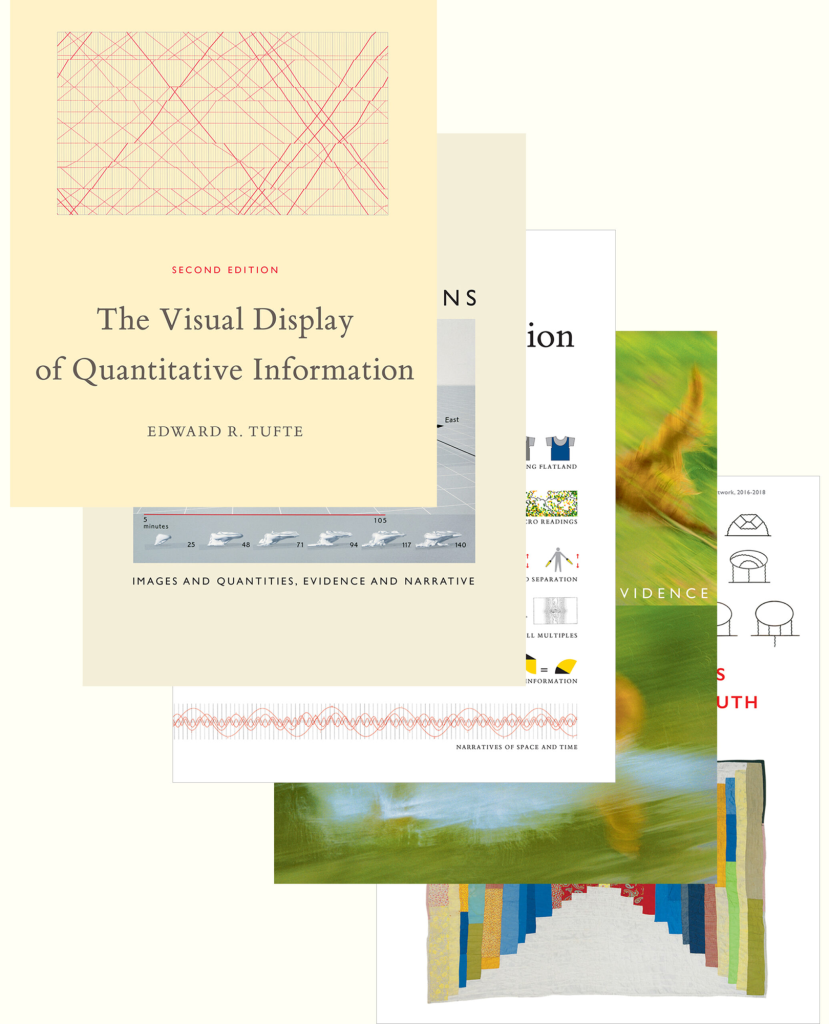
When I first began circulating in design circles in the early aughts, the hipster set was obsessed with Edward Tufte and his now classic Visual Display of Quantitative Information.

Edward Tufte taught data analysis and public policy as a professor at Princeton and Yale for 31 years.

Tufte, via his Graphics Press, wrote, designed, and self-published 5 books on analytical thinking and showing, taught a one-day course, Presenting Data and Information for 923 days to 328,001 students.

Who knew Tufte and I both shared a love of marking the days of our work? He influenced many more people than I have but I find some joy in that coincidence.

His most referenced work, which I mentioned above was published in 2001. Visual Display of Quantitative Information was on the desks of everyone designer I knew, from fashion and Silicon Valley to public policy it was a mainstay. The man knew how to lay out information visually and he became the standard.

Some of Tufte’s self published tomes

The long tail of enthusiasm for displaying data beautifully surely owes its ubiquity in some part due to his success in teaching my generation’s designers.

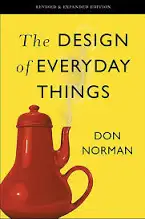
He’s became for a period so universally referenced that Tufte became a cliche. Now he’s classic a quarter century later. His work arguably as successful as a visual language reference anchor as bookshelf favorite, “The Design of Everyday Things” by Donald Norman. His work is also denigrated as cliche in some circles.

The Design of Everyday Things second book cover

Both men offered clarity and practical principles over taste and theory. Those academic predecessors befuddled many who experienced aesthetics primarily through semiotics and critical theory. It felt revolutionary to return to form and function

You “Kant” really learn to love the languages of aesthetics from theory alone as it turns out. I’ll place a little AI synopsis to make the connection clear. This is from Perplexity:

Someone might relate to the popularity of Edward Tufte and The Design of Everyday Things as part of a broader hunger for clarity over clutter in how information and objects are presented.

Tufte’s work is influential because it treats visual design as a serious vehicle for understanding data, while Norman’s book argues that everyday things should be intuitive, legible, and centered on the user.

A Tufte-style chart removes decoration so the trend is easy to read, while a Norman-style kettle shows clearly how to fill it and pour it without guessing.

Both are forms of respect for the user: one respects the reader’s attention, the other respects the user’s actions.

Learning how to use an item or a tool, or how to interpret charts or graphics, can easily overwhelm anyone and feel disrespectful to students. A whole era of computing was stuck between the power of the command line and the legibility of the desktop metaphor.

Norman spoke of the Gulf of Execution as the gap between a user’s goal and the means to execute that goal. Tufte similarly wished to remove the confusion in charts and graphs so one’s ability to glean information wasn’t stuck in a gulf of understanding thanks to overwrought bar chart or sankey diagram.

With new artificial intelligence tools we are bridging some of that gap, not with design but with raw computing power. We are moving beyond the CLI and the desk and into a world of reference and inference.

I just hope we all take the time to learn our reference set so we can do more than say “I know it when I see it” as that will be our only way across the gulf of execution. Some things never change. Learning the languages of your field is one of them.

Categories
Aesthetics Internet Culture

Day 1958 and Skymall Kities

My father loved gadgets. He was always tinkering with something and was always upgrading his electronics to some new specification.

Is it any wonder that I married such a handy husband? Men love futzing around with stuff. Sometimes they have daughters and then you’ve got women like to mess around with projects too.

I am sure we will have endless rounds of nostalgia for the eighties and nineties era gadget, electronics and novelty shops. You could get lots of mileage out of building your own computer.

But even setting up something silly from Skymall or Sharper Image captured some of the joy. The novelty of a new invention was visceral. I wouldn’t say no to a Hammacher Schlemmer renaissance myself.

I didn’t love it when we remade that style of retail into quirk chungus millennial fandom but I didn’t hate getting Star Trek tchotchkes either. And now I dearly love websites that my friends have built like WireCutter.

My husband was humming the tune to a piece of YouTube esoterica that is a deep cut to the original editor of that bastion of shopping guides. Choire Sicha launched the WireCutter but it’s in some ways the least soulful of his franchises. A Mike Albo shopping column already nailed the bit we’ve just been redeeming it since then.

Choire gave us Gawker 2.0 before his his incredible era of independent publishing streak making properties like the Awl and the Hairpin.

In a world with more shops and essayists than good shoppers or readers, Choire found the good ones and shared. And one of his discoveries was Nina Katchadourian’s work.

And so now my husband sings the tune of SkyMall Kitties and he sometimes can’t get it out of his head.

Maybe that is my own submission to the “thing I think about too much” essay franchise. It’s my own personal Negroni season or Supreme’s clusterfuck of totally uncool jokers.

I’m sure we will enter an exciting new era of curating down the perfect piece of cultural detritus with artificial intelligence. But I will always be grateful to electronics dads and savvy buying guides for teaching me to enjoy the joy in making something. Even if it is profoundly uncool. I’m still team Barbara Kruger though. Don’t believe the hypebeasts.

Categories
Internet Culture Startups

Day 1953 and Helter Skelter

It’s been a very strange week if you work in or around the artificial intelligence segment of the technology industry.

lot of rumors have been swirling about executive orders and the upcoming China summit though fears are now being assuaged.

While I’m not primarily an investor in the LLM boom, I have invested in compute markets, vector databases, neolabs and most importantly I have invested in energy.

I am not someone who is all that worried about fast moving changes even though I clearly take both the changes in the world but also the changes in technology serious. I moved to Montana to stay out of trouble and I’m betting the ranch this will be a bumpy but successful ride.

I believe it will be good for those who open themselves up to the possibility that Americans can handle themselves. I won’t lie and say that we have unknowns ahead of us but that was true before we got powerful tools to solve problems at a much faster pace. It might get weird but we believe in our adaptability.

Categories
Aesthetics Reading

Day 1952 and Chapter House Complete Children’s Libary

One of my mother’s great passions is children’s literature. I am an avid reader and credit my love for books to my mother’s knowledge of the space.

She built a beautiful library to cover my needs from kindergarten to the upper grades that covers hundreds of foundational texts. It is the foundation of my moral, civic and business life.

Or if you prefer something a little less pretentious, I read all kinds of things from science fiction to periodicals to grand biographies as an adult because I was taught to read in the classical cannon of literature and history that has benefit many generations before me raised in the Western Cannon.

Children’s books tend to be sneered at self serious adults and it is more the pity. The beauty of childhood is that we need not approach all issues with grim learned gravity, rather in appreciating the childlike perspective see the truth that only a child’s eye reveals.

There are many books in the Western Cannon appropriate for children that can introduce them into the joys of critical thinking. And it can be quite intimidating to set out to build a library of you were not raised with this knowledge. This is a market opportunity.

Over the last 25 years I’ve seen the classics that I read as a child disappear from high quality prints. You could find items circulated in cheap paperback or you could search for used books. My girlfriends would text me about where to find classic high quality booksas their own children reached reading age. A child deserves a library that is not only quality in content but in form as well. Beautiful illustration sparks the imagine and quality binding grounds the experience.

My mother slowly built our library as my mother practiced her discipline as a teacher. It was not just raising me that drove her, but the combination of homeschooling and teaching in Waldorf schools that honed her favorite choices.

Many homeschooling families will attest to the challenge here. They know what they would like to find for their children, but it’s hard to find classics you can rely upon and curriculums vary in quality and tone.

So when my friends, Hannah and Josh Centers, told me last year that they were working on an imprint called Chapter House focused on great children’s literature in the Western Cannon I was excited. I knew the demand was there.

Chapter House’s Children’s Literature

They are also homeschooling parents interested in improving themselves in their effort to raise educated independent children. They have first hand experience in the challenges. They are, what we would call in startup world, operating in real world conditions.

Chapter House is a new publishing imprint created to serve the unmet needs of homeschool families and everyday parents.

We publish restored editions of classic children’s books in four Chapter House box sets, made with premium materials and meticulous craftsmanship.

We also curate a grade-by-grade bookstore from select publishers, giving families a complete reading curriculum for children at every stage

I have often wished I could gift my mother’s library to new parents. In reality, it was almost an impossible task. It easily costs many thousands of dollars and cannot easily be assembled. I feel like what Josh and Hannah have put together is the start of being able to gift my mother’s favorites.

Josh and Hannah very graciously listened to many stories about this library and my mother’s teaching inspirations which means that wish has been granted. Their choices reflect treasures from my childhood and those of many other children educated in the classical tradition.

Categories
Finance

Day 1944 and The Polymarket 1% Same As Any 1%

I am not a gambler. I don’t know how to play poker, or honestly any card game without a tutorial. I find the idea of playing the long odds where I have no advantage to be a bit crazy. Why would you involve yourself with a likely net negative outcome other than as entertainment?

People don’t do math though so I am sure I am overthinking the appeal. I am regularly amused by people who think that finance amounts to little more than legalized gambling

I chalk that attitude up to innumeracy and try to worry more about the challenges of introducing regular people to investing in assets where they can calculate the odds of a positive expected outcomes. People should be allowed to do as they please and I believe that self-interest has had positive outcomes here.

I am not for a nanny state. Quite the opposite. Regular people aren’t allowed to invest in private markets where I do most of my work and the accredited investor rules have significant downsides when companies stay private forever.

Companies used to be acquired or they would go public where anyone could invest in a new company they believed in. Thats how regular people like me would make money. Alas fewer companies make it to the IPO market (or are delaying the process) and have growth less in the public markets. So now I worry more about how anyone builds ownership in anything.

I myself am a boring public market investor. We can all work off the same numbers and animals spirits. Keep it simple with ETFs, some bonds and treasuries and the risky bits are contained to my specialities. It’s almost like I know the work is best done by professionals and computers.

Alas, finance and gambling both require having some grasp of the numbers. And this is getting to be a problem all around. I used to think well it’s not too hard to build a basic portfolio. There are books you can read.

Well, we’ve got a fun substitute for day trading now and it’s definitely more fun than owning some ETFs. Prediction markets have finally taken off. I hope for them to be liquid markets for information and exchange but it’s also fun for gamblers

II don’t know enough about how to place a decent bet though so I don’t use them. I’d rather take risk where I have the edge. And the data seems to bear that strategy out. The people who make money in Polymarket are the top 1 percent who know what they are doing

Martineau recently co-authored a paper that found that since 2022 around 69% of traders on Polymarket lost money, while the top 1% captured three-quarters of the profit

This didn’t strike me as particularly surprising, as presumably the people who lose money in any kind of trading situation are the ones who don’t actually understand the odds that they’re working with and the information that they have.

If you buy a random stock on a hot tip, that’s not really going to get you much further than placing a random bet on polymarket. Of course, the people who are making real money are sophisticated.

Automation seems like exactly what you would want if you knew the parameters of the market and the likelihood of payout, which is incidentally also how every other corner of finance works. So unless you’re the kind of idiot who trades on information they have on special forces actions, say, maybe it’s best to leave some of these things to the professionals.

Categories
Uncategorized

Day 1942 and Deep Sleep Sunday

Yesterday I was firing off zingers left and right like some kind of Internet Yosemite Sam hollering like cartoon frontier gunslinger.

Hair trigger with a side of facial hair

I am displeased with how silly things have become as I ponder the downsides of things falling apart and the upside of accelerating into the turn. That darn rabbit though right?

So this afternoon with some intentions of productivity on my mind, it only makes sense that I passed out sometime after lunch. I got an hour of deep sleep in the mid afternoon. Which is upsettingly more than I got the entire night before.

Don’t mind the alarmingly high heart rate

My heart rate was racing but my body did not care. I’d been exposed to too much autonomic stress the past couple of days and it was just done with letting that happen.

They say Sunday is a day of rest but that is because we are meant to use our response to consider the things that matter most in life. Family, faith and in some cases football. But I spent it passed out in a dark room without a thought in my mind. I hope it helped.

Categories
Media Politics Startups

Day 1941 and Uneven Off The Bars

It’s been such a crazy week. I don’t “feel the AGI” only because I am mired in the give and take of living in America where we still have businesses to run and a lot of regular people committed to actual civics. Progress is fast but implementation is slow.

And then above our daily lives, we are actively in the middle of a kinetic war that our population is only dimly watching.

The information environment being irradiated by foreign propoganda. I am astonished to read regular blatant campaigns that no one questions. I get ads for Chinese phone companies on Twitter. Phones that are not legal to sale in America.

It doesn’t even need to be about any of the active campaigns in the news that a New York Times reader would pay attention to. Below the fold, regional political issues go uncovered. The impolite “nobody reads the Africa pages” is an indelicate joke for readers of international newspapers. Americans often don’t even get them delivered with their printings.

As an example. What does an American understand about Mali anyway? I’ve got like a half dozen friends who care about French colonialism (and the sins of Nicholas Sarkozy) so it’s a niche Francophone thing. The stuff you maybe picked up from those who lived abroad.

So no real tangible value there that isn’t social, but lots of Americans used to study with French families so you might be dimly exposed. Or in the past we had a class of people who were and had state department of think tank jobs.

You’d be shocked at how much we’ve cut back on education in the liberal arts. Just as America has her very own Sicilian expedition, we stop bothering to teach Thucydides. I’m in my Allen Bloom season but without any book tour.

I have been trying to keep my cool as a week of progress is just so fast in very real world situations. I am relishing the success of Valar Atomics as they continue own a fast pace of progress. We are going to need a lot more power to meet needs in America. I want to meet them cleanly so I am honestly wishing for a boom in nuclear beyond personal interest.

All the pissing and moaning about the ethics of artificial intelligence misses the point that we need to supply a lot more power for both consumer and defense needs before disaster could strike. So we might as well suit up. We have to manage what might happen with our physical reality. Like physics bro.

So this week was wild to watch the labs stand off with fast releases. It’s very herky jerky the progress from OpenAI but they had a big week. The enthusiasm around Codex is very real even as no one entirely trusts the even management. Still it was fun to have two new models from OpenAI in a week. It’s funny how running a big startup is still largely product management. And they struggle with it.

Which sounds cute I realize. That I am charmed by progress in energy and algorithms while we test being under a kind of network attack with a very naive and easily swayed online population.

I like to think Americans are independent but we are not doing as much as we could to enable good governance. Americans have a say and plenty understand “right to compute” just as they did the “right to repair” but some in government are actual hard power types. Did no one do any of the reading? I thought everyone was all about the Powerbroker for like a decade.

But we seem to have some real second order effect issues being missed entirely by the labs. Like maybe they are bad at politics? I know it’s a cheap shot but I spend so much of my private time as a citizen doing mop up after companies whose management is under stress.

And being transactional with people isn’t very effective for revealed preferences. You can’t buy people and Americans don’t like the implication it sends about being treated like you can.

Categories
Media Startups

Day 1937 and The Great Rektening

Anytime you see dumb headlines and bizarre deal points show up on Bloomberg it’s worth doing a head tilt. The time for consolidation and winners in the first wave of artificial intelligence automation is here and surprise we replaced ourselves.

The first industry being automated is the creative destruction business that is big technology. Don’t worry we destroyed our own jobs first?! First up Google doesn’t having a coding product.

Catching up with various consumer offerings hasn’t mattered as AI coding is the stuff of money and even their own staffers might prefer Claude. Or refuse to use AI at all? That that sounds like the pampered Googlers we all know and sort of dislike.

Second up is the weirdest “deal” I’ve ever seen between Cursor and SpaceX I’ll share with a gift link link as I’ve never seen anything quite like this.

SpaceX said it has an agreement to either acquire AI coding startup Cursor for $60 billion later this year or pay $10 billion for its work together, as it works to catch up to rivals in AI coding

You know shit is rough out there when the billionaire with the space monopoly and the compute is offering up something this bizarre to the coding startup that was about to raise 2 billion to catch up to Anthropic but is now maybe going to buy extra time on Elon Musk’s dime. I’m sure stuff is fine at OpenAI right?

I honestly don’t know what the heck is going on except that it’s a good time to consolidate if you don’t have compute (and previous few have enough as hysteria builds in the dare center and power works) and if you have investments in energy you literally can’t go fast enough. It’s feeling a little rekt vibes out there. And I ain’t even ready to address the end of the cease fire.

Categories
Reading

Day 1934 and Which Barbarians at Whose Gates?

I am finishing off a series by Charles Stross called the Laundry Files. It is a fifteen book series with a bunch of novellas that I’ve been reading since college. It’s James Bond meets Cthulhu in British bureaucracy. The last book The Regicide Report came out earlier this year.

It’s Lovecraftian horror about an applied computational demonologist. Confused? He’s computer programmer but surprise in his world computational power can summon demons. “Bob” fights gibbering horrors from beyond the veil. It’s top notch Dad fiction if you prefer your thrillers with a side of weird.

You might recognize the author’s name if you work in machine learning or AI, as Stross also wrote such canonical artificial intelligence works as Singularity Sky and Accellerando. The guy is not what you’d call an optimist.

Charles Stross’s Singularity Sky

He left Twitter during the great Elon-ment so I hesitate to imagine what he thinks about say Anthropic’s Mythos or the current frontier labs racing to create “AGI” as he’s the guy who invented half the terminology our doomers currently use. He wrote a lot about mind viruses so he might not appreciate if one of his fans thought he caught one or two.

But boy is Stross prolific. I met the guy at a sci-fi con put on by the math department at SUNY Stony Brook before he became a publishing sensation. Not only has he exceeded a baker’s dozen in the Laundry Files but he’s also written dozens in a series called the Merchant Princess as well.

My best buddy and I were the only kids in the room waiting to hear him read. At the time, I think the only people worried about artificial super intelligence and the singularity were a bunch of mathematicians and some weirdos on a listserv. That included the two of us.

The worry that has never left Stross, no matter his subject matter, is whether or not we idiot humans are mere meat waiting to be devoured by barbarians held back by the gates of our reality.

Maybe the Elder Gods want our Mana. Maybe the historic light cone has spoken and we are pet humans at the end of all possible realities being kept from annihilating our future. Lots of sects of folks are in massive schism and have been for basically all of Stross’ career and my adult life.

It’s hard to imagine worse demons than the ones we’ve already imagined ourselves. Which is why it’s helpful to ask which barbarians are banging at whose gates? Who’s keeping what out? Or are we being kept in? And what counts as a barbarian anyway.