Categories
Aesthetics Media

Day 1955 and Neal Stephenson’s Reticulum

Neal Stephenson gets a lot of credit in the shaping our science fiction imagination. Maybe too much credit given Anthropic trained on grim depictions of AI. But I would say that, I’m a William Gibson fan while the most I can say about Stephenson is that I really enjoyed Snowcrash fan.

Still the man coined the term metaverse (not that we ever got it), there isn’t an education entrepreneur who will shut up about the Diamond Age (AI harnessed to provide a Young Lady’s Illustrated Primer), and of course his cryptography obsession Cryptonomicon.

But Stephenson has a few interesting takes on media when it becomes overrun run by content created artificially. I think his Anathem might be worth looking at as our open internet gets hard to interpret. The plot is loosely intellectuals are confined to monasteries for having misused technology.

Early in the Reticulum—thousands of years ago—it became almost useless because it was cluttered with faulty, obsolete, or downright misleading information,’ Sammann said.

“‘Crap, you once called it,’ I reminded him.

“‘Yes—a technical term. So crap filtering became important. Businesses were built around it. Some of those businesses came up with a clever plan to make more money: they poisoned the well. They began to put crap on the Reticulum deliberately, forcing people to use their products to filter that crap back out. They created syndevs whose sole purpose was to spew crap into the Reticulum. But it had to be good crap.’

“‘What is good crap?’ Arsibalt asked in a politely incredulous tone.

“‘Well, bad crap would be an unformatted document consisting of random letters. Good crap would be a beautifully typeset, well-written document that contained a hundred correct, verifiable sentences and one that was subtly false. It’s a lot harder to generate good crap. At first they had to hire humans to churn it out. They mostly did it by taking legitimate documents and inserting errors—swapping one name for another, say. But it didn’t really take off until the military got interested.’

“‘As a tactic for planting misinformation in the enemy’s reticules, you mean,’ Osa said. ‘This I know about. You are referring to the Artificial Inanity programs of the mid-First Millennium

Neal Stephenson Anathem

The artificial Inanity of the First Millennium is a pretty good joke about the Internet of 2026. Lots of people and machines are spewing misinformation into enemy reticules.

He later refined the concept in a slightly insulting way in Fall: Dodge in Hell. That society uses augmented reality glasses that deliver personalized news and media feeds. AI algorithms curate content based on users’ physiological responses, creating “personalized hallucination streams” or filter bubbles. He takes it to insulting places like Ameristan which is the interior country of reactionary racists.

But we do seem to be somewhere between Poisoned Reticulum’s of Artificial Inanity and needing to buy your way into high end human curated media feeds which is what the wealthy use to make sure they are not ruled by propaganda bubbles. At least now you can write your own algorithms to try to combat the inanity. How will we know when we’ve trapped ourselves in our preferred view?
Categories
Internet Culture Reading

Day 1176 and Vernor Vinge

If you’ve ever been on the receiving end of one of my information dumps, you know me to be a science fiction reader. It’s one of my true passions and most consistent hobbies.

I am very well read in the space through this love and it has proven to be an enormous advantage for a career in technology startups. It’s very rare to meet a builder that hasn’t in some way come to that love through imagining the future as it could be.

While I love classics from Asimov to Heinlein and I read everything from space opera to hard tech, my first true passion for genre fiction was cyperpunk. I saw a networked world of computation and I fell in love.

So it is with great sadness that I learned of the passing of one of the giants of science fiction, cyberspace progenitor, father of the tech singularity and mathematician Vernor Vinge.

Fellow author David Brin wrote a moving post about his friend’s monumental impact on the imaginations of optimists who believed we could build a better world with technology.

His 1981 novella “True Names” was perhaps the first story to present a plausible concept of cyberspace, which would later be central to cyberpunk stories by William Gibson, Neal Stephenson and others. Many innovators of modern industry cite “True Names” as their keystone technological inspiration.

 David Brin

It’s through the vision of authors like William Gibson and Neal Stephenson that I saw what computing could do to help us build.

Cyperpunk wrote many imaginative paths for artificial intelligence. Gibson’s Neuromancer and gave us early crypto culture. Neal Stephenson showed us a virtual world atop our current one in Snowcrash. The metaverse emerges.

I’ve lived my entire adult life online after an entirely analog childhood. I am straddling that small gap of in-between human. I helped build some small parts of the network of the internet. I am a citizen of the network state. I am all these things because of Vernor Vinge.

Humanity shines with tools and we had found in math a way to give an explanation of the workings the world. That our meager intelligences learned to compute and then to build computing machines astounds me.That we continue to build something more with those insights astounds me further. The acceleration of that started long before me.

At this moment in 2024 all anyone can talk about is if those computing creations might exceed us. Of course that question is fundamentally existential. A Copernican revolution recentering our known world again.

Networking our computation has taken us so far and so fast. It reflects the best and worst of us. Vernor explored “what if“ futures that went far behind our contained cyberspace. We wouldn’t have modern singularity thought about what could happen if artificial intelligence really will emerge amongst us without Vinge’s work. The Zones of Thought series is a mind bender.

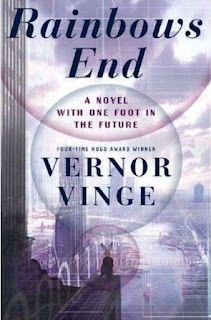
I myself have a different favorite. Set in 2025 but written in 2007, I didn’t expect Rainbows End to hew at all close to my reality. And yet. The earliest introduction I recall of crypto’s decentralized autonomous organizations are from this novel.

Vernor is as close as nerds have to a prophet. Here we are seeing the power of artificial intelligence dominate our human great power debates from culture to business to government. Everyone who makes things has an opportunity here to own building this.

I know that in whatever moment we are about greet (singularity or not) that I remember that we humans build technology from the imagination of Vernor Vinge.

No matter how alien the future may seem, we humans have build it first. Don’t you want to be a part of that?

The cover of Vernor Vinge Rainbow’s End