One consequence of consistent writing is having a large number of data points on my past predictions. I can go back and see how often I am right.
There is predictive value in back testing is clear. And in five years of writing I have lots of opportunities to apply my current dilemmas and compare them to what I’ve seen. If you’ve not heard of back testing here is a little summary from my Claude query.
Backtesting is a form of retrodiction—a special case of cross-validation applied to past time periods, used across finance, meteorology (where it’s called “hindcasting”), and other modeling domains.
In investment contexts, the underlying logic is that if a strategy performed poorly historically, it’s unlikely to perform well going forward, and vice versa.
The year 2026 has gone pretty well for me. I’ve made some good calls even as other situations globally look very chaotic. I feel like I’ve largely published my predictions and taken my shots and this is working out for me. The more I can look back on where I’ve been the better I get at acting on my calls.
I do continue to wonder how much anyone is paying attention to anything even as a huge amount of attention is being paid to manifestations that are only being seen as secondary or tertiary effects of bigger geopolitical and monetary events.
I don’t know if going into the future this corpus of guessing and noting and committing to thinking on the issues of the day will matter. Or might make life worse. But tomorrow on day 2027 maybe I’ll learn something new and put it into action and continue turning myself with the tides.
I’ve got to remember to keep tissues in my purse. I’m prone to crying when I’m proud. I am a crier by nature and the experience of pride and awe is becoming distressingly common. Woe is me right?
My very early bet on Valar Atomics (I wrote about it on Day 1145 but met Isaiah closer to day 900 early 2023) is paying off years, if not decades, ahead of my expectations. Never did I expect arguably the hardest operational bet in my portfolio to be such a fast breakaway hit. And I owe it to an executive order from Donald Trump and the efforts of patriotic Americans committed to regulatory reform. Which is crazy.
As it turns out, if the government gets out of the way of talented people, nay, if it demands that our state institutions help them, the impossible becomes possible in shockingly short order. The reports of America’s death are greatly exaggerated.
Today in front of a crowd of hundreds of current and potential investors, employees, Orangeville community members, government officials & scientists and most importantly our family members, we watched a reactor (that might not even exist without my first check), power an Nvidea Blackwell chip.
In a demonstration rivaling the greats (Ballmer, Jobs) Isaiah brought up NuclearWebsite.com and asked the audience to load it with him.
“Oh no it’s not loading?!!?” What’s happening? Do we have any electricity on site? Quick someone run the GPUs to the nearest electricity! Go go we can’t disappointment all these people!
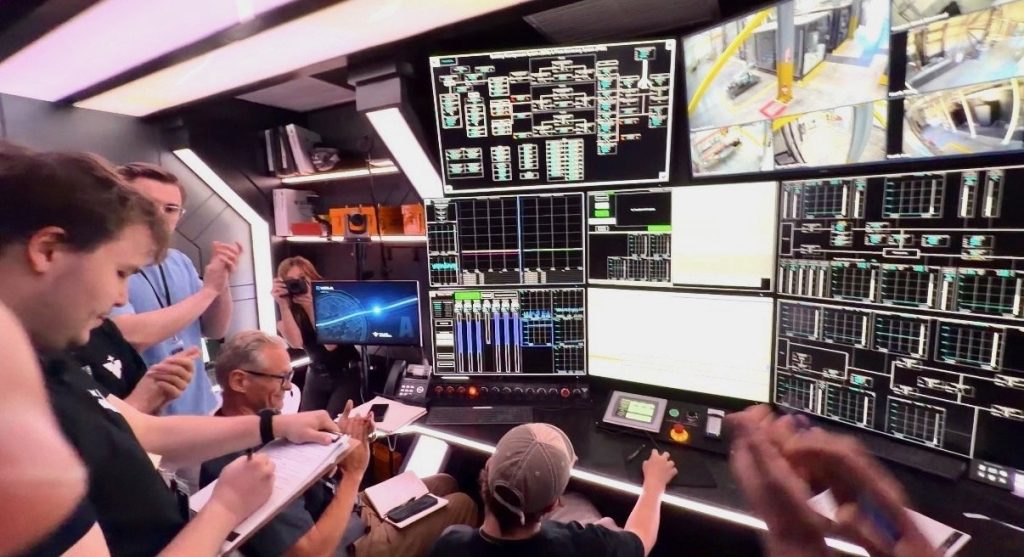
And then the Blackwell is rushed into the Ward250 reactor. In real time the chip is run to the control room, gets hooked up and boom the website loads.
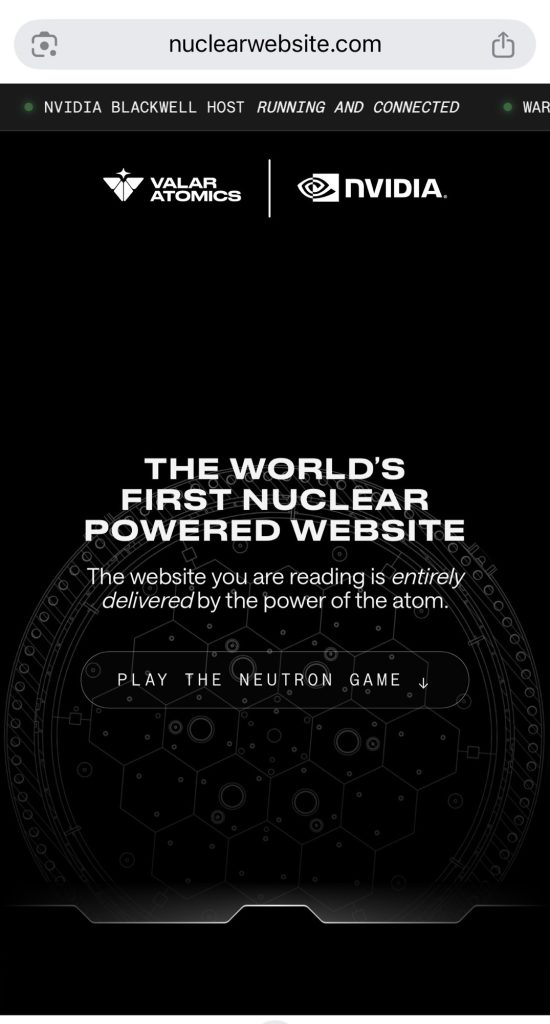
The first entirely privately funded nuclear startup was critical, stable, producing electricity and powering state of the art silicon.
We actually did it. The mad lads and ladies of Valar Atomics swept ahead of the competition in a frenzied year of progress (Day 1510) from seed round and Ward Zero to producing electricity to power GPUs.
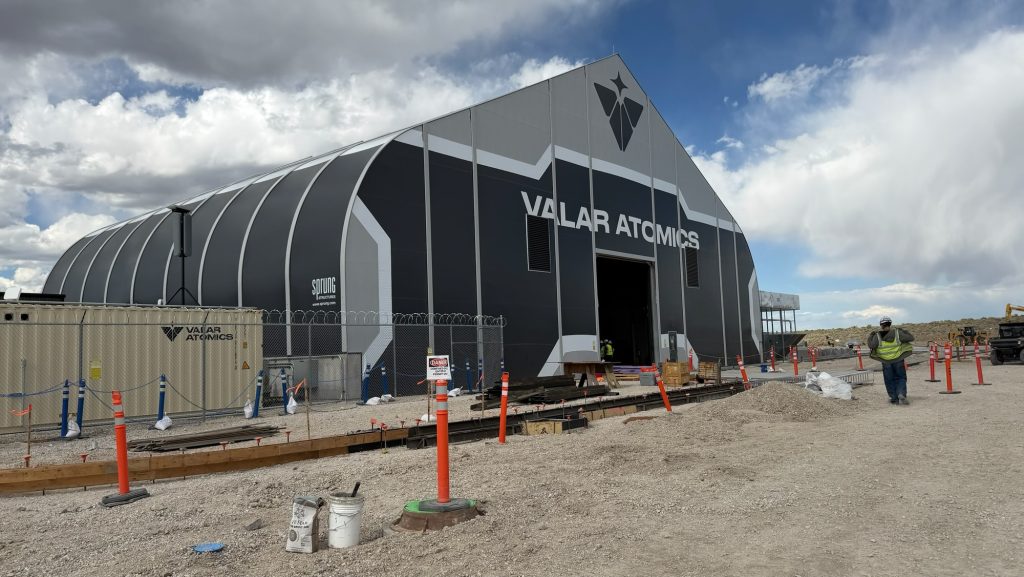
After a twenty four hour travel marathon to get from the Ionian in the Mediterranean to the southern Utah desert, being back at the Valar Atomics reactor facility for a demonstration of this magnitude felt surreal.
Just a few weeks ago (Day 1969) the reactor was days away from being shielded and then fueled. We’d driven down to see her before she was wrapped up in shielding.
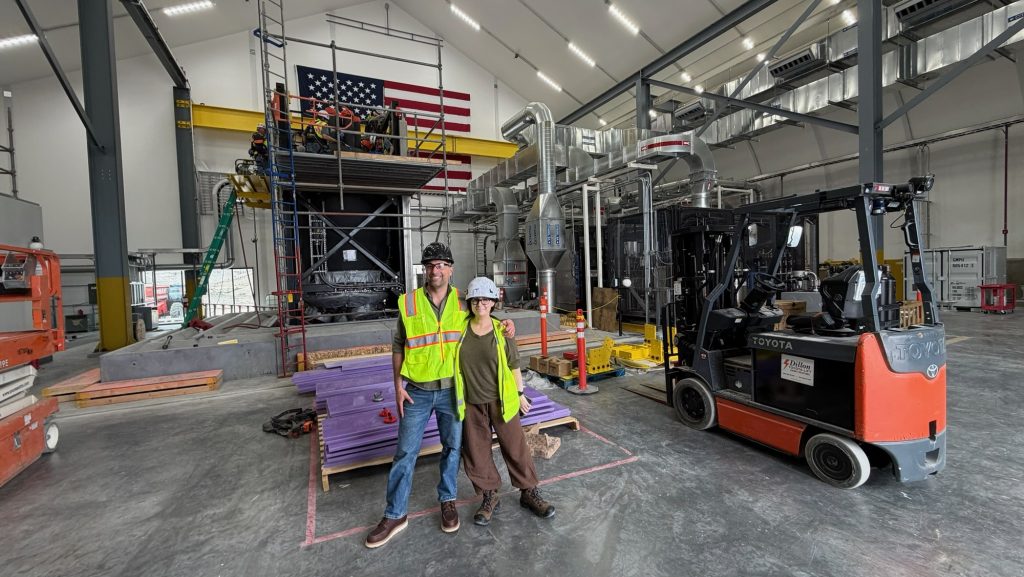
Proud first investors in front of Ward 259
Now not only has she gone critical (Day 1996) but I was able to walk into the running reactor room and see the live reactor for myself. The operator Ben (a former naval nuclear operator) seemed surprised and happy to see me. “Julie! Hi!” He exclaimed as me and the other early lead investors piled in for a tour.
Jason Calacanis (also a master of the live demo) never lets anyone forget he invested in Ubers seed round. I get to brag I wrote Valar’s very first check
And while success has a thousand fathers and failure is an orphan, I’ll always enjoy the satisfaction of being the very first to take a chance on a long shot no one thought had any business even trying. And well they were wrong. And I was right. Not just right but really fucking right. I backed the long shot dark horse (somewhere around day 950) because my gut told me that the kid had the right stuff. And wow did he.
I only had a dim hint of exactly what we’d be seeing today as the invite said “Watts Next” cohosted by Nvidia and Valar. Clearly a number of us connected the dots because it was packed. The atom would power the compute and we’d get to see it live.
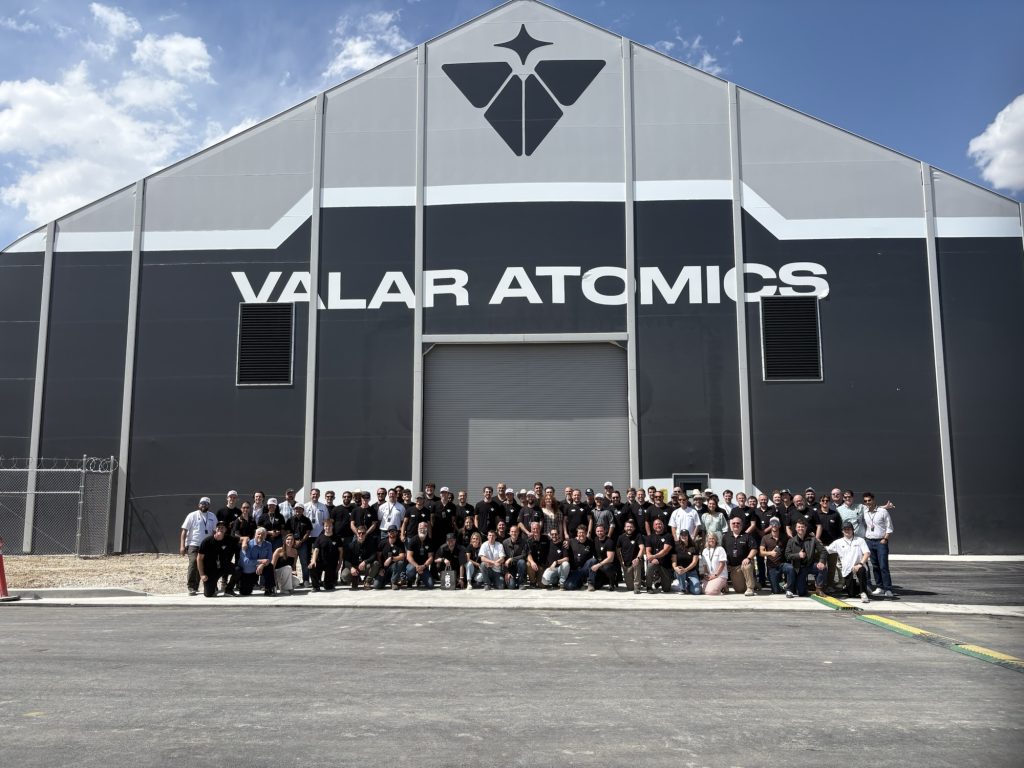
The team after the demo
Every existing investor, and quite a few later stage firms, came out to the middle of nowhere to see if these longshots had really done it. And indeed in just three years the impossible became reality. I’ve never felt prouder to be American. And clearly everyone around me felt the same.
And most importantly, it was a win for the team, led by the indomitable spirit of Isaiah Taylor. Their long nights and constant doubt paid off. The road ahead is long but no one is likely to doubt that we are serious contenders anymore.
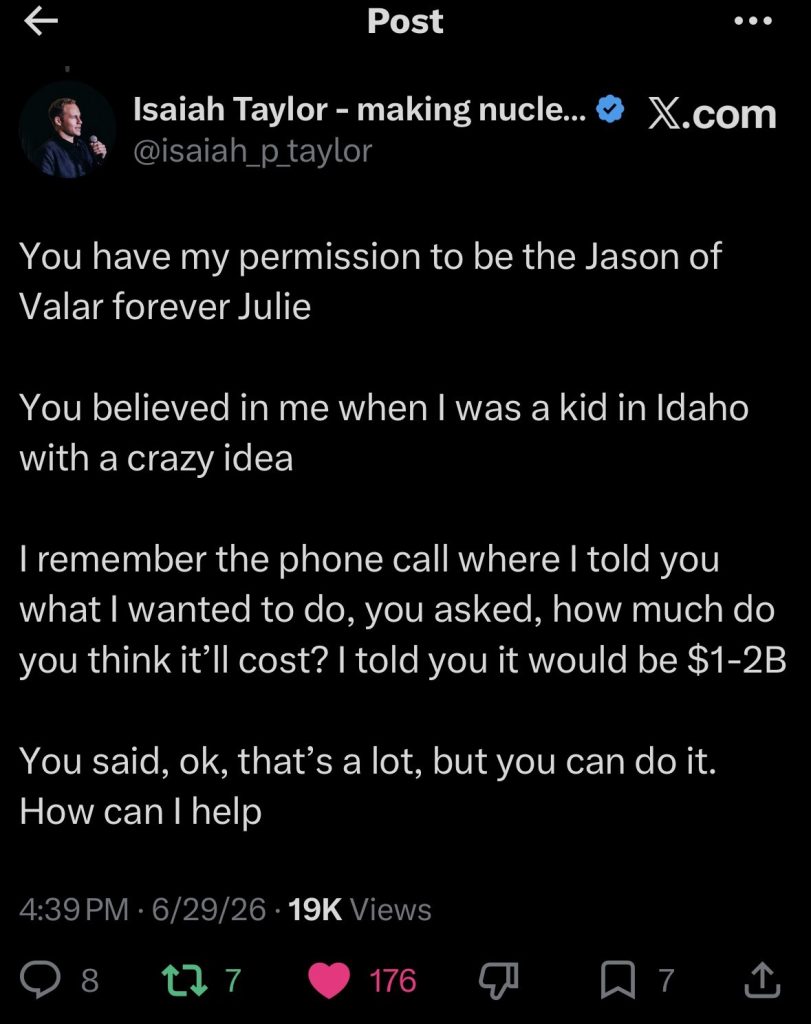
I always say there was never a doubt in my mind. I had faith. Isaiah joked he had moments of doubts. I say I’m blessed that I got to be that first believer to say “I think you can do it and I’m going to help.”
And whenever he doubted that we’d make it (there are always near death experiences in any startup) it was my privilege to remind him that doing the impossible is just what we humans do.
Like Captain Kirk, I don’t believe in no win scenarios. I hope you consider joining me for more impossible long shots. Because sometimes taking the shot is worth more than anything else you will ever do.
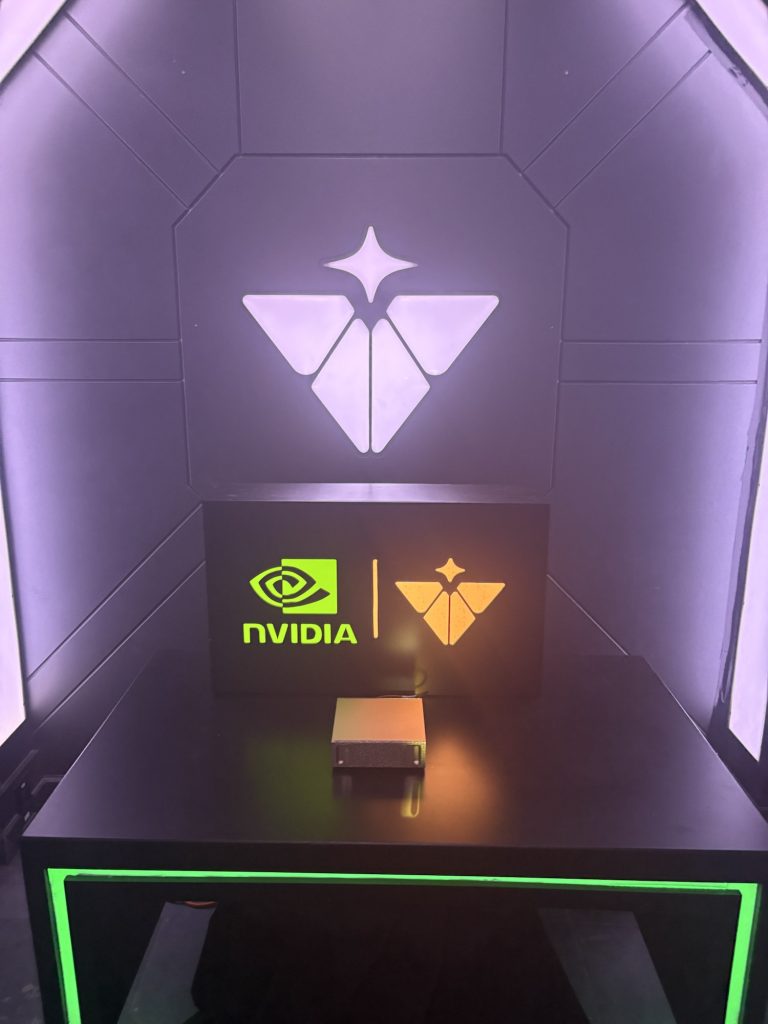
Want to run your compute on clean renewable cheap American energy?
Well I’ve done it. I have written and published to the internet a blog post every single day for two thousand days in a row. So I am going to toast myself to a job well done.
In earlier milestone posts, I was always surprised I’d made it, but now the harder thing to decide is if or when I’ll stop, not if I’ll keep going.
Half a decade goes by a lot faster than you think. The accomplishments actually do add up if you keep yourself pointed in the right direction.
In a personal capacity, we got ourselves to Montana, set up a life that let us live the way we’d always dreamed and invested in the future we wanted to see.
From a civic perspective during that time we helped pass meaningful reform in housing, testified for crypto rules of the road and worked to ensure Montanans have a right to compute.
From an investing perspective, we have been first in Solana’s most crucial infrastructure player Squads. Because yeah crypto is going to matter a lot in an artificial intelligence age. We have stuck to our core mission of adaptation by backing the tools needed to benefit from our new AI speed run.
And yes we care about open source. From vector databases to inference labs to experimental dueling models, we have snuck into some strange experiments. And oh yeah we were the first check in a small modular nuclear reactor that is winning the atomics renaissance race (at least this week having achieved criticality).
There have been a lot of failures in those years though oddly not investments or policy. I have battled health issues and fought to not just maintain working capacity but to gain back the capacity I thought I’d lost forever.
I did woo woo whacky things from PEMF and HBOT to peptide stacks and traditional biologics. Thanks to the horrors of hormones and steroids I was early to GLP1s and made some good investments there too.
Maybe I’ll tag all of this more cleanly later but I do think it’s important to remember the days are long but the years are short.
Get on the airplane. Go meet up in person. Buy that dream house. Build a solar array and a sauna. Do wildly romantic things and go to galas. Say yes to more.
And open your heart to the heroic efforts others are also putting into making our lives and our world better. We live among every day heroes. And yeah lots of bad shit has happened in this time too. My father died. We failed for five years straight at getting a visa for a close family friend.
I am aware of the shitty compromise we all make to survive. But you have got to hold on to that feeling. So yeah on day 2000 I think I’ve earned the right to be corny as hell. Don’t stop believing.
I’m so old I viscerally remember the Y2K panic that ate up the emotional bandwidth of the American media class who then stoked fear into the hearts of the doomer classes from system administrators to evangelical millenarians.
I was very much online during the Y2K era though I didn’t start blogging (unless you count girly message boards or Geocities) till much later. I was however happily a cybercore hippie girl. If you want to feel jealous and are a Zoomer, I owned a teal iMac G3 and iPod. So I it delightful that a younger generation has decided to dust off some of the silliest times of my youth and refurbished them into Instagram and TikTok aesthetic trends.
What is less funny is how much past fear mongering over technological doomsday scenarios look exactly like our current ones. I remember the simmering fears, the debates over types of damage, and extensive coverage of weirdos who were preparing for a kind of end times.
It feels familiar to how very extreme our reaction to artificial intelligence is being portrayed by both the media and its wildest singularity evangelists. I say this as someone who readily calls themselves a doomer so it’s not a milieu that’s foreign to me.
Here is a brief synopsis I patched together from a Perplexity query with links included if you are too young to remember it.
The Y2K crisis was the feared failure of computer systems when dates rolled from 1999 to 2000, because many programs stored the year with only two digits and could misread “00” as 1900 instead of 2000.
In practice, it became a major prevention project rather than a disaster, with governments, banks, utilities, and other organizations spending years fixing code, updating hardware, and testing systems before midnight on January 1, 2000.
So here I am on Day 1999 of writing every single day, and I’m waiting to turn over into my own 2000th day. I have no anticipated bugs for that event. I stayed up till midnight with my mother walking the main street of our town with a bunch of others waiting to see if anything happened. Nothing did so we drove home.
But it’s enjoyable to remember the kind of disasters that were predicted with such anxiety ended up being problems we worked our way through. We keep at problems by naming them early. Humans intervene and we change our behavior. That’s something you celebrate about us as a species.
I am excited to have achieved such long tenure of daily public writing because much of it covers we have worked our way into a new panic that I’ve been watching for over twenty years. Singularity thought and the extropians have been part of my daily internet diet for quite some time. I think we will find a way to survive this too. Though I grant it sounds a bit more complicated.
I’m sure 1999 me would be proud of the strange futurist I became in my adulthood. I doubt she would have expected that I’d be investing in nuclear power or that I’d have managed a career in cosmetics as a side quest. This is actually a side quest another nerd pursued. I don’t even wear makeup in 1999. I occasionally do in 2026. But if I need to party my way into the singularity I’ll probably at least wear lipstick.
I am going to be scattered and long winded so please excuse my exhaustion and joy, as I have used up all of my focus in the excitement of a truly incredible moment that represents years of work.
Moments ago, Valar Atomics took Ward 250 critical for the first time. This fulfills President Trump’s EO 14301, which called for 3 advanced reactors to go critical by July 4th.
This is our second criticality as a company, and an important step toward our goal of power by July 4.
This is a historic moment and the culmination of two years of work on the part of the Valar Atomics team. This is the most hardcore, intelligent, and driven people I’ve ever had the privilege of working with; which will be seen as we begin power ascension in the coming days.
Our mission at Valar Atomics is to make abundant energy for all mankind. The best way to make energy 10x cheaper today is to mass-scale nuclear fission. We began our mission by creating WardZero, our fully functional thermal prototype. Next, we took the NOVA core critical.
Today, we took the next step: criticality in the Ward 250 test reactor. Ward 250 is a TRISO-fueled High Temperature Gas Reactor (HTGR) designed for simplicity and scale, and is the first nuclear reactor ever air-lifted by a C-17.
We’ve been honored to be become part of the community in Orangeville, Utah, the home of Ward 250. Many thanks to all of our government partners who made this possible: hundreds of individuals across the Trump administration, the DOE, the DoW, and the government of Utah.
The list of individuals who have spent their time and energy and talents to accomplish this feat is too long to list in one post, but I am incredibly grateful to all of them.
I am one of those individuals who spent their time, energy, talents and capital to accomplish this incredible feat. Investing in Valar may well be the greatest accomplishment of my life.
You see I am Valar’s very first investor. Yes I mean I wrote the very first angel investment check from my small venture fund.
Crazy but possible makes complete sense to me. So I said he’s. And we chewed glass for a few years working towards the possible, while everyone told us it couldn’t be done.
Through the magic of Twitter DMs, I met Isaiah before he had even started Valar. He was working on another startup I didn’t love but I knew immediately that I loved him as a founder.
I was so impressed with his intelligence and his capacity to learn quickly. He had that ineffable “it” quality that all founders possess in some measure. He took feedback well but had a firm backbone. He listened to one piece of advice I gave him and based on that decision alone, I told him I’d back anything he did in the future and I meant it. I’ll admit I didn’t expect it to be “I’m building a nuclear reactor” but I am true to my word.
We’ve been there for every step of this amazing journey. It was an objectively insane thing to invest in. Yet the more time I spent with Isaiah the more convinced I was that he was a generational talent. The best part of being first is the opportunity to spend lots of time with a founder before anyone else learns of their genius. I learn as much from them as they do from me. And Isaiah is a quick study.
I wrote the check and went about the long grueling process of convincing others they should invest alongside me. It wasn’t easy. We got told no a lot. Failure lurked around every corner. People ranged from outright hostility to tempered skepticism. There were moments when defeat felt very close.
There were hard times. A lot of glass chewing. I never wavered in my belief that Isaiah would get it done. Alex and I were blessed with the opportunity to invest more and gladly wired in additional capital when others couldn’t see as far as we did. This may well be a career defining investment for me. I intend to keep putting in whatever Isaiah will allow us to invest.
And to everyone who said it couldn’t be done, or that it was too early or too risky to invest in something as crazy as nuclear, please let me invite you to join us now. There is much more to be done. We will need all the talent and capital we can get to win this bright future for America and for humanity.
Does anyone else remember when a congressman was off the grid for a few days and his staffers claimed was “hiking the Appalachian Trail” when in reality he was on vacation with his mistress? That story fell apart rather quickly, but remains my shorthand for silly excuse.
Following the meeting, the administration attempted to reach Amodei but was told he was unavailable because he was attending a wellness retreat, one of the administration officials and the senior White House official said.
A spokesperson for Anthropic rejected the claim that he was at a wellness retreat, saying, “this is absolutely false.”
I don’t, as a generally rule, take what public relations professionals say at face value without knowing them personally as their job is to protect the principle.
I might trust an individual publicist but when in doubt verify before you truest. This is true for both Anthropic and the current administration so all parties are now annoyed and suspicious.
Ironically I am enjoying some time on wellness activities this Sunday myself. I wouldn’t call it a retreat but I did take a swim and read Europe AI 2031 under an umbrella. So let’s call that as close as I will come to being on a wellness retreat at a point of crisis in the AI race.
As a school child, I was taught that the American constitution and our bill of rights protects our inalienable rights (given by God) from the government. The government doesn’t protect us. We wrote protections to guarantee our rights from the government m.
Yet you’d be hard pressed to find anyone pitching a government law these days that isn’t wrapped in logic about us needing protection from the world. Our laws now protect the American people from worldly fears.
Precious few of us discuss needing protection from the government in order to exercise our rights. The government protects us from the world’s many from dastardly threats. We don’t care so much about protecting our rights from the government anymore.
Protect the children, consumers, workers, businesses taxpayers we plead. Save us! And lawmakers respond in kind. It’s for your own good might as well be the nation state’s motto.
And what do we have to show for it? Are we freer? Do our financial systems enable life, liberty and the pursuit of happiness? It sure doesn’t seem like our recent track record is working well. Have the last two crashes and subsequent legislative responses led to a more productive prosperous economy?
Sarbanes-Oxley (and the enormous growth of private venture capital) mean companies don’t need to go public anymore, and prefer not to given the compliance cost.
Which of course means the small private investor has zero chance to grow assets like the already wealthy routinely do.
I scan 20 years of tech life, and can’t think of a single instance of regulation actually improving anything for the everyman user/investor
You used to be able to buy an initial public offering for a startup and grow with it. Now most of the gains are in the private markets. So if you were a SpaceX private investor you might have a great summer but it’s hard to say if you will want to buy the IPO.
It all reminds me a little bit of my favorite Christmas movie A Christmas Story. The movie follows a young boy and his family’s misadventures during Christmastime in 1940. He wants a a Red Ryder Carbine Action 200-shot Range Model air rifle for Christmas. Everyone from his mother to the mall Santa Clause insists “you’ll shoot your eye out!”
Ralphie is disappointed by Santa Clause saying he’ll shoot his eye out if he gets a BB gun
Now I don’t want to spoil the movie but let’s just say that the kid doesn’t come to any harm despite getting his wish even if there are a few moments of fear and regret. Because ultimately he’s a responsible kid and it’s a BB gun.
I’d hope we continue to conclude that Americans are responsible people. Sure BB guns, frontier large language artificial intelligence models, and investments in the stock market all come with risk. But isn’t a life with Christmas magic, helpful compute and capital gains worth it?
There is a lot of chatter as to the eventual ownership makeup of the frontier artificial intelligence labs and their economic surplus. One question that came up this weekend is whether equity in the companies should be owned in some portion at the nation state level. I am opposed to this for a host of reasons that I’ll try to get down in whatever garbled form.
I do not own a stake in any of the frontier labs other than owning ETFs that own Magnificent 7 exposure who own portions of the labs. I do invest in compute, nuclear energy and cryptography. I believe AI will change a lot about how we do business, my revealed preferences show I live remotely in Montana, I have a tendency toward emergency planning and Plan B scenarios. As a disclosure of my priors.
There are lots of competing interests in this and the self interests from the labs does no any favors. Especially after months, nay years, of overwhelmingly hyperbole about changing labor dynamics, the potential for mass layoffs due to automation as well as obfuscation and excuses about the reason for layoffs in existing companies. And that’s before we get the singularity which is a religious orientation toward making super intelligence that is Godlike in its framing.
I hate this entire conversation on nationalization and socialism. Part of it is that state actors desiring ownership of private companies reeks of the “you didn’t build that” malapropisms from Barack Obama’s presidency in which he attempted to articulate that America’s enormous wealth is built on generational compacts that no one individual could ever own outright. It triggers socialists and capitalists both.
We all contributed in our own ways to the shared infrastructure, institutions, education, cultural norms and the pluralism embedded in our governance systems that enabled the American Dream.
Unless you are a deep partisan, you understand Obama was trying to articulate that none of us made America alone. But the framing from liberals (and populists of all stripes) automatically make this conversation concerning.
Economics is complicated, central planning has a hell of a body count and your average American can only gesture towards the invisible hand and the benefits of self interested commerce. It’s easy to sell us bad policy from envy and fear.
So I must ask why are we acting like we have suddenly won a national level economic boom with clear winners whose spoils must be distributed by the nation state before we’ve even managed to understand how it will be used, at what level an AI model is a commodity and where the benefits will accrue?
Self interested pluralism with a system of checks and balances at the national federal level coupled with states exercising their own interests has been the bedrock of our national success. Changing this has not gone well for us as a nation nor do we have better examples in other nations.
Sure America has had a few twists and turns. The last time we made an attempt at a New Deal post Great Depression worked only thanks to a global world war industrial mobilization in which we won the war and all our other competitors were decimated on bombed our continents across massive geographical boundaries.
And that boom has been largely spent by the children of the generation that fought this war and their children are looking at a pretty significant bill. So why do labs suddenly want to “compensate” Americans and our collective contributions to the models?
And why are politicians taking this bait when we have so little insight into whether we should funnel cash into them in order to own them in trust for some nebulous future?
I have a few reasons in no particular order that I put on Twitter as to why I am opposed to this format of American state equity being the means through which we compensate the people who theoretically trained these models with our output on the wider open web and its content.
1) We don’t know who the winners will be or where the benefits will diffuse (as in post liquidity the current winners might not be the eventual winners) so compensation for model training when the eventual benefits disperse elsewhere isn’t ideal. Why aren’t taxes at state & federal level aren’t adequate enough here should be answered before we make moves
2) Existing IP law doesn’t account well for culture which is a shared co-creative process (i recommend Susan Scafidi of fashion law institute “who owns culture” ) so compensation is already not easy to track back
3) A state entity w the monopoly on violence can do a lot of damage on the margin by not fully understanding who created what and where it is applied especially in non deterministic systems
4) Much of what the models were trained on was open source licensing including the company where my own family made money Stack Overflow. We got paid sure, but none of this would exist without the effort of its users who contributed on those open license terms. But clearly the final value of the content created & company’s value itself were harvested much further down the line in enterprise contracts for coding models. It was not in the management of an open source license community product created by users or managed by engineers, so who should have been paid? The users who wanted their content to be open sourced? The volunteer moderators? The full time employees? The shareholders of the company, the buyer of the company or the users of that data set at Claude or Cursor or OpenAI? Or is it Americans that never even heard of SO? Where does value accrue over time versus point in time? It’s not an easy question to answer is it?
While I’m not primarily an investor in the LLM boom, I have invested in compute markets, vector databases, neolabs and most importantly I have invested in energy.
I am not someone who is all that worried about fast moving changes even though I clearly take both the changes in the world but also the changes in technology serious. I moved to Montana to stay out of trouble and I’m betting the ranch this will be a bumpy but successful ride.
I believe it will be good for those who open themselves up to the possibility that Americans can handle themselves. I won’t lie and say that we have unknowns ahead of us but that was true before we got powerful tools to solve problems at a much faster pace. It might get weird but we believe in our adaptability.
Anytime you see dumb headlines and bizarre deal points show up on Bloomberg it’s worth doing a head tilt. The time for consolidation and winners in the first wave of artificial intelligence automation is here and surprise we replaced ourselves.
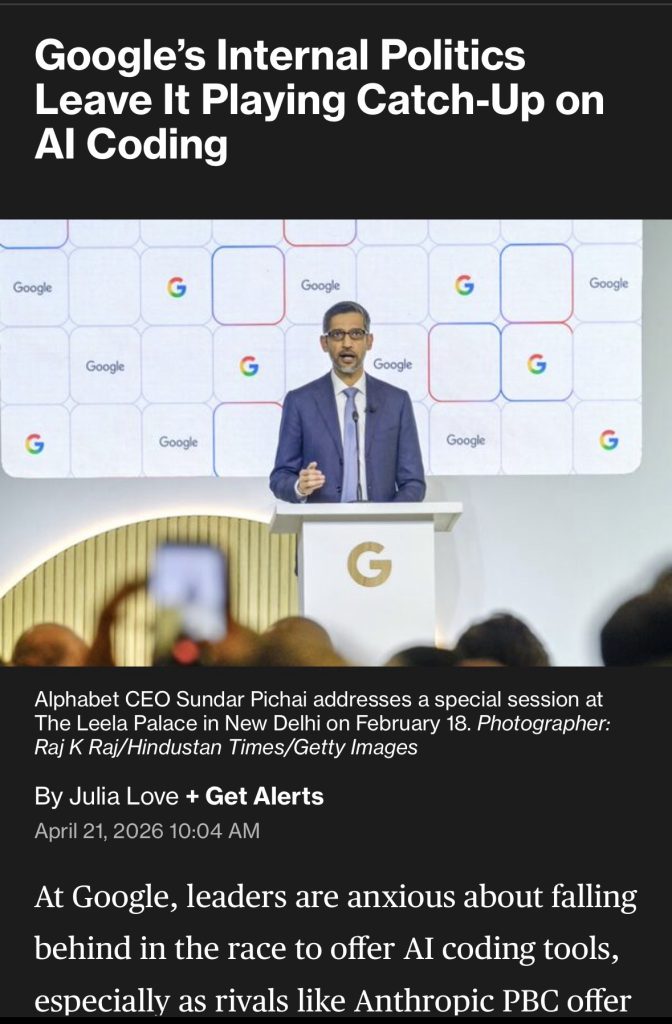
Catching up with various consumer offerings hasn’t mattered as AI coding is the stuff of money and even their own staffers might prefer Claude. Or refuse to use AI at all? That that sounds like the pampered Googlers we all know and sort of dislike.
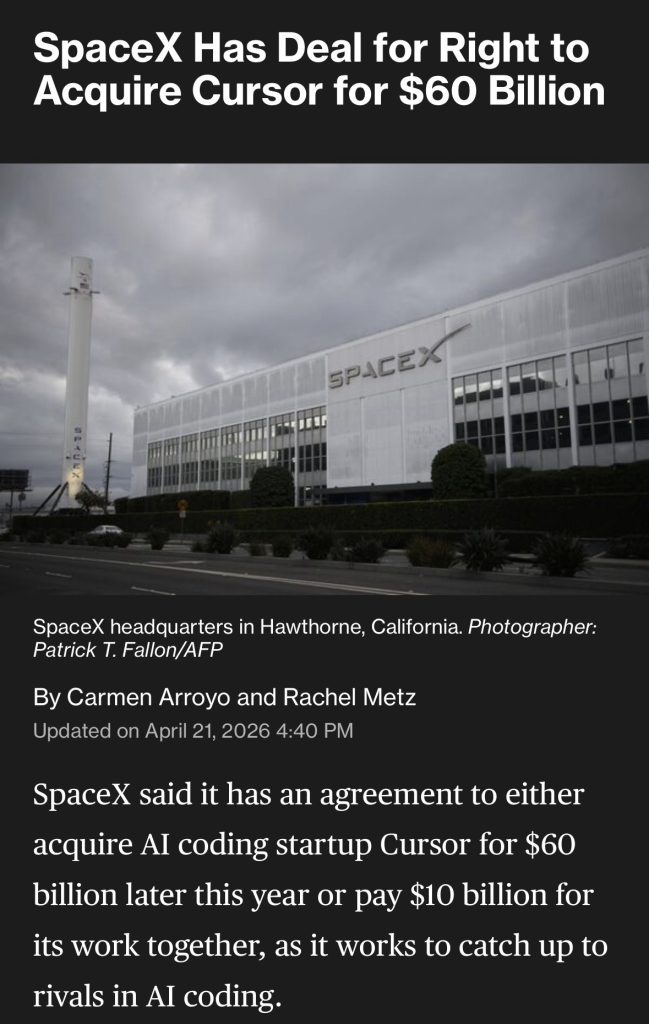
SpaceX said it has an agreement to either acquire AI coding startup Cursor for $60 billion later this year or pay $10 billion for its work together, as it works to catch up to rivals in AI coding
You know shit is rough out there when the billionaire with the space monopoly and the compute is offering up something this bizarre to the coding startup that was about to raise 2 billion to catch up to Anthropic but is now maybe going to buy extra time on Elon Musk’s dime. I’m sure stuff is fine at OpenAI right?
I honestly don’t know what the heck is going on except that it’s a good time to consolidate if you don’t have compute (and previous few have enough as hysteria builds in the dare center and power works) and if you have investments in energy you literally can’t go fast enough. It’s feeling a little rekt vibes out there. And I ain’t even ready to address the end of the cease fire.