My head hurts, I’ve lost my voice and I’m achy everywhere but I’ve got something resembling a tan and my lymph glands are only a little swollen.
Is this is the halfway point of the summer season I feel like I’m doing it rather well. That is rare for me as summer is traditionally my most challenging season but I seem to be doing rather well despite the workload and constant travel.
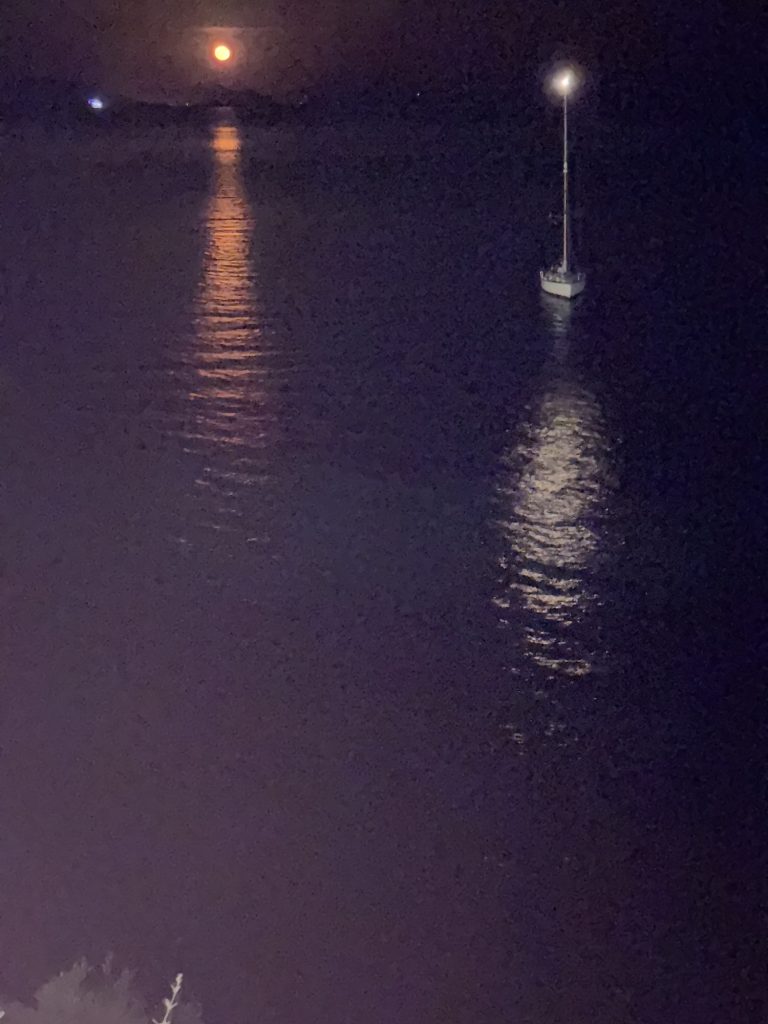
In a fun coincidence of scheduling, I shared a blue moon at the end of May in Greece and the waning of the full strawberry moon in Utah with same person.
A blue full moon and a sailboat light
What a joy to be half a world away and still find a way to come together. From the Ionian Sea to the high alpine skiing mountains of Utah you are never too far away from a friend.
I’m back in Montana and hoping I’ll enjoy a reasonable chunk of time here as I do feel the strain on my body. I don’t think I am sick but I am struggling to with fatigue and the annoyance of a throat so sore from talking that I should probably commit to a silent retreat for a few days.
So I’ll sip my slippery elm tea and browse the cosmetic sales for skincare (and a little makeup splurge to celebrate the big wins) and get myself back on a routine. I’d like to put on more muscle mass and improve my cardiovascular fitness now that I have more capacity.
If I can manage conference after conference, gala and launch demonstrations along with my workload and time with friends then surely I can add in some overhead presses and a plyometrics right? I did a short but brisk mile and half circuit around the neighboring pastures. And then I got back into bed.
I am going full weird Americana for the Forth of July in the mountains with friends . We are all committed to the beautiful wonders that is America as it is our natural beauty in the mountain west that feels right for celebrating our nation’s 250th birthday.
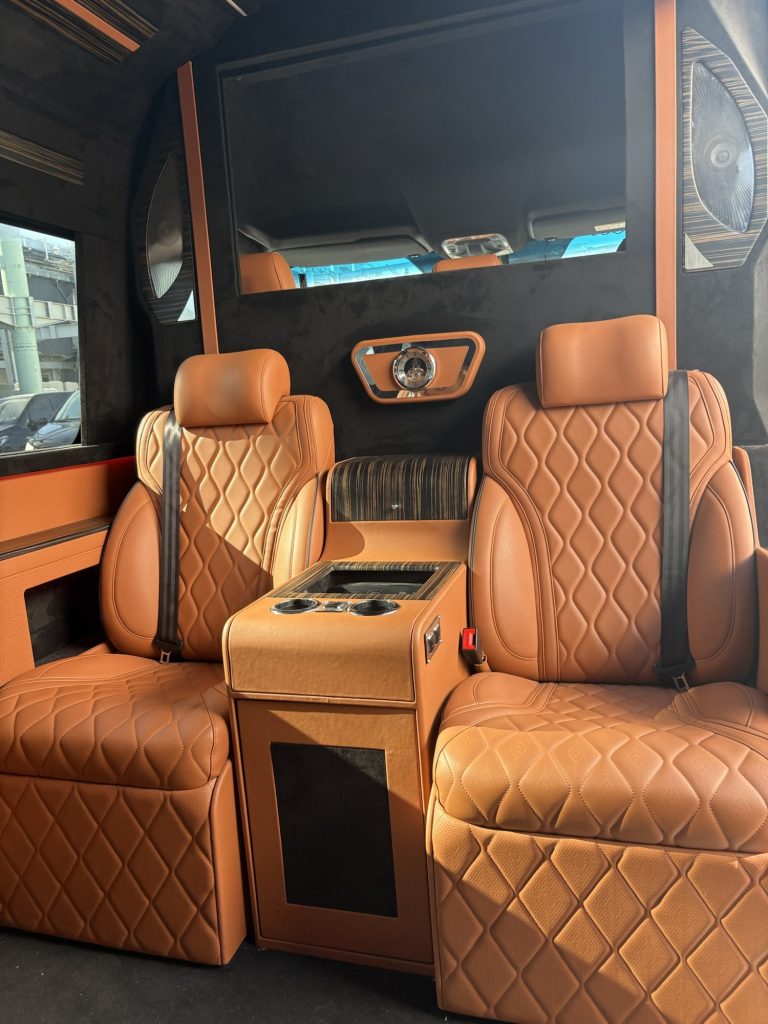
Being very in the moment means it’s hard to capture the moment. I’m in a Jeep Rangler going up one of the steepest graded roads in North America to the top of a ski mountain. I’m in a silk dress with a black baseball cap that says make nuclear great again and art deco costume jewelry. Just for fun because why not?
I hope it was reasonable dress code for a hoedown at a country club. I feel like I should be in cowboy boats, but not haven’t made it home to get any kind of riding boots so I’ll come as I am with a smile.
The alpine country in the summer lends itself to dressing a bit more country than city even with its evident creature comforts. I’m a townie from a mountain town so I can simply be eccentric. The counterculture of mountain towns is obvious to insiders but less to those who move in later in life.
I’ve been going between city, coastal and desert all within a month and I’ve not had space in my suitcase for cowboy boots. But I am glad I am able to enjoy the vista in any state. Who says silk and Jeeps aren’t a natural fit?
I wrote these notes while a little bit high, both literally (a transcontinental flight) and figuratively (CBD & a THCa blend meant to give anti-inflammatory relief without hitting your mind but it probably does) but it’s hard to say if I’m less focused than when I’m on the ground. You be the judge of that. Nostalgia machine clicks on
Business class and its perks are lost on me as I don’t drink alcohol. So I had rhubarb and raspberry tonic water in whatever passes for cut glassware on airplanes now. I said no at the fancy lounges to very decent champagnes but I don’t want to get dehydrated. I got a sugar crash instead.
I’m listening to Ethiopian jazz as I find this piece relaxing in the context of airplane travel. Mulatu Astake is a master in a genre I don’t even like but this particular piece has always spoken to me.
Nobody paid me for the diffusion but I was paid for the original campaign. A lesson for anyone bitching about how their work wasn’t compensated by the artificial intelligence models that ingested their contributions.
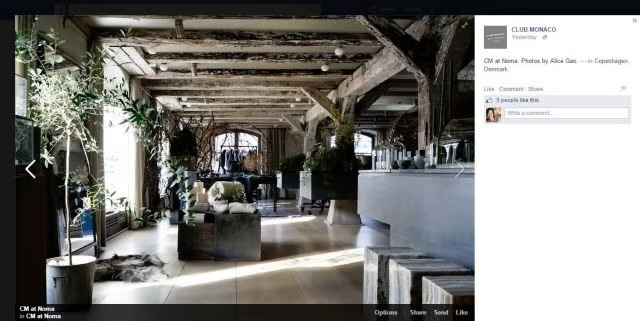
How funny that I should manage a Club Monaco Facebook page involving a pop-up event for a chef that would go on to define so much of culture.
I worked with impossibly cool creative director on the account who was famous in Japan for his photography and also as the guy who made Pabst cool for hipsters. I sometimes wonder where he ended up when his talent set was so hype sensitive. But we were pretty ahead of the times on this one.
Before this fashion agency career, in the post GFC aughts, lived across from a weekend installation of a projected light Pabst installation when I was in North 7th and Bedford. My Turkish banker roommate and I used to throw raves there so we couldn’t exactly complain about the lights hitting our living room. But it was a good campaign in a good location.
I shot low budget fashion shoots during the day with a very competent hungry young editor. She worked as a waitress at night and for me during running our fashion editorial to get toehold in the business. It seems to have worked.
She has an amazing career, a handsome husband, a beautiful child and kicked it off with an impossibly stylish wedding which every hipster you knew copied till well past the Tommy Hilfiger event horizon of having no soul. We had a tortured Swedish nepo-baby photographer too. I adored him. It was a very “rents were cheap” time in hindsight.
Anyways, in transit through Heathrow, I picked up a raft of print magazines from the Cathay lounge which kicked off this nostalgia. I’d browsed Wallpaper but as I’m not a design person a flip through was fine.
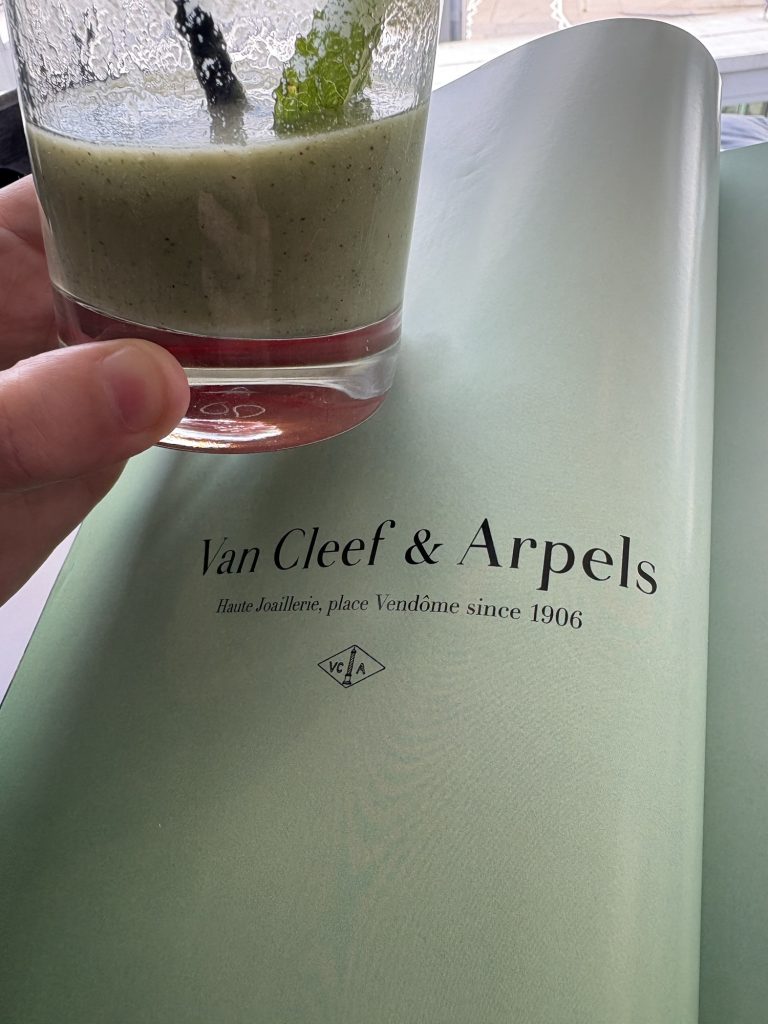
The Cathay Delight is the same shade as this campaign from Van Cleef and Arpels.
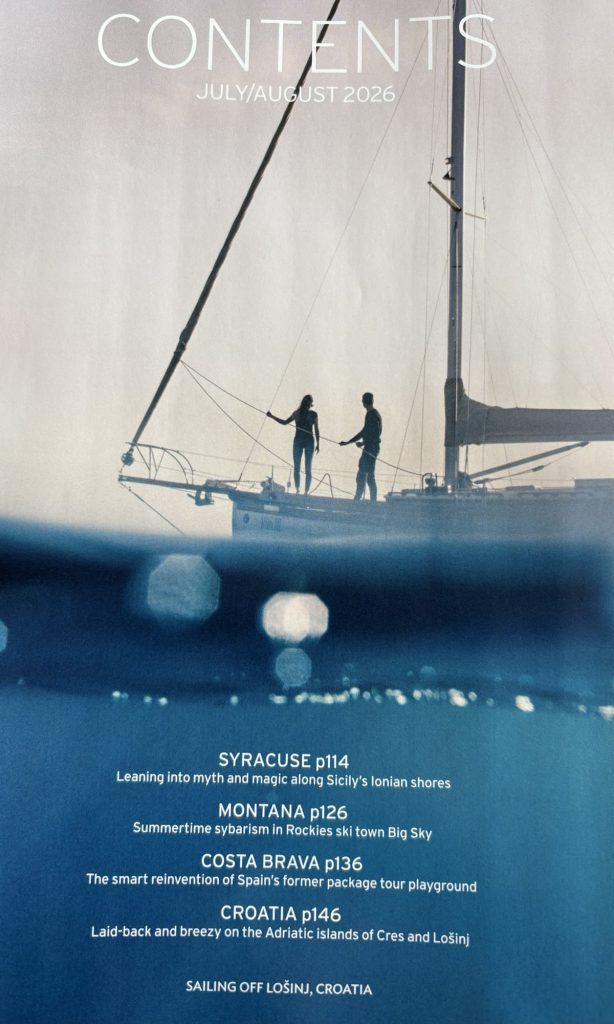
But Condé Nast Traveler caught my eye as I went in to grab the pink Financial Times. I got Tattler as well as why else fly British Airways if you can’t get some gossip on this social hierarchy right?
It’s just that taste is so far down the commodity chain anymore it’d hard to know when and where to find any thing that’s not made to be sold to someone. The menu on my flight had basque cheesecake. That became a joke on a trip I threw together last minute for girlfriends in Corfu. Apparently it’s made it into the Club World menu much to its detriment.
The choices from Condé Nast on a perfect summer was so on the nose. Montana’s Rocky Mountain sybarism and off the beaten path Adriatic and Ionian options for exploring covers and lots of seafood.
The whole damn thing reads like my travel itinerary.
Yeah that’s my coastal move with friends and family. And I do rather loudly live in Montana. It’s like am I joke to their psychographic team? A department that has three people no less. And they only market to women exactly like me. Funny that. I’ll have to check up on their old editor Lilit. She was much better than whatever this nonsense of repackaged Julie seems to be.
I’m in a private terminal in a tier three European capital, as I begin the long transit back to the remote regions of America’s effort to reboot our lost industrial capacity. I am ready to celebrate our 250th birthday.
All this can be yours if you pay a few backs to cut the line in the former eastern block
You will find me in the desert trying to convince anyone who will listen of the many industrial and environmental benefits of nuclear energy. Might you be interested in particular of the learning we gain from repeatedly making thousands of small modular nuclear reactors? Scale baby scale.
I’m team Valar Atomics or bust, but I know it won’t be a bust as we have just had a race to criticality that half a dozen companies will meet for July 4th. And what better birthday present to give Lady Liberty?
“When you have the will of federal policy and the will of the people, these things can absolutely happen.”
The artificial intelligence intelligence revolution pretends we still have the height of America’s wartime Industrial & Management Revolution capacity for the build out still available within America’s heartland.
We don’t but I believe despite the bread & circus it might be possible. Lord knows we are trying to get back up and going. Just look how quickly we got our nukes back up in just one year.
Yes we got algae bloom sabotage on the bloom in DC, UFC fights on the White House lawn and some bizarro corruption but at least we aren’t having a Flamingo Revolution of Zoomers rebelling against oligarchs skimming too much from corrupt socialists who need to revamp their attitude. The Geopolitical Cousints get what I’m saying right Marko?
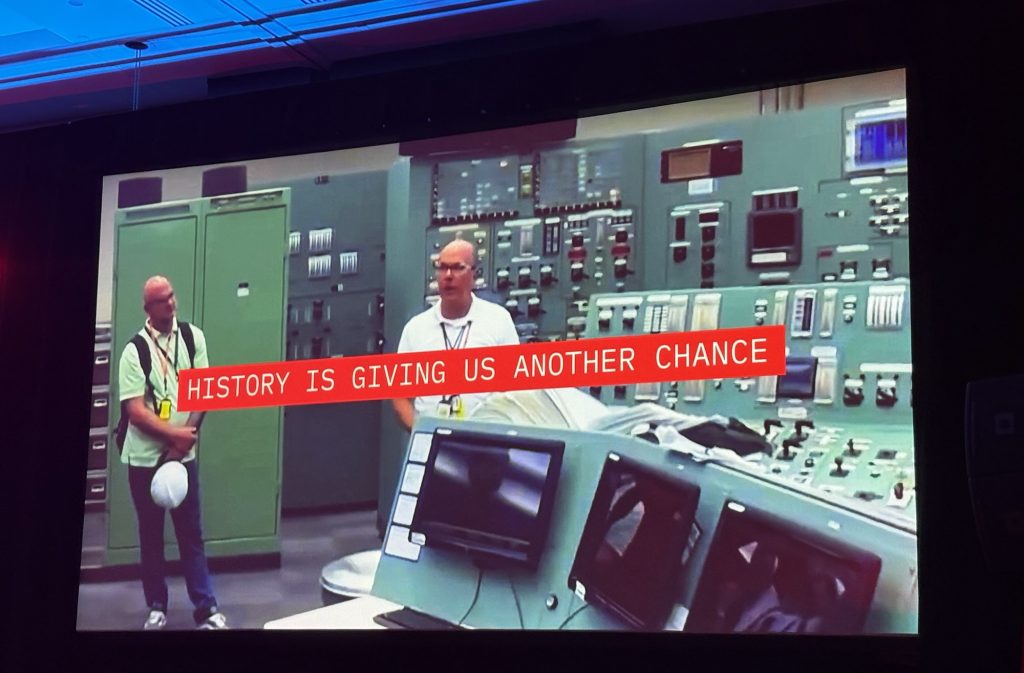
I rewatched season three & four of Apple’s For All Mankind alternative history of the space race as a hype effort to remember that we did indeed have other options for our near future and as the Abundance Institute reminded us all mere month’s ago history is giving us a second chance.
The Blue Sphere Transmission” is an electronic, modern-disco track by MelodiZenith that blends nostalgic 80s Eurodance rhythms (reminiscent of Bad Boys Blue) with deep house and synthwave.
Line dancing Euro-Disco Italian Pop on Mars? Now that’s a future I can get behind powering with SMRs by Valar
If professional class workers thin out as a function of artificial intelligence taking some of the work done by the professional management or PMC class, I suspect we will see nostalgia for the time they were seen as aspirational. I’d like to explore that near-future science fiction today with the PMC Olympics.
After the initial decade or two of upset (possibly even rage) at the power shifts & new status dynamics subside, we fondly remember business class types like lawyers & consultants with the same wistful fondness as we recall switchboard operators or the stenography pool.
I’d bet in the nostalgia wave, we see competitions, cosplaying and an equivalent of Renaissance Fairs or reenactments pop up where former PMCs and thr youth pretending to be them, compete in a cargo cult display of its cultural identity markers.
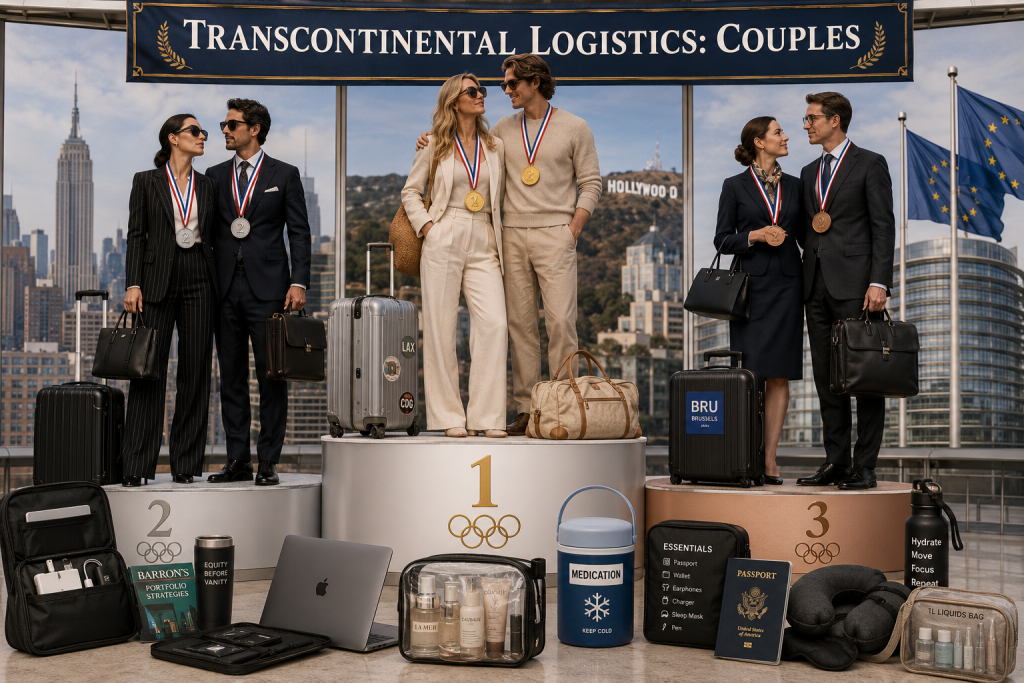
And when this does inevitably emerge as a cultural touchstone, I want to compete in the PMC Olympics with my husband in transcontinental logistics events. Think of it as figure skating but for married business partners.
I’m confident we would medal in the transcontinental travel logistics category. I’d get gold in the individual “cosmetic and liquids” category. Think of it as “uneven-bars” of the transcontinental logistics travel competition.
As part of this mirthful sci-fi exercise, I input a prompt to ChatGPT’s current image model and it gave me a very amusing montage of who might compete and win in just such an event.
Naturally the shining blonde California affluence worker (subcategory creative class) took the gold but let’s not forget the New York finance couple nor the European directorate class.
ChatGPT image prompted with: Make me an image of three sets of couples who are professional management class knowledge workers. They are on an Olympics podium receiving gold, silver and bronze medals for medalling in the “Transcontinental Logistics: Couples” event. I’d like two American couples (one New Yorker finance style and one California Hollywood style) as well as a European couple (Swiss) in the style of a Brussels bureaucrat. There should be suitcases, travel bags for laptops, a 1L cosmetics bag, a medication cold tube, and other travel essentials in the image
I know this sounds a little goofy, but the work that goes into managing what a couple need when constantly switching between personal life and work on the road involves a surprising amount of logistical support work. And that’s without children. I’d add a category with a toddler as the most extreme form of this event.
Just check this prompt I made for my own PDF for an event involving both industrial site visits and formal galas that I am attending after flying west from London. Some details are changed or redacted for modest privacy. Anyone can easily guess what I’m going to be doing.
Build a 8-10 day travel itinerary for a business trip departing from Heathrow London and arriving to Salt Lake City and a remote desert town in Utah, from June XX to July 2, 2026. Include a day-off rest plan for Salt Lake City, a Department of Redacted event logistics flow chart, transport coordination for a bus to small town and return back to the city on July X of event, and recommendations for high-quality food near event venues.
Include transitioning time and necessary grooming required for a facility floor tour with safety gear and a change for a formalwear gala with an hour buffer assuming an event mid afternoon, there hours transit and evening formal event at 7pm.
July 2-5th include a secondary itinerary for a follow on mountain social event at 8,000 feet Utah mountains with outdoorsman activities.
Format as a structured PDF briefing with time-stamped logistics, travel maps, and weather-appropriate clothing advice for the city to desert climate shift as well as mountain elevation needs. Include medications, standard pharmacy and first aid needs, cooled medications for peptide regimen, sun safety, facility floor safety gear, day event makeup, formalwear makeup, possible television ready makeup as well as hairstyle needs based on 3 day warning cycle.
Make sure personal preferences for all clothing, sleeping, cosmetic, medication and other gear is accommodated in a carry on suitcase, personal bag and one checked baggage.
Pretty fun right? And I might add that it’s relatively easy to spit these itineraries out once you’ve harnessed your preferences and all necessary items in one’s personal stock keeping. Always take inventory regularly when on the road and unpack and repack quickly for fast turn arounds. Oh and use the three pack cascade system. To my fellow flying logistic Olympians I wish you safe travels while we still enjoy global transportation for capitalism.
I’ve been hiding out from the heatwave in a hotel room. I am one of the lucky ones. Europe is as diverse as America so it’s a little silly to discuss it as a whole but only 20% of Europe’s housing has air conditioning. Germany is at 3%. The United Kingdom is at 5%. Honestly the mind reels as in America 90% of our housing has air conditioning even if we can’t all afford to run it.
It’s not just the housing either. A hotel room with strong air conditioning is a rarity in Western Europe. They will claim they have air conditioning at corporate chains and in Airbnbs, but it is not always the air conditioning you’d expect in America where you have more control.
In Europe you have a few options generally. A corporate hotel will be controlled by a central HVAC system. They may pretend that you can change it but in Germany they won’t let you go below 72 degrees at a Marriott. Ask a United Airlines pilot in Frankfurt what block of hotels they stay at to get a decent night sleep. It’s a nightmare and hacks are numerous but usually fruitless.
Your other options are finding independent hotels or Airbnbs with a mini-split. But good luck with that. The Germans and the French will tell you off for running it. There are towns where you need to show a medical need. I once had this happen to me.
So yes it’s usual that I’m in a comfortable hotel with a central HVAC system with individual room controls (not a mini-split) that allows me to get it down to 18C. That’s pretty unusual.
Why am I so lucky as to have air conditioning in a European hotel room that is central air and not a mini-split? Well I picked the hotel that the diplomats stay at in the capital. They don’t suffer at all.
The private small independent hotel I am at has NGOs staffers constantly winding people in and out of. It is a well maintained beauty of an independent hotel in an era of corporate standards. So it has a wiff of the old patrician smell to it and they enjoy their perks.
There are zoomers outside protesting corruption but inside technocrats and policy analysts and other bureaucrats enjoy cool temperatures at their control as they go about their work being high minded about democracy and equity.
During the current record-breaking European heatwave, the European Commission’s Berlaymont headquarters in Brussels experienced an AC system failure — or forced shutdown — on Friday, June 27.
Staff on floors 1–7 received an urgent text message at midday reading: “BERL — URGENT — Due to extreme weather conditions, forced shut down of air cooling system from floor 1 to 7 for the rest of the day” The Express
I’m glad my hotel was allowed keep its cool since her lower tier staffers don’t have that luxury. I understand why it’s a scandal. French and German cultural leaders can discuss their hospitals and schools without air conditioning with as much pride as they like. I am not buying it. Europe can fix this problem if it likes.
One of my extended family members owns an agency where they represent some well known talent. I learned a lot from them in both my childhood but as I came into my own as a business person.
They were basically always on the phone. When I was younger it was in an office with an assistant (who I got to know and watch grow into a career) but these days being on the phone is a far more mobile affair.
This practice was referred to as “rolling calls” where the agent and assistant are constantly going back and forth like a switchboard operator with the set of people needed to get a deal done.
Agents were big early adopters of the BlackBerry and rolled those calls straight into the iPhone. Being of an older generation talking was the way call rolling worked with a side of email delivered by your mobile device.
I’d say it’s probably as much a voice game as it is a text game now. My version of rolling calls is rolling Signal chats and Twitter DMs. A couple of good group chats self organizing can make your day really fire. So I’m rolling calls except I’m rolling chats and texts. It’s still basically the same job. We ping until we find the person who gets us to the deal. And then you close.
A vast somewhat intimidating vista is stretching ahead of me between two thousand days of writing every day and the possibility of reaching three thousand days of writing every day. One day and one post at a time right?
So like any sane woman setting out on a long journey, I ate a salad, had some protein and checked myself into a spa for a massage. No reason to start a long journey exhausted right? I need to pace myself.
I got a pedicure to immediately turn restoration to grooming necessities, but one can’t keep pool blue toenails all summer. Not every day is spent on the Ionian. Some days are spent at nuclear facilities in steel toed boots. Other days are spent in kitten heels inside conference rooms.
Just in case anyone does need to see my toes after those scenarios, I try to maintain a tidy nude set of nails. Isn’t it strange what expectations we have for women?
I may work remotely, at odd hours and in odd locations that allow the occasional eccentricity, but at any moment I might need to be on an airplane headed to parts unknown. You only get to be so weird when you have big goals.
In this case, next week I’m headed to a desert town and then a state capital. That’s state is becoming a more regular occurrence in my life. That’s a pretty big privilege for me.
Being a supporting player in a number of larger endeavors gives me the chance to add additional gravity if and when I might be useful. Even if it is just showing up as a cheerleader. I love trying to convince smarter, better capitalized and better connected players than me that indeed it is my startups are the winners in the grand game of macro-cycles.
I wrote that the world was getting to be a lot more chaotic when I first started this writing journey. Now that’s common knowledge. Then and now, I care about adaptability to this increasing complexity. This has turned out to mean compute, energy and decentralization.
The strength of your network is in the flexibility and foresight of its nodes. And I hope I remain a trusted node at the forefront of our long journey as a species for as long as I serve us well. I’ll carry on this Odyssey till then.
Well I’ve done it. I have written and published to the internet a blog post every single day for two thousand days in a row. So I am going to toast myself to a job well done.
In earlier milestone posts, I was always surprised I’d made it, but now the harder thing to decide is if or when I’ll stop, not if I’ll keep going.
Half a decade goes by a lot faster than you think. The accomplishments actually do add up if you keep yourself pointed in the right direction.
In a personal capacity, we got ourselves to Montana, set up a life that let us live the way we’d always dreamed and invested in the future we wanted to see.
From a civic perspective during that time we helped pass meaningful reform in housing, testified for crypto rules of the road and worked to ensure Montanans have a right to compute.
From an investing perspective, we have been first in Solana’s most crucial infrastructure player Squads. Because yeah crypto is going to matter a lot in an artificial intelligence age. We have stuck to our core mission of adaptation by backing the tools needed to benefit from our new AI speed run.
And yes we care about open source. From vector databases to inference labs to experimental dueling models, we have snuck into some strange experiments. And oh yeah we were the first check in a small modular nuclear reactor that is winning the atomics renaissance race (at least this week having achieved criticality).
There have been a lot of failures in those years though oddly not investments or policy. I have battled health issues and fought to not just maintain working capacity but to gain back the capacity I thought I’d lost forever.
I did woo woo whacky things from PEMF and HBOT to peptide stacks and traditional biologics. Thanks to the horrors of hormones and steroids I was early to GLP1s and made some good investments there too.
Maybe I’ll tag all of this more cleanly later but I do think it’s important to remember the days are long but the years are short.
Get on the airplane. Go meet up in person. Buy that dream house. Build a solar array and a sauna. Do wildly romantic things and go to galas. Say yes to more.
And open your heart to the heroic efforts others are also putting into making our lives and our world better. We live among every day heroes. And yeah lots of bad shit has happened in this time too. My father died. We failed for five years straight at getting a visa for a close family friend.
I am aware of the shitty compromise we all make to survive. But you have got to hold on to that feeling. So yeah on day 2000 I think I’ve earned the right to be corny as hell. Don’t stop believing.
I’m so old I viscerally remember the Y2K panic that ate up the emotional bandwidth of the American media class who then stoked fear into the hearts of the doomer classes from system administrators to evangelical millenarians.
I was very much online during the Y2K era though I didn’t start blogging (unless you count girly message boards or Geocities) till much later. I was however happily a cybercore hippie girl. If you want to feel jealous and are a Zoomer, I owned a teal iMac G3 and iPod. So I it delightful that a younger generation has decided to dust off some of the silliest times of my youth and refurbished them into Instagram and TikTok aesthetic trends.
What is less funny is how much past fear mongering over technological doomsday scenarios look exactly like our current ones. I remember the simmering fears, the debates over types of damage, and extensive coverage of weirdos who were preparing for a kind of end times.
It feels familiar to how very extreme our reaction to artificial intelligence is being portrayed by both the media and its wildest singularity evangelists. I say this as someone who readily calls themselves a doomer so it’s not a milieu that’s foreign to me.
Here is a brief synopsis I patched together from a Perplexity query with links included if you are too young to remember it.
The Y2K crisis was the feared failure of computer systems when dates rolled from 1999 to 2000, because many programs stored the year with only two digits and could misread “00” as 1900 instead of 2000.
In practice, it became a major prevention project rather than a disaster, with governments, banks, utilities, and other organizations spending years fixing code, updating hardware, and testing systems before midnight on January 1, 2000.
So here I am on Day 1999 of writing every single day, and I’m waiting to turn over into my own 2000th day. I have no anticipated bugs for that event. I stayed up till midnight with my mother walking the main street of our town with a bunch of others waiting to see if anything happened. Nothing did so we drove home.
But it’s enjoyable to remember the kind of disasters that were predicted with such anxiety ended up being problems we worked our way through. We keep at problems by naming them early. Humans intervene and we change our behavior. That’s something you celebrate about us as a species.
I am excited to have achieved such long tenure of daily public writing because much of it covers we have worked our way into a new panic that I’ve been watching for over twenty years. Singularity thought and the extropians have been part of my daily internet diet for quite some time. I think we will find a way to survive this too. Though I grant it sounds a bit more complicated.
I’m sure 1999 me would be proud of the strange futurist I became in my adulthood. I doubt she would have expected that I’d be investing in nuclear power or that I’d have managed a career in cosmetics as a side quest. This is actually a side quest another nerd pursued. I don’t even wear makeup in 1999. I occasionally do in 2026. But if I need to party my way into the singularity I’ll probably at least wear lipstick.