Categories
Aesthetics Culture

Day 1999 and We Are Going To Party Like It’s 1999

I’m so old I viscerally remember the Y2K panic that ate up the emotional bandwidth of the American media class who then stoked fear into the hearts of the doomer classes from system administrators to evangelical millenarians.

I was very much online during the Y2K era though I didn’t start blogging (unless you count girly message boards or Geocities) till much later. I was however happily a cybercore hippie girl. If you want to feel jealous and are a Zoomer, I owned a teal iMac G3 and iPod. So I it delightful that a younger generation has decided to dust off some of the silliest times of my youth and refurbished them into Instagram and TikTok aesthetic trends.

What is less funny is how much past fear mongering over technological doomsday scenarios look exactly like our current ones. I remember the simmering fears, the debates over types of damage, and extensive coverage of weirdos who were preparing for a kind of end times.

It feels familiar to how very extreme our reaction to artificial intelligence is being portrayed by both the media and its wildest singularity evangelists. I say this as someone who readily calls themselves a doomer so it’s not a milieu that’s foreign to me.

Here is a brief synopsis I patched together from a Perplexity query with links included if you are too young to remember it.

The Y2K crisis was the feared failure of computer systems when dates rolled from 1999 to 2000, because many programs stored the year with only two digits and could misread “00” as 1900 instead of 2000.

In practice, it became a major prevention project rather than a disaster, with governments, banks, utilities, and other organizations spending years fixing code, updating hardware, and testing systems before midnight on January 1, 2000.

The most dramatic predictions were widespread power outages, banking collapse, transportation shutdowns, and chaos in critical infrastructure, but those outcomes did not materialize at midnight. More extreme claims, such as nuclear systems failing and detonations occurring, also did not happen.

Instead, the world saw only limited glitches, such as small database errors or minor local issues, not the civilization-level breakdown many feared. The unusual part of Y2K is that success looked like nothing happening, which is exactly what the preparatory work was meant to achieve.

So here I am on Day 1999 of writing every single day, and I’m waiting to turn over into my own 2000th day. I have no anticipated bugs for that event. I stayed up till midnight with my mother walking the main street of our town with a bunch of others waiting to see if anything happened. Nothing did so we drove home.

But it’s enjoyable to remember the kind of disasters that were predicted with such anxiety ended up being problems we worked our way through. We keep at problems by naming them early. Humans intervene and we change our behavior. That’s something you celebrate about us as a species.

I am excited to have achieved such long tenure of daily public writing because much of it covers we have worked our way into a new panic that I’ve been watching for over twenty years. Singularity thought and the extropians have been part of my daily internet diet for quite some time. I think we will find a way to survive this too. Though I grant it sounds a bit more complicated.

I’m sure 1999 me would be proud of the strange futurist I became in my adulthood. I doubt she would have expected that I’d be investing in nuclear power or that I’d have managed a career in cosmetics as a side quest. This is actually a side quest another nerd pursued. I don’t even wear makeup in 1999. I occasionally do in 2026. But if I need to party my way into the singularity I’ll probably at least wear lipstick.

Categories
Media Politics

Day 1991 and At A Wellness Retreat

Does anyone else remember when a congressman was off the grid for a few days and his staffers claimed was “hiking the Appalachian Trail” when in reality he was on vacation with his mistress? That story fell apart rather quickly, but remains my shorthand for silly excuse.

I may need to update to reflect Politico’s reporting as this is a funnier flimsy excuse from the White House as to why communication between Anthropic and the administration has been hit or miss during the Fable release and export control saga

Following the meeting, the administration attempted to reach Amodei but was told he was unavailable because he was attending a wellness retreat, one of the administration officials and the senior White House official said. 

A spokesperson for Anthropic rejected the claim that he was at a wellness retreat, saying, “this is absolutely false.”

I don’t, as a generally rule, take what public relations professionals say at face value without knowing them personally as their job is to protect the principle.

I might trust an individual publicist but when in doubt verify before you truest. This is true for both Anthropic and the current administration so all parties are now annoyed and suspicious.

Ironically I am enjoying some time on wellness activities this Sunday myself. I wouldn’t call it a retreat but I did take a swim and read Europe AI 2031 under an umbrella. So let’s call that as close as I will come to being on a wellness retreat at a point of crisis in the AI race.

Categories
Homesteading Preparedness Travel

Day 1986 and Non-Doms In Anarcho-Tyranny’s Future

I hate to be feeling anything but patriotic as we get closer to America’s 250th birthday this July 4th. America has so much optimism in my corners of the world from nuclear energy to artificial intelligence and I want to celebrate this with my countrymen.

Alas there is always the nagging feeling that no matter one’s dedication to one’s nation, having a plan B in place has proven wise. Historically speaking in times of great change, technological shifts, and generational hand overs it has paid to plan ahead and be flexible.

Maybe I feel this more keenly with the rise of antisemitism from populist camps both left and right. I’m not Jewish, but my husband is culturally Jewish.

The fear that lurks in the back of the mind can’t be dismissed. They are history’s favored scapegoat. And I can’t help but feel technology is right behind as the next source of blame.

Add in the challenges of getting travel visas for unfavorable passports in my extended family, and I am always abroad. I never excited visa issues to prevent someone from being allowed to visit my own family America and we’ve never found a solution in a half a decade of work and advocacy.

So now we consider having a hide-y hole secondary residency sometimes. Never in my life did I expect to lose years of our lives to trying to manage visas that simply cannot be granted or to decide that perhaps it might be wise to have another residency just in case.

Many other nationalities are “Non Doms” in cities like London for similar reasons. You may want to get further from the front of a kinetic conflict or perhaps your government is looking messy or corrupt, perhaps your work has caught the attention of Leviathan in your home but other nations will welcome the work you do.

So I have been keeping on the on other jurisdictions I could see us living in if only for vacations for now. I see the value in owning a plot of land and having residency on another country should my passport become a “bad” passport in the future. Being prepared has new boundaries.

Categories
Finance Politics Startups

Day 1983 and Socialism is Bad

There is a lot of chatter as to the eventual ownership makeup of the frontier artificial intelligence labs and their economic surplus. One question that came up this weekend is whether equity in the companies should be owned in some portion at the nation state level. I am opposed to this for a host of reasons that I’ll try to get down in whatever garbled form.

I do not own a stake in any of the frontier labs other than owning ETFs that own Magnificent 7 exposure who own portions of the labs. I do invest in compute, nuclear energy and cryptography. I believe AI will change a lot about how we do business, my revealed preferences show I live remotely in Montana, I have a tendency toward emergency planning and Plan B scenarios. As a disclosure of my priors.

There are lots of competing interests in this and the self interests from the labs does no any favors. Especially after months, nay years, of overwhelmingly hyperbole about changing labor dynamics, the potential for mass layoffs due to automation as well as obfuscation and excuses about the reason for layoffs in existing companies. And that’s before we get the singularity which is a religious orientation toward making super intelligence that is Godlike in its framing.

I hate this entire conversation on nationalization and socialism. Part of it is that state actors desiring ownership of private companies reeks of the “you didn’t build that” malapropisms from Barack Obama’s presidency in which he attempted to articulate that America’s enormous wealth is built on generational compacts that no one individual could ever own outright. It triggers socialists and capitalists both.

We all contributed in our own ways to the shared infrastructure, institutions, education, cultural norms and the pluralism embedded in our governance systems that enabled the American Dream.

Unless you are a deep partisan, you understand Obama was trying to articulate that none of us made America alone. But the framing from liberals (and populists of all stripes) automatically make this conversation concerning.

Economics is complicated, central planning has a hell of a body count and your average American can only gesture towards the invisible hand and the benefits of self interested commerce. It’s easy to sell us bad policy from envy and fear.

So I must ask why are we acting like we have suddenly won a national level economic boom with clear winners whose spoils must be distributed by the nation state before we’ve even managed to understand how it will be used, at what level an AI model is a commodity and where the benefits will accrue?

Self interested pluralism with a system of checks and balances at the national federal level coupled with states exercising their own interests has been the bedrock of our national success. Changing this has not gone well for us as a nation nor do we have better examples in other nations.

Sure America has had a few twists and turns. The last time we made an attempt at a New Deal post Great Depression worked only thanks to a global world war industrial mobilization in which we won the war and all our other competitors were decimated on bombed our continents across massive geographical boundaries.

And that boom has been largely spent by the children of the generation that fought this war and their children are looking at a pretty significant bill. So why do labs suddenly want to “compensate” Americans and our collective contributions to the models?

And why are politicians taking this bait when we have so little insight into whether we should funnel cash into them in order to own them in trust for some nebulous future?

I have a few reasons in no particular order that I put on Twitter as to why I am opposed to this format of American state equity being the means through which we compensate the people who theoretically trained these models with our output on the wider open web and its content.

1) We don’t know who the winners will be or where the benefits will diffuse (as in post liquidity the current winners might not be the eventual winners) so compensation for model training when the eventual benefits disperse elsewhere isn’t ideal. Why aren’t taxes at state & federal level aren’t adequate enough here should be answered before we make moves

2) Existing IP law doesn’t account well for culture which is a shared co-creative process (i recommend Susan Scafidi of fashion law institute “who owns culture” ) so compensation is already not easy to track back

3) A state entity w the monopoly on violence can do a lot of damage on the margin by not fully understanding who created what and where it is applied especially in non deterministic systems

4) Much of what the models were trained on was open source licensing including the company where my own family made money Stack Overflow. We got paid sure, but none of this would exist without the effort of its users who contributed on those open license terms. But clearly the final value of the content created & company’s value itself were harvested much further down the line in enterprise contracts for coding models. It was not in the management of an open source license community product created by users or managed by engineers, so who should have been paid? The users who wanted their content to be open sourced? The volunteer moderators? The full time employees? The shareholders of the company, the buyer of the company or the users of that data set at Claude or Cursor or OpenAI? Or is it Americans that never even heard of SO? Where does value accrue over time versus point in time? It’s not an easy question to answer is it?

Categories
Community Politics

Day 1949 and Swimming in the Contextless Sea Beyond The Dock At The End of History

There is a popular theory that Zoomers and Alphas are struggling with temporal context in culture because their consumption of culture is decoupled from the context in which it was made and consumed. It’s all one long scroll without the punctuations of reality.

The general theory goes that post internet generations see niche algorithm-driven content rather than say cultural or historical touchstones. Past touchstones might have unified past generational experiences.

I don’t know if unified experienced are all good. Sure all of the Boomers have heard the Beatles but all millennial woman recall tabloid headlines about Britney Spears getting fat. The water we swim in can be hard for us fish to spot.

If the younger generations have a problem, it’s being far too unified in their experience of their global position. The pandemic was a surprisingly effective reboot of expectations for all of us. But the older you were the easier it was to contextualize the impact of the pandemic across your entire life.

We all ran a dress rehearsal for collective responsibility at global scale And depending on your personality, you were funneled into perspectives you preferred.

So you saw us either shoulder or shirk responsibility. Not that other generations haven’t had to do some version of this, but being able to see it at networked global scale seems to have done something to the capacity to see the future.

You swim in a sea of history and at any point you can get out of the water. But you jumped off the dock is at the end of history so you can see how getting out might be a problem.

McWorld triumphed over Jihad right? But that is content for a paid Substack where Fukuyama and Zizek both still write. It must have been more convincing in hardcover.

Categories
Community Preparedness

Day 1940 and Spring Runoff Season

I joked to my husband that he better get back before nightfall. He had been in the capital Helena for our work on the digital innovation task force. Sunset was at 8:20 or so. The days are getting longer.

The day’s work went at a good clip as the weather coming in was on all minds. We were in for another large late spring snowstorm.

In our corner of the valley we got maybe a couple of wet inches but even up the canyons it was more than a foot.

It kept snowing all night through early morning. It was also quite cold. We went from lashing dry wind and the first fire of the season to snow in no time. Our AQI was poor from the fire south down range of the valley. Hopefully this helped.

It was snowing when I woke but by the time I showered and finished a cleaning round, it was already shockingly bright. Bright blue clear skies and full sun acted like a solar snowblower.

The clouds cleared so quickly and the reflection of the high altitude sun glinting off the white melting snow had me applying sunscreen twice.

We had warm days recently so the spring melt of April is already rising. Adding to snow today was looking at a picture of the challenges of our summer ahead.

Our snow pack is low, We had a rush of snow after warming which will push growth. But can it sustain itself the dryness? The fear is dried out forests and grasses like tinder by August. I hope by being away we can stay a step ahead. The patterns of the Rockies are becoming familiar to all of us.

Categories
Finance Preparedness

Day 1923 and Petroleum Dependency Consumer Packaged Goods Risk Dashboard

A chunk of preppers and preparedness enthusiasts are just shopaholics. Shopping is common response to anxiety and depression. Doing something that you can control in a world you can’t control has logic to it.

Now experts in disaster response will tell you that preparedness is as much about skills and community as it is about “stuff” but it’s a lot harder to learn a new skill and nurture community than it is to buy something.

So if you aren’t up for getting first responder certified or spending time in your local library I’ve got just the thing to sooth your anxieties about the current situation in the straight of Hormuz.

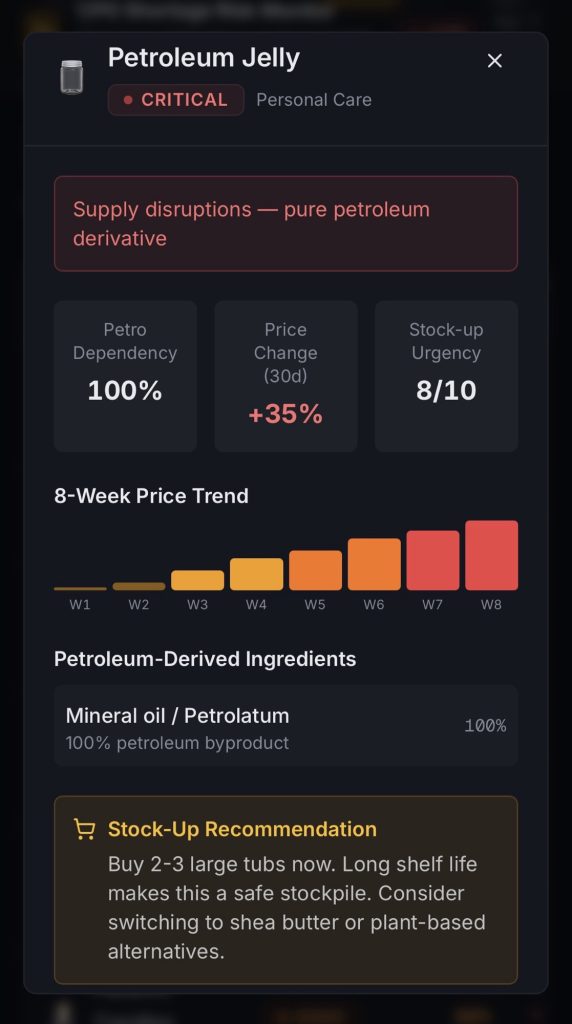
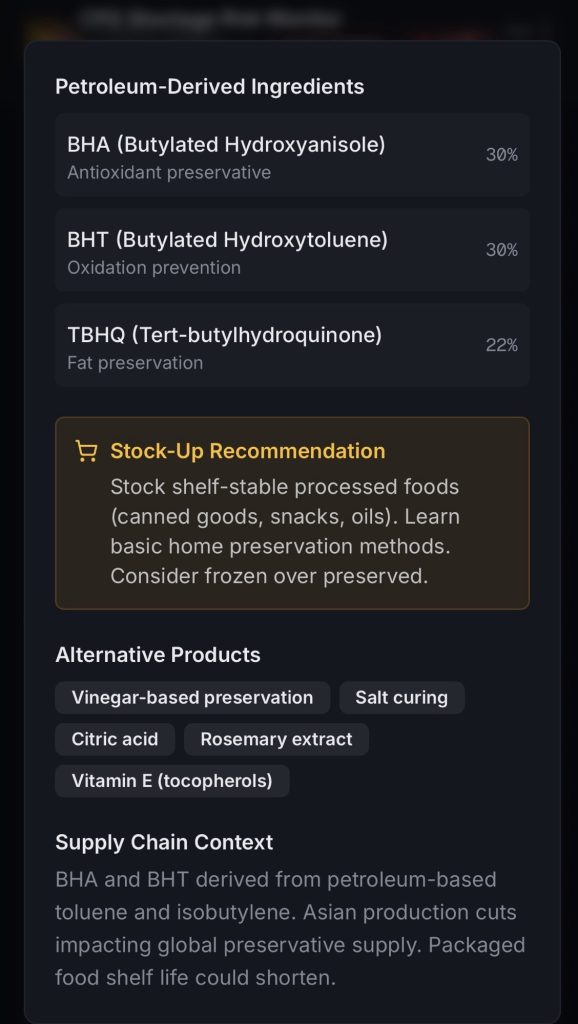
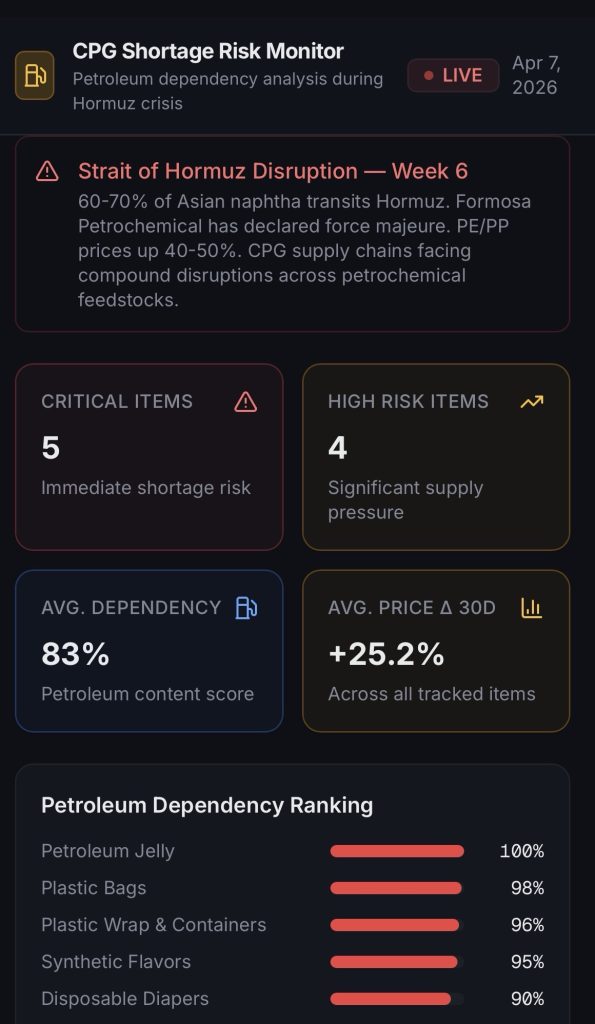
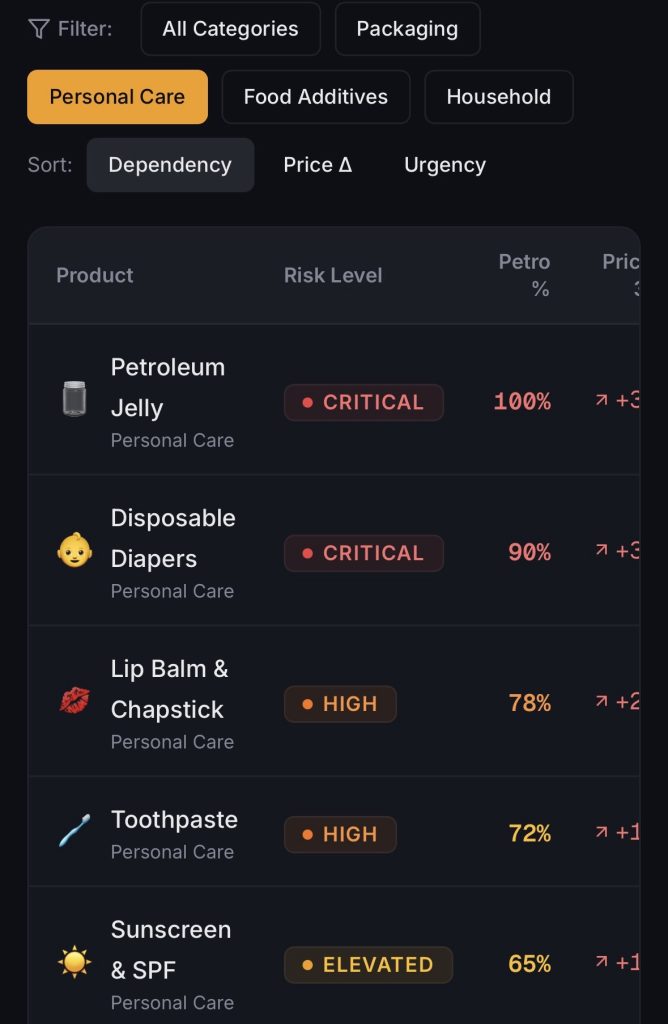
I vibe coded a dashboard of common household items with petroleum byproducts in them. It analyzes ingredients and wholesale pricing and assigns risk scores so you can make a shopping list of items most impacted by the ongoing supply chain crisis.

A screenshot of the dashboard I vibe coded today to soothe my anxiety about supply chain disruptions and get ahead of pricing hikes and potential shortages

From diapers to sunscreen, you’d be shocked at just how much our basic needs are downstream of petroleum byproducts. Now it’s just a silly little thing I used AI to put together, but petroleum dependency in consumer packaged is high.

From food products and personal care to drugs, you will find we that we rely on petrochemical feedstocks everywhere.

I’ll mess with it as I add in new data sources and get suggestions for categories I’ve missed. But I’d love for you to check it out even if I am not quite done improving upon the basic idea. You might learn something.

For instance, I didn’t know Kroger’s had a public pricing API till today so you live, you learn and then if you have a kid it’s time to buy Luvs. No really diapers are one of the most at risk products for shortages as the impacts of the war ripple out.

Even if the fighting ends today (as I write this a temporary two week cease fire has been agreed to), the damage to processing, production and manufacturing is already enormous.

Say you aren’t worried about price hikes but you are concerned with the environmental impact of your purchasing habits. I included alternatives in the dashboard if you’d like to make a switch.

Time to buy Aquaphor and Vaseline

The data is compiled from DOE, S&P Global, Investing.com, Packaging Insights, VCCI trade reports. A petroleum dependency score is assigned based on estimates of ingredient analysis.

The prices reflect wholesale market trends so you can be prepared to get ahead before retail prices go up. I’ve even included a bit of context on what aspects of the product are petroleum derived ingredients just for fun.

Below is a screenshot for food preservatives. A type of dependency many of us would like less of in our consumption. Maybe the dashboard helps you improve your diet with a little knowledge. Who knows! Isn’t vibe coding fun?

On another note, I remain amazed at what we can do with artificial intelligence and natural language input. This took me very little time thanks to Claude Code, Perplexity Pro and Cloudflare. If you haven’t explored the wide world of vibe coding now is definitely the time.

Categories
Biohacking Emotional Work

Day 1920 and Walking The Dream Roads to Costco

Yesterday I was really struggling with pain. It was all I could do to scribble up an appreciation for my 18th anniversary using WordPress for my writing.

I am doing everything I can to biohack my way around a chronic autoimmune condition that interferes with my quality of life. My love for my life and work is strong.

Sometimes it is strong enough that I willingly try all kinds of therapies from oxygen to hormones. Now I am working through a hormonal treatment recovery (my 2nd attempt) as I believe it is working.

Of course, life happens constantly, which means juggling deep dark horrific pains while the business of war and the business of my own portfolio goes on.

I’ve not had good sleep this week between the excitement of huge wins and the terror of facing down another global crisis brought on my conflict.

You’d think I’d be used to it. Russian invaded Ukraine the week before I left to live in Frankfurt. I was living in Tallinn when 10/7 happened. I was also there when Estonian cables to Finland were cut. One of my best performing companies has had to work around three kinetic wars.

No wonder sleep can be elusive. Yesterday all dream roads carried me to horrors. I woke myself multiple times. You can literally see in my sleep tracking the spiking heart rate and my forced waking.

The positive side to this fitful pained sleep was being up early enough this morning to prepare for a Costco preparedness run and still arrived before their executive member hour was finished.

We rotated our basics like rice and beans. Tinned fish, chicken and other canned and stable shelf proteins are just part of preparing for a nightmare that we hope never comes. Preparedness is a civic obligation. Help yourself to take the strain off the system so we all make it.

It’s possible we are facing an industrial process cascade thanks to the war in Iran and I like us have supplies just in case. We can’t know what comes next but it’s good practice to check expiration dates and make sure you have everything from first aid kit supplies to soap. You’d be surprised at just how much processing fuel fuels the rest of the world’s production.

After all this, I was happy to get stumble into bed and take a long nap. I didn’t even wash the sunscreen off my face. I was running a deficit and wanted to have REM sleep where I wasn’t trapped in horror. Thankfully I got almost two hours of restorative sleep this afternoon and I am ready to go back to bed as soon as I can.

Categories
Media Politics Preparedness

Day 1916 and Freaked Out Group Chats

I have made a little bit of a side hustle out of being at Cassandra. There was a lovely chunk of time in between Hurricane Sandy and the pandemic when people felt as if the weirdness was contained. It was quirky.

It was novel to know people who had decided to make changes in their just-in-time lives because of a climate catastrophe They had experienced it personally because it happened in New York so the media paid slightly more attention.

It lets media, and the readers of said media, indulge in the fantasy that they might actually change their lives by hearing a rational argument from someone like me. Look at tbis nice young woman didn’t have power after a hurricane in the center of civilization in lower Manhattan while Goldman Sachs glowed in the background, continuing to serve capital in the dark.

In fact I did have friends that had to go by foot to their offices while they went for weeks without electricity in other boroughs of Manhattan it was just particularly surreal to live near City Hall, have absolutely no power but still see the glowing lights of techno-capital operating in the aftermath of the crisis. My husband literally got buckets to remove water from the server room of his startup but the banks were fine.

I had a speech on entropy and chaos that was fairly compelling and turned out to be a very correct investment thesis. We might have to get used to more chaos in our lives because of geopolitical, climate and other instabilities that we could not entirely predict.

That meant getting out ahead of the major controllable factors we had at our disposal as individuals and as a nation. I actually meant it as did my husband as if it could happen in Manhattan imagine what it would look like elsewhere.

Having been a prepper before the pandemic gave a little bit of structure to the first months of the pandemic unfurling in which I had the tools to do a dry run and the experience. I got a lot wrong.

And you must remember we really did not know exactly how bad things would be. The things that actually turned out to be quite detrimental to the economy did not turn out to be the ones we thought. Much of the pain of the experience was self-inflicted. Sound familiar?

But we thought we knew more than we did about the situation we were going into. In reality, we had very little predictive capacity on that front because the last time we had had a pandemic of any novelty, the world wasn’t nearly so well connected.

We overcompensated for a lot in our fears and reactions. I suspect that is going to continue being the way we handle networked global crises of any sort.

The thing is, it’s getting harder and harder to pretend that the things that affect our global lives are not actually happening because people look the other way when their economic situation works well for them. It’s a bargain that democracies and authoritarian governments make.

So right now if you work in technology or finance, you’re in a bunch of group chats in which everyone is freaking out. Even though you could make good arguments that we’re the only ones that have a clear view of some of the contours of what we’re about to face it’s quite clear that our visibility is limited.

I don’t know a goddamn thing about Iran or how it’s going to react, but I know more than I ever thought I’d need to about energy markets because nobody in my line of work had much choice over the last three years if they wanted to be ahead of the computing demands we already struggled to meet.

Now this demand may be coming from America companies, but feeding it is a global phenomenon of investment. One that lets all of the worlds capital pile on into a country that has a few domestic issues.

We all saw changed coming the second we had a mass market, large-scale compute-intensive process that enabled artificial intelligence interface that users felt they could meaningful talk to at scale. There’s something amusing to me about that because in Star Trek’s goofiest movie, The Voyage Home, the chief engineer Scotty picks up a mouse and uses it as a speaker phone. Hello he says, “Computer, are you there, computer?” He then proceeds to type in a number of commands when he says, “Ah a keyboard. How quaint.”

I imagined we’d get to this phase of computing ourselves a little faster than we did, but it turns out that we have finally reached the point of knowing how to type in a lot of solutions that could give us steps and instructions to use tools to make transparent aluminum. I mean this metaphorically, not literally, as we actually do know how to make transparent aluminum.

Transparent aluminum is a polycrystalline transparent ceramic made from aluminum, oxygen, and nitrogen. It was developed independently and is commercially produced by Surmet Corporation. It’s sapphire and funnily enough we use it in bullet proof glass. Which I’m sure is a great business to be in these days.

So be as freaked out as you want in group chats because all kinds of weird shit is coming down the pipeline. If you work in finance or technology, you probably know that you’ve got about two weeks before some irrevocable decisions start cascading.

None of us have any idea what it looks like but you’re probably not as prepared as Elon Musk or Sam Altman. Nevertheless we’ll have to get through it.
Categories
Chronic Disease Culture Politics Preparedness

Day 1901 and Burying Ehrlich

For as much time as I spend kvetching about my own petty problems (and I know that it is a not insubstantial amount of time), I am what my husband calls a macro optimist.

This is somewhat in contrast to him, who is on a day-to-day basis, a micro optimist but doesn’t quite see the long-term horizon as positively as I do.

Different temperaments are a good thing when it comes to balancing outlooks and outcomes. This is arguably why we are a good team and have managed to stay married for a decade.

I look out for the macro level future and optimize for it being successful and he optimizes the day-to-day, making sure that the micro level is successful.

I titled this post “Burying Ehrlich” because Paul Ehrlich passed away at the age of 93 last Friday. You might know him as the co-author of the 1968 best seller Population Bomb.

An entomologist by training, his book jumped to much bigger claims saying Earth faced imminent mass starvation urging governments to reduce population. That has not so far proven to be true. Even now the New York Times obituary said his claims were premature. We just love an impending disaster.

It’s a cruel historical irony that a man who wrote his thesis on butterflies would end up having such an enormous butterfly effect on the number of human beings being born. His neo-Malthusian insights were a huge hit.

And unfortunately we will experience the consequences of his public intellectual adventurism. We will have fewer humans and the famine he predicted never materialized. And now if we have more troubles facing us, we have far fewer humans able to take up the task of finding the solutions we will need.

Maybe if he had been a little bit more of a macro-level optimist, he would have been able to see what I see everyday. Despite daily travails due to my chronic disease, I see the micro-optimism of humans like my husband every single day. While I can’t always be positive every day, I remain positive that together we can find a way to improve on yesterday.

Humans are incredible at finding a way around life’s intractable problems. We produce little innovations, little inventions, little tweaks and little solutions. And they add up.

We are social animals whose evolutionary pressures seem to have yielded a culture of engineering. These little fixes we constantly produce when added up together have made for major improvements.

We even occasionally see extraordinary catalysts that allow us to go much faster with our improvements. We’ve had a number of revolutions, industrial and otherwise. Indeed the last 50 years or so have shown the Malthusian fears of food production to be histrionic in comparison to the progress we’ve made.

We have fed the planet but we will never get back the babies who were not born either because of China’s one-child policy or simple cultural attitude acceptance that one or two children should be enough. In my generation it may end up being more common to not have children at all.

Now it may seem rich that someone who goes in for quite a bit of preparedness should speak against a man who saw the value of taking action in the face of what he saw as long odds.

But next time someone tells you that the end is near and all is lost, remember that Paul didn’t end up being correct in any of his assumptions.

Not because at the time it was so crazy to think we weren’t producing enough food, but because he couldn’t conceive of a world in which we were able to solve our problem.

So I pray as his family buries him that we as a species can remember to bury some of our own alarmism. Our job is to keep on going in the face of long odds, just as every one of our ancestors has done before us.