If professional class workers thin out as a function of artificial intelligence taking some of the work done by the professional management or PMC class, I suspect we will see nostalgia for the time they were seen as aspirational. I’d like to explore that near-future science fiction today with the PMC Olympics.
After the initial decade or two of upset (possibly even rage) at the power shifts & new status dynamics subside, we fondly remember business class types like lawyers & consultants with the same wistful fondness as we recall switchboard operators or the stenography pool.
I’d bet in the nostalgia wave, we see competitions, cosplaying and an equivalent of Renaissance Fairs or reenactments pop up where former PMCs and thr youth pretending to be them, compete in a cargo cult display of its cultural identity markers.
And when this does inevitably emerge as a cultural touchstone, I want to compete in the PMC Olympics with my husband in transcontinental logistics events. Think of it as figure skating but for married business partners.
I’m confident we would medal in the transcontinental travel logistics category. I’d get gold in the individual “cosmetic and liquids” category. Think of it as “uneven-bars” of the transcontinental logistics travel competition.
As part of this mirthful sci-fi exercise, I input a prompt to ChatGPT’s current image model and it gave me a very amusing montage of who might compete and win in just such an event.
Naturally the shining blonde California affluence worker (subcategory creative class) took the gold but let’s not forget the New York finance couple nor the European directorate class.
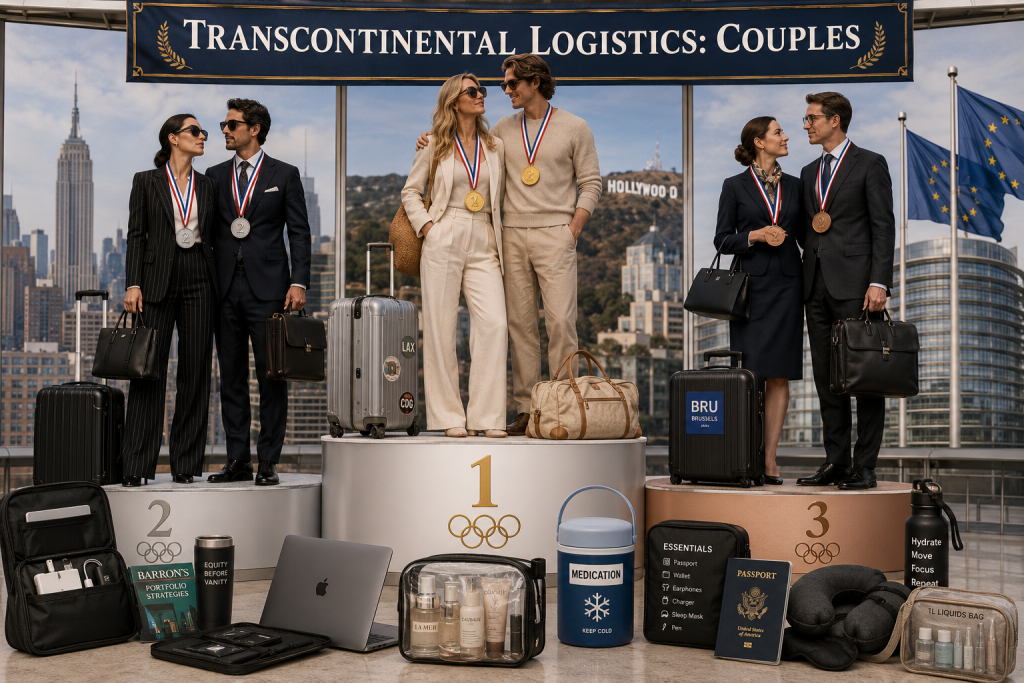
Make me an image of three sets of couples who are professional management class knowledge workers. They are on an Olympics podium receiving gold, silver and bronze medals for medalling in the “Transcontinental Logistics: Couples” event. I’d like two American couples (one New Yorker finance style and one California Hollywood style) as well as a European couple (Swiss) in the style of a Brussels bureaucrat. There should be suitcases, travel bags for laptops, a 1L cosmetics bag, a medication cold tube, and other travel essentials in the image
I know this sounds a little goofy, but the work that goes into managing what a couple need when constantly switching between personal life and work on the road involves a surprising amount of logistical support work. And that’s without children. I’d add a category with a toddler as the most extreme form of this event.
Just check this prompt I made for my own PDF for an event involving both industrial site visits and formal galas that I am attending after flying west from London. Some details are changed or redacted for modest privacy. Anyone can easily guess what I’m going to be doing.
Build a 8-10 day travel itinerary for a business trip departing from Heathrow London and arriving to Salt Lake City and a remote desert town in Utah, from June XX to July 2, 2026. Include a day-off rest plan for Salt Lake City, a Department of Redacted event logistics flow chart, transport coordination for a bus to small town and return back to the city on July X of event, and recommendations for high-quality food near event venues.
Include transitioning time and necessary grooming required for a facility floor tour with safety gear and a change for a formalwear gala with an hour buffer assuming an event mid afternoon, there hours transit and evening formal event at 7pm.
July 2-5th include a secondary itinerary for a follow on mountain social event at 8,000 feet Utah mountains with outdoorsman activities.
Format as a structured PDF briefing with time-stamped logistics, travel maps, and weather-appropriate clothing advice for the city to desert climate shift as well as mountain elevation needs. Include medications, standard pharmacy and first aid needs, cooled medications for peptide regimen, sun safety, facility floor safety gear, day event makeup, formalwear makeup, possible television ready makeup as well as hairstyle needs based on 3 day warning cycle.
Make sure personal preferences for all clothing, sleeping, cosmetic, medication and other gear is accommodated in a carry on suitcase, personal bag and one checked baggage.
Pretty fun right? And I might add that it’s relatively easy to spit these itineraries out once you’ve harnessed your preferences and all necessary items in one’s personal stock keeping. Always take inventory regularly when on the road and unpack and repack quickly for fast turn arounds. Oh and use the three pack cascade system. To my fellow flying logistic Olympians I wish you safe travels while we still enjoy global transportation for capitalism.