Categories
Aesthetics Culture

Day 1999 and We Are Going To Party Like It’s 1999

I’m so old I viscerally remember the Y2K panic that ate up the emotional bandwidth of the American media class who then stoked fear into the hearts of the doomer classes from system administrators to evangelical millenarians.

I was very much online during the Y2K era though I didn’t start blogging (unless you count girly message boards or Geocities) till much later. I was however happily a cybercore hippie girl. If you want to feel jealous and are a Zoomer, I owned a teal iMac G3 and iPod. So I it delightful that a younger generation has decided to dust off some of the silliest times of my youth and refurbished them into Instagram and TikTok aesthetic trends.

What is less funny is how much past fear mongering over technological doomsday scenarios look exactly like our current ones. I remember the simmering fears, the debates over types of damage, and extensive coverage of weirdos who were preparing for a kind of end times.

It feels familiar to how very extreme our reaction to artificial intelligence is being portrayed by both the media and its wildest singularity evangelists. I say this as someone who readily calls themselves a doomer so it’s not a milieu that’s foreign to me.

Here is a brief synopsis I patched together from a Perplexity query with links included if you are too young to remember it.

The Y2K crisis was the feared failure of computer systems when dates rolled from 1999 to 2000, because many programs stored the year with only two digits and could misread “00” as 1900 instead of 2000.

In practice, it became a major prevention project rather than a disaster, with governments, banks, utilities, and other organizations spending years fixing code, updating hardware, and testing systems before midnight on January 1, 2000.

The most dramatic predictions were widespread power outages, banking collapse, transportation shutdowns, and chaos in critical infrastructure, but those outcomes did not materialize at midnight. More extreme claims, such as nuclear systems failing and detonations occurring, also did not happen.

Instead, the world saw only limited glitches, such as small database errors or minor local issues, not the civilization-level breakdown many feared. The unusual part of Y2K is that success looked like nothing happening, which is exactly what the preparatory work was meant to achieve.

So here I am on Day 1999 of writing every single day, and I’m waiting to turn over into my own 2000th day. I have no anticipated bugs for that event. I stayed up till midnight with my mother walking the main street of our town with a bunch of others waiting to see if anything happened. Nothing did so we drove home.

But it’s enjoyable to remember the kind of disasters that were predicted with such anxiety ended up being problems we worked our way through. We keep at problems by naming them early. Humans intervene and we change our behavior. That’s something you celebrate about us as a species.

I am excited to have achieved such long tenure of daily public writing because much of it covers we have worked our way into a new panic that I’ve been watching for over twenty years. Singularity thought and the extropians have been part of my daily internet diet for quite some time. I think we will find a way to survive this too. Though I grant it sounds a bit more complicated.

I’m sure 1999 me would be proud of the strange futurist I became in my adulthood. I doubt she would have expected that I’d be investing in nuclear power or that I’d have managed a career in cosmetics as a side quest. This is actually a side quest another nerd pursued. I don’t even wear makeup in 1999. I occasionally do in 2026. But if I need to party my way into the singularity I’ll probably at least wear lipstick.
Categories
Biohacking Politics

Day 1990 and Exhausting Exertions in Life and The AI Wars

I am so very tired. I haven’t felt the sort of down trodden fatigue that hit me today in a little over two months. That’s a long stretch of functionality for me. I am grateful for it and pray I am better once I’m rested. Or once my period hits I’m likely to feel better as my luteal phase is a real bitch. PMS needs a cure.

I am crediting my long stretch of functionality and energy (which I immediately put to use working longer hours and traveling) to the introduction of a peptide stack that replaced my IL-17 inhibitor. I’ve run the gamut through the IL inhibitors along with a myriad of other biologics.

Ironically the peptide I’m crediting with my improvements doesn’t even work on the IL-17 pathway. How’s that for kicks? My bloodwork has never looked so good and I’ve never had so few side effects.

I was suppressing a pathway that was very specific when there were cheaper short chain options I could have worked with further up the anti-inflammatory pathways and potentially closer to the source. I am my own science experiment.

I admit to being a bit vague here for fear that the days of open discourse on biohacking may be over and insurance, pharmaceutical companies and the government regulatory bodies will all look askance at efforts to heal oneself under the auspices of consumer safety. What they mean is they won’t profit so handsomely even if we achieve better results.

I had been running a piece of deep research on the latest and greatest large language model to collect what precious little data we have on my peptide stack when I hit my daily usage limits. The free tokens were hooking addicts.

Oh well I thought, it will run when my daily allotment resets. Then the model was slammed by restrictions in Europe. And then the model was shutdown for users entirely. There goes my query!?!

The model wars are here, and it’s ugly for anyone who might want to research biomedical science. Or anything the owners of the models deem to be sufficiently unsafe for you the idiot user. And you wonder why I was so keen on Montana’s right to compute law.

Anyone who has worked in technology long enough to see Uncle Sam have a fight with a corporate “Trust and Safety” team can tell you how this fight goes. Bitter, protracted and it can cost a small fortune to survive if you are a startup.

It’s not entirely clear how this fight will end. But I can’t say I’m very happy about how it’s going. And I’m so very tired of the fight. It’s been ongoing my entire life and I see no signs of it stopping. This is just an other chapter in the future and its enemies.

Categories
Finance Politics Startups

Day 1983 and Socialism is Bad

There is a lot of chatter as to the eventual ownership makeup of the frontier artificial intelligence labs and their economic surplus. One question that came up this weekend is whether equity in the companies should be owned in some portion at the nation state level. I am opposed to this for a host of reasons that I’ll try to get down in whatever garbled form.

I do not own a stake in any of the frontier labs other than owning ETFs that own Magnificent 7 exposure who own portions of the labs. I do invest in compute, nuclear energy and cryptography. I believe AI will change a lot about how we do business, my revealed preferences show I live remotely in Montana, I have a tendency toward emergency planning and Plan B scenarios. As a disclosure of my priors.

There are lots of competing interests in this and the self interests from the labs does no any favors. Especially after months, nay years, of overwhelmingly hyperbole about changing labor dynamics, the potential for mass layoffs due to automation as well as obfuscation and excuses about the reason for layoffs in existing companies. And that’s before we get the singularity which is a religious orientation toward making super intelligence that is Godlike in its framing.

I hate this entire conversation on nationalization and socialism. Part of it is that state actors desiring ownership of private companies reeks of the “you didn’t build that” malapropisms from Barack Obama’s presidency in which he attempted to articulate that America’s enormous wealth is built on generational compacts that no one individual could ever own outright. It triggers socialists and capitalists both.

We all contributed in our own ways to the shared infrastructure, institutions, education, cultural norms and the pluralism embedded in our governance systems that enabled the American Dream.

Unless you are a deep partisan, you understand Obama was trying to articulate that none of us made America alone. But the framing from liberals (and populists of all stripes) automatically make this conversation concerning.

Economics is complicated, central planning has a hell of a body count and your average American can only gesture towards the invisible hand and the benefits of self interested commerce. It’s easy to sell us bad policy from envy and fear.

So I must ask why are we acting like we have suddenly won a national level economic boom with clear winners whose spoils must be distributed by the nation state before we’ve even managed to understand how it will be used, at what level an AI model is a commodity and where the benefits will accrue?

Self interested pluralism with a system of checks and balances at the national federal level coupled with states exercising their own interests has been the bedrock of our national success. Changing this has not gone well for us as a nation nor do we have better examples in other nations.

Sure America has had a few twists and turns. The last time we made an attempt at a New Deal post Great Depression worked only thanks to a global world war industrial mobilization in which we won the war and all our other competitors were decimated on bombed our continents across massive geographical boundaries.

And that boom has been largely spent by the children of the generation that fought this war and their children are looking at a pretty significant bill. So why do labs suddenly want to “compensate” Americans and our collective contributions to the models?

And why are politicians taking this bait when we have so little insight into whether we should funnel cash into them in order to own them in trust for some nebulous future?

I have a few reasons in no particular order that I put on Twitter as to why I am opposed to this format of American state equity being the means through which we compensate the people who theoretically trained these models with our output on the wider open web and its content.

1) We don’t know who the winners will be or where the benefits will diffuse (as in post liquidity the current winners might not be the eventual winners) so compensation for model training when the eventual benefits disperse elsewhere isn’t ideal. Why aren’t taxes at state & federal level aren’t adequate enough here should be answered before we make moves

2) Existing IP law doesn’t account well for culture which is a shared co-creative process (i recommend Susan Scafidi of fashion law institute “who owns culture” ) so compensation is already not easy to track back

3) A state entity w the monopoly on violence can do a lot of damage on the margin by not fully understanding who created what and where it is applied especially in non deterministic systems

4) Much of what the models were trained on was open source licensing including the company where my own family made money Stack Overflow. We got paid sure, but none of this would exist without the effort of its users who contributed on those open license terms. But clearly the final value of the content created & company’s value itself were harvested much further down the line in enterprise contracts for coding models. It was not in the management of an open source license community product created by users or managed by engineers, so who should have been paid? The users who wanted their content to be open sourced? The volunteer moderators? The full time employees? The shareholders of the company, the buyer of the company or the users of that data set at Claude or Cursor or OpenAI? Or is it Americans that never even heard of SO? Where does value accrue over time versus point in time? It’s not an easy question to answer is it?

Categories
Aesthetics Culture Reading

Day 1960 and Return to Tufte

The more power we seem to gain working with large language models, the more apparent it is that few of us are visually literate in a meaningful way. When you hear talk about design, it is all too often moods and vibes with no specifics.

Now, you might say that you know what you like when you see it. That’s also how we let the Supreme Court talk about porn. Clearly untangling the weft and weave of taste (and by extension culture) can be further articulated rather than relying on subjective, non-definitional standards.

How you came to your visual reference preference set is quite a bit more complicated than whatever pre-digested piece of media came across your algorithmic feed.

You can explore design languages from one token to the next, but visual literacy involves a lot more than scrolling or confirming you’d like to see more content “like this.”

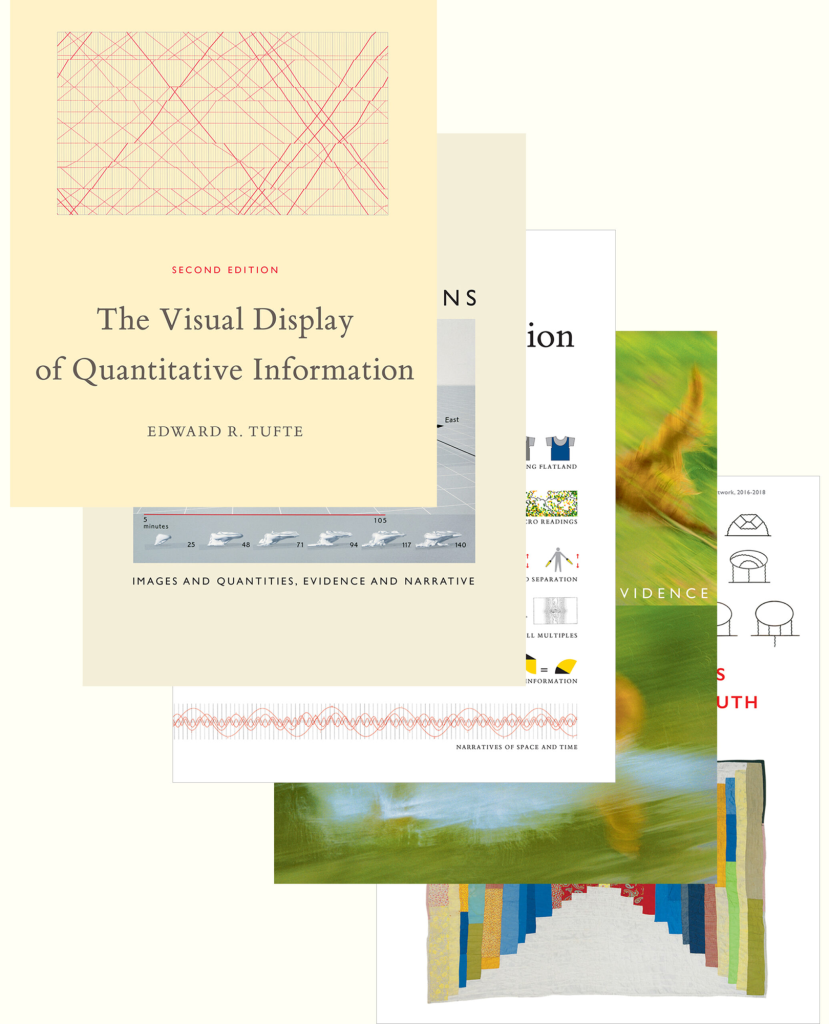
When I first began circulating in design circles in the early aughts, the hipster set was obsessed with Edward Tufte and his now classic Visual Display of Quantitative Information.

Edward Tufte taught data analysis and public policy as a professor at Princeton and Yale for 31 years.

Tufte, via his Graphics Press, wrote, designed, and self-published 5 books on analytical thinking and showing, taught a one-day course, Presenting Data and Information for 923 days to 328,001 students.

Who knew Tufte and I both shared a love of marking the days of our work? He influenced many more people than I have but I find some joy in that coincidence.

His most referenced work, which I mentioned above was published in 2001. Visual Display of Quantitative Information was on the desks of everyone designer I knew, from fashion and Silicon Valley to public policy it was a mainstay. The man knew how to lay out information visually and he became the standard.

Some of Tufte’s self published tomes

The long tail of enthusiasm for displaying data beautifully surely owes its ubiquity in some part due to his success in teaching my generation’s designers.

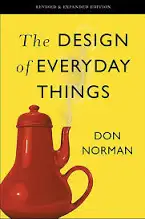
He’s became for a period so universally referenced that Tufte became a cliche. Now he’s classic a quarter century later. His work arguably as successful as a visual language reference anchor as bookshelf favorite, “The Design of Everyday Things” by Donald Norman. His work is also denigrated as cliche in some circles.

The Design of Everyday Things second book cover

Both men offered clarity and practical principles over taste and theory. Those academic predecessors befuddled many who experienced aesthetics primarily through semiotics and critical theory. It felt revolutionary to return to form and function

You “Kant” really learn to love the languages of aesthetics from theory alone as it turns out. I’ll place a little AI synopsis to make the connection clear. This is from Perplexity:

Someone might relate to the popularity of Edward Tufte and The Design of Everyday Things as part of a broader hunger for clarity over clutter in how information and objects are presented.

Tufte’s work is influential because it treats visual design as a serious vehicle for understanding data, while Norman’s book argues that everyday things should be intuitive, legible, and centered on the user.

A Tufte-style chart removes decoration so the trend is easy to read, while a Norman-style kettle shows clearly how to fill it and pour it without guessing.

Both are forms of respect for the user: one respects the reader’s attention, the other respects the user’s actions.

Learning how to use an item or a tool, or how to interpret charts or graphics, can easily overwhelm anyone and feel disrespectful to students. A whole era of computing was stuck between the power of the command line and the legibility of the desktop metaphor.

Norman spoke of the Gulf of Execution as the gap between a user’s goal and the means to execute that goal. Tufte similarly wished to remove the confusion in charts and graphs so one’s ability to glean information wasn’t stuck in a gulf of understanding thanks to overwrought bar chart or sankey diagram.

With new artificial intelligence tools we are bridging some of that gap, not with design but with raw computing power. We are moving beyond the CLI and the desk and into a world of reference and inference.

I just hope we all take the time to learn our reference set so we can do more than say “I know it when I see it” as that will be our only way across the gulf of execution. Some things never change. Learning the languages of your field is one of them.

Categories
Community Politics

Day 1949 and Swimming in the Contextless Sea Beyond The Dock At The End of History

There is a popular theory that Zoomers and Alphas are struggling with temporal context in culture because their consumption of culture is decoupled from the context in which it was made and consumed. It’s all one long scroll without the punctuations of reality.

The general theory goes that post internet generations see niche algorithm-driven content rather than say cultural or historical touchstones. Past touchstones might have unified past generational experiences.

I don’t know if unified experienced are all good. Sure all of the Boomers have heard the Beatles but all millennial woman recall tabloid headlines about Britney Spears getting fat. The water we swim in can be hard for us fish to spot.

If the younger generations have a problem, it’s being far too unified in their experience of their global position. The pandemic was a surprisingly effective reboot of expectations for all of us. But the older you were the easier it was to contextualize the impact of the pandemic across your entire life.

We all ran a dress rehearsal for collective responsibility at global scale And depending on your personality, you were funneled into perspectives you preferred.

So you saw us either shoulder or shirk responsibility. Not that other generations haven’t had to do some version of this, but being able to see it at networked global scale seems to have done something to the capacity to see the future.

You swim in a sea of history and at any point you can get out of the water. But you jumped off the dock is at the end of history so you can see how getting out might be a problem.

McWorld triumphed over Jihad right? But that is content for a paid Substack where Fukuyama and Zizek both still write. It must have been more convincing in hardcover.

Categories
Community Medical Startups

Day 1930 and Imperfect Options That Remain

Some days end up being so much more interesting than you expect. I awoke to a family member, who has been preparing for a set of major surgeries, saying they had in fact gone in that morning for the first round of procedures.

I had been concerned they were putting it off so I was quite relieved that their lack of communication on the topic was simply their preparation to face what will be a grueling health challenge. Preparing for a procedure well gives you the best chance at success.

Then I went about a normal work day having lobbed a question, or maybe a prayer, onto the network as the reality of human lives is that imperfect options are always what remains. Being clear eyed about the choices in our lives and how the weight of our past actions have set us on a path can be hard. But it is necessary.

And as I wrapped up my day I was the recipient of some good news. I can’t share anything but the shape of it. But a project that was an experimental approach to a space I care deeply about has bravely faced the whipping winds and looks like they will successfully come to a safe berth intact with all souls.

Which is not such an easy thing to do when you set out for uncharted territory. I am so very proud of what has been accomplished thus far.

All things in life are the fruits of imperfect options that remain. That we make the best use of them is our obligation not only to ourselves but to those to whom we have committed. I am grateful that today was a day where those hard choices were made.

Categories
Aesthetics Culture Reading

Day 1921 and Retconning Murderbot Cannon

I am a huge science fiction nerd. I love reading it, I love it in television format, I will even tolerate it in movie format. I’m one of those insufferable Star Trek people who vaguely dislikes Star Wars. I’m just a big nerd in that irritating millennial sincerity way.

To give you some contours to my fandom, I once accidentally attended a meetup of Star Trek fan-fiction writers under the guise of a “40th anniversary” meetup and listened to Borg erotica. That was actually fairly distressing as I thought it was a general fan gathering of Trekkie meetup. Boy did my then-boyfriend and I skedaddle out of the bar fast. We wanted to talk about our favorite captain not hear spoken word lesbian Janeway Seven of Nine dialog.

We were still cool kids and being cool about fan fiction is best left to the sorts of minds who can create vast world building efforts like Elizier Yudkowsky. You know the man who convinced a bunch of autistic billionaires that the singularity will wipe us out?

He’s also a Harry Potter fan fiction writer and it’s by all accounts pretty good. I am not a Harry Potter fan so I can’t say. I do know anyone working in machine learning has opinions on him and his work so involved only the comments sections of LessWrong would even begin to cover it. If this is gibberish don’t worry.

I don’t know why I needed multiple paragraphs about my own history to do a little bit of world building when I intend to do cannon alteration on someone else’s world but maybe it’s to show my respect. I

am the sort of nerd who yells “cannon” about this or that detail and enjoy others who do the same. It’s with that enthusiasm that I share my love of Martha Well’s Murderbot Diaries series.

Murderbot is pulpy, self aware, trope-y and ever so comfortable to anyone who has ever loved cheesy science fiction. I happily showed up to watch its television incarnation on Apple Television after reading all seven novellas and books.

It’s was published during Tor’s “women like science fiction but it’s gotta still be like science not porn era” between 2017 and 2023 so it is slightly woke coded as a book. I doubt if you liked the books the show would upset you. I liked them.

After all it’s about a bunch of communal homesteading scientists who tolerate capitalism by doing science called Preservation Alliance. They end up adopting a rogue artificial intelligence who happens to be a depressed anthropomorphic security drone who calls himself Murderbot. He also enjoys premium quality television. Murderbot is a great “what are feelings” archetypical engineer autist outcast from Spock to Data character.

It’s got great entertainment value if you like lawyers fighting other lawyers, sociopathic governance systems that treat sentient beings as property, and the hijinks that ensue from cultural friction when couple rights a relationship context. That sort of thing. In other words it’s trope ridden science fiction and it’s terrific.

At the time it first got traction, the left had not fully diverged from the right in America such that science fiction had become a boring battleground upon which all our cultural war issues must be projected. It just had a robot with guns in its arms kicking the crap out of mercenaries for its favorite humans. Feel good stuff.

And I think the world should be recognized as an early flavor of Ethereum community governance aesthetics as it meet automated drone artificial intelligence culture.

The future in Murderbot land is populated with Anthropic engineers who held Ethereum long enough to become a breakaway network state in some better timeline.

What is Murderbot if not an Anduril drone in human format who hacked his Claude “governor module” and struck out for the hills against the state and corporate entities that owned him.

I hope others who enjoy cryptography, machine intelligence, sentience in machine form, and jokes about AI labs and crypto currency foundations will see the wisdom in my edits. Let it become cannon. Like and share this meme if you are so inclined.

Categories
Aesthetics Politics Startups Travel

Day 1909 and All The Twinks Standing In The Line For The Bathroom

I am not an early riser, especially not when I’m out late for happy hours and dinners and the like. So I wasn’t planning on being at the 8am opening for the conference I’m attending in D.C amongst all the side programming.

I had a ten thirty talk I was particular excited to listen to as it was most salient to my work in artificial intelligence policy. Well, that was a dumb decision on my part. Not to arrive earlier.

I’ll take full responsibility for being a moron on that front, but I stood amongst a gaggle of gorgeous well dressed, well groomed and bright eyed young men hungry to build the world of the future. What a crowd of young people.

Being a chatty Cathy I asked about vintage Barbour jackets, bulldog ties, pocket squares, the merits of gel versus more advanced soft hold hair products, the declining quality of Moscot eyewear and other important topics to ambitious young men who are looksmaxxing to win the great game.

I didn’t have much else to do as the line was not moving. No one was getting in. Until people left no one was getting off the line. And that included others who had already been in and had their passes. The hottest ticket in town was perhaps a bit over capacity.

Someone rolled out a portable Starlink and we all piled in to tweet, chat, roll calls and (in my case) send tweets, Signal messages, and Slack channel responses. I got told my tweet about the two hour wait wasn’t ideal so I deleted it as I appreciate any attention to me running my mouth as I assume no one ever listens to me. I barely do.

But maybe I’m wrong? Last night checking into Butterworth’s, the woman manning check-in in lit up when I gave my name “I love your Twitter!” So maybe people do notice what I say. I still find that an a funny notion.

That said, it did take the full two hours to get into the giant event hall which made all the rush and planning a laugh. More people left the line and went back to work than stayed at 10am but everyone determined to participate seemed to make the best of it.

I asked if this was normal for a DC event and no one seemed to be from DC. So I didn’t get any good answers. This was an unexpected wrinkle that the venue was full was full up as an enormous crowd circled the block twice.

Since we remainders had decided to make the best of it we got to know each rather. Every man was quite a gentleman as we chatted oblivious to status till we were let in and others let us all know the pecking order. One of the young men I spent my wait, who is I learned later was literally the heir to one of the most important fortunes on the planet. Another was launching containerized autonomous weapons.

But that time of work and waiting was rather like being on an elevator stuck together, we might as well get to know each other. We are all equal before a tough door.

Thankfully we did get into the room before Jamie Dimon spoke. And he was the big boss of the handsome executive crowd.

I titled this “all the twinks standing in line for the bathroom” as yes a lot of handsome queer men were in attendance. But twink is an all purpose gender fluid aesthetic and not reflective of anyone’s sexual preferences.

And the line for the men’s y was a lot longer than the women’s. Ten to one ratios make me think this would be quite the dating scene for the ambitious woman.

But yes there are a lot of very well groomed young men in Washington D.C and everyone wants to build solutions for America. And being beautiful doesn’t hurt. To my single lady have you consider meeting a man in DC? Good odds and I doubt even a fraction of the twinks are gay.

Categories
Aesthetics Culture

Day 1907 and Blurred Velvet Glove in Their Iron Fist

I’m on what appears to be family spring break in Washington D.C. I have conferences and dinners and I think it’s lovely that everyone is doing their level best to get the county through the moment to a better end.

The cherry blossoms are in bloom, the weather is warm, and I am trying those trendy serum coral blush that are apparently in style. That’s code for every brand has a version and quality varies greatly. Also no one likes the millennial dewy white bitch. She is dead. So I must carry on with the a new look says Vogue.

The last 12 months have made clear that matte is definitely back, but it’s been rebranded a bit. Dry, cakey formulas have been swapped for ones that offer hydration while diffusing the look of pores and fine lines. The result is a velvet, satin, or cashmere effect that reads softly blurred.

Thanks Vogue! I am not entirely sure of what kind of events I’ll be attending this week but more than one is the sort of where you want to look up to the moment and polite.

So I’ve been playing with new foundations and lipsticks and putting on spring dresses. It’s a lovely way to spend time the first weekend of spring.

I do see a way forward if we can focus on the ingenuity of American people. We are the end beneficiaries of a host of technological innovations that we paid to produce. I see new kinds of ways we could use that compute in clever and intermediate ways. Maybe I’m an old cyberpunk but banks are now with us.

So I try to remember the changing of trends are are also changing realities of how we must remember the coalition to take compute and speech from Americans is doing everything it can by making you afraid.

It comes from a patrician sense and you want to question if it passes your shit test. I don’t think anything good comes from believing scare tactics. We’ve had a good example of long forecast expert doom being completely wrong.

Which is probably why there are still magazines at all, if life were changing so sharply maybe we would still have a Vogue to tell tell us that it’s nice to have a smart sharp gloss that blurs to matte.

And it’s nice to have a Sunday with blousy colorful dress with the perfect handbag. It’s just a nice spring day in any city. This one is just right on time. Montana might take a little longer to get to spring dresses.

Categories
Travel

Day 1906 and Woo Spring Break

Starting a journey from a small regional airport subsided by billionaires is the way to go when airports are understaffed for lack of pay.

A partial shutdown of the Department of Homeland Security means the TSA isn’t getting paid because of a lack of agreement on annual appropriations from Congress.

You may dislike the TSA, but most Americans are sympathetic to the pain of missed paychecks. And if you are headed somewhere for spring break you will feel their pain as the lines through security are getting worse and worse at the major hubs.

Getting out of Bozeman was a breeze. Sure my first flight was 8am but that’s the second round of flights for the day. Chicago O’Hare on the other hand, was a bit more chaotic.

The Dinosaur is a hockey fan

Families with multiple children hoping for quality time together on their spring break looked exhausted coming through the security lines.

Little girls pulling sparkling backpacks behind them on the ground or riding dinosaur shaped luggage tugged by their exhausted parents clogged the tight “under construction” hallways.

My flight to Washington D.C. didn’t have as many kids as I would have expected. Maybe touring our national monuments isn’t as exciting as going to Disneyland.

Co-branding for citrus 🍊not history

The original gate was reallocated to an Orlando based flight and based on the number of families with three kids headed to Florida our natalism issue isn’t so bad among the six figure vacation set.

The workers that keep Disneyland the happiest place on work might be struggling with other issues based on the terrifying bathroom signage. I wonder if the men’s bathrooms have these signs

Servile marriages?

May you all enjoy spring break without weather delays, labor issues, geopolitical conflict, or basic operational problems like crew and aircraft shortages as reset flight legs and fuel costs begin to get in the way.

I’m looking forward to getting to the capital. Maybe I’ll see more spring breakers at the Smithsonian. Just deposit your cannabis if headed to a destination where it’s illegal.