Categories
Aesthetics Finance Internet Culture

Day 1880 and the Global Intelligence Crisis Kerfuffle

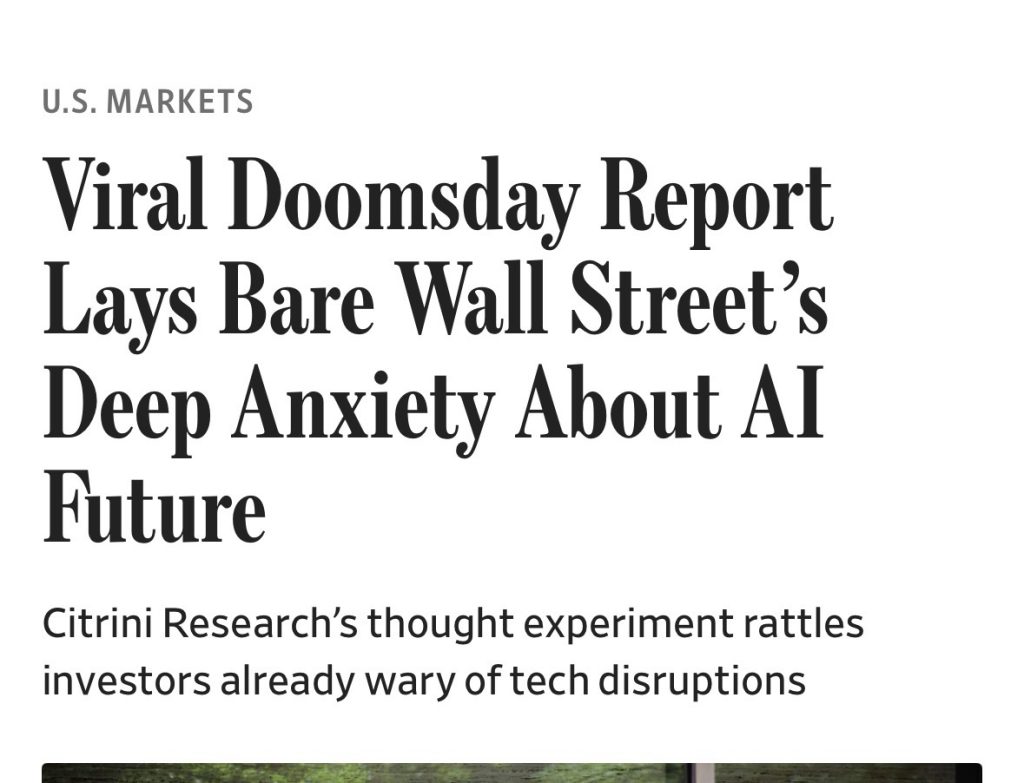
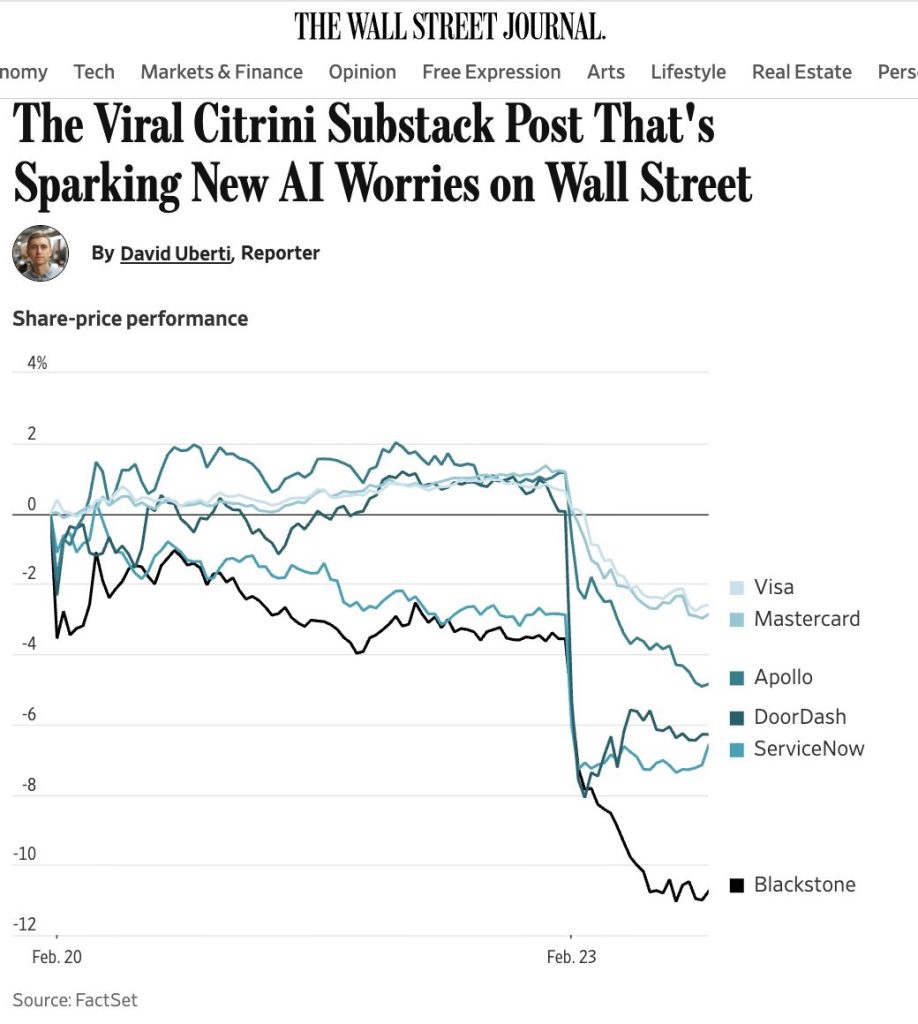
“It’s not a prediction” he said. It’s just a hypothetical possible reality. I believe we used to call that fiction. A science fiction short story wrapped in a macroeconomic essay written by Citrini Research hit the algorithms like a bomb Markets lapped it up like beasts who’d been lost in a barren desert for weeks. Liquidity!
Remember in 2023 when when Sam Altman said that we’d have superhuman persuasion before we had artificial general intelligence?
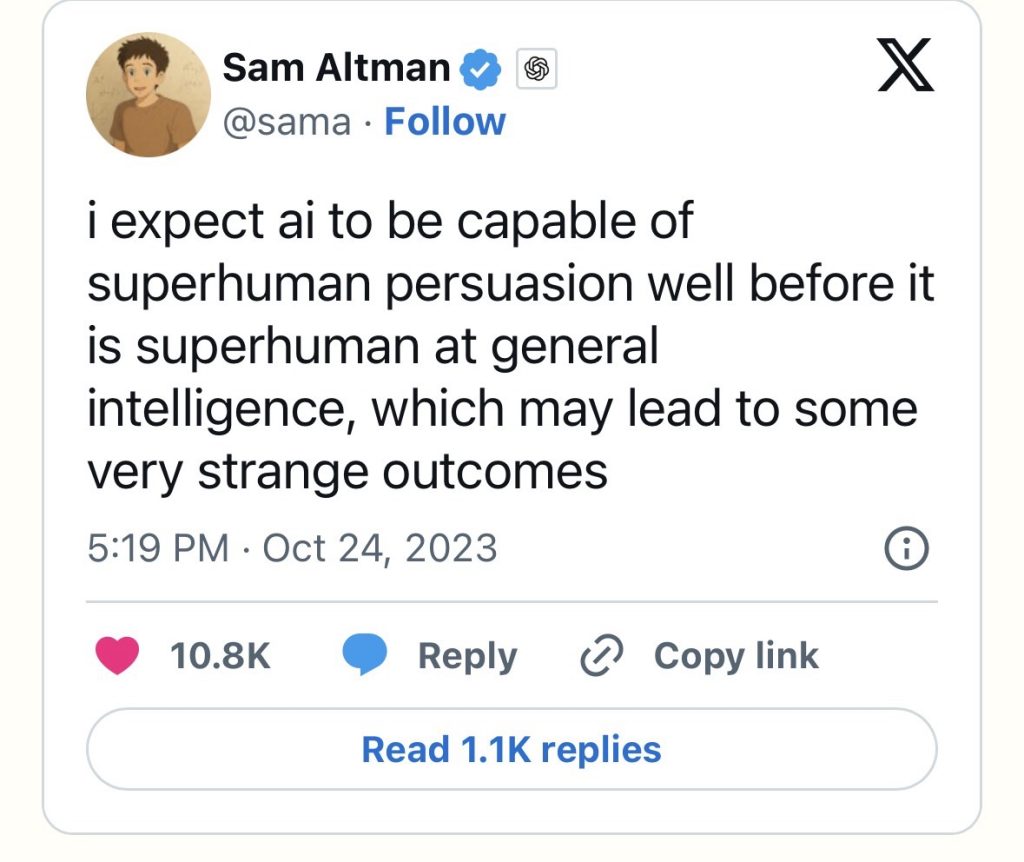
Citrini is capable of super human persuasion before AI reached super human general intelligence and it has been strange.

As the market sell off was playing out, a flood of “Contra Citrini” essays emerged immediately from players as varied as Joe Wiesenthal John Loeber, Will Manidis, even proper economists like Alex Imas. The co-author Alap Shah went onto TBPN. Fun fact he was Sheel Mohnot’s roommate in college.
I am unclear if white collar workers are in a frenzy about are doing their existing jobs or if they have even noticed the danger. As a real time update from a fellow investor had us both laughing. An intern couldn’t manage a basic research task. The intern asked them how to get to the Founders Fund’s website.

We may need the bull case for AI, as the bear case for white collar workers acquiring any intelligence in their education process is rather unconvincing.

For some reason “how do I get to the founders fund website” started me singing an old tune sung by Dionne Warwick “Do you know the way to San Jose?”

Do you know the way to San Jose?
I’ve been away so long
I may go wrong and lose my way
Do you know the way to San Jose?
I’m going back to find some peace of mind in San Jose

LA is a great big freeway
Put a hundred down and buy a car
In a week, maybe two, they’ll make you a star


Weeks turn into years, how quick they pass
And all the stars that never were
Are parking cars and pumping gas

Do You Know The Way To San Jose?

The song was used in another completely different “science fiction story goes viral”context. Maybe it’s in my mind as automated virology lab unleashing apocalypse, is a AI doomer staple also recently in the discourse.

Do you know the way to San Jose? Or if Helix is available for download.

In an SyFy channel show from 2014 called Helix, which follows an Arctic research station where research on viruses goes horribly wrong. It used the Burt Bacharach & Hal David song “Do You Know the Way to San Jose” as an unsettling musical motif and clue to resolving the mystery. Unsettling California music has my ear this week.

In 1968 you could return to San Jose from Los Angeles and start a relatively normal life as one of the stars who never made it. Pumping gas and parking cars. If we get too close to the sun of artificial intelligence success we don’t have a San Jose to run to. You can’t get away there as it’s filled with just the part of technology folks peddling dreams as unrealistic as the ones down in Hollywood.

Categories
Finance Politics

Day 135 and 4 Quadrants of Crypto

I’m on my own this weekend so I had some time to listen to podcasts on my daily walk. I stupidly decided to listen to a podcast entitled “best crypto debate ever” which was vastly overselling both participants capacity to engage in productive debate. Not because either wasn’t smart but simply because they were both approaching the topic from entirely different vantage points. One had reasonably well founded concerns about about the how existing powers will fight to preserve their interests and the other was too fixated on proving that the market was the only player that matters. I am beginning to think that crypto, and in particular Bitcoin, is having a “blind men and the elephant problem” that makes discourse challenging.

I’m not pretending to have a full understanding of the future of cryptocurrencies or Bitcoin, merely articulating to myself as an exercise (it’s my blog after all but maybe my thinking helps you too) the four expertises required to wrap one’s mind around how cryptocurrency will evolve and what consequences we need to consider. Because there are no “right” answers at the moment merely different vantage points to consider as we stumble into the future.

1. Macroeconomic: understanding central banking, treasuries, monetary policy and macroeconomic actors is a specialized skill set. I studied it at arguably the best university on the planet for the subject and I still find the ins and outs to be heady stuff. Who decides what money is worth? When do we change those valuations? How does one country’s currency impact another’s? You hear a lot of buzzwords tossed around like “rules not rulers” but the practicalities of it are in fact hard problems. Just tossing off that you think “fiat currency” is bad isn’t enough.

2. Geopolitical: governments need money to provide services and security which makes them economic actors in addition to being political ones. America’s political ambitions are distinct from China’s. How we make make our money and how we spend it both at home and abroad will affect how we perceive other currencies. You need to understand things like how the dollar’s reserve currency status operates (ideally it’s history) to even begin to understand the geopolitical implications of cryptocurrency. Much hay was made of Peter Thiel suggesting Bitcoin could be weaponized by China against the US. Clearly any currency, especially one not run by Americans, will have geopolitical consequences. That anyone got hysterical about it suggested to me that our understanding of monetary policy and its political implications is limited in the general population. One needs to understand how the many actors on the political stage intersect their interests, political and economic, to even begin to comprehend how a cryptocurrency, particularly a decentralized one like Bitcoin, might evolve. In other words you have to understand how it works before you can do any predictive work.

3. Technical: concepts like distributed ledgers, hash rates, decentralized computing, and cryptographic keys are all crucial subjects for understanding the mechanics of a cryptocurrency, who owns it, and how it’s transacted. The chances that you understand the above geopolitical and macroeconomic problems and also understand how to code say your own token or have the wherewithal to acquire and set up hardware for a mining rig are slim. Maybe you grok it but being an expert in all is vanishingly slim. Computer science, political science and economics are all separate disciplines. Sure Bitcoin mining basically operates like loot crates in a game and who am I to say whether it’s a better system to have dorks with a lot of hardware run our money instead of Steven Mnuchin.

4. Microeconomics: the final area expertise is how markets and all the different players in them will value a currency and use it both as an asset and as a payment system. The elaborate financial systems that exist to determine what you think something is worth versus what someone else does is elaborate. We’ve got Byzantine financial products that decide everything from your mortgage to your salary to the cost of a sandwich. And while it’s not intuitive the folks that work on currencies, monetary policies and macroeconomic issues are not equipped with the same skill sets at all as the folks who trade on financial markets, cut deals between market participants or work out balance sheets. I’m much more studied in the macroeconomic issues than the financial ones and I wish that weren’t true. It’s a lot more lucrative to work in futures, arbitrage and market making.

When it comes down to it these four quadrants all require distinct skills and very different areas of study. Much of the debate and disagreement may simply come about because we are seeing different possibilities. Wrapping your head around the whole is difficult and no matter how brilliant you are having exposure to all areas is a lifetime of work.