Categories
Culture Travel

Day 1835 and Sweater Shaving As My Travel Yak Shaving

If you are an engineer you may have heard someone irritated with a project that has drifted out of scope because unforeseen new problems are blocking completion as “yak shaving”

In software and engineering, people use “yak shaving” to describe being forced into a long dependency chain: updating a tool, which requires upgrading a library, which requires fixing build scripts, before touching the actual feature or bug. Perplexity Synopsis via TechTarget

If you find yourself obsessing over small problems that are absolutely “core dependencies” and getting lost in all the problems that must be done before you can do the actual thing you might be Yak Shaving.

Somehow this is related to a Yen and Stimpy episode about a fake holiday. Coined by what I assume is a Gen X coder (who else watches MYV cartoons) named Carlin Vieri in the 1990s at the MIT AI Lab.

Sometimes a seemingly useless task (reading a manual or fixing a subroutine) does actually do need doing in order to progress on the wider task. But you have to be wary that you aren’t simply procrastinating on supposedly crucial preparations for the actual task.

Well I am packing myself up for week long trip, and while I know basically what needs to be packed and how I’d like it organized, I have not put anything in my bags yet. Want to guess why?

A piling cashmere turtleneck with a cheap sweater shaver filled with fuzzy bits of wool

I am yak shaving by shaving my wool sweaters. It’s now midwinter and my favorite pieces have little bits of pilling in areas that rub or have had more friction. Longer fibers pill less but all wool fibers including cashmere eventually pill a little bit.

We are in an age of down market cashmere thanks to the proliferation of the contemporary price point (lets say under $150) cashmere sweater thanks to the success of Uniqlo, Nadaam, Quincy and Italic.

My older sweaters from past well managed contemporary brands like Ann Taylor are in excellent shape as are my higher end pieces from APC and it’s ilk.

But more disposable 3-4 year basics I wear down? Well sweater care is a constant issue, especially the texture of a pilling fuzzy sweater bothers you. And it somewhat bothers me.

Cashmere are isn’t too hard. You can brush them gently and hand comb the pilling out. You hand wash, lay flat and fold your sweaters. You can use a sweater stone to gently brush them out. And that’s worth it for something that lasts. But the Italic sweater above gets a shave.

You can see from the picture I’ve got a lot of fuzzy bits inside the cheap shaver I bought off an Amazon seller years ago. It has lasted longer than some of my sweaters.Alas if I don’t want to look sloppy then shave I must.

If you want elegant functional code even in your basic systems well sometimes you must yak shave. If you want an elegant functional wardrobe sometimes you must sweater shave.
Categories
Internet Culture Startups

Day 1805 and Dark Leisure, Time Violence & Outputting Value

Any other software developers out there remember the mythical man hour? It comes from Fred Brooks’ classic book The Mythical ManMonth which argues that adding more people to a late software project often makes it even later. This is also known as Brooks’s Law.

The man‑hour is “mythical” when tasks are not perfectly partitionable and require significant communication, shared context, and integration.

I think in the age of artificial intelligence we need to be revisiting this classic complexity insight as it applies across a world where we understand even less about how the time of input drives its notional value.

Measuring productivity in hours is a relic of a past labor era. And most workers have little incentive to improve output when they aren’t paid for it.

If we had quiet quitting during the pandemic where jobs could be done in minimal ways without getting fired, in this new artificial intelligence roll out we see another type of value capture mismatch between input labor and firm.

We are seeing what Fabian Steltzer calls Dark leisure. Others call it shadow user innovation.

Innovation happening through employee adoption of new technologies that is opaque to management doesn’t get counted and workers are reticent to be transparent.

the reason ppl hide their AI use isn’t that they’re being shamed, it’s that the time-based labor compensation model does not provide economic incentives to pass on productivity gains to the wider org

so productivity gains instead get transformed to “dark leisure”

Fabian Steltzer

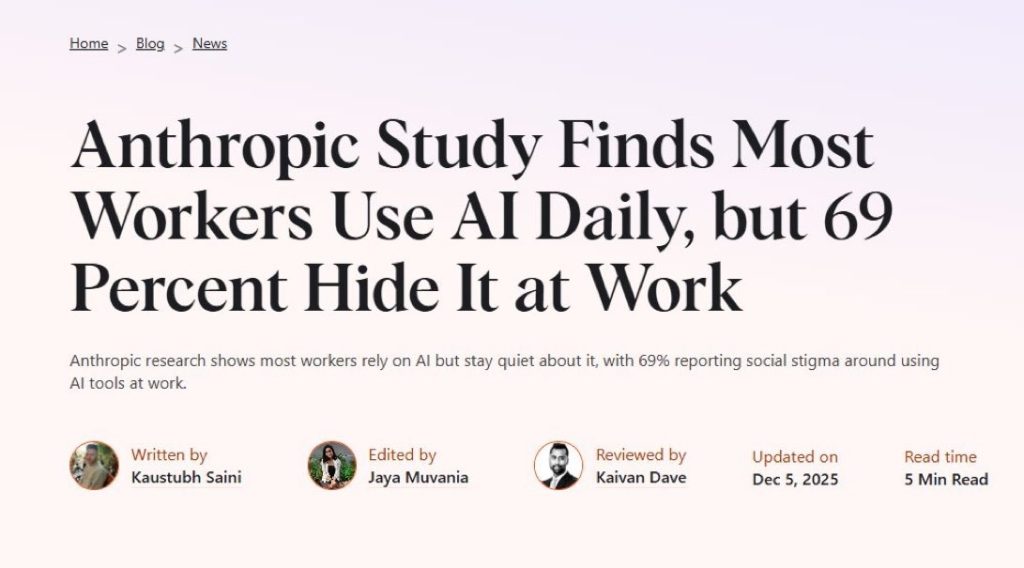
Anthropic released a study on the supposed stigma attached to using artificial intelligence at work. Humans are already reacting to artificial intelligence as if it were an existential threat.

Except it’s been generally existentially freeing up to this point. Anyone who has used commercial large language models on healthcare can attest to that. So why are hiding its use?

Even coders are doing it. And who can blame them. It’s a lot less fun for some folks to coordinate a swarm of agents than it is to write code for a living. If you wanted to be a product manager, well you’d already be one.

The boss makes a dollar and I make a dime so that’s why I prompt on the company dime!

We are seeing the early artificial intelligence era take off collide with industrial-era systems of management that are no longer relevant in age of increasing complexity.

We’re putting intelligence into systems designed to measure hours and surprised when there is a misalignment. A Twitter mutual has a theory of consciousness systems they believe makes this is a form of time violence.

Human beings can tolerate NP hard moments of complexity, but cannot survive continuous low-grade complexity

The gap between human adaptability and systemic inertia is now wide enough to generate an entirely new form of harm: time violence

Idea Nexus Ventures

We just cannot keep up with the varieties and types of complexities that are arising, so any advantage that can be used is being used. And you’d want to hide that advantage as long as you can. Sharing it has no rational basis. I find that disappointing.

I’d rather we not vice signal artificial intelligence as it only harms us. The value capture won’t always match up, but the gains to be made are worth having so keep using it where it works for you.