In the post, I said I planned to keep writing the manual old fashioned way on this blogs and so I have. I appreciate the value of a process where one thinks, occasionally plans, writes, erases, writes some more and occasionally deviate wildly from the plan as you learn what you want to write about. I learn something from every attempt even the shitty ones.
Fun fact, that is the day I met Isaiah Taylor of Valar Atomics. I believed so much in the coming demand for energy and compute that I backed him. He’s doing very well. And I am excited that I look intelligent and am rewarded for it.
And while the tools the AI labs have delivered, I am still writing by hand with little machine intelligence involved in the act of my own thinking my writing philosophy.
The tools help me achieve more in other areas of life from passing policy to running silly experiments to aiding my own health journey. But I still write daily. That’s my present.
Sure every thought involved some research which is much easier now. I can search for a link I only remember in context much faster now. I may post a synopsis from an LLM for information conveying purposes (always labeled) but I’m generally on here to think for myself and not to convince an audience.
I do think being accountable to ones thinking can involve public debate, statements of belief and revisions of past opinions as information changes.
I am excited that others see the value in working those muscles. It’s always been the norm of startups to chronicle things publicly in the hopes that your answer might help someone else. It’s our way and I hope to take that from present day to near future.
The shrinkflation and reformulation that’s rampant in food has hit clothing quite hard. And has made much easier to justify simply buying fast fashion that’s disposable simply because the quality bar for even beloved basics like L.L Bean has gone down.
The sweatpants had cost somewhere in the realm of $30 for a decade, I owned at least a dozen, and have now worn them all out entirely. They were cotton with just a hint of elastane, very lightweight, and the ideal pant for sleeping and home wear.
Now you find pants that are 30-40% plastics of various blends that promise super soft or super drape-y silhouettes consumers don’t know or even mind that the clever branding of “scuba” pants is just marketing for thick polyester knits.
I’m not against some of it. Somewhere between 2% and 5% works just fine for most fabrics, but I’m up to 10% for some garments as I’ve got boobs to work around. However when things are close to your body, particularly in the intimates category, 100% cotton is absolutely my standard.
To be clear, I have no problem with technical fabrics and am a great fan of innovators in that space, from Uniqlo to Norma Kamali, both of whom I wear. I do care about using the best possible quality in any given category. I also look for that in my wool, silk and leather goods.
This is all a somewhat elaborate setup for the fact that, having been sick in bed for the last week or so, I spent a lot of time browsing Quince.
The idea that you should be able to get something high quality and tasteful is, alas, becoming a luxury. Even when you spend full freight. A Substack called Magasin today seemed excited when most pieces were “under a thousand” when despite doing alright, I am entirely an under $300 shopper for most items. Coats and bags I’ll go higher but I’m not crossing a thousand. I’m from the industry I know what this costs thanks.
I am also no stranger to the direct-to-consumer world. I was a long-time shopper of Everlane as their founding team was close to me. I’m also a big fan of previous attempts in the category, like Italic, to bring the factories that we in the fashion industry know so well closer to the consumer.
However, I don’t think any of us expected the category winner Quince. That we would get one giant sourcing machine whose entire philosophy appears to be that merchandising is unnecessary. They will allow whatever the market pulls forward. On to the website and take customer demand pulls from there.
Which I suppose I’m going to have to get used to, because why hire a merchandising team when you can just make the market do it for you? Unfortunately, the market isn’t always as good at the job as somebody who is actually a capable market editor or a top merchandising manager. It’s maddening for many consumers to have no sense of quality, fit, style, color or other characteristics we might like from an online retailer. And yet here we are.
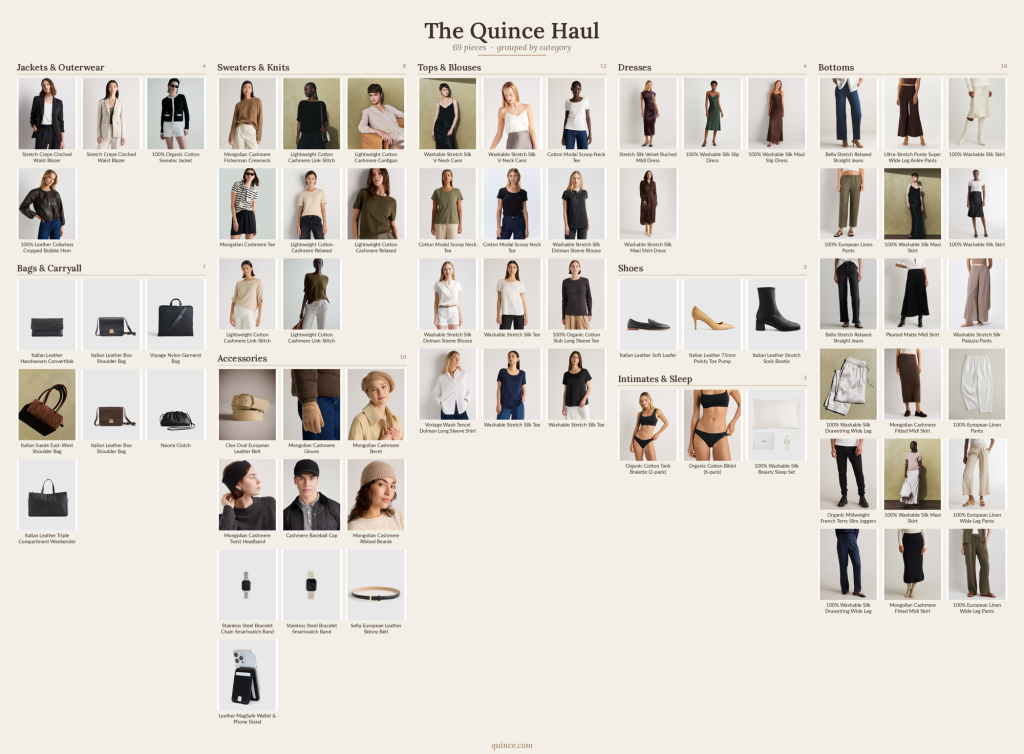
So I did something insane. I went through the entire women’s section of Quince. I scrolled through shirts, skirts, pants, dresses, sweaters, blazers and layers, accessories, hand bags and shoes. I didn’t set out to do it as I just added on what I thought might work for me to see if this was part of the appeal. The sense of hope was always there but it was easy to spot where corners had been cut and the reviews are often hit or miss unless it’s a definite best seller.
I ended up selecting what I thought would be a comprehensive capsule wardrobe for what fashion calls pre-fall. It’s the maddening middle season where you have to layer but it also can get very hot.
Sixty nine items culled from mid July Quince I could see being useful in the next quarter.
We will see if I can reconstruct a capsule wardrobe from what is merchandising that has no sense of what will fit, what will flatter, how consistent their sizing will be, how consistent the quality will be, or if entire categories will fail me.
Now some categories are heavier weighted as I’m trying a lot of bags and travel. Some are light like shoes as I have basics from actual functional fashion lines from my past but I’ll try these out. I don’t know what fabrics will flatter in what cuts so I got multiple colors but if it doesn’t fit I am likely a full pass as I don’t want to double the order with sizes so if it fits I sits.
I am an enormous fan of Freddie Mercury thanks to my mother’s excellent collection of classic rock. You’d be surprised at how much I’ve committed to memory from the core cannon and deep cuts that span the Beatles to Cream & Edgar Winter to Led Zeppelin.
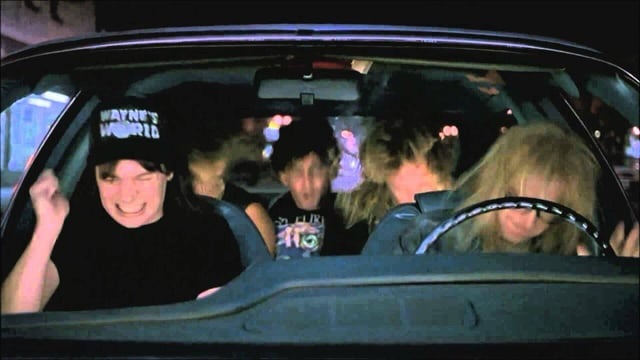
I’m not much for karaoke, though I once tweaked my neck doing a full head bang hair whipping, Wayne’s World style, for a friend’s birthday party.
Knowing all the lyrics to Bohemian Rhapsody is clutch in these circumstances. As can go in, do a full rock opera and ease yourself out of any further obligation to participate saying “oh I had easily three times the stage time as everyone else I’ll just cheer you on!” Pro-tip for group activities amirite?
Fun fact from Reddit. During the Bohemian Rhapsody scene in ‘Wayne’s World’ (1992) Mike Myers and Dana Carvey are both grimacing in pain while headbanging. The director, Penelope Spheeris, shot the scene for approximately five hours. Basically how I felt after my friends birthday karaoke.
Now I don’t always have the common sense to stop myself. I am a real mess at the moment as I have finally come home and I can let the whirlwind dissipate for a moment
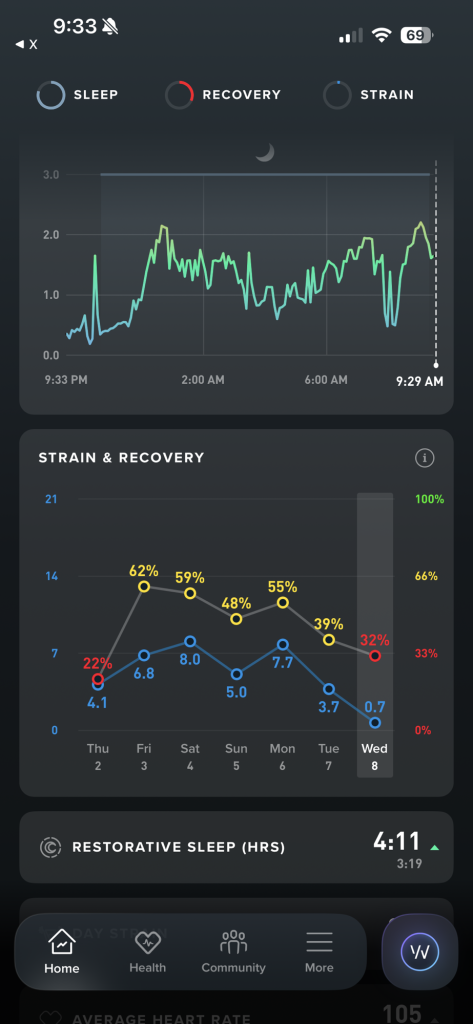
Strained sleep with upsettingly high strain but at least it’s restorative. Now if only I could get my resting heart rate down and my HRV back up I’d be right as rain.
My Whoop is sending up red recoveries with a week of barely better yellows, as I spent a bit too much of the last few months going full Freddie Mercury “Don’t Stop Me Now” as not only was I having a real good time but I had a lot to get done.
Tonight, I’m gonna have myself a real good time I feel alive And the world, I’ll turn it inside out, yeah I’m floatin’ around in ecstasy So don’t stop me now Don’t stop me ‘Cause I’m havin’ a good time Havin’ a good time
It’s nice when you work and your life are aligned such that every step feels like you can only accelerate. But if we are sticking to thermodynamics, l may have allowed a little more entropy into the equation.
So give me some time to sleep it off. I’ll be in bed trying to keep my heat rate down. But being in the red won’t stop me forever. It’ll just stop me for a little bit.
The beginning of the post Great Recession (or The Global Financial Crisis) recovery was just getting traction in 2014, not so much that everyone you knew felt like their goal in life was to become a product manager at Meta or Google.
And this turning point provided a surprising amount of freedom to try to turn an aesthetic into a business. Previously most were happy with an advertising campaign from a big brand and now every constituent part is its own fully monetized subculture.
Money was being thrown at any authentic form of culture that could be commoditized during turn Zero Percent Interest Rate phenomena years. I didn’t know it then but everything I considered to be the day to day culture of my friends was about to be hovered up first by venture and then by private equity and turned brands.
Coolhunters didn’t sell out they were eaten by the inexorable logic of attention economies. More than one Style Forum guy has gone on to success. One of them even runs national security now. No really.
Just as an aside, Freeman’s is still a thing and the New Musuem is involved. Some fashion substack (that is hired an editor who used to run fashion blogs) alerted me to this fun fact. I genuinely feel for folks in fashion as it feels as if culture has simply devoured itself orosbourus style into a null space.
And I agree. Being cool has always meant doing your own thing. And we are all just here to be entertained. From Gladiator to Accellerando, our lightcone demanded to be entertained.
Honestly the first generation of beauty bloggers giving product reviews. What are we even doing anymore? Ipsy turned a YouTuber into a makeup sampler and Allure turned into self into a sampling service. Albeit the best of the sampling services, but still who are we even meant to trust anymore?
Maybe that is why the only style anyone can ever really have honestly comes from study of themselves and their life. What is empathy of not conform to the rules that help make others feel at ease. Manners are after all, meant for the comfort of others not yourself. I am sure that can make it very tempting indeed to only say nice things. Which should be easy as editor of taste. Only tell us about the good stuff.
I am going full weird Americana for the Forth of July in the mountains with friends . We are all committed to the beautiful wonders that is America as it is our natural beauty in the mountain west that feels right for celebrating our nation’s 250th birthday.
Being very in the moment means it’s hard to capture the moment. I’m in a Jeep Rangler going up one of the steepest graded roads in North America to the top of a ski mountain. I’m in a silk dress with a black baseball cap that says make nuclear great again and art deco costume jewelry. Just for fun because why not?
I hope it was reasonable dress code for a hoedown at a country club. I feel like I should be in cowboy boats, but not haven’t made it home to get any kind of riding boots so I’ll come as I am with a smile.
The alpine country in the summer lends itself to dressing a bit more country than city even with its evident creature comforts. I’m a townie from a mountain town so I can simply be eccentric. The counterculture of mountain towns is obvious to insiders but less to those who move in later in life.
I’ve been going between city, coastal and desert all within a month and I’ve not had space in my suitcase for cowboy boots. But I am glad I am able to enjoy the vista in any state. Who says silk and Jeeps aren’t a natural fit?
I wrote these notes while a little bit high, both literally (a transcontinental flight) and figuratively (CBD & a THCa blend meant to give anti-inflammatory relief without hitting your mind but it probably does) but it’s hard to say if I’m less focused than when I’m on the ground. You be the judge of that. Nostalgia machine clicks on
Business class and its perks are lost on me as I don’t drink alcohol. So I had rhubarb and raspberry tonic water in whatever passes for cut glassware on airplanes now. I said no at the fancy lounges to very decent champagnes but I don’t want to get dehydrated. I got a sugar crash instead.
I’m listening to Ethiopian jazz as I find this piece relaxing in the context of airplane travel. Mulatu Astake is a master in a genre I don’t even like but this particular piece has always spoken to me.
Nobody paid me for the diffusion but I was paid for the original campaign. A lesson for anyone bitching about how their work wasn’t compensated by the artificial intelligence models that ingested their contributions.
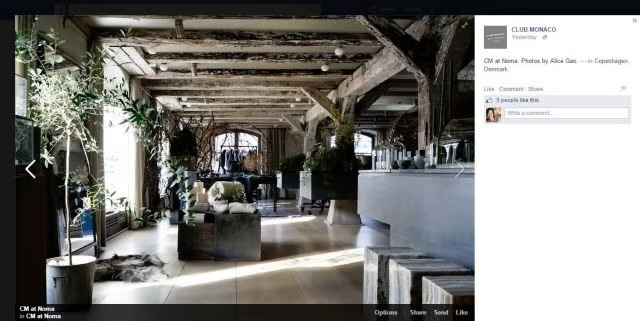
How funny that I should manage a Club Monaco Facebook page involving a pop-up event for a chef that would go on to define so much of culture.
I worked with impossibly cool creative director on the account who was famous in Japan for his photography and also as the guy who made Pabst cool for hipsters. I sometimes wonder where he ended up when his talent set was so hype sensitive. But we were pretty ahead of the times on this one.
Before this fashion agency career, in the post GFC aughts, lived across from a weekend installation of a projected light Pabst installation when I was in North 7th and Bedford. My Turkish banker roommate and I used to throw raves there so we couldn’t exactly complain about the lights hitting our living room. But it was a good campaign in a good location.
I shot low budget fashion shoots during the day with a very competent hungry young editor. She worked as a waitress at night and for me during running our fashion editorial to get toehold in the business. It seems to have worked.
She has an amazing career, a handsome husband, a beautiful child and kicked it off with an impossibly stylish wedding which every hipster you knew copied till well past the Tommy Hilfiger event horizon of having no soul. We had a tortured Swedish nepo-baby photographer too. I adored him. It was a very “rents were cheap” time in hindsight.
Anyways, in transit through Heathrow, I picked up a raft of print magazines from the Cathay lounge which kicked off this nostalgia. I’d browsed Wallpaper but as I’m not a design person a flip through was fine.
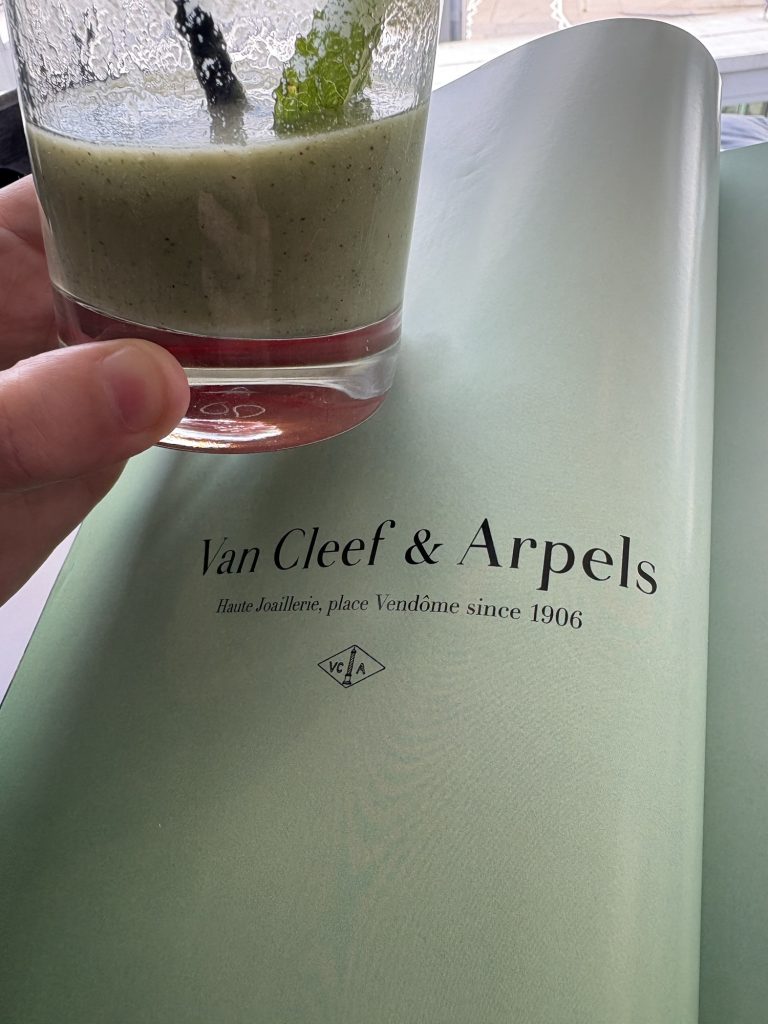
The Cathay Delight is the same shade as this campaign from Van Cleef and Arpels.
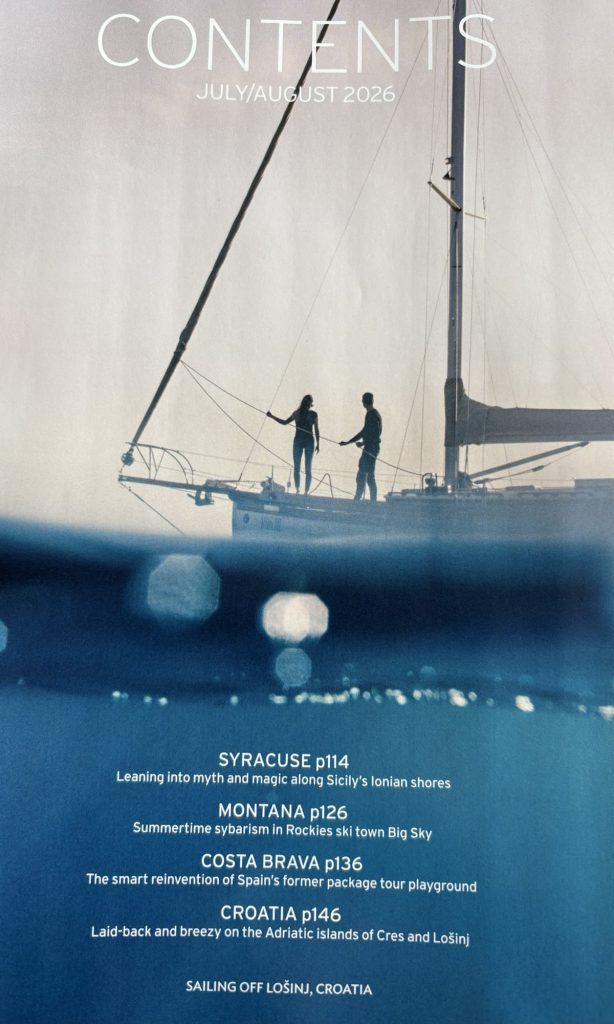
But Condé Nast Traveler caught my eye as I went in to grab the pink Financial Times. I got Tattler as well as why else fly British Airways if you can’t get some gossip on this social hierarchy right?
It’s just that taste is so far down the commodity chain anymore it’d hard to know when and where to find any thing that’s not made to be sold to someone. The menu on my flight had basque cheesecake. That became a joke on a trip I threw together last minute for girlfriends in Corfu. Apparently it’s made it into the Club World menu much to its detriment.
The choices from Condé Nast on a perfect summer was so on the nose. Montana’s Rocky Mountain sybarism and off the beaten path Adriatic and Ionian options for exploring covers and lots of seafood.
The whole damn thing reads like my travel itinerary.
Yeah that’s my coastal move with friends and family. And I do rather loudly live in Montana. It’s like am I joke to their psychographic team? A department that has three people no less. And they only market to women exactly like me. Funny that. I’ll have to check up on their old editor Lilit. She was much better than whatever this nonsense of repackaged Julie seems to be.
A vast somewhat intimidating vista is stretching ahead of me between two thousand days of writing every day and the possibility of reaching three thousand days of writing every day. One day and one post at a time right?
So like any sane woman setting out on a long journey, I ate a salad, had some protein and checked myself into a spa for a massage. No reason to start a long journey exhausted right? I need to pace myself.
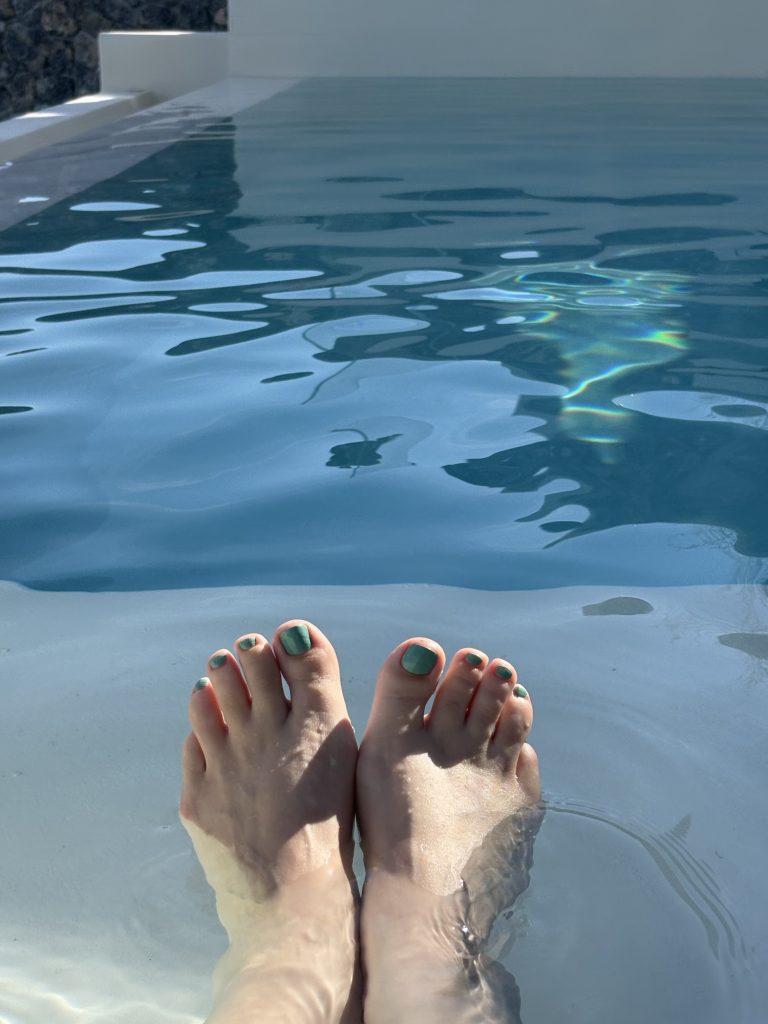
I got a pedicure to immediately turn restoration to grooming necessities, but one can’t keep pool blue toenails all summer. Not every day is spent on the Ionian. Some days are spent at nuclear facilities in steel toed boots. Other days are spent in kitten heels inside conference rooms.
Just in case anyone does need to see my toes after those scenarios, I try to maintain a tidy nude set of nails. Isn’t it strange what expectations we have for women?
I may work remotely, at odd hours and in odd locations that allow the occasional eccentricity, but at any moment I might need to be on an airplane headed to parts unknown. You only get to be so weird when you have big goals.
In this case, next week I’m headed to a desert town and then a state capital. That’s state is becoming a more regular occurrence in my life. That’s a pretty big privilege for me.
Being a supporting player in a number of larger endeavors gives me the chance to add additional gravity if and when I might be useful. Even if it is just showing up as a cheerleader. I love trying to convince smarter, better capitalized and better connected players than me that indeed it is my startups are the winners in the grand game of macro-cycles.
I wrote that the world was getting to be a lot more chaotic when I first started this writing journey. Now that’s common knowledge. Then and now, I care about adaptability to this increasing complexity. This has turned out to mean compute, energy and decentralization.
The strength of your network is in the flexibility and foresight of its nodes. And I hope I remain a trusted node at the forefront of our long journey as a species for as long as I serve us well. I’ll carry on this Odyssey till then.
I’m so old I viscerally remember the Y2K panic that ate up the emotional bandwidth of the American media class who then stoked fear into the hearts of the doomer classes from system administrators to evangelical millenarians.
I was very much online during the Y2K era though I didn’t start blogging (unless you count girly message boards or Geocities) till much later. I was however happily a cybercore hippie girl. If you want to feel jealous and are a Zoomer, I owned a teal iMac G3 and iPod. So I it delightful that a younger generation has decided to dust off some of the silliest times of my youth and refurbished them into Instagram and TikTok aesthetic trends.
What is less funny is how much past fear mongering over technological doomsday scenarios look exactly like our current ones. I remember the simmering fears, the debates over types of damage, and extensive coverage of weirdos who were preparing for a kind of end times.
It feels familiar to how very extreme our reaction to artificial intelligence is being portrayed by both the media and its wildest singularity evangelists. I say this as someone who readily calls themselves a doomer so it’s not a milieu that’s foreign to me.
Here is a brief synopsis I patched together from a Perplexity query with links included if you are too young to remember it.
The Y2K crisis was the feared failure of computer systems when dates rolled from 1999 to 2000, because many programs stored the year with only two digits and could misread “00” as 1900 instead of 2000.
In practice, it became a major prevention project rather than a disaster, with governments, banks, utilities, and other organizations spending years fixing code, updating hardware, and testing systems before midnight on January 1, 2000.
So here I am on Day 1999 of writing every single day, and I’m waiting to turn over into my own 2000th day. I have no anticipated bugs for that event. I stayed up till midnight with my mother walking the main street of our town with a bunch of others waiting to see if anything happened. Nothing did so we drove home.
But it’s enjoyable to remember the kind of disasters that were predicted with such anxiety ended up being problems we worked our way through. We keep at problems by naming them early. Humans intervene and we change our behavior. That’s something you celebrate about us as a species.
I am excited to have achieved such long tenure of daily public writing because much of it covers we have worked our way into a new panic that I’ve been watching for over twenty years. Singularity thought and the extropians have been part of my daily internet diet for quite some time. I think we will find a way to survive this too. Though I grant it sounds a bit more complicated.
I’m sure 1999 me would be proud of the strange futurist I became in my adulthood. I doubt she would have expected that I’d be investing in nuclear power or that I’d have managed a career in cosmetics as a side quest. This is actually a side quest another nerd pursued. I don’t even wear makeup in 1999. I occasionally do in 2026. But if I need to party my way into the singularity I’ll probably at least wear lipstick.
One of my most disappointing life lessons remains the value of gatekeeping. Sometimes the fences do indeed make good neighbors and Chesterton may have had a point.
My ambition coming out of school was to be in media, more specifically I wanted to be a fashion editor. A job a million girls would kill for right? No, I am not falling for the nostalgia dross of the Devil Wears Prada sequel.
A not uncommon response to growing up in a mountain town or remote place, is the desire to is escape to bigger places. Media used to be the portal to the stories about the wider world. You found new worlds in books, magazines, movies, television and eventually the internet. Many of us want to reach broader culture of the world.
Alas I was immediately confronted with the reality that those jobs were glamorous and thus badly paid. I couldn’t afford a job at Vogue nor did they want me so I made websites instead. I became a fashion editor after my own fashion.
Like so many millennials, I had naive expectation that if we could simply open up the gates keeping regular people out of these rarified closed worlds we’d not only bring more beauty to regular people but the beauty of regular people would also improve culture.
Yeah, that’s not how social media turned out is it? I still feel some guilt over how much the “here comes everybody” age of social media degraded many of the spaces I aspired to be inside.
And I am witnessing a new wave of closed spaces and gatekeeping emerge in order to nourish the cultivation of culture that gets crushed under the weight of algorithmic speed and microsecond trend cycles.
The rise of the group chat is an immune response to a world without any sort of borders or checkpoints for quality control except the pricing mechanism. Why cultivate taste if we can cultivate cost? If we haven’t figured out a taste barrier a price one will have to do.
I am personally opposed to price being the barrier function to culture, but if no one is willing to enforce standards in any other manner I am not shocked that we will go further inside perceived safe spaces in order to avoid the harsh glare & garish expectations of mass market access at all hours to all people.
I am trying to remain committed to being accessible to others by remaining online but even I gate-keep myself now with little litmus tests and hurdles to keep from being flooded by asks and audiences. The private world of access cycles will come and go and for now the fences have gone back up.
Fashion rules are not hard rules. Soft rules apply to soft people who lovingly break them if something better would liven the mood. Being mercurial is a delight for them.
Soft rules do bind some people though. That’s the old canard about conservatism.
Conservatism consists of exactly one proposition, to wit: There must be in-groups whom the law protects but does not bind, alongside out-groups whom the law binds but does not protect. Frank Wilhoit
If you take the above statement at face value it makes for interesting thought experiments. Is the fashion industry is a conservative industry? Why then does it present to some as an entirely progressive culture? Fashion scholars could go on at length.
And this cultural rules exist ,about when to wear white that no one follows except those who are fearful enough to have it forced on them.
I am on an island after Memorial Day so I’m well into wearing white territory. No white before Memorial Day or after Labor Day isn’t enforced now in any meaningful sense but years after late‑1800s upper‑class habits dictated a practical, status‑signaling summer color meant for seaside or country time which were put away when people returned to sootier cities in fall.
At least I hope you aren’t somewhere covered in soot in either winter or summer. I myself am in full costal grandma regalia from white cotton pants to summer weight cashmere. Isn’t it absurd we have summer weight wools? It should really be a tee shirt but like I said soft rules for soft people.