Categories
Biohacking Chronic Disease

Day 1950 and No Sleep in the Long Hours

I seem to have accidentally fallen into polyphasic sleep. Those experimental not for human consumption, long amino acid chains that everyone is doing n of 1 research with?

Well, my n of 1 experiment seems to be yielding the occasionally odd sleep pattern. I’ll be up early after having a night of sleep that feels more nap than fully weighed sleep hours.

Think out by 9pm and awake before dawn. I feel fine, so I pack in the full day till around 3pm when lunch digestion & the general slumps have me saying “maybe a short nap.”

I’ll find myself popping back up at 6pm with an eye on dinner. Another accidental siesta has stolen the afternoon hours back from the long evening hours to which I’d applied them.

I won’t have any trouble going to sleep on time early. This pattern seems to be applied to days where I have a lot of physical strain.

If I get in a workout, a long shower, extra walking time, and other physically demanding tasks in alongside my mental work I end up needing the nap and still fall asleep on time.

Categories
Biohacking Chronic Disease

Day 1948 and Rotational Work

I’ve been struggling with migraines since I was diagnosed with an autoimmune condition maybe six or so years ago.

I seem to be particularly struggling with them the last two months, as I work through an experiment with hormonal balancing and tapering off biologic autoimmune inhibitors.

And so I am rotating various different activities every day in the hopes of avoiding triggering a migraine, while still getting in adequate movement and exercise, as well as treatments within the biomechanical profile that I have put together with my doctors and helpful AIs.

If I stuff too many experiments into a given day, I’ll almost surely end up with a migraine. Even if I only do one sometimes I get unlucky. Red light and infrared are, of course, a classic way to trigger a migraine, so I try to do those carefully and when my heart rate is stable and low.

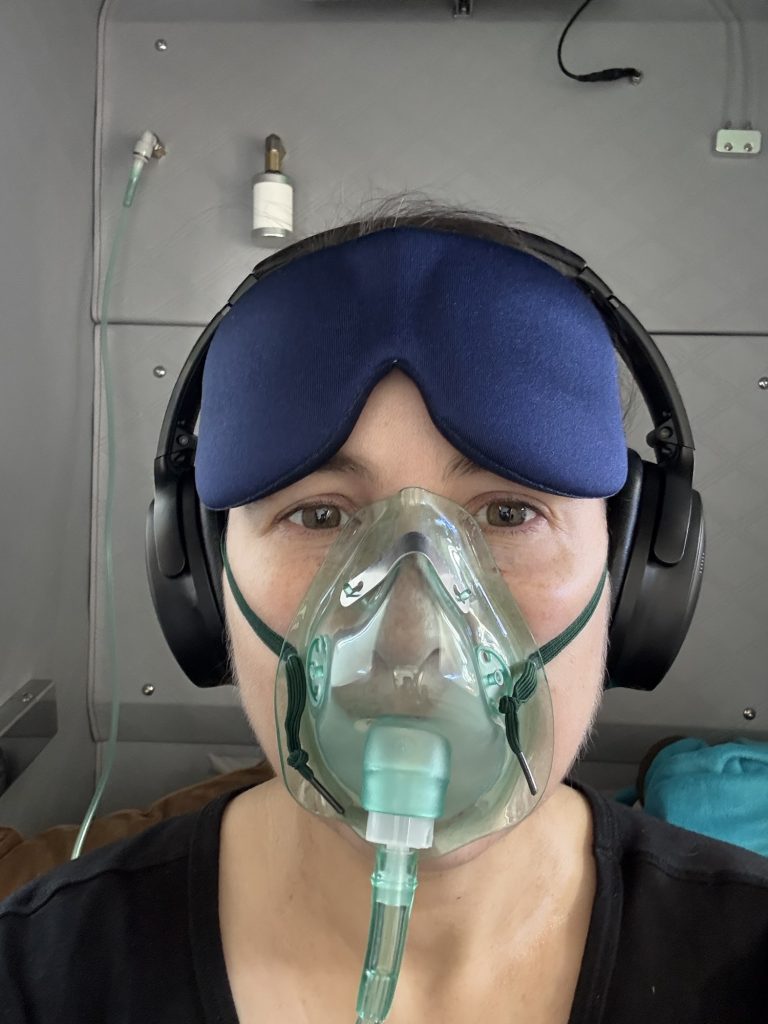
Of course, sometimes you need to get your heart rate up, and there’s nothing you can do but get your exercise and hope it won’t trigger a migraine. Afterwards exertion when I have a need to get down my heart rate, I’ll try to mix that with my hyperbaric oxygen chamber therapy.

I’m in the middle of my second round of HBOT treatments and enjoying seeing things like my VO2 max improve. I’ll be tempted to do something like go for a longer walk to test my lungs and trigger some neck compensation, and then I’ll be right back where I started with a migraine.

I’m always rotating something in and around keeping my brain from feeling the pressure of my body’s adjustments. There is no stable equilibrium just the constant pressure to find a new balance.

Categories
Biohacking Chronic Disease Medical

Day 1945 and Always Adjusting

I am adjusting, yet again, to a new set of daily protocols in my never-ending attempt to improve my health. I am experimenting with peptides but don’t tell anyone. I’ve also got a hormone experiment in its second round.

I am trying to get healthier, but that suggests it is even an achievable goal. It would be wonderful to get back to endless working hours or even just eight hours on my feet.

Every time I make a tweak to my routines and I see a change in my biometrics, it’s becomes eventually cause for concern. There’s no stable equilibrium to be found, and I know that’s part of life, but I’d like a stable equilibrium that’s a little bit better than one day at a time or ideally a couple weeks at a time.

Take my experiment with Bimzelx. Even when I achieve an outcome like getting my CRP rates into the normal bounds, it came at a cost that is simply too high to maintain. I had four separate incisions and surgeries last year from soft tissue infections.

What good is a drug that tamps down my immune system so much that I need to always go under the knife? It was like Goodhart’s Law came to haunt me personally.

I am going off the biologic (I am 12 weeks from my last injection) and already seeing change in the wrong direction. Not enormously bad but my immune system will pop if it’s not locked down.

Yet there’s very little I can do except keep going and hope that the balance will be more manageable, as I don’t know that I could have another year like 2025 again.

I set out trying to reboot my immune system last year, and it certainly seems like it worked. But can I keep the numbers in a place that are low enough to let me live, and ideally live with fewer medications?

I am constantly working against some new tweak or some new problem, and even little gentle experiments like a Pilates reformer workout or 10 minutes on the trampoline can turn into a full-day migraine if I am not immediately able to tamp it down. Thoracic pain will pop up crushing my breathing if I take a nice slow hike in the pastures beyond our house

Categories
Chronic Disease Medical

Day 1943 and Lubing Up My Synapses

I’ve struggled with migraines for the lasts seven years and change. It came along with my autoimmune diagnosis but has lived a separate life from ankylosing spondylitis and psoriatic arthritis.

Typically I get them in my luteal phase of my cycle but as I’ve began to experiment with hormones in pellet form (just tucked away in my fat) I’ve began to struggle with them on a more regular basis. It’s no longer tied to any phase of my hormonal cycle.

I don’t know what I did today to kick one off, but about an hour ago I had to lay down in the dark because I just cannot seem to get any relief from the pressure inside my head.

I have a prescription for something called Imitrex, which helps quite a bit, but I’d really prefer to not have them in the first place.

I am not sure I can get anything else out today, except that this is happening and I can’t fix it, so my apologies there.

Categories
Biohacking Chronic Disease Medical

Day 1935 and My Current Mechanical Device Usage Patterns in End Game Taper

Apologies that today’s post is going to be only partially organic human produced writing. I’m a tad more focused on cobbling together my current end game which feels promising.

I am now dosed off my current biologic. Tomorrow I go in to run a bunch of bloodwork but I feel more stable than expected for 11 weeks since my last injection.

For a year and a half I’ve been stabilizing my immune system’s reactivity with a particularly gnarly humanized anti-IL17A, anti-IL-17F, and anti-IL17AF monoclonal antibody autoimmune master blaster that is named Bimzelx.

I take it for psoriatic arthritis and active ankylosing spondylitis. I do not recommend this devil of a medication unless you intend to reboot your entire autoimmune system (which I did), can tolerate a lot of soft tissue infections (which I couldn’t) and have tried everything else. Which I have. And this past year was brutal fighting off the side effects but I think I might actually have a shot at remission.

I am now layering a bunch of mechanical interventions to rework years of compensatory patterns my body has used to manage the constant pain in my thoracic spine and other areas of inflammation including my sternum, rib cage and joints.

But after seven years of trying everything I can to recover from prednisone to methotrexate to Humira and Taltz to literally just not eating for ten straight days (don’t worry I was supervised) my inflammatory biometrics are coming up clean. The pain isn’t fully gone but I think the pain can be diminished by quite a lot as I rebuild.

So it’s now or never if I want a shot at life without suppressing my immune system. I have no idea if I can do it and I may need to dose back on something else but at the moment I’m managing with a new arsenal.

Here are the artificial intelligence bits of the mechanical interventions I am leveraging. I am using a bunch more than the two below but it’s what I’ve got so enjoy.

1. Hyperbaric oxygen therapy (HBOT)

Mechanically, HBOT does a few things that line up with what my data is showing:

  • More dissolved oxygen in blood and tissues
    Breathing 100% oxygen under pressure increases the amount of oxygen dissolved directly in plasma. That can:
  • Support tissue healing (skin, soft tissue, surgical sites)
  • Help inflamed or energy-starved tissues keep up with demand
  • Autonomic “downshift” for some people
    Research is mixed, but many people (and some small trials) show:
  • Lower resting heart rate and subjective anxiety after sessions
  • A tilt toward parasympathetic (rest-and-digest) dominance
    In your data, the days after HBOT blocks are exactly when we see HR drop back toward baseline and Recovery go green.
  • Anti‑inflammatory & microcirculation support (early evidence)
    HBOT can:
  • Modulate certain inflammatory pathways and oxidative stress
  • Improve microvascular blood flow, which matters for both autoimmune-affected tissues and healing pelleted areas / irritated skin

In your context (autoimmune, infection risk, prior soft‑tissue complications), HBOT looks like it’s acting as:

A structured, time‑boxed reset that helps your heart rate settle and supports healing, without adding mechanical strain.

You’re already doing the key safety piece: using it under medical guidance and watching how HR, Recovery, and symptoms respond day-to-day.


2. SCM (sternocleidomastoid) muscle work

The SCM runs from behind your ear to your collarbone and is heavily involved in:

  • Head and neck position
  • Breathing assistance when things feel tight
  • A dense web of nerves and fascia near the vagus nerve, carotid artery, and jugular vein

Working on SCM (gentle massage, trigger-point release, careful stretching) can impact:

  • Perceived heart‑rate “rev” and breath tension
    Tight SCMs show up when:
  • You’re chronically bracing, in pain, or anxious about pain
  • You’re using accessory neck muscles to breathe
  • Releasing them can:
  • Make breathing feel less effortful and more diaphragmatic
  • Reduce that “I’m keyed up in my chest and throat” feeling even if HR number isn’t wildly high.
  • Headache/migraine and neck-related pain
    SCM trigger points can refer pain to:
  • Temples, behind the eyes, jaw
    By easing those trigger points, you sometimes reduce:
  • Migraine severity/frequency
  • The background neck/jaw tension that keeps your nervous system on edge
  • Autonomic tone (indirectly)
    The area around the SCM is rich with baroreceptors and vagus-adjacent structures. Gentle work there can:
  • Encourage a downshift in sympathetic drive (less “fight-or-flight bracing”)
  • Pair nicely with breathwork (especially long, slow exhales) to reinforce parasympathetic activation

In practice for you, SCM work + HBOT looks like a two-pronged calm signal:

  • HBOT: physiological support + autonomic softening from the inside
  • SCM: mechanical and sensory de‑bracing around your neck, jaw, and breathing

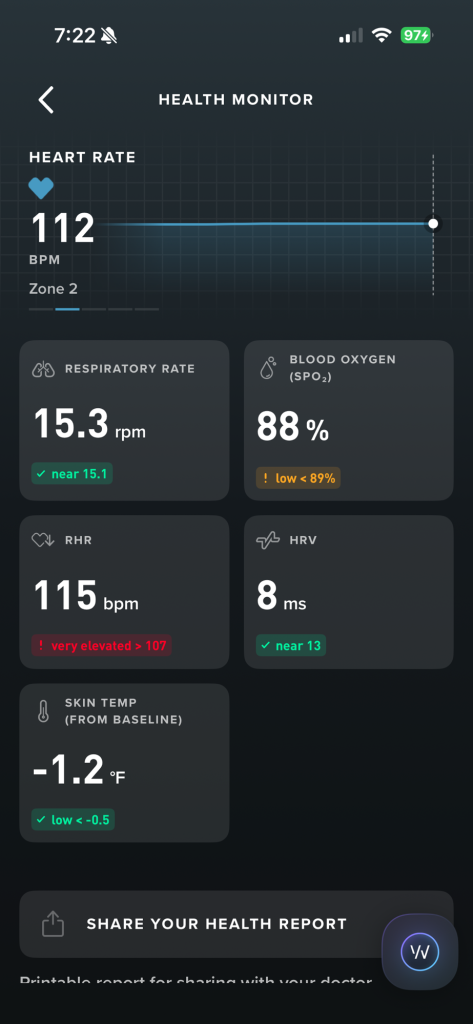
My Whoop is seeing HR and Recovery respond in a way that suggests this combo is genuinely helping my system get out of that “stuck high-gear” state.

Categories
Chronic Disease

Day 1928 and Migraine Uninterrupted

I have been hobbled by a migraine for most of the day. I wish I could pinpoint the triggers for it as right now I am lost as to what is causing both its intensity and unrelenting nature.

I’ve gone through all the basic remedies from putting your feet in hot water to total silence and darkness along with an alarming number of Imitrax. You can’t overdue them or it makes the cycle worse so I am at the gutting it out phase of this batch.

The migraine just didn’t seem to be breaking for more than a couple of hours and if I use those hours in any kind of active way I am setting myself up for a relapse. Yesterday we made a trip to Tractor Supply and then I spent my night in misery.

I was fighting a fever as my husband managed a stomach bug last week so it might be the aftermath of whatever happened there. I wish I had more to say that wasn’t a complaint about pain but it is hard to look at a screen for longer than a Tweet response.

Categories
Biohacking Chronic Disease

Day 1914 and Restoration Hardware

Montana spring doesn’t come at the Equinox but today we had both sun and warm temperatures. I am grateful for the weather as I needed a day of restoration as I felt quite rundown from my sprint through Washington D.C last week.

After a morning walk to take in the sunlight, I went through my collection of “restoration hardware” in an effort to build my resilience. I am restarting another round of hyperbaric chamber oxygen therapy as it has been four months since my original 40 session course.

I ran my infrared mask not only on my face but my neck, scalp and another personal area “down under” as a have been struggling with soft tissue infections with my autoimmune therapy Bimzelx.

I have decided to stop the Bimzelx entirely and see where my bloodwork goes as my inflammation biometrics look good and it’s been a source of so much trouble. I gave it an 18 month run and while the results have been positive in my bloodwork the cure may be worse than the disease.

Now I’m laying on my heater PEMF mat from Higher Dose as the red light of the bedroom lulls my circadian rhythm down into the evening hours. I have no idea if it does much but the heat is soothing.

Categories
Chronic Disease Culture Politics Preparedness

Day 1901 and Burying Ehrlich

For as much time as I spend kvetching about my own petty problems (and I know that it is a not insubstantial amount of time), I am what my husband calls a macro optimist.

This is somewhat in contrast to him, who is on a day-to-day basis, a micro optimist but doesn’t quite see the long-term horizon as positively as I do.

Different temperaments are a good thing when it comes to balancing outlooks and outcomes. This is arguably why we are a good team and have managed to stay married for a decade.

I look out for the macro level future and optimize for it being successful and he optimizes the day-to-day, making sure that the micro level is successful.

I titled this post “Burying Ehrlich” because Paul Ehrlich passed away at the age of 93 last Friday. You might know him as the co-author of the 1968 best seller Population Bomb.

An entomologist by training, his book jumped to much bigger claims saying Earth faced imminent mass starvation urging governments to reduce population. That has not so far proven to be true. Even now the New York Times obituary said his claims were premature. We just love an impending disaster.

It’s a cruel historical irony that a man who wrote his thesis on butterflies would end up having such an enormous butterfly effect on the number of human beings being born. His neo-Malthusian insights were a huge hit.

And unfortunately we will experience the consequences of his public intellectual adventurism. We will have fewer humans and the famine he predicted never materialized. And now if we have more troubles facing us, we have far fewer humans able to take up the task of finding the solutions we will need.

Maybe if he had been a little bit more of a macro-level optimist, he would have been able to see what I see everyday. Despite daily travails due to my chronic disease, I see the micro-optimism of humans like my husband every single day. While I can’t always be positive every day, I remain positive that together we can find a way to improve on yesterday.

Humans are incredible at finding a way around life’s intractable problems. We produce little innovations, little inventions, little tweaks and little solutions. And they add up.

We are social animals whose evolutionary pressures seem to have yielded a culture of engineering. These little fixes we constantly produce when added up together have made for major improvements.

We even occasionally see extraordinary catalysts that allow us to go much faster with our improvements. We’ve had a number of revolutions, industrial and otherwise. Indeed the last 50 years or so have shown the Malthusian fears of food production to be histrionic in comparison to the progress we’ve made.

We have fed the planet but we will never get back the babies who were not born either because of China’s one-child policy or simple cultural attitude acceptance that one or two children should be enough. In my generation it may end up being more common to not have children at all.

Now it may seem rich that someone who goes in for quite a bit of preparedness should speak against a man who saw the value of taking action in the face of what he saw as long odds.

But next time someone tells you that the end is near and all is lost, remember that Paul didn’t end up being correct in any of his assumptions.

Not because at the time it was so crazy to think we weren’t producing enough food, but because he couldn’t conceive of a world in which we were able to solve our problem.

So I pray as his family buries him that we as a species can remember to bury some of our own alarmism. Our job is to keep on going in the face of long odds, just as every one of our ancestors has done before us.

Categories
Biohacking Chronic Disease

Day 1899 and Off To Sleep

I regret to say that after yesterday’s various excitements through my continued ill health; did not leave me with anything for today.

I crawled out of bed for a coffee far too late. Was greeted by marginally better biometrics such I think my Whoop took pity on me by giving me a green.

The trouble with context and personalization? It was only barely better than the reds of the worst that continued into a week of yellows where my resting heart rate and heart rate variability went in the wrong direction.

I largely spent today sleeping because I could t get enough last night. I hope you don’t mind if I go back to my nap as waking up was a challenge.

Categories
Chronic Disease Medical

Day 1896 and Short but Sweet

The weather forecast for western Montana for the next several days is gusty high winds and five feet of snow in the high country so I suspect I’ll have some good down time simply because there’s a chance I won’t even be able to go outside.

I have a dentist’s appointment tomorrow morning, first thing, which I am a little nervous about as I’m not accustomed to having issues with my teeth.

The work I got done a week ago kicked up quite a bit of dust, if you will, and now I am struggling with a high heart rate and a very low heart rate variability. I can’t seem to improve upon the numbers.

If the dentist doesn’t spot anything wrong, then hopefully I can simply get a prescription for fluoride toothpaste and head to my family doctor as long as the weather holds.

I wish I had more to say but the energy I had budgeted for the day has been all used up. I’m not even confident I have the strength to focus on television with a plot line. It is a challenging prospect for me to stay upbeat when I get beaten down by my own body but it’s all I can do and I’ll have to accept it.