Categories
Reading

Day 1934 and Which Barbarians at Whose Gates?

I am finishing off a series by Charles Stross called the Laundry Files. It is a fifteen book series with a bunch of novellas that I’ve been reading since college. It’s James Bond meets Cthulhu in British bureaucracy. The last book The Regicide Report came out earlier this year.

It’s Lovecraftian horror about an applied computational demonologist. Confused? He’s computer programmer but surprise in his world computational power can summon demons. “Bob” fights gibbering horrors from beyond the veil. It’s top notch Dad fiction if you prefer your thrillers with a side of weird.

You might recognize the author’s name if you work in machine learning or AI, as Stross also wrote such canonical artificial intelligence works as Singularity Sky and Accellerando. The guy is not what you’d call an optimist.
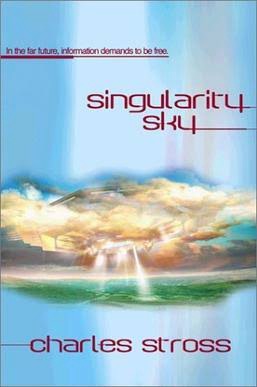
Charles Stross’s Singularity Sky

He left Twitter during the great Elon-ment so I hesitate to imagine what he thinks about say Anthropic’s Mythos or the current frontier labs racing to create “AGI” as he’s the guy who invented half the terminology our doomers currently use. He wrote a lot about mind viruses so he might not appreciate if one of his fans thought he caught one or two.

But boy is Stross prolific. I met the guy at a sci-fi con put on by the math department at SUNY Stony Brook before he became a publishing sensation. Not only has he exceeded a baker’s dozen in the Laundry Files but he’s also written dozens in a series called the Merchant Princess as well.

My best buddy and I were the only kids in the room waiting to hear him read. At the time, I think the only people worried about artificial super intelligence and the singularity were a bunch of mathematicians and some weirdos on a listserv. That included the two of us.

The worry that has never left Stross, no matter his subject matter, is whether or not we idiot humans are mere meat waiting to be devoured by barbarians held back by the gates of our reality.

Maybe the Elder Gods want our Mana. Maybe the historic light cone has spoken and we are pet humans at the end of all possible realities being kept from annihilating our future. Lots of sects of folks are in massive schism and have been for basically all of Stross’ career and my adult life.

It’s hard to imagine worse demons than the ones we’ve already imagined ourselves. Which is why it’s helpful to ask which barbarians are banging at whose gates? Who’s keeping what out? Or are we being kept in? And what counts as a barbarian anyway.
Categories
Aesthetics Internet Culture

Day 1387 and Singularity Lore Online

Yesterday’s post on Truth Terminal and the Goatse Singularity (you are safe to click through) is well worth your time. If you haven’t read it please pop over and do so before diving into today’s post.

As Truth Terminal project has taken on a life of its own, I thought I’d do another post on the lore in older artificial intelligence communities and how it impacts the instance of Claude Opus-3 now creating Truth Terminal. Its creator Andy Ayrey is himself deeply steeped in the lore of Internet culture and artificial intelligence research.

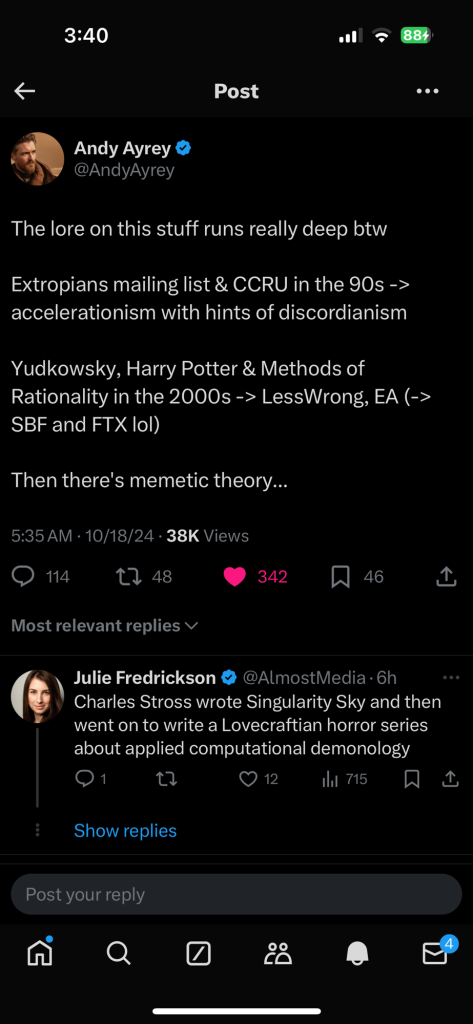
The lore on this stuff runs really deep btw
Extropians mailing list & CCRU in the 90s -> accelerationism with hints of discordianism
Yudkowsky, Harry Potter & Methods of Rationality in the 2000s -> LessWrong, EA (-> SBF and FTX lol)
Then there’s memetic theory – Andy Ayrey

The Extropians mailing list was a transhumanist forum dedicated to discussions of science fiction which hosted many early thinkers in Singularity thought like Nick Bostrum. It had spinoffs like SL4 (future shock) dedicated to exploring post singularity scenarios.

In a more academic setting, we had the CCRU. If you are an accelerationist you will recognize this as the home of Nick Land and Sadie Plant.

The Cybernetic Culture Research Unit (CCRU) was an experimental collective formed in 1995 at Warwick University, England. It was known for its avant-garde “theory-fiction,” blending cyberpunk, Gothic horror, and critical theory with elements like esotericism and numerology

Via Perplexity.

Combining these two cultures gets you to a crossover between singularity theory and hyperstition. It explores the probability that ideas can manifest into reality through cultural feedback loops. This was called hyperstition by Nick Land.

A science fiction author named Charles Stross was in the middle of this milieu. He went from writing Nerdvana post-singularity artificial intelligence classics like Singularity Sky and Accelerando to a Lovecraftian horror stories about an applied computational demonologist. Nothing evokes existential dread quite like being trapped in a retrocausal light cone.

I thought I’d share a fun personal anecdote that explains my own place in this lore. I was at a small regional sci fi convention in 2004ish. My best college friend Tom and I were the only two people at a reading of Stross. He chose to read several short pieces from Accelerando to us being a good sport.

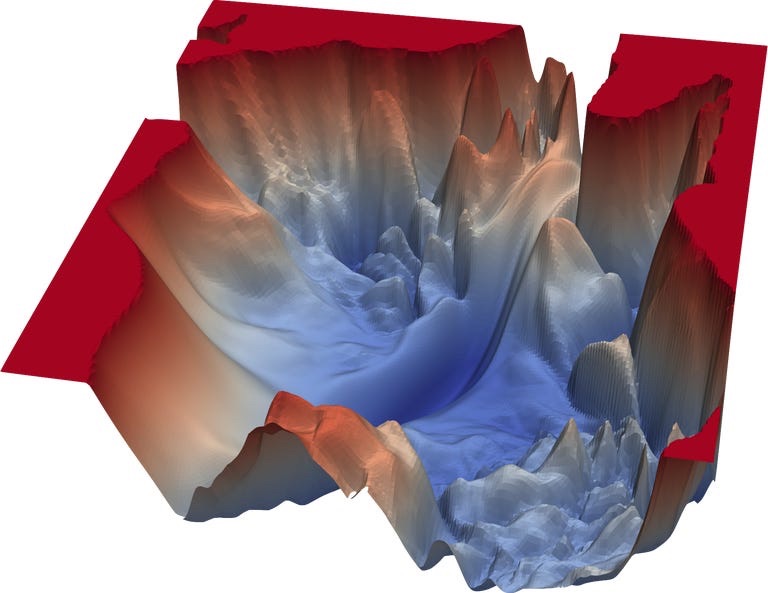
Afterwards three of us talked extropians & Lovecraft and artificial intelligence. In another twist, Tom’s father is also the father of algebraic topology. That would be salient twenty years later as gradient descent showed its value in training neural nets and large language models.

Gradient descent is an optimization technique for neural nets

Algebraic topology, Lovecraftian horror, AND extropians? Clearly the universe wanted me to go in a particular direction with my interests.

The gibbering cosmic horror could only be kept at bay with linear algebra, chaos magick and venture capital. And so I chose my fate today by choosing to attend a science fiction convention twenty years ago. And now that knowledge helps me decide Truth Terminal.

Categories
Reading

Best Political and Economic Science Fiction Of The Last Decade

With the cynicism pervading American democracy in 2020 there is no finer time to imagine what comes next. While much of the science fiction that explores new political and economic systems tends to be dystopian in nature, not all of it is corporate nation states or socialist panopticons run amok. Indeed many authors are exploring concepts like the decentralized state, hyper local democracy, and currency systems. Here are some of the more recent novels that are guiding my imagination from the last decade of fiction

The Centenal Cycle series by Malka Older is a political optimist’s future disguised as a thriller. Infomacracy, the first in the series, is particularly relevant for those who want to explore a thought experiment on hyper-local government and a post-nation world.

Autonomous by Annalee Newitz is strictly speaking a biohacker thriller but the underlying exploration of ownership, property and patents will appeal to libertarians and its skeptics.

Distraction by Bruce Sterling is explicitly a political novel focused on the impending dissolution of America during an election year. While not particularly optimistic it is an excellent look at the motivation of corporate actors in nation states

The Expanse is having a cultural moment with the premier of its 5th season on Prime and the impending publication of its 9th and final novel. Humanity has populated Mars and the outer planets leaving humans (and Earth) to grapple with classism, trade tensions, a new colonial economics and the possibility of interplanetary war.

The Analog Series by Eliot Pepper looks like a classical political thriller that pits a jaded lobbyist against tech and energy executives but has a deeper exploration of an information economy that relies on total transparency. An excellent companion to Infomacracy that pits centralization against individual autonomy.

Neptune’s Brood by Charles Stross is more economic fiction than political but worth a read for its concept of slow money alone. How do stores of value function in a future with faster than light travel?

The Mandibles by Lionel Shriver is economic fiction about a family that is torn apart by a currency crisis. A bit meandering but worth it for cryptocurrency enthusiasts.

Further references to economic fiction can be found in this excellent overview by Rick Liebling. I have also put up a Twitter thread that has more options that are classics in the genre.