Categories
Aesthetics Culture Reading

Day 1960 and Return to Tufte

The more the power we seem to gain working with large language models, the more apparent it is that few of us are visually literate in a meaningful way. When you hear talk about design, it is all too often moods and vibes with no specifics.

Now, you might say that you know what you like when you see it. That’s also how we let the Supreme Court talk about porn. Clearly untangling the weft and weave of taste (and by extension culture) can be further articulated than through subjective, non-definitional standards.

How you came to your visual reference preference set is quite a bit more complicated than whatever pre-digested piece of media came across your algorithmic feed.

You can explore design languages from one token to the next, but visual literacy involves a lot more than scrolling or confirming you’d like to see more content “like this.”

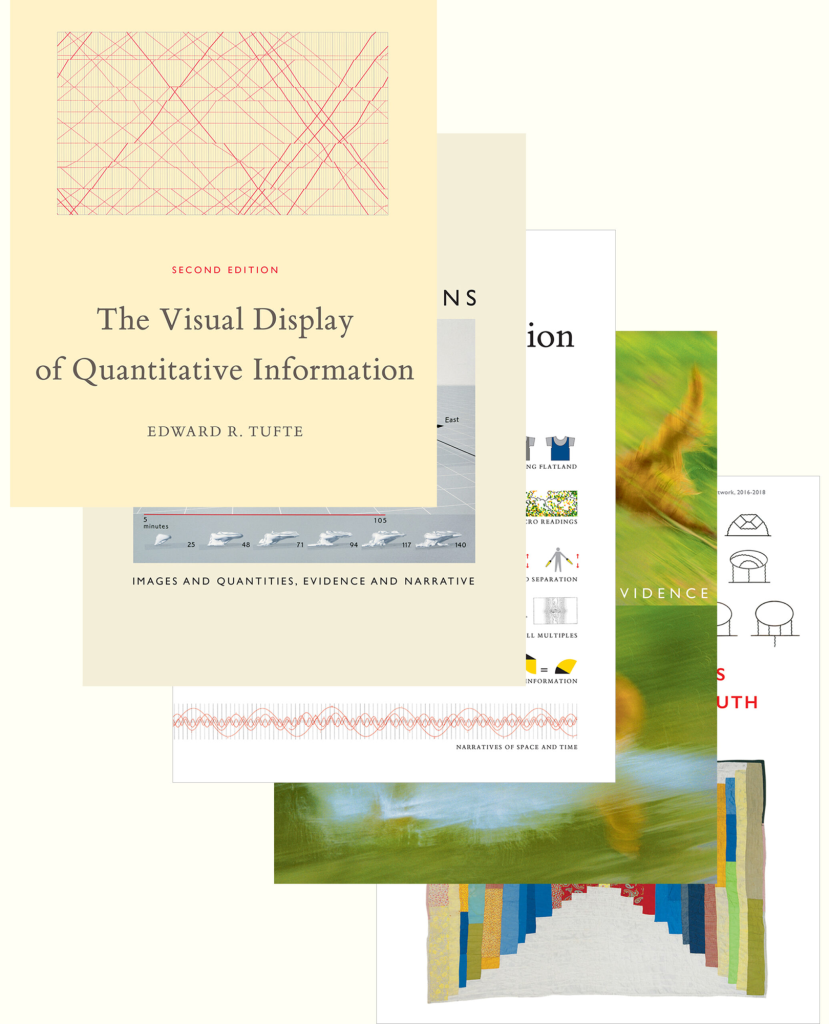
When I first began circulating in design circles in the early aughts, the hipster set was obsessed with Edward Tufte and his now classic Visual Display of Quantitative Information.

Edward Tufte taught data analysis and public policy as a professor at Princeton and Yale for 31 years.

Tufte, via his Graphics Press, wrote, designed, and self-published 5 books on analytical thinking and showing, taught a one-day course, Presenting Data and Information for 923 days to 328,001 students.

Who knew Tufte and I both shared a love of marking the days of our work? He influenced many more people than I have but I find some joy in that coincidence.

His most referenced work, which I mentioned above was published in 2001. Visual Display of Quantitative Information was on the desks of everyone designer I knew, from fashion and Silicon Valley to public policy it was a mainstay. The man knew how to lay out information visually and he became the standard.

Some of Tufte’s self published tomes

The long tail of enthusiasm for displaying data beautifully surely owes its ubiquity in some part due to his success in teaching my generation’s designers.

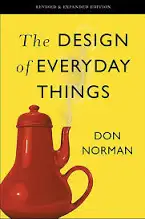
He’s became for a period so universally referenced that Tufte became a cliche. Now he’s classic a quarter century later. His work arguably as successful as a visual language reference anchor as bookshelf favorite, “The Design of Everyday Things” by Donald Norman. His work is also denigrated as cliche in some circles.

The Design of Everyday Things second book cover

Both men offered clarity and practical principles over taste and theory. Those academic predecessors befuddled many who experienced aesthetics primarily through semiotics and critical theory. It felt revolutionary to return to form and function

You “Kant” really learn to love the languages of aesthetics from theory alone as it turns out. I’ll place a little AI synopsis to make the connection clear. This is from Perplexity:

Someone might relate to the popularity of Edward Tufte and The Design of Everyday Things as part of a broader hunger for clarity over clutter in how information and objects are presented.

Tufte’s work is influential because it treats visual design as a serious vehicle for understanding data, while Norman’s book argues that everyday things should be intuitive, legible, and centered on the user.

A Tufte-style chart removes decoration so the trend is easy to read, while a Norman-style kettle shows clearly how to fill it and pour it without guessing.

Both are forms of respect for the user: one respects the reader’s attention, the other respects the user’s actions.

Learning how to use an item or a tool, or how to interpret charts or graphics, can easily overwhelm anyone and feel disrespectful to students. A whole era of computing was stuck between the power of the command line and the legibility of the desktop metaphor.

Norman spoke of the Gulf of Execution as the gap between a user’s goal and the means to execute that goal. Tufte similarly wished to remove the confusion in charts and graphs so one’s ability to glean information wasn’t stuck in a gulf of understanding thanks to overwrought bar chart or sankey diagram.

With new artificial intelligence tools we are bridging some of that gap, not with design but with raw computing power. We are moving beyond the CLI and the desk and into a world of reference and inference.

I just hope we all take the time to learn our reference set so we can do more than say “I know it when I see it” as that will be our only way across the gulf of execution. Some things never change. Learning the languages of your field is one of them.

Categories
Aesthetics Culture

Day 1959 and Chambre Syndicale

I’m in my luteal phase so primed to be grumpy, frumpy and otherwise combative. You’d think this wouldn’t be an issue as I’m currently experimenting with synthetic hormones and all sorts of experimental peptides but the feminine is a mystery.

Thankfully this cunty attitude had a positive side effect of spiraling me into a group chat debate over what constitutes couture. Haute couture literally means “high sewing” or “high dressing making” in French.

I just had to be technically correct as it’s the best kind of correct. I only know as once upon a time I picked a fight with Fédération de la Haute Couture et de la Mode aka La Chambre Syndicale as old school fashionistas tend to still call it.

I may have done a kind of DDOS (allegedly) on their publicity fax machines to get their attention to further my guerrilla reporting efforts. They were not amused by the chron job I set to send them regular faxes at specific intervals. Anyways.

The TLDR is essentially that what constitutes couture is a bit like champagne. It only counts if it’s from the ateliers of Paris with very specific artisans (and a number of them) using hand sewn techniques which sell only to private clients with custom fittings. They then approve your atelier if you meet these standards.

Couture is not custom made clothing nor is it a form of luxury determined by price or self labeling. And it is definitely not “ready to wear” clothing you can buy off the runway. If an elaborate dance of craftsmanship and French bureaucracy. As an American I find it a bit silly but I don’t care for cartels of any kind be it drug, oil or clothing.

Many designers will try to get away with calling a custom made item couture in order to ride on the 170 year aura of French fashions but it’s not really what is meant by couture and it’s absolutely not what is meant by haute couture.

You don’t see Savile Row tailors calling themselves couture designers nor should they. That would be silly and imprecise. They are Savile Row tailors and that’s its own special custom suiting process.

Being imprecise in one’s specifications is exactly the opposite of what you’d want from someone making you a custom wardrobe based upon nearly two centuries of a professional cartel’s specifications.

So please don’t call something couture as a short hand slang for custom design. It may be ready to wear. It may be tailored to you. But only those who meet the standards of the Chambre Syndicale carry the designation haute couture. Otherwise it’s just sparkling custom made clothing.

Categories
Aesthetics Culture

Day 1925 and The Road to Nora Ephron

Yesterday both my husband and I were quite sick. We had very different symptoms but my worst one was a fever which added additional pain to the usual autoimmune nonsense. Naturally I subjected myself to more pain by spending the day on the internet. There is a lot going on and my brain was foggy in the wilds of the open internet.

Thankfully my fixation on consumer packaged goods’ price risk coincide with the arrival of a fresh round of skincare as well as a number of grim stories on the K shaped economy. Southeast Asian is rationing fuel while in Harper’s Bazaar wanted me to know that K-Beauty was coming for my neck. .

I don’t write headlines but I thought it was a bit on the nose to suggest fashion magazines are vampires. I clicked though.

It turns out there is a lot you can do for your neck but be warned the skin is thinner so promote collagen growth and be aware fewer sebaceous glands means it is dryer and more prone to irritation when exposed to actives like retinol. Useful information reinforcing my recent experiment with using Medicube’s PDRN Pink Niacinamide Milky Toner on my neck.

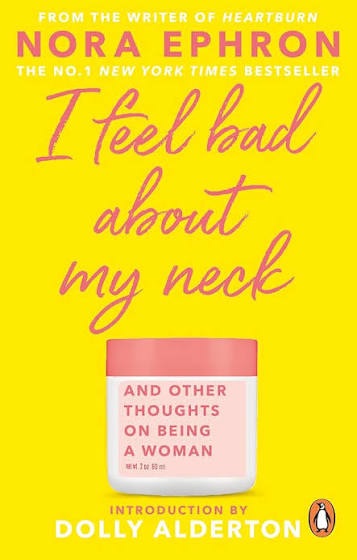
The beloved director of romantic comedies Nora Ephron m released a book in 2006 about the trials of womanhood. One essay was dedicated to how her neck was giving away her age. At the time I don’t even know one could be anxious about one’s neck but I filed it away as a to do in the endless list of feminine expectations.

“Short of surgery, there’s not a damn thing you can do about a neck. The neck is a dead giveaway. Our faces are lies and our necks are the truth. You have to cut open a redwood tree to see how old it is, but you wouldn’t have to if it had a neck.” – Nora Ephron’s “I Feel Bad About My Neck: And Other Thoughts on Being A Woman

I Feel Bad About My Neck illustrates book cover

Now maybe back in 2006 there wasn’t as much you could do about your neck when you’d smoked, tanned, and I will presume maybe occasionally enjoyed m drinking or other substances. But her Boomer fears encoding their neurosis into my generation was not in vein. I did none of those things.

Now that my fever has broken, I’ve been able to enjoy simple pleasures like the arrival of a box of skincare for myself (and also Alex because obviously I help him out) and ponder that I can feel anxiety about risk in the petroleum derivative markets like consumer packaged goods and also I can worry if my neck isn’t aging well.

I imagine I won’t get to enjoy that luxury forever. We have it very good in America with access to the best French pharmacies and South Korea plastic surgery clinics have have produced. I slathered on a milk toner and then topped it with hyaluronic acid water cream and a few drops of a Matrixyl peptide to boost collagen and elastin production.

The Internet as we know it is under new pressures from artificial intelligence as automation washes across digital spaces once populated by humans. The pressures in the market for technology private debt as it reconciles old Internet companies with cash flow against changing terrain.

It’s not just creative destruction in software businesses. Storied luxury families like the owners of Puig and Estee Lauder are discussing a merger. Price inputs are a killer when share prices are under pressure. Thats more of a geopolitical risk worsened by consumer struggles. The top 20% of the market does 80% of the spending is the new horror metrics.

So much for the lipstick indicator eh? Maybe I’ll look back and be glad I stocked up on serums, creams, drops, peptides and other petrochemical packed Swiss and Seoul laboratory style miracles. There is always shea butter and beeswax.

Categories
Community Internet Culture Politics

Day 1903 and Ranting About Bentham

The tyranny of small differences can be the most vicious. I love vendettas in fashion and venture as they are connoisseurs of grievance.

Small communities with insular structures simmer embittered for years. You always know where someone, who is otherwise quite close to you, has committed a venal sin which cannot be forgiven.

But many times these small differences are actually the stuff of the breach. Once crossed you can never return. The opening cannot be closed without a great sacrifice. And these sacrifices are your character.

I am as well versed in the ridiculous schisms of my own affinity groups. As libertarians I’ll go on about the Cato libertarians, I’ll support my an-caps but I I’ll blood feud with the rest.

I feel this way about rationalists and the way they have introduced utilitarianism to Silicon Valley. And I want to be sympathetic here because there are aspects of effective altruism that are perfectly reasonable at first. I like prudent spending and reducing suffering with effective allocation.

But utilitarianism, taken to its end, has issues that anyone who has read Jeremy Bentham has to grapple with. The means do not justify the ends. We are all struggling with the horrors of the problems this creates in a modern society.

I saw the value of the manufactured meme campaign of effective acceleration as it oddly ended up dragging us to the middle. That was the intention and it achieved it. One can have many disagreements in the details.

However I do not think that political actors as far apart as Steve Bannon and MIRI agree on anything philosophically except “we want control over artificial intelligence so the people who are lesser than me can have no say.”

I cannot see how opposing forms of populist control can travel together without fear for character.

Everyone tries to be agreeable right up until coercive violence from Leviathan is required. And I guess some of you don’t think too hard about hard power huh?

I happen to find the request to have so much control over your fellow Americans to be an offensive view.

You think so little of the citizens of your own country when our core constitutional values require us to have so much more responsibility for ourselves?

I do think it is actually a moderate viewpoint that I believe in all of us. I believe in Americans no matter how stupid we can be. Remember that whole being a libertarian thing. I think personal responsibility requires more and Americans have delivered more despite our many failures.

I recognize that my personal stance here is not the final stance, especially as something of an outlier but because we have checks and balances, I know my involved citizenship demands that I declare where I stand.

Which is why the right to compute law that Montana adopted was a largely uncontroversial and popular when it was a bill. Before politics got involved, regular citizens, who were not whipped into a froth or frenzy, could understand that participating in the digital economy is crucial to living in the modern world.

It impacts our first, second, and fourth amendment rights directly because it demands we answer questions about property.

The wider existential issues on artificial intelligence do not get to be more important than our existing jurisprudence nor the opinions of our citizens.

The way we legislate and the value of our system of government, both state and federal, have a part to play. It’s funny the libertarian is making this argument I know, but it is a good revealed values exercise. Don’t get trapped by charlatans who have already declared that the ends justify the means. We both know they don’t.

Categories
Aesthetics Chronicle Finance Internet Culture

Day 89 and The Real Fake Fendi

What is real? Do originals exist? Can we determine the source of creative genesis when we stew in the folklore of cultural memetics? A knockoff has its own reality steeped in the accretion of culture.

I was once was asked by a tourist for direction’s to find “a real fake Fendi” when I lived in Manhattan’s Chinatown. I was honestly stumped by this inquiry. Was there a fake that had inherent realness that other knockoffs did not possess? Was there a vendor who sold the most authentic mimicry of Fendi which the tourist wished to find? I had no clue how to answer. Did they mean the realness one sees on the catwalks overseen by RuPaul? But which kind of realness? The creation that evokes the spirit of its inspiration? A realness so over the top and yet absolutely true to its essence. Or perhaps the blunt direct feedback that no construction no matter how convincing is the original artifact. Is is serving realness? I honestly didn’t know. I just told them Canal was one block north.

But perhaps authenticity isn’t the issue. In drag authenticity is manufactured. In fashions’ knockoff districts the question of authenticity is a layered confect of replication adhering to the aesthetics of the original. In some cases it actually is the original conveniently lost from some faraway inventory count. The real fake Fendi might in fact be real.

I bring this all up because in Illegal.Auction’s second collection we have curated a selection of the most outrageous instances of authenticity being the commodity sold in the NFT space. None of what we have posted are originals. They are all knockoffs. But like the real fake Fendi how can you tell? What makes something original in digital spaces. All is perfectly replicable. And no we have no new answers from Benjamin’s Art in the Age of Mechanical Reproduction either. But maybe you will. You can buy a token of these real fake NFTs. Like the real Fake Fendi realness is in the eye of the beholder.