Categories
Aesthetics Politics Startups

Day 1898 and Please Copy Our Homework

Today has been a very gratifying day for a very strange intersecting set of reasons. You may know that I have spent several years working to pass a “right to compute” law in Montana. It was signed into law in August of 2025 by Governor Gianforte.

I was so grateful that a campaign I initiated became not only become a bipartisan policy but a law supported by many Montana citizens & legislators. Now to see it go national not only model policy for the American Legislative Exchange Council but now have a second state, New Hampshire, pass it in their house, gives me indescribable joy.

Just forty eight more states to go. Though I believe it’s going to be an uphill climb as the topic of artificial intelligence has well and truly become politicized which makes stating simple cases of shared values much harder.

Except this isn’t really about artificial intelligence. Compute is a much broader and bigger thing than AI. It’s the stuff of the modern world. But that doesn’t mean we can’t apply what we know to be core American values as the lens through which we see it. Indeed it’s crucial we do.

Last year people could easily see that this was a sensible law that reflected our American values. Because of this sensible approach “the right to compute” is a winning coalition. It was bipartisan. So naturally it became a culture war.

I urge you not to adopt that frame. The right to compute speaks to American’s most cherished beliefs. Recognizing that it is not a novel legal theory. It is the application of the Constitution’s oldest commitments—to expression, to property, to liberty against government coercion

Even if you do not understand how all of its parts work, most understand that the entire digital world, in its constituent parts, is mathematics executed on physical hardware.

When government restricts computation, it does not merely regulate an industry. It restricts the tools through which people think, express themselves, and make use of their own property. Through that lens it’s clear we as Americans decide ourselves how to use it.

I hope we can remember this as the world changes and political actors look to change your mind. I do expect this to become a very complicated and uncomfortable position to have staked out.

Yet I feel confident that we will be able to make the case that this is not only the most American way of handling our future challenges, but is also practically the best way to bring abundance in a chaotic world. America is a land of reinvention that changes material conditions. We need not seek doom.

I believe that I have articulated that vision over the last five years of writing and investing so you can see my revealed preferences. I called our fund chaotic.capital for a reason. It’s hard, weird, difficult and scary but it’s also possible to be a lot better in the digital world such that we can use those gains to make the material world better. We can be more than productive primates with jobs

From nuclear energy to compute, this is what I believe and where I have put my time and money. We are organizing our world of atoms through the power of compute. And that can bring about a materially better world for everyone. Which I want.

I have been thrilled to see so many different people come together around the basic premise that we are empowered to do things.

We can lean in to the accelerating changes, all while holding fast to the reins of the values that built America, so that we may steer ourselves to material success.

Travis Kalanick of Uber may be among the best founders to have ever played the venture startup game. Today he has espoused our thesis & reinforced the work of my friends & founders. To see a cultural program written by a big coalition be part of his return to startup life (though he was never gone) is validating. We’ve found a rallying call.

The way forward is through the application of math on real problems. We can dramatically reimagine outcomes and the pace at which we do it. It’s scary and will look different but our grandparents lived through a lot of change too. Their grandparents as well. It’s the human condition.

I believe all of this is grounded in a philosophical foundation that is a recommitment to America’s core constitutional values. We are free to make things. And sometimes, when we apply ourselves, the world really does change.

If you are a canny socialist thinking look at this useful idiot for capital, I am honestly surprised that dialectical materialism has become so disliked by its own movement. If states with conservative libertarians can see that culture only changes when material conditions improve why don’t you want to improve them? Please feel free to copy our work as we have studied yours. You can find model policy here.
Categories
Politics Preparedness Startups

Day 1887 and Trust Me Bro

I don’t feel terrific so I’ll keep this as a ramble but with some links. I fear some sort of Rubicon has was crossed, which we will only recognize in hindsight, in the fight for property rights in America versus the tyranny of failing state capacity.

I am referring to the contract dispute between foundation model developer Anthropic and American Secretary of War Hegseth that boiled over on Friday night as some sort of Murderbot surveillance subplot parsed only by lawyers, policy wonks and anyone who remembers the patriotism of Chelsea Manning.

Right before America and Israel went all Epic Fury on Iran over the weekend, somehow it was felt a messy public fight between defense contractor and the civilian oversight of our military was ok? Good thing everyone is too distracted to care.

Funny how one can go from cheering on our military’s capacity for innovation one week and the next to be waving one’s arms screaming “no oh no no no” but that’s just politics as run by the instincts of reality television I suppose.

The best writing on this so far has been Dean Ball (who worked in this Trump administration on its AI position statement not so long ago) who feels that Hegseth took an approach on renegotiating a contract with a frontier AI model developer that has consequences.

Loosely and I am missing much Anthropic had its previous contract to parse classified documents in the Department of Defense (now the Department of War) negotiated by the prior administration. Some aspects of this contract wasn’t going to work for the Trump administration. Anthropic didn’t want to change it and Hegseth threatened to call Anthropic a supply chain risk unless it complied. They didn’t and Sam Altman signed a deal.

Wrapped up in this is that of course we all eventually comply with Leviathan who has the monopoly on violence. I don’t claim any expertise here but lots of people understand defense contractor law.

On its face Anthropic looks like the moral high ground and the position all capitalists and private property respected would prefer. However, it’s in Dean’s words, a bit weird for a company to tell the state that a private corporation has a say in policy as opposed to our democratic institutions.

Anthropic is essentially using the contractual vehicle to impose what feel less like technical constraints and more like policy constraints on the military

This is all complicated by the model developer having wishes for frontier AI development to be nationalized and for their work in particular to be safeguarded by a different political administration. It has become a right versus left thing as it was bound to do.

Now Anthropic gets to enjoy the full throated defense of its industry peers and even conservative policy makers like Dean, because our current state capacity is not what I’d call excellent when it comes to our civilian government capacity. Honestly our military still seems to be crushing it.

Secretary Hegseth looked a bit like he was over reaching in his command that he get his demands met. Americans are very touchy about surveillance of if’s citizens and much less touchy about autonomous weapons so it’s natural to be a bit suspicious if you are a millennial who remembers the Global War on Terror. If you are Zoomer who doesn’t know who Chelsea Manning is please go ask Claude.

However it’s not at all clear that Hegseth’s original negotiations were out of hand as of course it’s the state who decides legal use not the private company and we are meant to have laws, judicial process and all the rest. It’s just that we don’t. So what on earth do we do about it? Trust me bro is not a policy.

Categories
Internet Culture Politics Startups

Day 1058 and Battle Plans

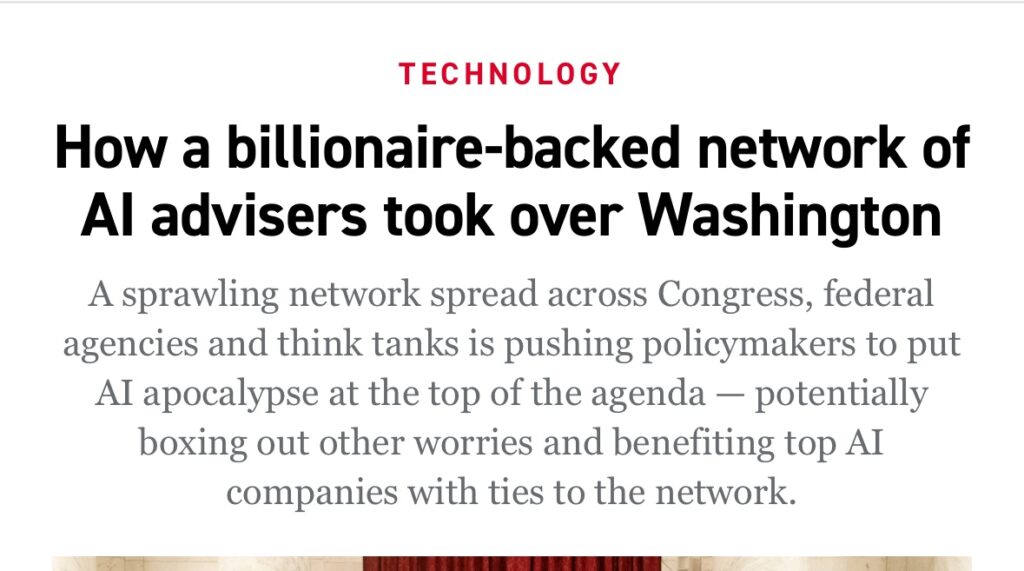
The sense of anger, frustration and disappointment in Silicon Valley startup circles over the current regulatory mess around artificial intelligence and compute limits is intense. #FreedomToCompute is resonating.

As with any new technology there are invested interests, naysayers, panicking and paranoia. Which would be enough to make us remember past battles over encryption and privacy. This time we’ve got the cherry on top of existential risk.

While I agree that artificial intelligence is a technology that will have many risks, I tend to think of them as of the more quotidian types like algorithmic bias. We cannot allow incumbent powers to centralize a new technology that can and should benefit us all.

Math and computing power are as essential as speech. In today’s world, they ARE speech. We may speak in natural language, but the way we extend ourselves, build things, and grow as a species is through our tools. Computation is a tool.

We oppose all attempts to restrict computational power and envision a world where we all have the right to build whatever we can dream.

#FreedomtoCompute Julie Fredrickson