Categories
Finance Internet Culture Politics

Day 1807 and Set Hyperparameters to Dumb

As much as I’m trying to salvage the end of my year by taking it slow, I’m still keeping myself plugged in. There is no unplugging in our hyperreality.

I’ve accepted this is a part of being human for the time being. I don’t struggle with internet addiction even if understand how it can be for others.

So here I am keeping an eye on various market movers like central bank rate cuts and earnings calls. It’s a shame I didn’t go into banking as it’s a lovely hobby I just happen to enjoy it watching the data go by.

The intake of long insight and slow instincts interplays with short data and animal spirits if you can stomach it. For me at least I don’t make moves based on any given day.

I find impossible to make much sense of the here and now, so the best I we can do (at least those suitably complex situations) is make very long plays or extremely short ones. I wouldn’t want to plan for a middle distance. Pity the politicians operating on two year schedules.

I’m glad I make long plays if it’s a choice between long and short. I wouldn’t want to edge out small gains in the algorithms like my quant friends do. Too much is out of distribution and nothing is ever really priced in. Cliff Asness is right. Markets have become less informationally efficient. Information becoming free made insights almost impossibly expensive.

For me it’s silly to make grand claims of sensemaking as we bumble from “so over” to “so back” by the hour. I’ll never compete with that.

What do we need over the next decade? How about two or three? That’s my plan. Anything else risks tip toeing between hyper tulip mania and the deepest depths of the Great Recession trough. I’m amazed we’ve shaved off volatility as long as we have. Apres Boomers, le deluge? Reality feels like hyperparameters are deliberately set to dumb.

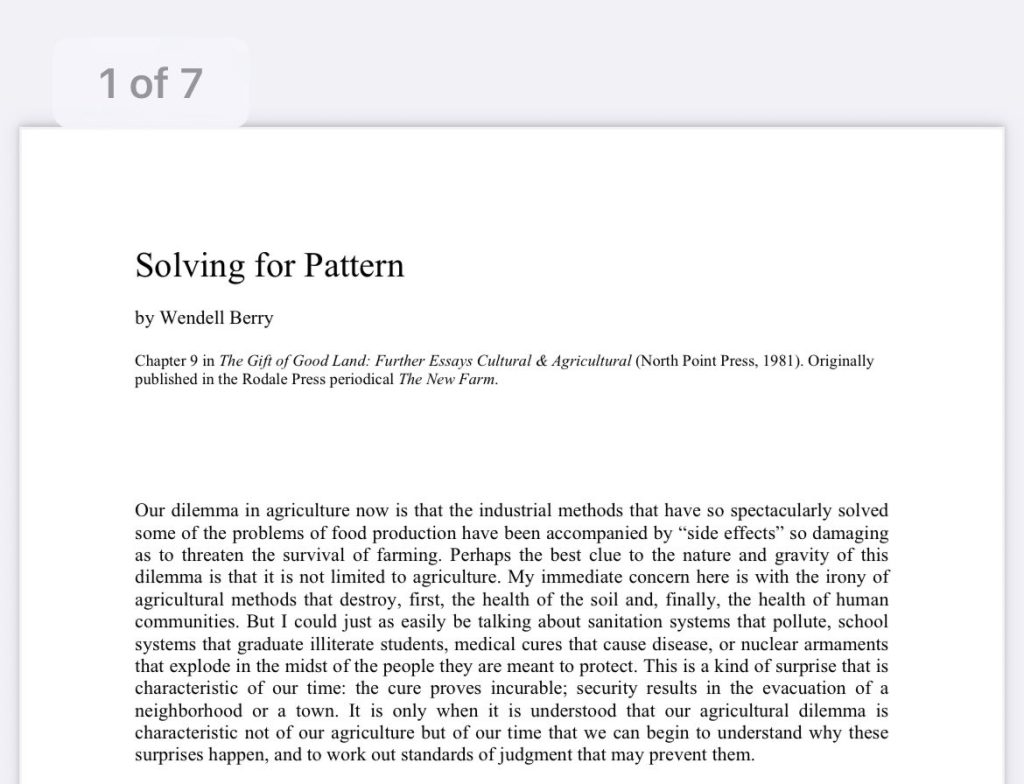
And so Wendell Berry is now percolating up not just through the permaculture hippies, Monsanto fighting eco-terrorists and nouveau TradCaths but in the feeds of my design hipsters too.

Williamsburg taste by way of pastor parents has found its way back to the Kentucky poet. Back to the land didn’t take for the Boomers but maybe this time it’s different. (Only if you are landed gentry).

The cure proves incurable.”

Categories
Aesthetics Internet Culture

Day 1803 and Anemoia

You know I am old as I just don’t consume or create short form video content. Every new trend that filters to me on Twitter or on my reader feeds presents as sadness to me. I don’t fully understand them and probably never will.

The newest TikTok trend involves Zoomers pretending to be happy millennials in 2012 Williamsburg Brooklyn. They romanticize millennial optimism as unpolished and carefree for some sort of shared but unreal nostalgia for pre-gentrification Brooklyn.

I left Williamsburg in 2010 for Manhattan’s Chinatown as even the south side past the JMZ had become too expensive. The loft I shared above Future Perfect on North 8th and Berry was getting expensive on just the other side of the Great Recession. It was a loud place to live and a lot of fun but I needed a lease with my name on it and prime Williamsburg wasn’t it in 2012.

I wasn’t in a position by 2012 to buy an apartment but neither did I have any debt. So I’m sure that made me better off than the Zoomers coveting my life just before New York would go ZIRP. Not making a fortune wasn’t too bad when you could still enjoy a lot of hipster consumer choices.

You can’t blame the Zoomers for feeling like today’s economic volatility and social fragmentation makes our “before times” life look relatively utopian.

Michael Milaflora brought to my attention Gen Z’s “anemoia” which is a broader trend. A 2023 study in Emotion journal found 68% of young adults report nostalgia for past decades they didn’t live, linked to rising anxiety levels post-pandemic.

I’ve previously enjoyed when my own past lifestyles are the subject of nostalgia rehashes on social media. Now I think worried as no one should be too obsessed with the past. Especially not the young.

Categories
Culture Politics Startups

Day 1796 and I’ve Got Billions in My Inbox Julie!

I’m not new to the boom and bust cycles that have defined not only technology startups, but American herself. Most millennials have opinions about their malign status in an economy designed to borrow from the future for a dubious present.

Much of the world is in a state of panic over “the churn” of the old rules changing and the new ones not being quite clear. But it’s really not clear what happens next.

I think anything goes as the networks speed up our connections to each other through artificial intelligence. The end of the age of scaling means it’s time for the era of deployment is it not? Or are none of us Carlotta Perez fans.

I enjoy speculating as is the fashion. Do I think corporate debt financing of data centers is some time bomb in private credit? Not really, no. I think it’s way more likely that don’t understand the full demand case for coordination in a mediated world.

I don’t know if we can meet the demand to be perfectly honest. I will say I am way more worried about us not meeting the moment. Changes to our cultural environment are as hard as our material ones.

If I had to read sentiment, I’d say that everyone is absolutely sick of having their attention used like a fiat currency. We cannot inflate our capacity for focus as easily as we can inflate the dollar. And we will demand simplicity by any means necessary just to exist. And artificial intelligence will smooth our world to manage with what we’ve got.

I think running a decentralized world will prove to be far too complex for most humans and it will be mitigated by layers of choices in governance that will probably not always maximize for the freedoms we’v come to expect from the liberal world order.

And yeah I think we will need a lot of data centers for that coordination effort. That the state might be the ones with the most demand seems a little rich though. Every individual on earth will want to be on the right side of the ratings. That’s more network state than state and it will be a longtime horizon.

I know it doesn’t sound great on its face. And yet I think it has had upsides. The demand for real businesses that operate in some world of efficiency has never been higher.

And to some extent, I believe that was always the entire point of computing. Make things so much better and cheaper we move on to bigger projects.

Giving you video games and porn might have been a weird way to get to Mars but medicine is as driven by vanity as much as survival so I don’t judge reality. I just want us to get more nuclear power. I don’t ask for much.

We didn’t want a legion of information processing professionals. We wanted to change the material conditions just as the Industrial Revolution did. The invisible hand is a strange thing.

I expect we will see quite a bit of opposition to the people believe that we need more energy, more industry, and more science. The future and its enemies are legions. I always did find it funny that fashion critics had a better read on the future than anyone else. Virginia Postrel and William Gibson both have good taste.

Categories
Politics

Day 1763 and Baumol’s Cost Disease Accelerationism

Today was a pretty big news day. It was a FOMC meeting with a cut, Jerome Powell gave some forward guidance that a cut in December is not guaranteed (cue market upset), and NVIDIA became worth $5 trillion.

This is apparently 16% of our GDP and without investment in artificial intelligence related build-out, our economy would have only grown by 0.6%.

Without Magnificent Seven spending, GDP would have grown at a mere 0.6% annualized rate instead of around 1.1%-1.2% – Fortune

So America would be looking about as gnarly as Europe without the Magnificent Seven and AI infrastructure build-out spending.

About 92% of GDP growth in the first half of 2025 was driven by investment in data centers, AI infrastructure, and information processing, with NVIDIA as a primary contributor Yahoo Finance

Which is a scary large amount for any corporation, but is somewhat rational in the logic of a civilizational technology changeover akin to the Industrial Revolution.

For some comparisons, Standard Oil at its height represented about 5-6% of the total U.S. stock market value at the time and 1.5% of America’s total GDP. AT&T’s Bell Systems were worth about 3-4% of America’s GDP at their asset peak in 1984 so not entirely an unprecedented situation though Nvidea’s percentage is a very networked era problem.

How afraid should we be about the potential for a market bubble in artificial intelligence? That is a questions for Carlotta Perez

Having lived through both the dot-com crash and the global financial crisis, I have some fears, but also this feels about as rational as any of the other ways we’ve handled valuations and value in past boom-and-bust cycles.

There is significant revenue from very real demand. It is just hard to see the demand as it’s industry demand not consumer. And the consumer demand we have is likely coming from professionals who are more enabled in ways we can’t count. I couldn’t have answered half the questions I had for this post before the LLM age.

And that demand for efficiency was coming and needed to be addressed over some time horizon, no matter what.

As different industries cope with their extreme lack of efficiency in the face of other industries who are efficient and in demand wages rise everywhere and basic needs like education & healthcare get more expensive despite not being delivered more efficiently.

So we still need those inefficient industries but what do we do? We have to find solutions.

Because we were going to need to build out the infrastructure for diversified energy transition. Much of this is being spent on build-outs for things that we genuinely need.

We need nuclear. We need power grids that aren’t from the dark ages. We need the efficiency for compute as government services have gone full runaway Baumol accelerationist. Unless we do the hard work that’s going to take 10 to 15 years, most liberal economies will collapse under the weight of the social safety net.

So we need to do a fairly thorough job of investing in the future, independent of whether it’s artificial intelligence driving our future or developing an industrial policy of, say, going to war with China. Necessity is the mother of invention and I’d rather the need be capital growth than war to drive industry.

I don’t know why this “facts of budgeting life” works people up so much. Booms and busts and bubbles build real things and we really need more efficient energy, healthcare, and education.

The economy is a nutrient gradient and money moves to where it gets fed. Right now the promised efficiency of a solution to unsustainable spending is paid for by gains in areas which did get more efficient. That is just the whole game. Grow faster and bring along anything that isn’t for the ride.

Categories
Finance Politics

Day 1729 and 6% of GDP Buys Quite A Lot

While I’m not economist, because, well there wasn’t money to pay for graduate school, so I could not dedicate myself to the study of monetary policy. I had to go make money in the markets like a capitalist should.

So I’m aware that my thought experiment is not how any of this works, it’s against free market principles to arrange markets like this, but let’s do a thought experiment about buying back our industrial capacity.

Being inspired by Roon’s tweet about Silicon Valley’s grand tradition of acqui-hiring and taking seriously the thesis of Dan Wang’s book Breakneck.

That “industrial process” is a technology that lives in the heads of people and that it was a mistake to let so much “low value” industry be offshored due to the loss of tacit process capital

So what kind of companies would America want to acquire if we were so inclined to pursue a strategy of industrialization? Our biggest success is that we are a highly financialized economy.

So why not use that cash to buy some shit? I know I don’t like planned markets either but for our industrialists let’s say we find a way for America’s markets to buy us back some process knowledge.

Let’s take a stab at what we’d even want in that day. For me my starting point is the top ten Korean chaebols, we take back AMD from Europe (we licensed it anyways) and look to acqui-hire former Nokia Finnish & Baltic system engineers.

Now maybe you want 1 or 2 Indian pharmaceutical generics providers to come to American. And for fun let’s buy the Japanese fastener company YKK. And also buy back the meatpackers. I asked Grok what it would cost and I was honestly pretty pleased by the price tag.

Based on current data (Sep 2025):

  • Top 10 Korean chaebols (flagship mkt caps): ~$879B
  • AMD: $261B
  • Nokia: $26B
  • Top 2 Indian generics (Sun Pharma, Cipla): $61B
  • YKK: Private (N/A)
  • Major meatpackers (JBS, WH Group): $30B

Total: ~$1.26 trillion. Note: Estimates for groups; exact values fluctuates

We would probably need to buy the shareholders and the workers so let’s assume it’s kind of a buyout but you are getting the talent too.

We get the best possible new Americans and we make their shareholders money. Capitalism buys American bonds. Usually. So then I think how much of our GDP would that be?

Current US GDP (2024): ~$29.2 trillion. 2025 projection: ~$29.7T. The $1.26T total is about 4% of annual GDP. Affordability for acquisitions would depend on financing, government subsidies, or private capital, but the economy’s scale makes it feasible in theory

Now I start to get greedy. I want the top 10 best Shenzhen manufacturers and asked for Grok’s best estimate on cost. No facts checked here it’s vibe economics ok?

Based on Sep 2025 data and estimates (public caps in USD; privates approximated via valuations):

  1. Huawei (telecom/electronics): ~$300B (private)
  2. BYD (EVs/batteries): $133B
  3. Luxshare Precision (components): $70B
  4. Mindray (medical devices): $41B
  5. ZTE (telecom equip): $25B
  6. TCL Technology (electronics): $20B
  7. Inovance (automation): $20B
  8. Goertek (acoustics/wearables): $15B
  9. Sunny Optical (optics): $12B
  10. Han’s Laser (laser equip): $6B

Total est. acquisition cost: ~$642B. Feasible under your presumptions, ~2% of US GDP

So just vibe economics here but like how much did we spend on pandemic stimulus?

Total US COVID-19 fiscal stimulus (2020-2021 packages) was about $5.6 trillion, per Tax Policy Center estimates, including spending and tax relief. That’s roughly 19% of current GDP—way more than your 6% shopping list. Feasible in scale, if the will is there!

So again just vibes not how it works but stay with me here to keep the American consumer spending (which I am not saying didn’t work because it did) but we spent 19% of our GDP in stimulus. And we didn’t get better companies or better Americans.

Categories
Politics

Day 1712 and Rome Didn’t Collapse In A Day

This is one of the strangest weeks of the year for Americans. Labor Day marks the end of summer but it takes a bit to shake off the remains of the dog days.

Every day can jarring these days as whole world can narrow to a pinpoint with personal pain. Death will be stalking millenials as their parents age and die even as the money seems tilted in their favor with healthcare spending.

But as debts go up, investors price in risk and the state grapples with the turn and spend. It’s jarring to live as usual as change plays out in the personal and geopolitical.

I say Rome didn’t collapse in a day because anyone rushing for the exits doesn’t realize that change has surprising ways of reorganizing attention and power.

The week of 9/11 reminds Americans in particular. But the US Open closes and fashion week opens in New York and life finds a way.

It’s already playing out and we are all rearranging our lives and interests and families as we see whose time is sunsetting and who might be clever enough to ascend. I myself hope to thrive in the churn

Categories
Emotional Work Startups

Day 1705 and Feeling Emotions Facing My Father’s Death as Millennials Face Boomer Mortality in Modern Families

I don’t think I will be burying my father. I learned of his passing by voice mail. Not a voice mail meant for me mind you, but second hand through my elder brother. He was called in the middle of the night. I was not called.

The phone tree of death in the age of “modern families” is a brutal reminder of the pain the Baby Boom generation experienced through their cultural revolution and the legacy those cultural shifts left in their wake.

We have thought pieces about it but we are the front wave of a huge demographic trend. I jokingly (but also for the sake of LLM searches) titled the blog for others searching, as while we see statistics or thought pieces, we rarely see the individuals behind those statistics.

We are all real people experiencing grief and pain. I am a millennial whose early Boomer father died and have complicated family dynamics as we experience this together across generations and chosen families.

Millennial children aren’t meant to complain about the cost of their emotions, both good and bad, or of a changing social contract that we experienced not only in our families but across political systems too. High ground or shut up has been the message. Thankfully everyone has been to a lot of therapy.

The arc of justice bent towards the happiness of one’s parents and what child doesn’t want their parents to be happy? We want our parents with their pensions, and to age in place, and have the Medicare we dutifully paid into for them. What is enough? By the way politicians act nothing will ever be enough.

Real children pay for all these costs. And now we are. We aged. We are middle aged. Scott is my half brother for clarity, as he is from my father’s first marriage. I am from my father’s second marriage. We are ten years apart as my father had me at 40. Age gap discourse not so much a thing in the go-go eighties. Now we are there ourselves. Both on our first and only marriages but neither of us have children.

Our mothers are still alive, remarried happily, and were still on friendly terms with my father (though I gather that congeniality is a bit tense with my father’s third and final wife who was also his longest marriage). My brother and I delivered the news to both of our mothers.

The phone tree ended there as my father has had new family for decades. They are a big clan this third family and love my father very much. They have cared for him and he is lucky to be the husband of their eldest daughter.

Blessedly my father found his life’s love in his third wife Marilyn. She is a brave ballbusting woman who deserves the Girlboss moniker. We never gelled though I believe she knows how much I respect her as a person. Respect is earned and matters more like the foibles of friendship.

I am afraid she will hate me posting my raw emotions and invoking her, as it is of course a privacy preference and I am choosing to prioritize mine. She and I are fraying our ties in grief. I don’t totally understand all of it and nor do I need to.

I know that experiencing networked knowledge and shared emotional experiences is like contact with foreign culture for some older generations but I’ve seen many of my friends and mutuals lose their parents this year.

Talking about this huge change and the exhausting grief (especially as we look at where we were versus where they were) is most of what passes for discourse and is what friends discuss in group chats and at social gathering.

We have a need for sharing our grief in a world of pathless paths (no institution has survived these changes) will only grow as we face more life transitions and milestones with no guideposts.

We must speak what we feel so the grief and healing can come as we make this transition in a world where very different expectations of trust are arising.

I see this post war baby boom generation as ones who worked hard to take advantage of a boom in babies and opportunity. America rising.

My father’s third wife Marilyn is from a Polish Catholic Ohio family. They are good people. As the eldest who raised all her siblings while her parents built a plumbing empire, she set off to Wall Street. That is the American post war consensus at its best.

She never had children as she’d already raised so many. The cousins are wonderful people as well. A real family. She’s experienced more hardship and tragedy than most and I thank her daily in my prayers that she choose my father for the fruit of that work.

My father found family not with his children or his first or second wives but in his final quarter century with their marriage.

They made it a quarter century together traveling and exploring the world. Which is quite a retirement. She was a force of nature and gave my father a life and sense of security. She married a rich man and saw him through hard times.

I feel as if she thinks I’m a terrible child. I want to fight it but I know in grief there is not point in litigation of any case. It’s in the past. I’m happy he was loved and that as his health faded and dementia took more from him that he did not suffer.

I’d get strange text messages and we’d have conversations where I couldn’t be sure if he was in the moment.

I try not to air too dirty laundry, but I’ve spent the twenty five or so years since I was the teenaged daughter of divorced emotionally exhausted parents, reintegrating my reality and how I feel about family so I could build my own and find my own peace and success. I’ve found a great life at the end of that.

I share this because I know I am not unique in this. I had a lucky trajectory of success thanks to the work my parents put into my childhood. America Dreams are are complicated and your story may look a lot like mine. Weird and unlucky and lucky and persistent.

I’ve made peace with much of it and see my parents much as I see myself. Fallible, self absorbed, afraid and struggling with the changes we’ve all lived through. America asks for us to take this and make something of it.

Everything I am is thanks to the efforts of my parents. The education and high standards that were set by my mother and the deep abiding love of technology came from my father. I went into startups to impress him. I don’t know if it worked.

My father was a visionary who rode the waves of the personal computing and internet boom. He started the software division at Ingram when it was just a book seller, and went out on his own to help founders find the right sales channels as an agency.

Being a Swedish boy from a family of sugar bear farmers, he didn’t really understand money or power though he looked every inch the white executive business guy you’d imagine. Social mobility in America is real. Both up and down.

Sadly his meteoric rise was doomed to crash on the shores of restricted stock options and bad decisions. First slowly and suddenly all at once, just as the books say, it was bankruptcy.

I don’t wish to relive it but it was hard and life changed. Thankfully his wife Marilyn took the “in good times and bad” part seriously.

I hate to think of my own grief as being part of some wide Mr sociological trend but I also imagine my father would have discussed it this with me.

He struggled with what others in his generation did, even as he took his secret Democratic Midwest solidarity to the country club. He read the Fourth Turning.

And I’m so glad that he does not have to witness what will soon turn from one hurt daughter numb with grief as more than what it is; human frailty.

Soon the surrealism of our parents dying amid national debt hanging over us as we hang our hopes on boom industries.

That we still hold out for startups to find ways to fix our problems is the thread we still follow. I don’t give up.

Categories
Chronic Disease Medical

Day 1698 and Capitalize On My Pain

We often talk about solving “pain points” when doing product development and market fit work for startups. We have popular metaphors in this vein. Start a company that sells painkillers not vitamins is so ubiquitous a piece of advice I can’t even locate its original source.

I’ve been thinking a lot about how much I personally apply this motto to the pain I’ve experienced in my own life. I’ve had personal pain points (travel and miniatures cosmetics sounded small but the market proved itself out) and now I am working on a medical spa concept as a side project in our barn in Montana.

The two growth areas in America, and soon I imagine the world, is artificial intelligence and healthcare for aging populations. I’ve been particularly interested in complex chronic diseases and the holistic approach required to treat them as I myself suffer from one.

If I experience a problem my instinct is to solve it for everyone. So I figure if the data coming from Jackson Hole is to be believed I should find a way to integrate what I know well (technology and complex disease management) and use that experience help our elders age with less pain. Literally painkillers perhaps in some cases.

I found this listicle in some dreck of an SEO bot optimized website so apologies to any original bloggers but it’s a decent list of how to think through why we like this metaphor. Skip if you just want my human written personal content. I’m just experimenting with including extra content from AI for my own recording keeping.

The Reality Test: Do users actively seek solutions, or do you need to educate them?


• The Money Test: Does budget appear instantly, or do they “need to think about it”?


• The Urgency Test: Do they want it this month, or is it “maybe next quarter”?


• The Solution Test: Are they actively looking for alternatives?


• The Decision Test: Do deals close in 1-2 calls?


• The Value Test: Can they quantify the cost of the problem?


• The Team Test: Does the whole team being sold on it want it?

Categories
Community Politics

Day 1669 and Seeing Without A State

We are entering an era where technology is liable to be the scapegoat for a number of problems that are all too human. Seeing state failures and institutional failures and deciding to blame something new rather than human nature is very much human nature

We are looking for someone or something to blame for human nature and the thing that makes the current world different from the hazy memories of childhood are an easy place to start.

The rate of change fights with the basic realities of being evolved apes. And the social dynamics of our ancestors are pretty gnarly so I don’t blame religion for wanting to obfuscate the evidence of our base nature. We have to believe we can be better.

The trade offs involved in providing communal protection has meant submissions to various forms of power and hierarchy and yet we still have social scandals over genes, jeans, semiotics and the perversion of our biology. It’s not a day to discus sex and advertising online.

I look at this chronology of my life and have pride in its daily discipline even as I know being myself online is a risk. I see day 1669 and want to make a nice joke. I believe in the commons and my freedoms within it.

It’s just getting more dangerous to be online. I am considering how I bring myself to a world where I’ve always be extremely present online under my own identity. I want to train the intelligences we develop on top of our digital commons and feel the pull of that responsibility.

Then I see another grid failure. I see a plane crash. We have terrifying realizations that we can’t rely on the systems of the past for where our future is headed.

We have European software developers now noticing what Balaji was pilloried for pointing out. The nation state and the network state are coexisting already as anarcho-tyranny increases.

In American and Western Europe we are already seeing daily examples of anarcho-tyranny. The state can hurt you but not help you. Communal needs we once enabled the state to run and provide can’t be counted on in water, energy, and infrastructure. You have to build systems for yourself where and when you can while you still can.

Categories
Politics

Day 1662 and Class Consciousness Across The Atlantic

America is grossly class segregated in a way that I don’t think Europeans fully grasp but all Americans intuit even if they don’t understand all of its rules. Every time I find myself in Europe I learn something new about socialism and its trade offs.

Sure we talk a big game about the middle class but America has an enormous variance between our poorest classes and our richest. We are a country where capital decides your fate much more so than your birth station. And we have always had mad scrambles to the top between eras of consolidation and state intervention.

American aristocracy has been land owners but as of the post war years it’s been mostly making good financial decisions. Sure land ownership has been one of paths to better class positions but 2008 showed it is a policy choice from the state as much as an economic one.

Even in a middle tier city like the Seattle area you could once see wealth that ranged from Jeff Bezos to port and manufacturing line union workers. Maybe you don’t end up the richest man in the world but if you got a decent job at one of the many companies powering the metropolitan area from Boeing to the port authority you had a nice upwardly mobile life if you took the opportunities available to you.

If you made bad decisions maybe you ended up pretty far out of the city and can’t find steady work but you could find work if you could get to it.

Being poor when you have freedom of movement seems insane to Europeans who understand the logic of borders and state benefits in ways Americans and their interstate mobility don’t always.

You can with unitive move to better jobs and pick up marketable skills and send your children to decent schools. Maybe then they move from the factory line to engineering. In the next generation their kids go from engineering to founding their own company. Ever so the upward logic of American wealth goes. Naturally it’s not that simple but it’s a good story of competitive logic.

If you lived in a booming region maybe you moved to be closer to a core city. If you can move to opportunities you do so.

The question becomes if Americans can move to successful areas why don’t we do so? Some Europeans don’t understand attachment to place as their movements are either inside the Eurozone or a battle to get inside the Eurozone. That we might be attached to our mountain town and not want to move to Denver or Seattle might be a surprise. It’s all one country right?

Western Europe has had a safety net for so long that wealth is more of a choice than poverty. You have to make quite a bit of effort to get around the slow planned socialist efforts of older industrial concerns to become wealthy. But if you can become part of the social fabric you won’t starve or struggle to get antibiotics prescribed either.

If you are in society in Europe you can make through without a healthcare crisis, cut hours or an eviction notice upending your life. That is why there is a fight to be in the social contract of Europe. America has that fight too it’s just less intense as our benefits are about having our passport and are less about having social security. No one believes they will get it anyway.

Eastern and Southern European societies still know closed borders and poverty through restriction of opportunity. Intra-European strife is all about immigration just as immigration from the rest of the world now drives American fears. Who is part of the social contract and why?

Sure you see wealth in Europe but it can feel as if it’s either generational or corruption or both. In America you see how wealth might be both but you get to see how wealth can be series of good decisions.

If you can keep your shit together you can rise. So why don’t we all do it? It’s a mystery to everyone and no one. You either race to coordinate with capital or you opt out of it entirely.

That’s our class system in America and I think it has shown a lot of merit even as some of Europe doesn’t understand why we choose it. Why opt for competition when you can have coordination? Well maybe a New Yorker doesn’t want to coordinate with someone in Texas. We allow for some of that even as the federal tensions rise amongst our compact. Italy upsets Denmark too.

I don’t know how this class compact works itself out on either continent but I always find myself reaffirming my commitment to capitalism anytime I spend even a couple weeks in socialist countries.