Categories
Aesthetics Media Travel

Day 2007 and Notes While Airborne on Condé Nast Traveler or My Life Commodified Without Pay

I wrote these notes while a little bit high, both literally (a transcontinental flight) and figuratively (CBD & a THCa blend meant to give anti-inflammatory relief without hitting your mind but it probably does) but it’s hard to say if I’m less focused than when I’m on the ground. You be the judge of that. Nostalgia machine clicks on

Business class and its perks are lost on me as I don’t drink alcohol. So I had rhubarb and raspberry tonic water in whatever passes for cut glassware on airplanes now. I said no at the fancy lounges to very decent champagnes but I don’t want to get dehydrated. I got a sugar crash instead.

I’m listening to Ethiopian jazz as I find this piece relaxing in the context of airplane travel. Mulatu Astake is a master in a genre I don’t even like but this particular piece has always spoken to me.

You may know it as it was featured in an episode of the Bear where a pastry chef is sent Copenhagen to study at maybe Noma. I’m annoyed that a cuisine and a composition I used for marketing fifteen years ago is now the stuff of prestige television. 

Nobody paid me for the diffusion but I was paid for the original campaign. A lesson for anyone bitching about how their work wasn’t compensated by the artificial intelligence models that ingested their contributions. 

I brought the chef for a pop up event for Club Monaco sometime in the early teens before he was a full blown sensation (and well before the fall).

How funny that I should manage a Club Monaco Facebook page involving a pop-up event for a chef that would go on to define so much of culture.

I worked with impossibly cool creative director on the account who was famous in Japan for his photography and also as the guy who made Pabst cool for hipsters. I sometimes wonder where he ended up when his talent set was so hype sensitive.  But we were pretty ahead of the times on this one.

Before this fashion agency career, in the post GFC aughts, lived across from a weekend installation of a projected light Pabst installation when I was in North 7th and Bedford.  My Turkish banker roommate and I used to throw raves there so we couldn’t exactly complain about the lights hitting our living room. But it was a good campaign in a good location.

I shot low budget fashion shoots during the day with a very competent hungry young editor. She worked as a waitress at night and for me during running our fashion editorial to get toehold in the business. It seems to have worked.

She has an amazing career, a handsome husband, a beautiful child and kicked it off with an impossibly stylish wedding which every hipster you knew copied till well past the Tommy Hilfiger event horizon of having no soul. We had a tortured Swedish nepo-baby photographer too.  I adored him. It was a very “rents were cheap” time in hindsight. 

Anyways, in transit through Heathrow, I picked up a raft of print magazines from the Cathay lounge which kicked off this nostalgia. I’d browsed Wallpaper but as I’m not a design person a flip through was fine.
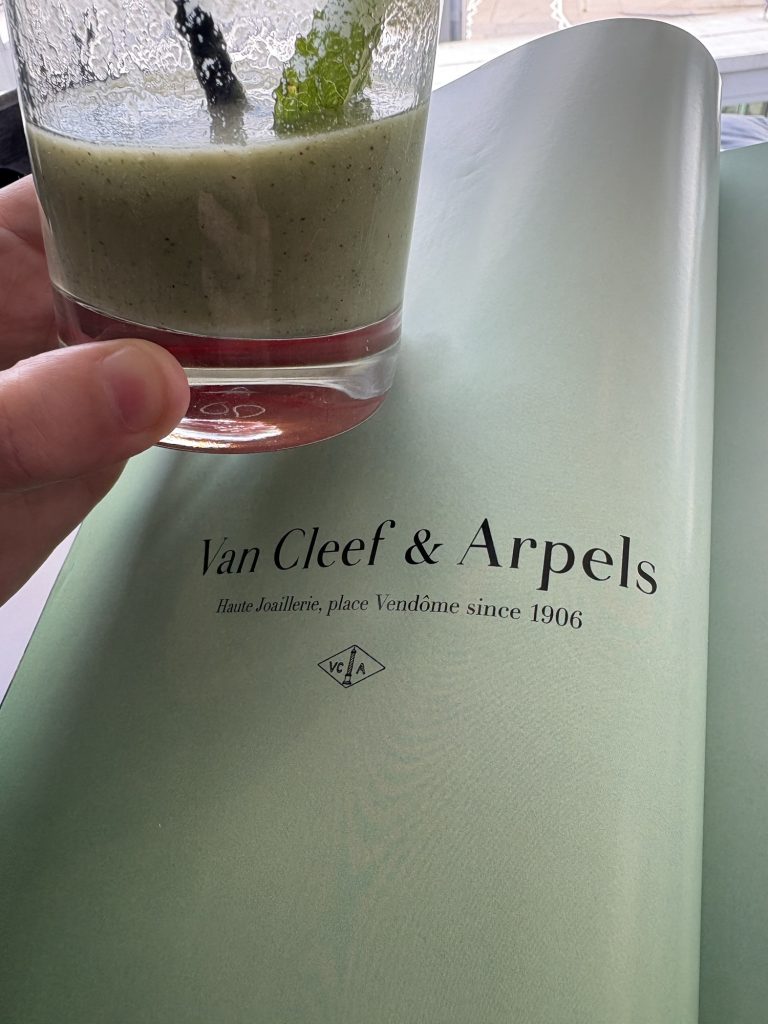
The Cathay Delight is the same shade as this campaign from Van Cleef and Arpels.

But Condé Nast Traveler caught my eye as I went in to grab the pink Financial Times. I got Tattler as well as why else fly British Airways if you can’t get some gossip on this social hierarchy right?

It’s just that taste is so far down the commodity chain anymore it’d hard to know when and where to find any thing that’s not made to be sold to someone. The menu on my flight had basque cheesecake. That became a joke on a trip I threw together last minute for girlfriends in Corfu. Apparently it’s made it into the Club World menu much to its detriment. 

The choices from Condé Nast on a perfect summer was so on the nose. Montana’s Rocky Mountain sybarism and off the beaten path Adriatic and Ionian options for exploring covers and lots of seafood.

The whole damn thing reads like my travel itinerary.

Yeah that’s my coastal move with friends and family. And I do rather loudly live in Montana. It’s like am I joke to their psychographic team? A department that has three people no less. And they only market to women exactly like me. Funny that. I’ll have to check up on their old editor Lilit. She was much better than whatever this nonsense of repackaged Julie seems to be.
Categories
Biohacking Culture Travel

Day 2003 and Till the Sweat Drips Down Europe’s Nuts

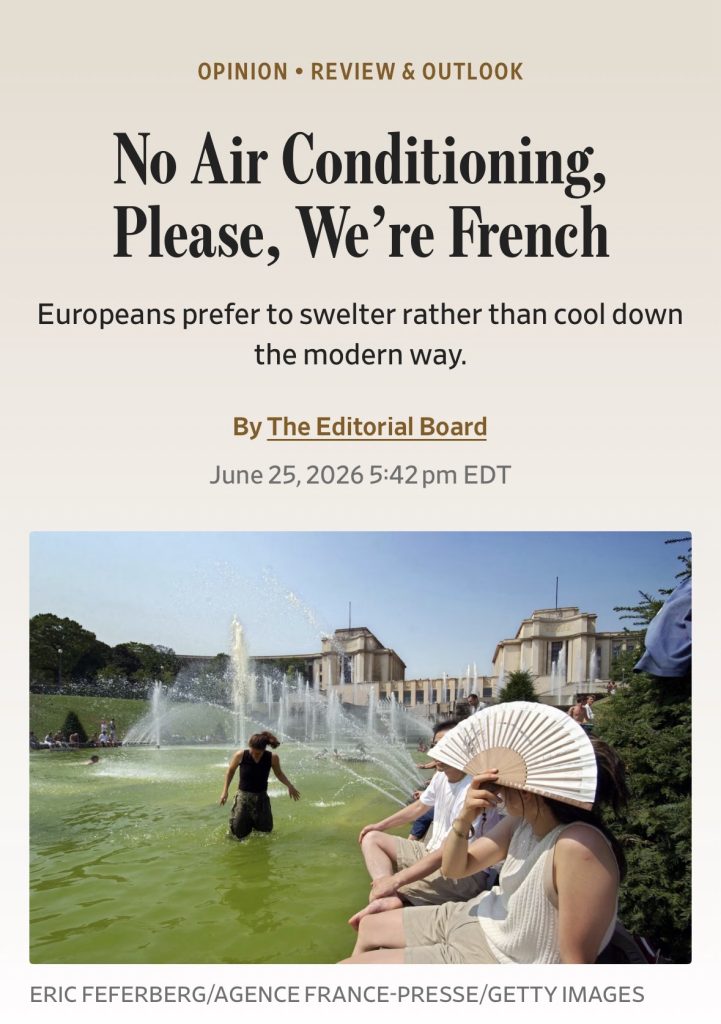
Few topics of cultural exchange are more more humorous (and occasionally anger inducing) to me as an American with a disability than European heat waves. And Europe is in its worst heat wave apparently ever at the moment.

The persistent resistance of the French, Germans and British to installing air conditioning and updating their cities to manage climate change seems to wobble between old health superstitions and smug moral superiority. Eastern Europe and Southern Europe do not suffer from this issue.

The WSJ editorial board shared this information from France’s ecological transition agency. They are slowly being convinced that the death tolls and hospitalizations that heat waves produce may need mitigation.

The French ecological transition agency said in May guidance that AC may be necessary for the elderly, chronically ill or pregnant. But if you really can’t live without it, use it in only one room of your home, and don’t set the temperature below 79 degrees Fahrenheit. That’s because AC uses too much energy and contributes to climate change.

I prefer to sleep at 20C or 68F. This partially because my sleep & biometric tracking apps as well as my physician recommend a cold dark room to achieve the sleep required to keep my health stable. The 26C recommended by the French for us chronically ill types? It is 79 degrees Fahrenheit.

Yeahhhhh almost ten degrees warmer than my doctor recommends. No thanks you. Even at 72F if I’m down to my socks (always sleep with socks no really) and my underwear I’ll still find myself thrashing under just a top sheet. I once had my neighbors attempt to call the police on me for running air conditioning during a notorious heat wave in 2023 in Frankfurt. It was a noise complaint. Sure.

On my most recent European trip, I brought paper fans. Not electronic (though I did bring two of them as well) but the sort you languidly wave yourself with in an attempt to look cool when in a desultory mood. Which never seems to lift in this heat. It actually does look rather chic and the movement of the air helps.

I brought the pharmaceutical storage grade ice sheets used for shipping injections that have granulated particles that bond with ice to keep them cold longer.

I strap the ice inside a travel vest with dozens of pockets or wrap them around pressure points on my feet, ankles, wrist and neck with scarves when I’m particularly overheated. I’ve seen people do this with socks filled with rice and water kept in the freezer as well.

I have those goofy towels that absorb extra water and keep it cooler that I wear around my neck and head to go under the several wide brim hats I travel with. I always swear SPF 50. A sunburn is a nasty way to bring on heatstroke. I also bring my own ice trays to freeze ice cubes for both drinks & a bowl over which my hand fan blows for faux AC. I’ve dampened cotton sheets over open windows at night with a fan in to create evaporative cooling. It’s not AC but it helps. That’s why I carry two charger fans.

I will also chill wet wipes and my cosmetics. I carry small misting sprays with me everywhere (I like the classic Mario Badescu Rose). I have even mixed mint essential oil into my travel-size aloe antiseptic gel. My soup is peppermint as well to give that feeling of cool. And I always carry few rehydration sachets of electrolytes.

I’ve made friends with these techniques pretty regularly. Hydrating salts and a water bottle refill is a good conversation starter. Because as much as the French fear drafts for their health with artificial cold the Germans seem to think it’s a necessary part of life to suffer the heat (as if we don’t have enough heat in hell) everyone is suffering and needs help to get through this kind of extreme heat.

The only person who makes sweat dripping down his balls sound appealing is Lil’Jon in Get Low. And even he said at the Democratic National Convention that it’s time to get low..er temperatures. So to Europe I say get cool or you can have deez nutz. Let’s all get lower temperatures together.

Categories
Aesthetics Culture

Day 1999 and We Are Going To Party Like It’s 1999

I’m so old I viscerally remember the Y2K panic that ate up the emotional bandwidth of the American media class who then stoked fear into the hearts of the doomer classes from system administrators to evangelical millenarians.

I was very much online during the Y2K era though I didn’t start blogging (unless you count girly message boards or Geocities) till much later. I was however happily a cybercore hippie girl. If you want to feel jealous and are a Zoomer, I owned a teal iMac G3 and iPod. So I it delightful that a younger generation has decided to dust off some of the silliest times of my youth and refurbished them into Instagram and TikTok aesthetic trends.

What is less funny is how much past fear mongering over technological doomsday scenarios look exactly like our current ones. I remember the simmering fears, the debates over types of damage, and extensive coverage of weirdos who were preparing for a kind of end times.

It feels familiar to how very extreme our reaction to artificial intelligence is being portrayed by both the media and its wildest singularity evangelists. I say this as someone who readily calls themselves a doomer so it’s not a milieu that’s foreign to me.

Here is a brief synopsis I patched together from a Perplexity query with links included if you are too young to remember it.

The Y2K crisis was the feared failure of computer systems when dates rolled from 1999 to 2000, because many programs stored the year with only two digits and could misread “00” as 1900 instead of 2000.

In practice, it became a major prevention project rather than a disaster, with governments, banks, utilities, and other organizations spending years fixing code, updating hardware, and testing systems before midnight on January 1, 2000.

The most dramatic predictions were widespread power outages, banking collapse, transportation shutdowns, and chaos in critical infrastructure, but those outcomes did not materialize at midnight. More extreme claims, such as nuclear systems failing and detonations occurring, also did not happen.

Instead, the world saw only limited glitches, such as small database errors or minor local issues, not the civilization-level breakdown many feared. The unusual part of Y2K is that success looked like nothing happening, which is exactly what the preparatory work was meant to achieve.

So here I am on Day 1999 of writing every single day, and I’m waiting to turn over into my own 2000th day. I have no anticipated bugs for that event. I stayed up till midnight with my mother walking the main street of our town with a bunch of others waiting to see if anything happened. Nothing did so we drove home.

But it’s enjoyable to remember the kind of disasters that were predicted with such anxiety ended up being problems we worked our way through. We keep at problems by naming them early. Humans intervene and we change our behavior. That’s something you celebrate about us as a species.

I am excited to have achieved such long tenure of daily public writing because much of it covers we have worked our way into a new panic that I’ve been watching for over twenty years. Singularity thought and the extropians have been part of my daily internet diet for quite some time. I think we will find a way to survive this too. Though I grant it sounds a bit more complicated.

I’m sure 1999 me would be proud of the strange futurist I became in my adulthood. I doubt she would have expected that I’d be investing in nuclear power or that I’d have managed a career in cosmetics as a side quest. This is actually a side quest another nerd pursued. I don’t even wear makeup in 1999. I occasionally do in 2026. But if I need to party my way into the singularity I’ll probably at least wear lipstick.

Categories
Media Politics

Day 1991 and At A Wellness Retreat

Does anyone else remember when a congressman was off the grid for a few days and his staffers claimed was “hiking the Appalachian Trail” when in reality he was on vacation with his mistress? That story fell apart rather quickly, but remains my shorthand for silly excuse.

I may need to update to reflect Politico’s reporting as this is a funnier flimsy excuse from the White House as to why communication between Anthropic and the administration has been hit or miss during the Fable release and export control saga

Following the meeting, the administration attempted to reach Amodei but was told he was unavailable because he was attending a wellness retreat, one of the administration officials and the senior White House official said. 

A spokesperson for Anthropic rejected the claim that he was at a wellness retreat, saying, “this is absolutely false.”

I don’t, as a generally rule, take what public relations professionals say at face value without knowing them personally as their job is to protect the principle.

I might trust an individual publicist but when in doubt verify before you truest. This is true for both Anthropic and the current administration so all parties are now annoyed and suspicious.

Ironically I am enjoying some time on wellness activities this Sunday myself. I wouldn’t call it a retreat but I did take a swim and read Europe AI 2031 under an umbrella. So let’s call that as close as I will come to being on a wellness retreat at a point of crisis in the AI race.

Categories
Finance Politics Startups

Day 1983 and Socialism is Bad

There is a lot of chatter as to the eventual ownership makeup of the frontier artificial intelligence labs and their economic surplus. One question that came up this weekend is whether equity in the companies should be owned in some portion at the nation state level. I am opposed to this for a host of reasons that I’ll try to get down in whatever garbled form.

I do not own a stake in any of the frontier labs other than owning ETFs that own Magnificent 7 exposure who own portions of the labs. I do invest in compute, nuclear energy and cryptography. I believe AI will change a lot about how we do business, my revealed preferences show I live remotely in Montana, I have a tendency toward emergency planning and Plan B scenarios. As a disclosure of my priors.

There are lots of competing interests in this and the self interests from the labs does no any favors. Especially after months, nay years, of overwhelmingly hyperbole about changing labor dynamics, the potential for mass layoffs due to automation as well as obfuscation and excuses about the reason for layoffs in existing companies. And that’s before we get the singularity which is a religious orientation toward making super intelligence that is Godlike in its framing.

I hate this entire conversation on nationalization and socialism. Part of it is that state actors desiring ownership of private companies reeks of the “you didn’t build that” malapropisms from Barack Obama’s presidency in which he attempted to articulate that America’s enormous wealth is built on generational compacts that no one individual could ever own outright. It triggers socialists and capitalists both.

We all contributed in our own ways to the shared infrastructure, institutions, education, cultural norms and the pluralism embedded in our governance systems that enabled the American Dream.

Unless you are a deep partisan, you understand Obama was trying to articulate that none of us made America alone. But the framing from liberals (and populists of all stripes) automatically make this conversation concerning.

Economics is complicated, central planning has a hell of a body count and your average American can only gesture towards the invisible hand and the benefits of self interested commerce. It’s easy to sell us bad policy from envy and fear.

So I must ask why are we acting like we have suddenly won a national level economic boom with clear winners whose spoils must be distributed by the nation state before we’ve even managed to understand how it will be used, at what level an AI model is a commodity and where the benefits will accrue?

Self interested pluralism with a system of checks and balances at the national federal level coupled with states exercising their own interests has been the bedrock of our national success. Changing this has not gone well for us as a nation nor do we have better examples in other nations.

Sure America has had a few twists and turns. The last time we made an attempt at a New Deal post Great Depression worked only thanks to a global world war industrial mobilization in which we won the war and all our other competitors were decimated on bombed our continents across massive geographical boundaries.

And that boom has been largely spent by the children of the generation that fought this war and their children are looking at a pretty significant bill. So why do labs suddenly want to “compensate” Americans and our collective contributions to the models?

And why are politicians taking this bait when we have so little insight into whether we should funnel cash into them in order to own them in trust for some nebulous future?

I have a few reasons in no particular order that I put on Twitter as to why I am opposed to this format of American state equity being the means through which we compensate the people who theoretically trained these models with our output on the wider open web and its content.

1) We don’t know who the winners will be or where the benefits will diffuse (as in post liquidity the current winners might not be the eventual winners) so compensation for model training when the eventual benefits disperse elsewhere isn’t ideal. Why aren’t taxes at state & federal level aren’t adequate enough here should be answered before we make moves

2) Existing IP law doesn’t account well for culture which is a shared co-creative process (i recommend Susan Scafidi of fashion law institute “who owns culture” ) so compensation is already not easy to track back

3) A state entity w the monopoly on violence can do a lot of damage on the margin by not fully understanding who created what and where it is applied especially in non deterministic systems

4) Much of what the models were trained on was open source licensing including the company where my own family made money Stack Overflow. We got paid sure, but none of this would exist without the effort of its users who contributed on those open license terms. But clearly the final value of the content created & company’s value itself were harvested much further down the line in enterprise contracts for coding models. It was not in the management of an open source license community product created by users or managed by engineers, so who should have been paid? The users who wanted their content to be open sourced? The volunteer moderators? The full time employees? The shareholders of the company, the buyer of the company or the users of that data set at Claude or Cursor or OpenAI? Or is it Americans that never even heard of SO? Where does value accrue over time versus point in time? It’s not an easy question to answer is it?

Categories
Culture Travel

Day 1978 and In And Out of Reality

The “circuit” of conferences, events, parties and social goings on can make you feel like a consummate insider or give you social anxiety. For some of us, a given circuit is an exercise in social overwhelm, and for others it can be highlight of their calendars. It takes all kinds.

The “circuit” is a part of life for every industry. For some it’s a bit more glamorous; oh yes I’m off to such and such fashion week for cruise. And for others it’s much more pedestrian. A cash bar with drink tickets in a Courtyard by Marriott surely does the trick for state level budget professionals.

At a certain point, you realize there is always another room and a better party and a circuit inside the circuit and you get rid of the highs and lows of the experience and simply learn to live with the iron law of the circuit and schedule life around various aspects where real life and circuit life intersect. Everyone is on some part of the circuit.

Many places are aggressively part of the circuit. My hometown of Boulder lobbied hard to take on Sundance from Park City. I was just in Deer Valley above Park City for a new crew of energy policy folks. Swapping Hollywood schmoozing for nuclear energy seems like a wise move though I don’t know how Boulder will handle an event of that size.

Meanwhile, I learned that Athens is booting up a new technology conference that I just missed. Right before summer high season is an excellent time to bring folks down to the Mediterranean before jumping off to private islands and yachts.

I wonder about other mainstays on the circuit sometimes. Austin won’t host SXSW forever one imagines. But where should it go and should it split up? March will never be the same.

Burning Man is changing, maybe forever, and even storied camps are selling their vehicles. It’s a great week on the circuit and that time will surely be coveted. If I were Wyoming, I’d been keen to extend folks out from the Federal Reserve contingent within the western region but one doubts Nevada coordination with Wyoming is a top priority amongst old party hippies and economic enthusiasts, but you better believe the overlap includes a few folks.

Not that the circuit is a geographically constrained issue for most people on the most serious aspect of the circuit. And if it is you probably fly private or have excellent transit logistics. Bouncing from Fashion Week to Word Economic Forum isn’t a huge stretch if that’s your world.

I’m thinking about the circuit because I was on a chunk of business that was circuit related most of the spring. There was a brief pause in international traffic as the Iran situation worked itself out but everyone seems to be back to normal travel again.

The friction of coming in and out of reality is surreal. The circuit is not exactly part of normal reality as if you only participate in a few events it is the unreality of your calendar which makes it so special. If you live entirely outside of reality, it’s not quite so special.

I myself always find reality special but the dip in and out of unreality is jarring. I find one foot in each is hard to manage. I’m in unreality at the end of the circuit. And I need to reach again for reality even on vacation in unreality land.

Categories
Aesthetics Politics

Day 1971 and An American Pope Meets Effective Altruism

To my Catholic friends, I sincerely hope today brought you closer to your faith. It is my hope that you received comfort from Pope Leo XIV’s new encyclical, Magnifica humanitas: On Safeguarding the Human Person in the Time of Artificial Intelligence.

I myself look forward to reading all 42,000 words of it on an airplane tomorrow. My reader application’s AI says it should take me two hours and thirty minutes. Already the tools have opinions on my study.

I can’t say I fully understand the relationship between the knowledge and teachings put forth by the Pope and a Catholic’s personal faith.

I have very little exposure to Catholicism that isn’t entirely academic so please do not take anything I say seriously or personally, as I’m a mere Protestant.

The Vatican said that Leo had signed the new encyclical on May 15, 135 years to the day since the pope’s namesake, Pope Leo XIII, signed the landmark encyclical Rerum Novarum (“Of New Things”) on the rights of workers amid the Industrial Revolution. I understand is a crucial modern document in Catholic social doctrine

I read his namesake’s encyclical long ago when I studied economics in Chicago (not very far from where the Pope himself studied) so I am looking forward to comparing the documents once I have had a chance to read the new encyclical.

It’s very hard to have an opinion on a document written by a faith leader to whom I do not defer myself so please hold your judgement as I have held mine.

Without careful study I hesitate to say much beyond my initial impressions of the media circus surrounding the encyclical’s release and the social context of several attendees of the event around the signing.

The document is officially addressed not only to Catholics but to “all people of goodwill,” calling on us to seek the “protection of the human person in the age of artificial intelligence.”

I feel this is an invitation to us all to consider the document seriously. Silicon Valley has been anticipating its release for sometime, with both excitement and trepidation.

We have seen venture capitalists speak on fears of an emergent technological anti-Christ and the role artificial intelligence might play in eschatological matters.

There has also been a significant amount of discussion over the last several years as to the role a movement which calls itself effective altruism has played in the development of artificial intelligence.

In particular, there is concern as to whether the movement itself has become its own theology complete with a singularity eschatology.

I make no secret of my concerns around the EA community, its scandalous financial frauds and its intellectual roots in Benthamite utilitarianism.

They aim to be “less wrong” and take a rationalist approach to moral questions. At first glance this appears to be a kind of technocratic solutionism but has millenarian tendencies in singularity thought.

Several years ago an internecine split developed in Silicon Valley with a faction “meme schism” jokingly calling itself effective accelerationism. I myself professsed a preference for their approach as I am neither a utilitarian nor a rationalist.

E/acc encouraged an approach to technological development which focuses the benefits of material progress in reducing human harms while warning of the harms of the precautionary principle.

Neither are real philosophical traditions in any meaningful sense, but rather competing narrative memetics that came out of the diverse group of technologists making industrial progress from nuclear to computing chips and algorithms.

My concern today came from the highly visible corporate representation at the New Synod Hall in the Vatican during the press release. Past encyclical rollouts were normally handled only by curial officials. This was much flashier and included the Pope.

Further, the Vatican chose to highlight large language model developer Anthropic, and one of its many cofounders Christopher Olah. Both the man, and the corporate entity he represents, are part of an explicitly effective altruist world.

That only one frontier lab with a very particular viewpoint was put front and center as an emissary from the technical community may end up sending an unintended message. Or more worryingly, a very deliberately intended message. Only time will tell.

Categories
Aesthetics Internet Culture

Day 1958 and Skymall Kities

My father loved gadgets. He was always tinkering with something and was always upgrading his electronics to some new specification.

Is it any wonder that I married such a handy husband? Men love futzing around with stuff. Sometimes they have daughters and then you’ve got women like to mess around with projects too.

I am sure we will have endless rounds of nostalgia for the eighties and nineties era gadget, electronics and novelty shops. You could get lots of mileage out of building your own computer.

But even setting up something silly from Skymall or Sharper Image captured some of the joy. The novelty of a new invention was visceral. I wouldn’t say no to a Hammacher Schlemmer renaissance myself.

I didn’t love it when we remade that style of retail into quirk chungus millennial fandom but I didn’t hate getting Star Trek tchotchkes either. And now I dearly love websites that my friends have built like WireCutter.

My husband was humming the tune to a piece of YouTube esoterica that is a deep cut to the original editor of that bastion of shopping guides. Choire Sicha launched the WireCutter but it’s in some ways the least soulful of his franchises. A Mike Albo shopping column already nailed the bit we’ve just been redeeming it since then.

Choire gave us Gawker 2.0 before his his incredible era of independent publishing streak making properties like the Awl and the Hairpin.

In a world with more shops and essayists than good shoppers or readers, Choire found the good ones and shared. And one of his discoveries was Nina Katchadourian’s work.

And so now my husband sings the tune of SkyMall Kitties and he sometimes can’t get it out of his head.

Maybe that is my own submission to the “thing I think about too much” essay franchise. It’s my own personal Negroni season or Supreme’s clusterfuck of totally uncool jokers.

I’m sure we will enter an exciting new era of curating down the perfect piece of cultural detritus with artificial intelligence. But I will always be grateful to electronics dads and savvy buying guides for teaching me to enjoy the joy in making something. Even if it is profoundly uncool. I’m still team Barbara Kruger though. Don’t believe the hypebeasts.

Categories
Community Politics

Day 1949 and Swimming in the Contextless Sea Beyond The Dock At The End of History

There is a popular theory that Zoomers and Alphas are struggling with temporal context in culture because their consumption of culture is decoupled from the context in which it was made and consumed. It’s all one long scroll without the punctuations of reality.

The general theory goes that post internet generations see niche algorithm-driven content rather than say cultural or historical touchstones. Past touchstones might have unified past generational experiences.

I don’t know if unified experienced are all good. Sure all of the Boomers have heard the Beatles but all millennial woman recall tabloid headlines about Britney Spears getting fat. The water we swim in can be hard for us fish to spot.

If the younger generations have a problem, it’s being far too unified in their experience of their global position. The pandemic was a surprisingly effective reboot of expectations for all of us. But the older you were the easier it was to contextualize the impact of the pandemic across your entire life.

We all ran a dress rehearsal for collective responsibility at global scale And depending on your personality, you were funneled into perspectives you preferred.

So you saw us either shoulder or shirk responsibility. Not that other generations haven’t had to do some version of this, but being able to see it at networked global scale seems to have done something to the capacity to see the future.

You swim in a sea of history and at any point you can get out of the water. But you jumped off the dock is at the end of history so you can see how getting out might be a problem.

McWorld triumphed over Jihad right? But that is content for a paid Substack where Fukuyama and Zizek both still write. It must have been more convincing in hardcover.

Categories
Startups

Day 1936 and Life Inside The Jackpot or I Remain An Optimist

I did not expect to spend so much of my time on politics. Or maybe that’s the wrong word. I look being in voluntary service to American governance as my civic obligation. It can look like politics even when it’s mostly trying to be helpful to the running of our polity.

After 2016 I felt regular citizens like myself needed to recall Kennedy’s patriotic inaugural address from 1961. “Ask not what your country could do for you, but what you can do for your country.” America is a complicated place but we get a say in it. And I’d like to help people understand what I know so it might be useful in serving America in very strange times.

My mother loved Kennedy’s profiles in courage. Boomers have beautiful mythos on facing the new world together. He was the first president born in the 20th century. The social compact of America changed quite a bit then. I wonder who the first president born in the 21st century will be. Maybe it will be another young Catholic man.

The optics of progress aside, it was clear as a new generation in Kennedy’s era took on a new obligation to come together when the American experiment felt at risk. So much about who benefit from the military industrial complex rested in the transition from Eisenhower to Kennedy.

I think the context is a little different when progress feels inevitable. Our moment is scary. Though the Cold War was not primarily optimism. They experienced as many breaks with institutional trust as we do in 2026.

Tines are different but I do not think the prescription is different. We owe it to each other to embrace change together. What can we do for America?

I am not the son of a mobster nor am I a nepo-baby of America’s great cultural surplus. I wish. I’m not presidential material or Tiktok star material.

I do have some singular cultural advantages. I am a regular person from slightly unusual circumstances that happened to enjoy some upwardly mobility which let me to participate as an equal in an important transition point. I am actually rather surprised to matter at all. But I do and I intend to advocate for America succeeding together in this change.

I do take technology as a force in society seriously. I believe surplus is an amazing thing. My life is completely different than my biological history. Given how my human DNA was programmed and what I can do daily beyond that you bet I take artificial intelligence seriously. Material progress is real.

I take the physics of demand seriously. It seems like not everyone is confident we can speak to the general public about what it means that the technology industry has found a way to automate itself. It is a scary thing to say. And we begin with ourselves. It is actually our jobs that go first. If we believe it can be better on the other side of the Jackpot live like it.

And I do. I live a little further from civilization for the peace and quiet and because I am a little uncertain. But artificial intelligence’s new incredibly malleable models have changed my capacity by an order of magnitude. How wish I could have had this when I was a software and cosmetics founder.

I am a heavy user of all the hosted commercial models because they are in fact very good. I can do so much more across all the areas of life where I have to figure things out on my own.

I have health problems that are expensive and challenging. I’m lucky to be able to explore extensively the web of issue that drive having a body which has decided it must overreact. And I am in the process of fixing it. In ways that I’d never have had access to before Claude or ChatGPT. I have comfortably setups in spreadsheets and web apps and we can map years of bloodwork and experiments.

I think America is having an autoimmune reaction to the idea of automation as the end product of artificial intelligence. We sense it as a threat and it’s both terrifying in its potential but also a bit of the optimism has waned as the culture of technology fails to engage the mainstream as normal or even beneficial.

It’s the same process of making life better we have run. We took all our brain power to make our physical jobs easier. This has largely been viewed as a benefit to everyone except by strict biological determinists. Bronze Age romanticism is just that.

Thanks to progress in mathematics, we can now make knowledge that was extremely expensive to find, query, and organize as as accessible as asking an expert a good question.

Which is actually still tricky. Most Arthurian legends seem to resolve on knowing what to ask in order to receive wisdom. Knowing what to ask is not easily solved by mathematics. It’s not actually a cheat sheet but rather a powerful way to enable yourself. If you wish to take on that responsibility.

I feel I am somewhere between Hill and Valley in that I work in this world and I chose to become civically engaged. And I am concerned about where we are at. I am genuinely an optimist though as I think humans are so very adaptable. So I try to translate between the tribes who run our system and the tribe of people who make the systems run by the first tribe.

Maybe it’s be being somewhat in between that lets me be a node between the hill and the valley in America. Or as others frame it as a tripartite of Athens, Jerusalem, and Silicon Valley. I think that’s a bit grandiose only because maybe empires run on roads and plumbing but let’s not get forget that power is diffused in a network era. Every node that can route information has power.

The criticisms technology rightly takes from our body politic is that we are going quite fast. I know. I am inside the Gibsonian Jackpot with you. And I know it’s hard to believe that living through the change can be good even if we have inklings of the way life is already better right now. So we have to work together to figure it out.