I am a stricken by the malaise that comes with minor injuries. Yesterday I had some dental work done (with a laser) and today is all wretched inflammation.
An affliction that requires recuperation gets me down as I can’t say I’m really miserable or in much. I live with worse pain whenever I flare with my ankyloysis. I just feel pretty shitty and my brain is slugging slowly through the muddy waters of stress toxins.
It’s m the mixture of stress, antibiotics (doctor recommended prophylactic course given my soft tissue infection risks of my biological injection) and the tide going out in the cortisol. Being flooded with cortisol is not just a meme.
And so I don’t recommend being this in this state, but you also need to do proper care and maintenance of things like healthcare. And your teeth are a core part of this. After a certain age you can’t just ignore problems. And so I’ll be on Twitter as I can’t concentrate well enough to do much useful today. And my husband will kill me if I do any more cosmetic shopping.
I mentioned yesterday I needed to get my lower left molar 19 fix up. The filling placed there long ago by a dental student wasn’t holding up well and looked pretty nasty
A warning for the squeamish that I am going to post before, during and after photos. If things like gums, blood, funky messed up teeth close ups are upsetting to you this is where you should stop.
I was schedule for an hour as molar 19 needed a new filling while 20 was also looking a bit funny as well. First they carefully numbed the left side of my mouth which always feels weird. You feel no pain just pressure. Which is an experience I’ve had a few times this year.
A cleaning was required as well as a cool laser which smelled like popcorn as it zapped out the damage areas.
These hard‑tissue dental lasers (mainly erbium) ablate tooth structure by rapidly heating water and hydroxyapatite in the tooth, “micro‑exploding” tiny amounts of tissue rather than cutting mechanically like a bur.
Erbium laser preparing teeth decay for a small filling on 19 and 20
These systems are typically used for small‑to‑moderate decay especially when soft tissue injury is concern. These lasers can mean less pain and less anesthesia is needed.
A composite filling matched exactly left my teeth looking as good as new. My mouth is still a bit numb but I’m glad to have things fixed up with relative ease. Now I can only hope the healing goes easy as well.
I have always been fastidious when it comes to dental hygiene. I floss twice a day, I brush morning and night. I always carry dental picks for good measure.
I didn’t earn enough for steady dental care in my younger years so I knew my habits would have to carry me. But I did have a few tricks that helped me manage in my twenties. I would volunteer my time as a patient at the NYU Dental Clinic.
Not only were you not charged for procedures but you’d learn a lot as students went through clinical hours and professors lectured using your mouth as the live lessons.
I thought this was a pretty good trade for low stakes maintenance work like cleaning but I let them do more involved work including a filling on one of my molars which I’d cracked.
Fifteen years later that the crack which has been filled needed a little maintenance. A another crack had formed and it was looking a little unaesthetic. I was experiencing some dull pain so I decided to get it looked at. And it’s a good thing I did.
For a brief moment there was concern that the nerve in the tooth had died. I should have felt more pain than I did. But the cold test cleared it up. I don’t think I’m healthy enough to manage a tooth being pulled and replaced with my immune suppression medicine.
As I explained the filling’s provenience and just how old it was, it became clear that it needs to be redone. A bit of it had edge over to the back molar I’ll get two teeth filled.
A filling is a treatment where a dentist removes decayed or damaged tooth structure (sometimes it’s a cavity others a crack ) and replaces it with a material (like composite “white” resin, metal amalgam, or other restorations) to restore shape, strength, and function while preventing further decay.
It’s not a crown so the title is a misnomer but it is a bit glorious that one can get care from students and have it hold up for so many years. It’s always something in the maintenance and care of one’s body and I tend to prepare for the worst.
It’s just clear that some people are enabled to bigger, better and faster output thanks to rapidly advancing tools coming from the foundation model companies.
Will Manidis is on hot streak of essay writing (aided by artificial intelligence in the best way) and has produced thought provoking writing at a great clip. I love nothing more than seeing an exited founder feel free to express their views at their fullest. I’ve written about his essays in the past and suggest following him.
“I left with an unsettling feeling that I had seen a vision of the future that I wasn’t supposed to see. A country that had gotten extraordinarily wealthy but stayed coherent to its pre-industrial identity—a country that didn’t turn into a museum, didn’t paralyze itself in amber, but became a modern, functioning, wealthy nation that did not feel like it had been strip-mined of itself by the money.
In the West, we really have convinced ourselves there are only two options for our post-economic future. You can be Shenzhen or you can be Athens. … Shenzhen is the city that chose money over place so completely that it deleted itself.
…Athens is the opposite failure, and I say this as someone who is at least Greek enough that I feel like I won’t offend anyone. Athens chose place over money so totally that the city itself is a mausoleum”
A photo from Will’s tweet essay on visiting Oman
I don’t know much about Oman and I make no claims to understanding its politics or histories but I too think about what we lose without a sense of place but am also fascinated by the liminal zones of the hyper future set against a past we are actively forgetting. And no nation is immune from this process.
I do however have two books to recommend if the topic of place, continuity and the future interests you. One is a work of fiction and one a photography compendium whose forward was written by my favorite author.
Photographer Greg Girard’s work documents Asian cities in transition, especially Shanghai and Kowloon, was closely associated with William Gibson, who wrote the foreword to Girard’s book Phantom Shanghai. Gibson is the father of cyperpunk. And I contend that his near future fiction gets quite a bit right about how close the dark past is to almost arrived future. These images were shot in 2007 and yet the outlines of the super cities was already energy
The premise follows a protagonist’ traumatic life as a a radicalized agent of terror preyed on by different foreign influences living in a refuge camp in what was once Georgia.
It rhymes with both Will’s essay and with William Gibson for me. In a review of the book, they quote Faulkner “the past is never dead. It’s not even past.” And as these examples all show us, cyperpunk was born in Some Dark Holler
I spent most of yesterday on an airplane. I flew nearly 12 hours along the polar routes to go from Heathrow to America’s west coast. I flew British Airways and was disinclined to spend the many pounds for internet access.
Alas this meant I missed the rollout of the joyful flight of one of my favorite investments. Valar Atomics began its journey from California to Utah just as I too was flying. Me and the reactor I angel invested in were both up in the air like bluebirds and sunshine.
HILL AIR FORCE BASE, Utah, Feb 15 – The U.S. Departments of Energy and Defense on Sunday for the first time transported a small nuclear reactor on a cargo plane from California to Utah to demonstrate the potential to quickly deploy nuclear power for military and civilian use.
The agencies partnered with California-based Valar Atomics to fly one of the company’s Ward microreactors on a C-17 aircraft — without nuclear fuel — to Hill Air Force Base in Utah. Via Reuters
I tear up just thinking of the incredible accomplishments of millions of people coordinating together across centuries that these technologies represent.
It’s easy to think of ourselves as being small in the vastness of time and space. I almost cannot believe I was handed such gifts in this life, but I can claim a small but early part in Valar’s story.
U.S. Energy Secretary Chris Wright and U.S. Under Secretary of Defense for Acquisition and Sustainment Michael Duffey on board a C-17 cargo plane that transported Valar Atomics’ Ward nuclear microreactor from March Air Force Base in California to Hill Air Force Base in Utah, at the Hill Air Force Base in Utah, U.S., February 15, 2026. On the right, with the American flag and the Valar logo on his jacket is our CEO Isaiah Taylor
Just a little over three years ago I sent Isaiah a message on Twitter. We had a lot in common and I felt a kinship with this young entrepreneur. It was before he had even begun the incorporation work on Valar. He was working on something else, but I trusted his quiet intelligence and admired his humble inquisitiveness. We kept in touch as he mapped out his path.
His lack of ego instantly marked him as special, as it meant he could hear even the hardest criticisms. His fortitude was clear. He could incorporate what was necessary into his mission, a skill usually developed much later in life.
It’s rare to build trust so early on, and yet we both did. I told him I’d back anything he did so long as he was the CEO. Little did I know just how lucky I would end up as his very first backer.
You might think you will have doubts in high risk early stage investing. But I’d be lying if I said I didn’t believe in him from day one. I knew he was on a mission bigger than any of us. I knew it and he knew it. For God and country as they say.
That faith was required, as it was tested in rapid succession again and again over the next three years. Chewing glass is part of every startup. Even when you go as rapidly as Valar has gone, there are harsh conditions, brushes with death, and moments of utter joy in between.
Not only did we write a first check in the angel round, but in tight spots before the seed closed we wired follow on within minutes when a concern about a cash flow question arose. We put together special purpose vehicles. Nothing could jeopardize this mission. I’d invest more if I could.
We weren’t always the ideal investors as we struggled to showcase to bigger and better firms our conviction. Not too long ago it was all about being asset light and software as a service. Thankfully the execution always outshone the skeptics and we were ahead of the times. And while the skepticism was fierce, Isaiah never wavered. Neither did I.
And you can better believe that I am looking forward to July 4th this year. We promised the president we’d be turning on the reactor, so there is much to be done between now and then.
Even the Department of Defense (War?) is writing swan songs about Valar from the Pentagon Twitter account
At March Air Reserve Base, California, yesterday, a next-generation nuclear reactor was loaded aboard a C-17 Globemaster III aircraft for transport to Hill Air Force Base, Utah. The reactor will eventually head to the Utah San Rafael Energy Lab for testing and evaluation.
The Ward 250 is a 5 megawatt nuclear reactor that fits into the back of a C-17 aircraft could theoretically power about 5,000 homes.
For military use, such a reactor could provide energy security on a military base ensuring the mission there need not depend on the civilian power grid, and in military operations overseas, such reactors would mean U.S. forces could operate without concern that an enemy might cut fuel supplies.
A reactor such as the Ward 250 also means greater energy security for the entire United States. It is firmly in line with President Donald J. Trump’s executive orders to reshape and modernize America’s nuclear energy landscape.
The president signed four executive orders designed to advance America’s nuclear energy posture, May 23, 2025. Those include “
Michael P. Duffey, the undersecretary of war for acquisition and sustainment, said the partnership between the War and Energy Departments is critical to advancing the president’s nuclear energy initiatives.
“It’s clear to me that advancing President Trump’s priority on nuclear energy depends on close coordination between the Department of Energy and the Department of War,” Duffey said. “This partnership ensures advanced nuclear technologies are developed, evaluated and deployed in ways that strengthen energy resilience and national security.”
The future of warfare is energy-intensive, he said, and includes AI data centers, directed-energy weapons, and space and cyber infrastructure. The civilian power grid was not built for that, and so the War Department will need to build its own energy infrastructure.
“Powering next generation warfare will require us to move faster than our adversaries, to build a system that doesn’t just equip our warfighters to fight, but equips them to win at extraordinary speed,” Duffey said. “Today is a monumental step toward building that system. By supporting the industrial base and its capacity to innovate, we accelerate the delivery of resilient power to where it’s needed.”
Secretary of Energy Chris Wright said that with small reactors like those transferred from March Air Reserve Base to Hill Air Force Base, the United States is aiming for a nuclear energy renaissance.
“The American nuclear renaissance is to get that ball moving again, fast, carefully, but with private capital, American innovation and determination,” Wright said. “President Trump signed multiple executive orders that have unleashed tremendous reform of all the things that stopped the American nuclear industry from moving.”
Part of that effort, he said, will mean that by July 4, three small reactors will be critical — or running smoothly.
“That’s speed, that’s innovation, that’s the start of a nuclear renaissance,” Wright said. By
I have a little bit of childhood anxiety around packing for having moved around a lot that has alas never left me. Many people having anxiety about flying so at least it is a bit relatable but I don’t know if packing anxiety is as common.
For me it’s not about being in the air but rather leaving behind an established base for parts unknown. Will I be able to find medicine for issue that arise or soap that won’t trigger eczema? What if I need to appear at an event requiring a dress & makeup? What if I need to walk for two miles with all those things?
Every time I pack I go through the same routine and I use the same bags with the same labeling system to manage all the permutations I might encounter. And it is a science.
I have a small pajama bag I carry in my backpack in case of an unexpected overnight or long delay. I carry small clear vanity case to clean & groom myself with full allergy protocols that passes even the crankiest Heathrow checkpoint. I am prepared.
I carry on my person a a small pill bag with every detail labeled that can handled medical incidents big and small along with my first responder certificate. If you have an issue on an airplane you want to be seated next to me.
From there in my carry on suitcase I label the packing cubes with every item I bring, from underwear to wrap dress and ballet flats. Everything that is packed in my larger Tumi that gets checked is also labeled and I place an itinerary on top as I find my bags opened more frequently than seems reasonable.
There are no questions from the TSA or the most belligerent customs agent that won’t be immediately cleared up with minor inspection. Now with artificial intelligence I can translate my labels on the fly into any language.
Despite this clarity and organization, I admit I’ve had a few amusing incidents. Once through Heathrow I unsettled a British Airways agent with my fiber and protein powder baggies. Because clearly middle aged woman would smuggle in a quart sized baggie of cocaine in her purse.
I really wish with all the travel I do and my very strict system that this would all somehow take a little bit less time than it does. I generally allow myself two days to pack as I like to check and double check as it’s an iron law that things will be forgotten. And Montana is remote enough that if I forget a fancy serum or a favored sweater I won’t get a replacement easily. We only just got a Sephora this year.
I am however headed for a large American city that has absolutely everything I could possibly want in short order. So as I leave behind a European home base where I do keep things on hand (I didn’t always but extended family has been kind to me) I feel much less pressure this time. And still somehow I will allow myself to let it take more time than I’d prefer.
I let something fester for far too long. A family member had some health troubles that were not immediately threatening and I didn’t want to push them. They promised to see to it after a lengthy set of other issues were resolved.
Well, now the list was all finished or at least that is the rationalizing we are all doing around it, as it’s gone too far to be left alone. And it has to be seen to with a surgery.
Now they are healthy, young and the damage can be undone with a little science but I can’t help but feel I failed them. I knew they were leaving it to fester but the first rule of medical ethics is informed consent. The patient chooses even if you think you know better. This goes for doctors just as much as family.
And so here I am feeling guilty that I knew they were putting it off based on actions that I was partially responsible for resolving. They kept pushing it off citing this and that needing to be done first.
Now budget was an oft cited reason and I aid on that to some degree but it was really about a whole tangle of issues or managing till it was unendurable. And I don’t control their endurance or capacity to tolerate discomfort.
I know I couldn’t have done anything to force the issue, especially when the pride of an individual is concerned, but I still feel like shit about it.
Why couldn’t I have pushed forward the other issues and projects to rid the excuses? Why wasn’t I more forceful insisting they get it looked at sooner?
You know how guilt works when you have some responsibility but no ultimate say in the doing of the deed.
Not only did they let it fester but now it will fester with me as I try to forgive myself for something I couldn’t have changed. The body is sovereign and it wasn’t mine so I better let it go and help them recover.
Yesterday I wrote that I had no gas in the tank. Today is not much better. I am barely keeping my head above the proverbial water line. I finished a major purchase which I thought would give me respite for a few days.
Alas changes in destination, an emergency dental appointment for a family member, and the promise of rest was more like a promise of fretful semi-consciousness.
After days of rushing around seem to have swept me off my feet and into bed I still am not quite rested.
I thought I was mended yesterday but it seems as if I’m on the second day of exaggerated sleeping patterns with long arcs of sleep in the wrong places and times. Add in a bit of overheating on top of it and something feels off.
It’s not unusual for me to absorb major changes and shifts throughout their unfolding via some migraine induced osmotic pressure. I feel the animal spirits and global vibes push in past my physical limits and I shut down. I hope I’ll reboot soon.
People tell stories of where they were or what they were doing when major world events happened. Most of them are silly and personal but necessary to ground the horrors of being connected at scale while still being such small bit players in the scale of things.
On 9/12 I had just left New York City to return home to Colorado to finish out the high school I’d dropped out of the year prior. My grandmother called me at dawn before I’d left for the annual start of school camping trip, distraught that we couldn’t reach cousins and other family who were first responders or worked downtown. Then we couldn’t get through for hours.
When Lady Diana was killed I was up early for a sports competition preparing my gear when the news broke. My mother and I watched in shock at 4 in the morning as we packed bags.
When Michael Jackson died I was in Miami on my first solo vacation between jobs having sublet a condo for two weeks while I sublet my New York apartment. The grocery clerk at Publix ringing me up asked if I had heard. I attempted to explain that I’d seen it on something called Twitter.
When Jeffrey Epstein didn’t kill himself I was in the hospital. I had been entirely off social media but still listened to the five minute radio news update. I don’t know why but I told my doctor that he was dead and her immediate response was to swear. I recall us both being upset as she shook her head saying “now he will never face justice.”
The entire weekend was a deluge of people processing, concocting, and turning over the “flood the zone with shit” dump of files on Epstein. As if the Friday night “take out the trash” media playbook somehow still held sway over a population of networked humans.
Now we are a species who remember every Harry and tragedy both personally in the context of our own small lives and at large as it emerges into a wider understanding shaped by the contours of those who seek to distract or draw attention.
It’s no wonder we spellbound by conspiracies. I lived across from ground zero for years. Tourists grieved and paid homage next to soap box schizophrenia weaving tales. I grew up on forums dissecting every aspect of death and tragedy from princesses to the King of Pop. Why should the coverage of depraved sins be any different?
So I ask myself why should I believe any of it. Who should I give information dumps and theory threads and newspaper headlines any attention at all? I’ll never know if crimes were punished. Justice works slowly and sometimes not at all.
The world is a topsy turvy place and I am doing my best to meet it head on. Physically I’ve managed a surprisingly steady period from December through January, even though I spent a decent portion of that on the road.
I credit this mostly to using antibiotic and anti-fungal regimens prophylactically. The biologic immune suppressant I currently take for my ankylosing spondylitis is quite frankly too good at its job. And I’ve tried quite a few.
That means I am locked in a battle of constant vigilance in order to keep my inflammation numbers down while also not becoming a host to bacterial, fungal or other infections. It’s a balance that is anything but delicate.
In 2025 I had been unable to fight off skin, soft tissue and mucosal infections seemingly at all. Even with extensive protocols for decolonization (intranasal mupirocin, chlorhexidine washes, environmental decontamination) I had four major infections.
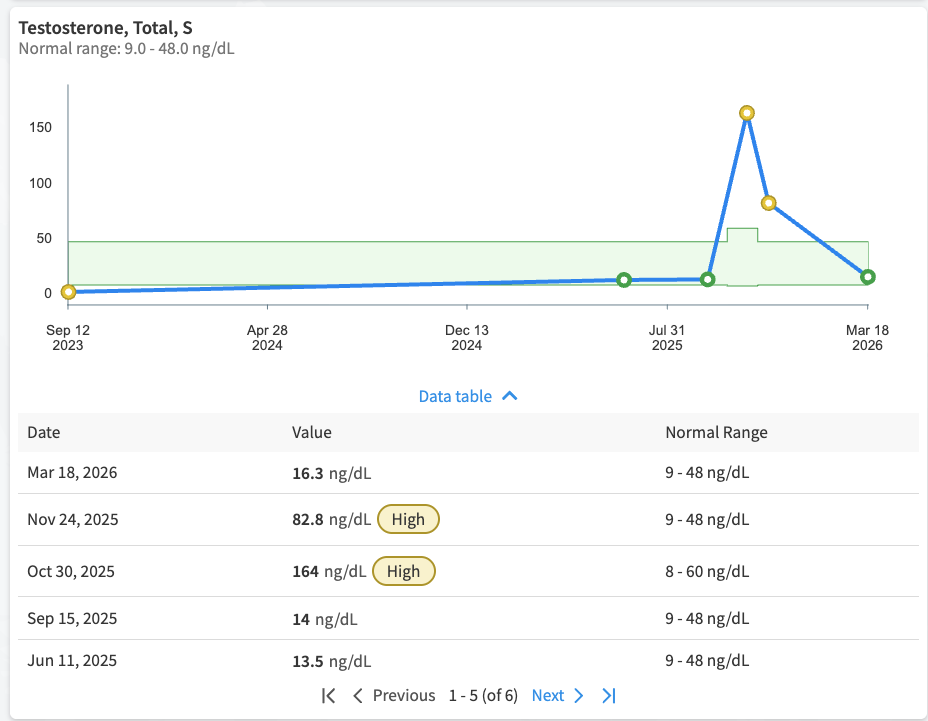
The last one (testosterone) helped quite a bit with energy but being energetic doesn’t matter much if you can’t fight off infections.
So while I know there is an individual and social long‑term systemic risk in using antibiotic prophylaxis, I will say it does seem to be helpful in mediating say outbursts of allergens flaring into soft tissue infections from skin breakage or having exposure to molds and fungal growths that fester in old damp buildings and water systems creep their way into any opening available.
Since it is always something, I figure I need to always be trying something. Frankly I am over the push and pull of managing medical care in America. It’s a mess and mostly designed at risk mitigation for the health systems.
I have found going abroad to be much more useful and cost effective in many cases. I may even find that it would be useful to document the experience in a format beyond a blog as I doubt I’m the only person manage complex chronic disease.