I have complained in the past about the slow degradation of quality standards in contemporary fashion and the negative consequences it has had on quality for consumers who are not in the top half of the K-shaped economy.
The shrinkflation and reformulation that’s rampant in food has hit clothing quite hard. And has made much easier to justify simply buying fast fashion that’s disposable simply because the quality bar for even beloved basics like L.L Bean has gone down.
I actually sent a note to the Chief Merchandising Officer of Gap, who, of course, did not email me back, about the loss of a particular pair of basic straight-leg black cotton sweatpants. I asked if it was possible to bring it back, as I had discovered a number of other internet complaints about its discontinuation.
The sweatpants had cost somewhere in the realm of $30 for a decade, I owned at least a dozen, and have now worn them all out entirely. They were cotton with just a hint of elastane, very lightweight, and the ideal pant for sleeping and home wear.
Now you find pants that are 30-40% plastics of various blends that promise super soft or super drape-y silhouettes consumers don’t know or even mind that the clever branding of “scuba” pants is just marketing for thick polyester knits.
I’m not against some of it. Somewhere between 2% and 5% works just fine for most fabrics, but I’m up to 10% for some garments as I’ve got boobs to work around. However when things are close to your body, particularly in the intimates category, 100% cotton is absolutely my standard.
To be clear, I have no problem with technical fabrics and am a great fan of innovators in that space, from Uniqlo to Norma Kamali, both of whom I wear. I do care about using the best possible quality in any given category. I also look for that in my wool, silk and leather goods.
This is all a somewhat elaborate setup for the fact that, having been sick in bed for the last week or so, I spent a lot of time browsing Quince.
I have not successfully found garments from them to work, though as a regular reader of things like Wirecutter and The Strategist, I notice when their items get put on lists. Or when people are skeptical of its promise.
The idea that you should be able to get something high quality and tasteful is, alas, becoming a luxury. Even when you spend full freight. A Substack called Magasin today seemed excited when most pieces were “under a thousand” when despite doing alright, I am entirely an under $300 shopper for most items. Coats and bags I’ll go higher but I’m not crossing a thousand. I’m from the industry I know what this costs thanks.
I am also no stranger to the direct-to-consumer world. I was a long-time shopper of Everlane as their founding team was close to me. I’m also a big fan of previous attempts in the category, like Italic, to bring the factories that we in the fashion industry know so well closer to the consumer.
However, I don’t think any of us expected the category winner Quince. That we would get one giant sourcing machine whose entire philosophy appears to be that merchandising is unnecessary. They will allow whatever the market pulls forward. On to the website and take customer demand pulls from there.
Which I suppose I’m going to have to get used to, because why hire a merchandising team when you can just make the market do it for you? Unfortunately, the market isn’t always as good at the job as somebody who is actually a capable market editor or a top merchandising manager. It’s maddening for many consumers to have no sense of quality, fit, style, color or other characteristics we might like from an online retailer. And yet here we are.
So I did something insane. I went through the entire women’s section of Quince. I scrolled through shirts, skirts, pants, dresses, sweaters, blazers and layers, accessories, hand bags and shoes. I didn’t set out to do it as I just added on what I thought might work for me to see if this was part of the appeal. The sense of hope was always there but it was easy to spot where corners had been cut and the reviews are often hit or miss unless it’s a definite best seller.
I ended up selecting what I thought would be a comprehensive capsule wardrobe for what fashion calls pre-fall. It’s the maddening middle season where you have to layer but it also can get very hot.
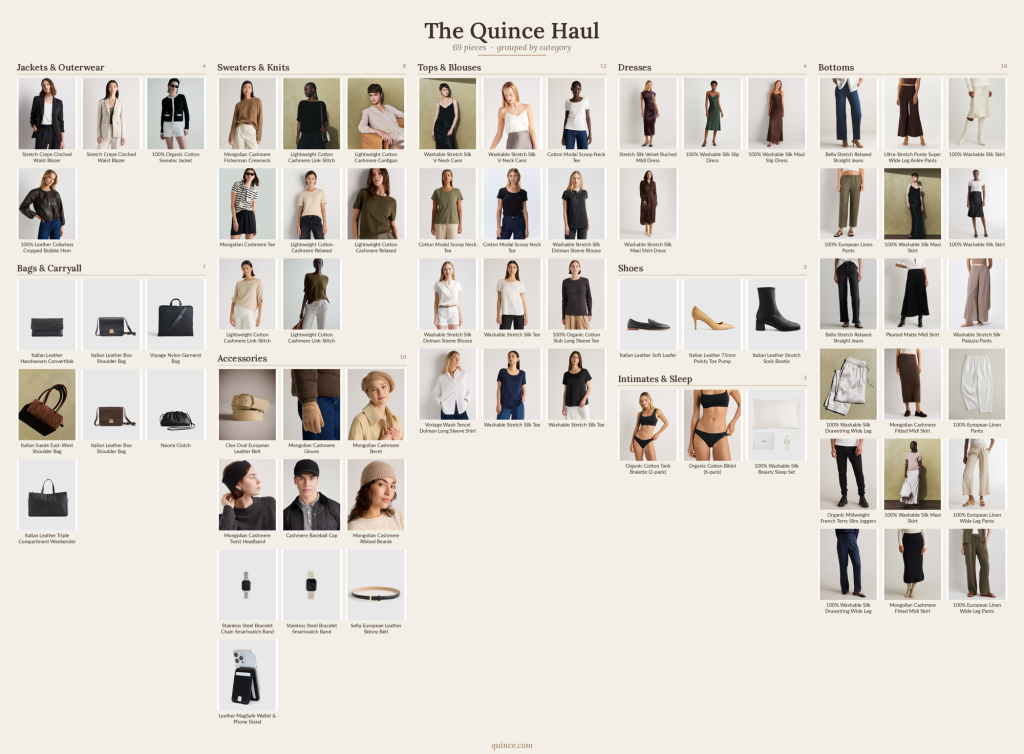
We will see if I can reconstruct a capsule wardrobe from what is merchandising that has no sense of what will fit, what will flatter, how consistent their sizing will be, how consistent the quality will be, or if entire categories will fail me.
Now some categories are heavier weighted as I’m trying a lot of bags and travel. Some are light like shoes as I have basics from actual functional fashion lines from my past but I’ll try these out. I don’t know what fabrics will flatter in what cuts so I got multiple colors but if it doesn’t fit I am likely a full pass as I don’t want to double the order with sizes so if it fits I sits.