Categories
Startups

Day 2008 and From Running On A Dream to Running On Our Reactor

I’ve got to remember to keep tissues in my purse. I’m prone to crying when I’m proud. I am a crier by nature and the experience of pride and awe is becoming distressingly common. Woe is me right?

My very early bet on Valar Atomics (I wrote about it on Day 1145 but met Isaiah closer to day 900 early 2023) is paying off years, if not decades, ahead of my expectations. Never did I expect arguably the hardest operational bet in my portfolio to be such a fast breakaway hit. And I owe it to an executive order from Donald Trump and the efforts of patriotic Americans committed to regulatory reform. Which is crazy.

As it turns out, if the government gets out of the way of talented people, nay, if it demands that our state institutions help them, the impossible becomes possible in shockingly short order. The reports of America’s death are greatly exaggerated.

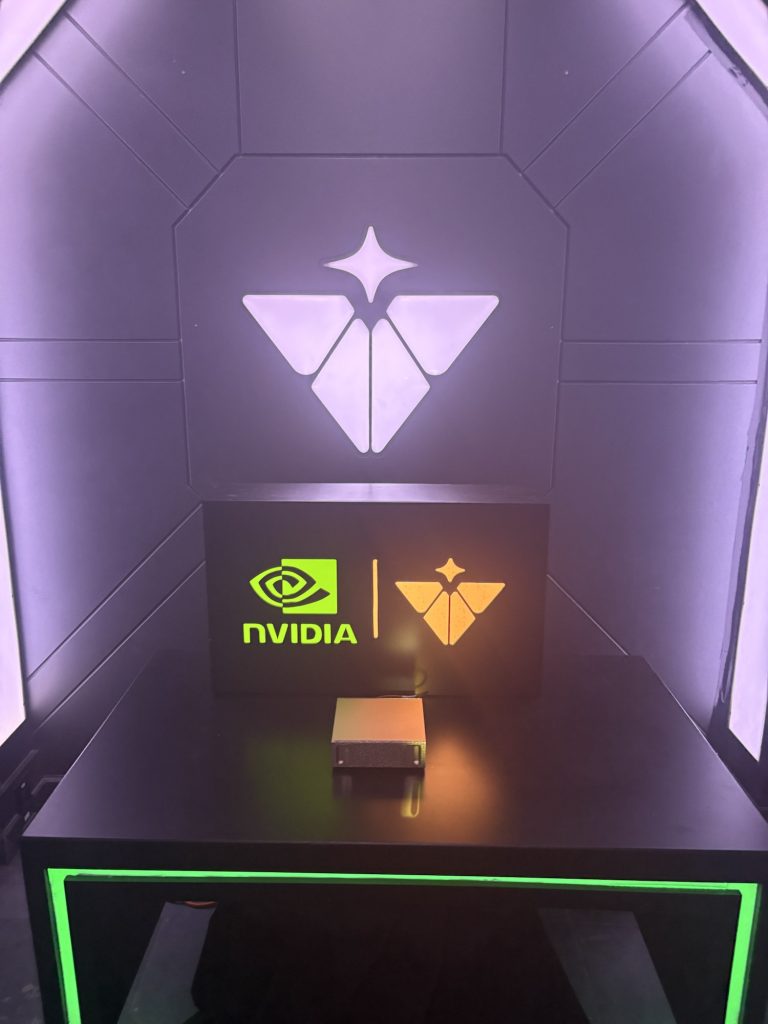
Today in front of a crowd of hundreds of current and potential investors, employees, Orangeville community members, government officials & scientists and most importantly our family members, we watched a reactor (that might not even exist without my first check), power an Nvidea Blackwell chip.

In a demonstration rivaling the greats (Ballmer, Jobs) Isaiah brought up NuclearWebsite.com and asked the audience to load it with him.

“Oh no it’s not loading?!!?” What’s happening? Do we have any electricity on site? Quick someone run the GPUs to the nearest electricity! Go go we can’t disappointment all these people!

And then the Blackwell is rushed into the Ward250 reactor. In real time the chip is run to the control room, gets hooked up and boom the website loads.
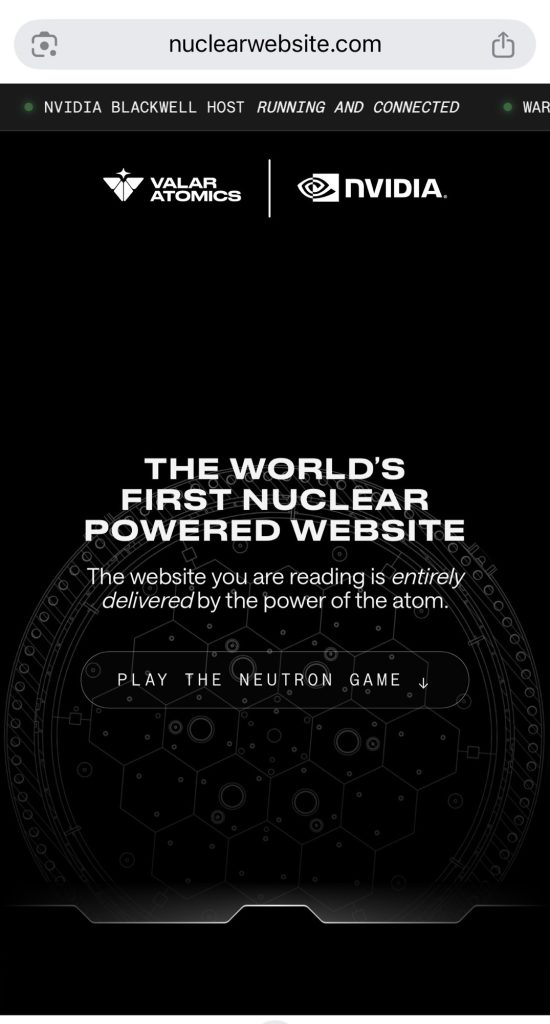
The first entirely privately funded nuclear startup was critical, stable, producing electricity and powering state of the art silicon.

We actually did it. The mad lads and ladies of Valar Atomics swept ahead of the competition in a frenzied year of progress (Day 1510) from seed round and Ward Zero to producing electricity to power GPUs.

After a twenty four hour travel marathon to get from the Ionian in the Mediterranean to the southern Utah desert, being back at the Valar Atomics reactor facility for a demonstration of this magnitude felt surreal.

Just a few weeks ago (Day 1969) the reactor was days away from being shielded and then fueled. We’d driven down to see her before she was wrapped up in shielding.
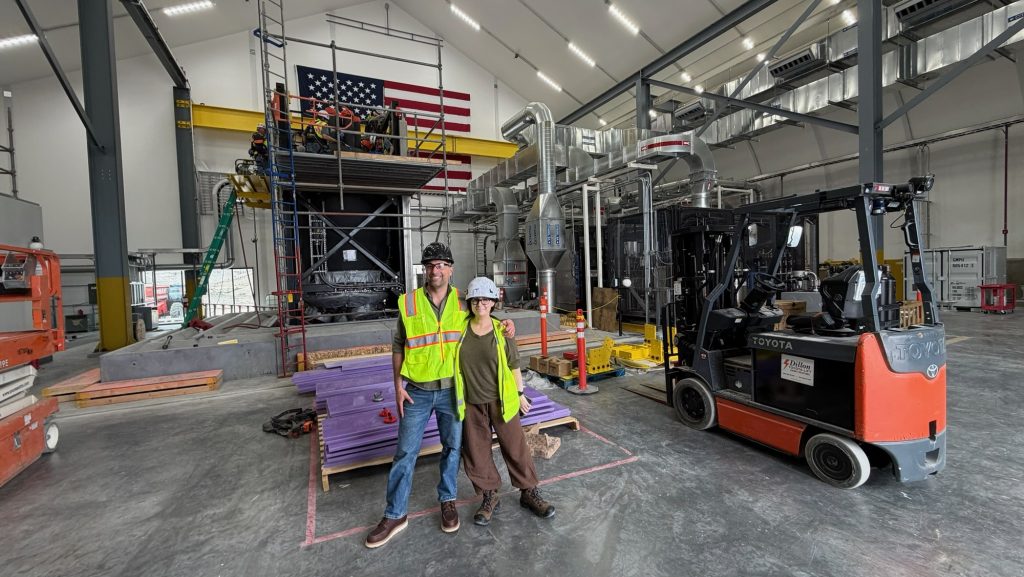
Proud first investors in front of Ward 259

Now not only has she gone critical (Day 1996) but I was able to walk into the running reactor room and see the live reactor for myself. The operator Ben (a former naval nuclear operator) seemed surprised and happy to see me. “Julie! Hi!” He exclaimed as me and the other early lead investors piled in for a tour.

I won’t lie it felt really cool that the team knows me on sight. The perks of being the very first believer (Day 1145) are worth the risk. Sure you get called crazy quite a bit, and only half the time does anyone mean the good kind of crazy, but sometimes you get to enjoy being right.
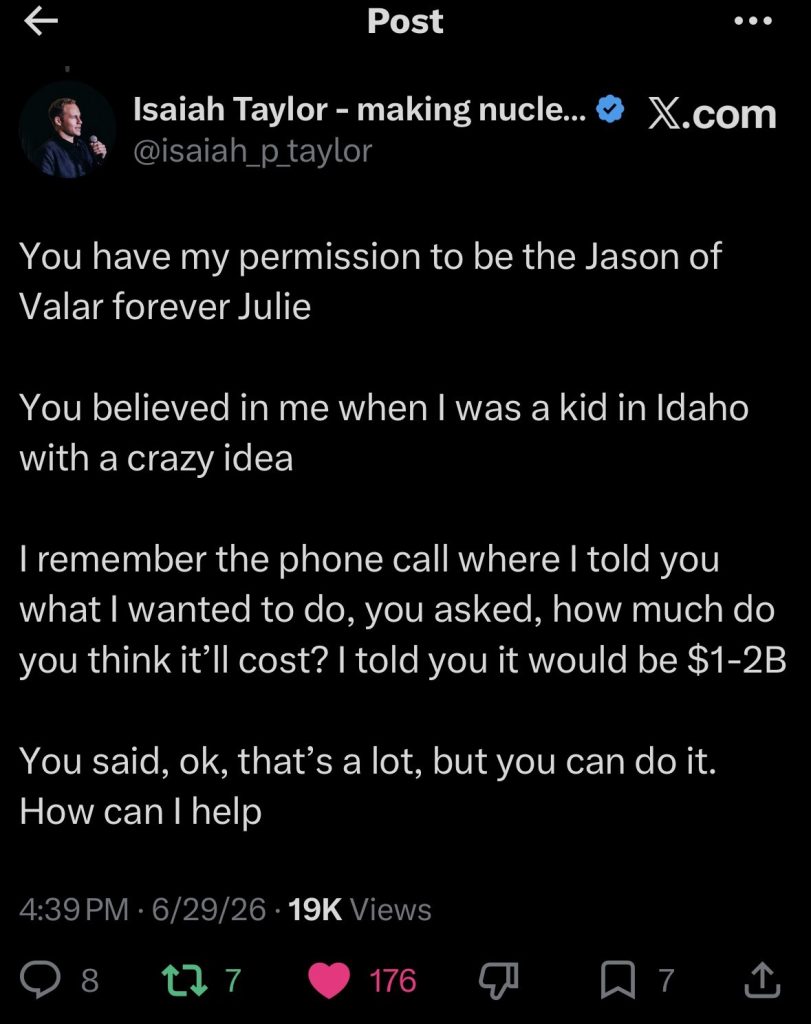
Jason Calacanis (also a master of the live demo) never lets anyone forget he invested in Ubers seed round. I get to brag I wrote Valar’s very first check

And while success has a thousand fathers and failure is an orphan, I’ll always enjoy the satisfaction of being the very first to take a chance on a long shot no one thought had any business even trying. And well they were wrong. And I was right. Not just right but really fucking right. I backed the long shot dark horse (somewhere around day 950) because my gut told me that the kid had the right stuff. And wow did he.

I only had a dim hint of exactly what we’d be seeing today as the invite said “Watts Next” cohosted by Nvidia and Valar. Clearly a number of us connected the dots because it was packed. The atom would power the compute and we’d get to see it live.
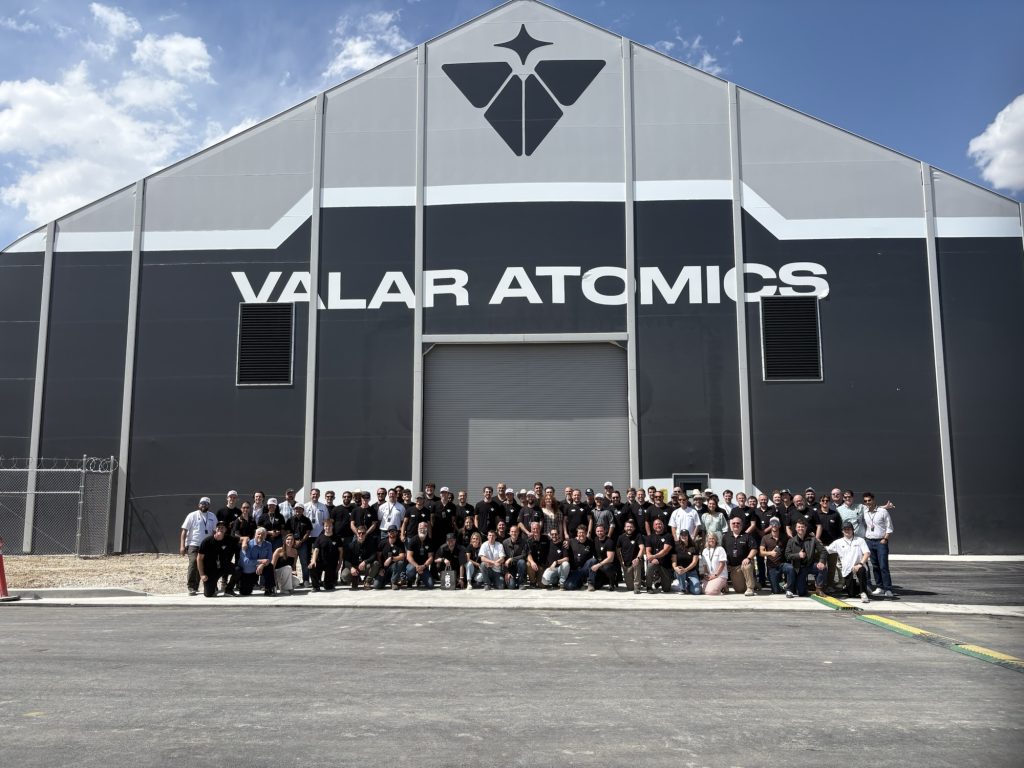
The team after the demo

Every existing investor, and quite a few later stage firms, came out to the middle of nowhere to see if these longshots had really done it. And indeed in just three years the impossible became reality. I’ve never felt prouder to be American. And clearly everyone around me felt the same.

This is a win for all of us. The families who gave up time with their loved ones so their loved one could pursue a dream. The policy makers and scientists who did everything in their power to prove we could make nuclear work again. The investors who wrote checks that no one else wanted to write as it was too risky.

And most importantly, it was a win for the team, led by the indomitable spirit of Isaiah Taylor. Their long nights and constant doubt paid off. The road ahead is long but no one is likely to doubt that we are serious contenders anymore.

I always say there was never a doubt in my mind. I had faith. Isaiah joked he had moments of doubts. I say I’m blessed that I got to be that first believer to say “I think you can do it and I’m going to help.”

And whenever he doubted that we’d make it (there are always near death experiences in any startup) it was my privilege to remind him that doing the impossible is just what we humans do.

Like Captain Kirk, I don’t believe in no win scenarios. I hope you consider joining me for more impossible long shots. Because sometimes taking the shot is worth more than anything else you will ever do.
Want to run your compute on clean renewable cheap American energy?
Categories
Uncategorized

Day 1849 and The Great Look Backward

The ChinaTalk Substack has an excellent analysis of the “Net Left” (wang zuo, 网左). A group of young Chinese yearn for the cultural revolution era.

Accordingly to the essay, the “Net Left” traces its earliest roots to a niche group on Weibo between 2011 and 2015 known as the “Franco Left” (fa zuo, 法左).

An American social media user might notice these dates as being concurrent with the stirrings of the Great Awokening whose murky protean identity played out across Tumblr beginning in 2011-2015 as well. Oppressor and oppressed was the narrative for the identity politics which was nouveau chic branding on Marxist capital versus labor.

This simplified narrative attracted a massive influx of young people who were frustrated with their poverty and pressure but struggled to find an answer. Suddenly, the solution was no longer buried in thousands of pages of Deleuzian tomes. Everything was reduced to a single, omnipotent, and evil symbol: “capital.”

Longing for the Cultural Revolution

Even the struggles of Chinese youth sound like American Gen Z’s struggles. American youth were once pushed toward upward class mobility by The Sort.

Now they critique the high costs of that expensive competitive credentialist systems who put them in debt. Youngsters just starting out see its current failure as a mechanism for training and selecting talent and are opting for new solutions.

China has “small-town test-takers” (xiaozhen zuotijia, 小镇做题家) who don’t have the social capital to make the leap. Sounds familiar doesn’t it? In their case it is strongly gendered, which mirrors some red pill and incel culture on the American web.

Just as in America, many Chinese youth blamed capital and its elite power holders. Who needs to read dense critical theory when the warmth of collectivism is easier to understand than the Frankfurt School or Continental Marxist philosophy.

It seems all great powers are experiencing flavors of third worldism where all is “the oppressed ” and those with capital & power are oppressors. And yet Europe, ever the laggard, is trying “almost revolutionary ideas” to make them more like nimble capitalist powers.

The Europeans must be scared of the tractors I saw protesting the Mercosur trade block deal even though ironically German-Italian initiative claim their goals are making “the European Union less susceptible to pressure from trading partners and global powers” after a week of embarrassing news.

They wish to boost economic growth, calling for “an emergency brake” and a revamp of the EU budget to focus resources on making companies more competitive. I wonder who they think will run and staff these firms?

Just as the rest of the world nostalgically looks back for a leap backwards, Europe says “we want to have a fast, dynamic Europe.” Good luck with that based on the protests I saw.

At least Europe, like the Net Left and the Tumblr DSA crowd, are basing some of this on a misty eyes interpretation of a past that once was but was never quite this. The first year of Davos emerged in similar situations

Well, it goes back to 1971, which was actually another year of trans-Atlantic tension. Nixon left the gold standard. The dollar fell. The U.S. imposed tariffs on European imports. And the Europeans were totally blindsided. This German economist, Klaus Schwab, convenes this gathering of politicians and academics and business people in Davos. It gradually grows into this giant business conference that’s also an exercise in virtue signaling.

Peter Goodman New York Times “Davos Stops Pretending

Categories
Aesthetics Internet Culture

Day 1803 and Anemoia

You know I am old as I just don’t consume or create short form video content. Every new trend that filters to me on Twitter or on my reader feeds presents as sadness to me. I don’t fully understand them and probably never will.

The newest TikTok trend involves Zoomers pretending to be happy millennials in 2012 Williamsburg Brooklyn. They romanticize millennial optimism as unpolished and carefree for some sort of shared but unreal nostalgia for pre-gentrification Brooklyn.

I left Williamsburg in 2010 for Manhattan’s Chinatown as even the south side past the JMZ had become too expensive. The loft I shared above Future Perfect on North 8th and Berry was getting expensive on just the other side of the Great Recession. It was a loud place to live and a lot of fun but I needed a lease with my name on it and prime Williamsburg wasn’t it in 2012.

I wasn’t in a position by 2012 to buy an apartment but neither did I have any debt. So I’m sure that made me better off than the Zoomers coveting my life just before New York would go ZIRP. Not making a fortune wasn’t too bad when you could still enjoy a lot of hipster consumer choices.

You can’t blame the Zoomers for feeling like today’s economic volatility and social fragmentation makes our “before times” life look relatively utopian.

Michael Milaflora brought to my attention Gen Z’s “anemoia” which is a broader trend. A 2023 study in Emotion journal found 68% of young adults report nostalgia for past decades they didn’t live, linked to rising anxiety levels post-pandemic.

I’ve previously enjoyed when my own past lifestyles are the subject of nostalgia rehashes on social media. Now I think worried as no one should be too obsessed with the past. Especially not the young.

Categories
Aesthetics Internet Culture Media

Day 1114 and Aging Without History

I don’t use TikTok at all. I have an Instagram account I’ve failed to reboot which I only open if a Groupchat sends me a link.

I deliberately insulate from algorithmic visual content. It makes you miserable for one. But more importantly, it deadens your aesthetic palette from overexposure.

If you want to develop and sustain personal taste and style, do yourself a favor and do it deliberately without the subtle nudging enforcement of refinement culture.

I do however avidly follow the propagation of different fashions as a personal interest. I like to see where a runaway trend goes as virality and social contagion set in. The New York Post’s entire culture section is dedicated to moral panics but it occasionally hits on real sources of social anxiety.

Gen-Z is allegedly having an anti-aging culture panic over turning 30. Their source on this is a Reddit post about skincare obsessives on social media.

“I feel like aging to Gen Z is what ‘being fat’ was to millennials. Remember how ruthless the media [and] everyone was about that?,” another noted.

Gen Z’s Fear of Aging NYPost

I still have anxiety about weight from living through the TMZ era of body shaming. So I’m sympathetic to what it must feel like to younger women facing the relentless scrutiny of living online. They rightly perceive appearances to be a part of how value is calculated in wider society and are afraid of losing it.

I’m convinced some portion of the extremely online Gen Z are living entirely out of the slipstream of historical culture. They consume artifacts from other people’s youth culture but live in a what amounts to a “long now” in which the future seems unstable. We rebooted 2003 as a micro trend but the apocalypse is almost here.

The nostalgia machine gives Gen Z an ever present history but very little present to hold onto for grounding in physical reality. Their ahistorical vibes approach seems to overweight the need for youth.

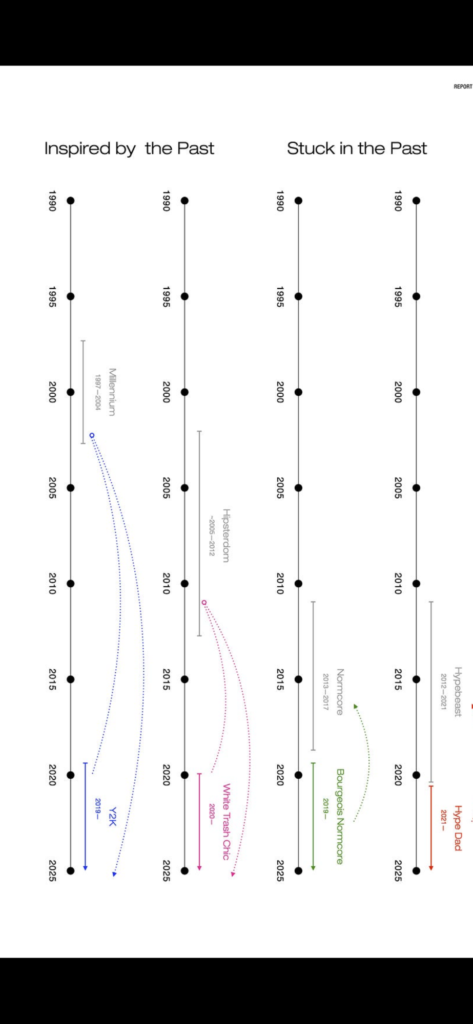
Sean Monahan of K-Hole normcore fame posted a mapping of the aesthetics of the decade that I thought spoke well to the strange relationship digital aesthetics have to time. I’m posting a diagram here from his post here.

8Ball “Stuck in The Past vs Inspired By The Past” trends breakdowns

If Gen Z is aging like milk it’s probably not because they are actually aging quickly. Though I’m sure the stress isn’t doing them any favors. I think dit’s what Ryan Broderick of Garbage Day points out here. The glamified hyper-media full face contour is an ageless one. It’s inspired by the past and stuck in the past. It’s got nothing to do with their actual age.