Categories
Finance Politics

Day 1799 and Thucydides Middle Income Local Maxima Traps

I have been catching up on Odd Lots which is the one podcast I listen to with any consistency. As all discussions about economics boil down to great power discussions as of late. The times they are indeed a-changing.

I noticed that both hosts brought up their collegiate studies of international relations across two back to back episodes. First on the Thanksgiving episode with Graham Allison of Thucydides trap fame.

I just caught up on it today and then the subsequent interview with Ray Dalio on his five forces episode. Joe and Tracy brought up international relations studies in both episodes as it does seem to be the current mood.

Dalio is always an enjoyable listen but I’m much more interested in Professor Allison as (to prove the joke Joe made) in the introduction that “a substantial portion of our listeners are really into ancient Greek history

And indeed Joe is right. I’m a huge Thucydides fan, I went on a Peloponnesian War tour and am a regular visitor of the Balkans and its ancient Mediterranean and Roman history.

So naturally I have followed Allison’s work on rising power and its threat to established ones.

The US and China are in a “Thucydides Trap,” whereby the risk of war is heightened when an established power is threatened by a rapidly rising power. This is the framework that’s been popularized by Graham Allison, the Douglas Dillon Professor of Government at Harvard University. Professor Allison has been writing about China and the US-China relationship for decades

I guess all millennials grew up thinking we’d study these historical concepts in an eternal Pax Americana only to find the end of history wasn’t here to stay and we might fall into the trap. It’s just hard to imagine America feeling threatening to anyone at the moment.

As I listened to the episode, I happened to be walking through a neighborhood on the outskirts of a city that is keen to tear down some of its older homes to make way for new roads and denser apartment buildings. Much of those changes were clearly already in motion, as I saw cranes and construction crews.

The older homes looked multi-generational, but not in that wealthy polished way, so much as the middle income stalled economy compromise.

And yes you see it even in first world nations. In America and Europe, many conditions would benefit from more of a longhouse “in it together” approach. As elders stretch on in years and millennials go into middle age with few markers of adulthood. You’d think we’d want more of these style of homes.

I wondered if a city carving out the old construction through imminent domain tactics and buyouts, would make this outskirts neighborhood more vibrant. It would certainly bring in new buyers of condominiums. Consumption must go up.

I wondered about the families inside of the homes that looked more like multi home construction. Gates and other obstructions made it hard to tell, but the impression I got was more middle income local maxima family compound trap.

China rising, while the first world learns it may be more second world than it realized, makes me wonder if we’ve got it all wrong. More of the planet is in the middle income trap than the World Bank realized.

What if there is no Thucydides trap to fear as other powers sputter and stall. We long for an artificial intelligence boom to launch the globe into a high earning high efficiency world.

Sociologist Salvatore Babones and political scientist Hartmut Elsenhans call the middle-income trap a “political trap” as economic methods to overcome it exist. However, few countries use them because of their political situation. They trace the causes of the trap to the structural problems and the inequalities generated in the early development process.

According to them, the wealthy elites then follow their interests by bargaining for a strong currency which shifts the economy’s structure towards the consumption of luxury goods and low-wage labor laws, which prevents the rise of mass consumption and mass income.  Via Wikipedia

That sure sounds like a lot of the problems we see in America and Europe. All we are doing is getting gummed up in Baumol’s Cost Disease as we try to reinvent new ways of living that consume what remains of the old without the new going as fast as is needed.

But old multi-generational homes blocking the expansion of a city won’t get anyone to mass affluence. So it’s time to bulldoze old neighborhoods and make luxury boxes in the sky.

Not sure that ended well for China either. They popped their real estate bubble. And they wisely tamp their currency to export all their consumer goods. They might be stuck in a local maxima middle income trap too. Maybe Thucydides isn’t the framework here. Or maybe war is the only reset humanity knows.

I myself am hoping we choose to go to space instead but the South China Sea sits waiting. The only currency that matters in this strange moment is GPUs and that’s a different trap entirely.

Categories
Culture Politics Startups

Day 1796 and I’ve Got Billions in My Inbox Julie!

I’m not new to the boom and bust cycles that have defined not only technology startups, but American herself. Most millennials have opinions about their malign status in an economy designed to borrow from the future for a dubious present.

Much of the world is in a state of panic over “the churn” of the old rules changing and the new ones not being quite clear. But it’s really not clear what happens next.

I think anything goes as the networks speed up our connections to each other through artificial intelligence. The end of the age of scaling means it’s time for the era of deployment is it not? Or are none of us Carlotta Perez fans.

I enjoy speculating as is the fashion. Do I think corporate debt financing of data centers is some time bomb in private credit? Not really, no. I think it’s way more likely that don’t understand the full demand case for coordination in a mediated world.

I don’t know if we can meet the demand to be perfectly honest. I will say I am way more worried about us not meeting the moment. Changes to our cultural environment are as hard as our material ones.

If I had to read sentiment, I’d say that everyone is absolutely sick of having their attention used like a fiat currency. We cannot inflate our capacity for focus as easily as we can inflate the dollar. And we will demand simplicity by any means necessary just to exist. And artificial intelligence will smooth our world to manage with what we’ve got.

I think running a decentralized world will prove to be far too complex for most humans and it will be mitigated by layers of choices in governance that will probably not always maximize for the freedoms we’v come to expect from the liberal world order.

And yeah I think we will need a lot of data centers for that coordination effort. That the state might be the ones with the most demand seems a little rich though. Every individual on earth will want to be on the right side of the ratings. That’s more network state than state and it will be a longtime horizon.

I know it doesn’t sound great on its face. And yet I think it has had upsides. The demand for real businesses that operate in some world of efficiency has never been higher.

And to some extent, I believe that was always the entire point of computing. Make things so much better and cheaper we move on to bigger projects.

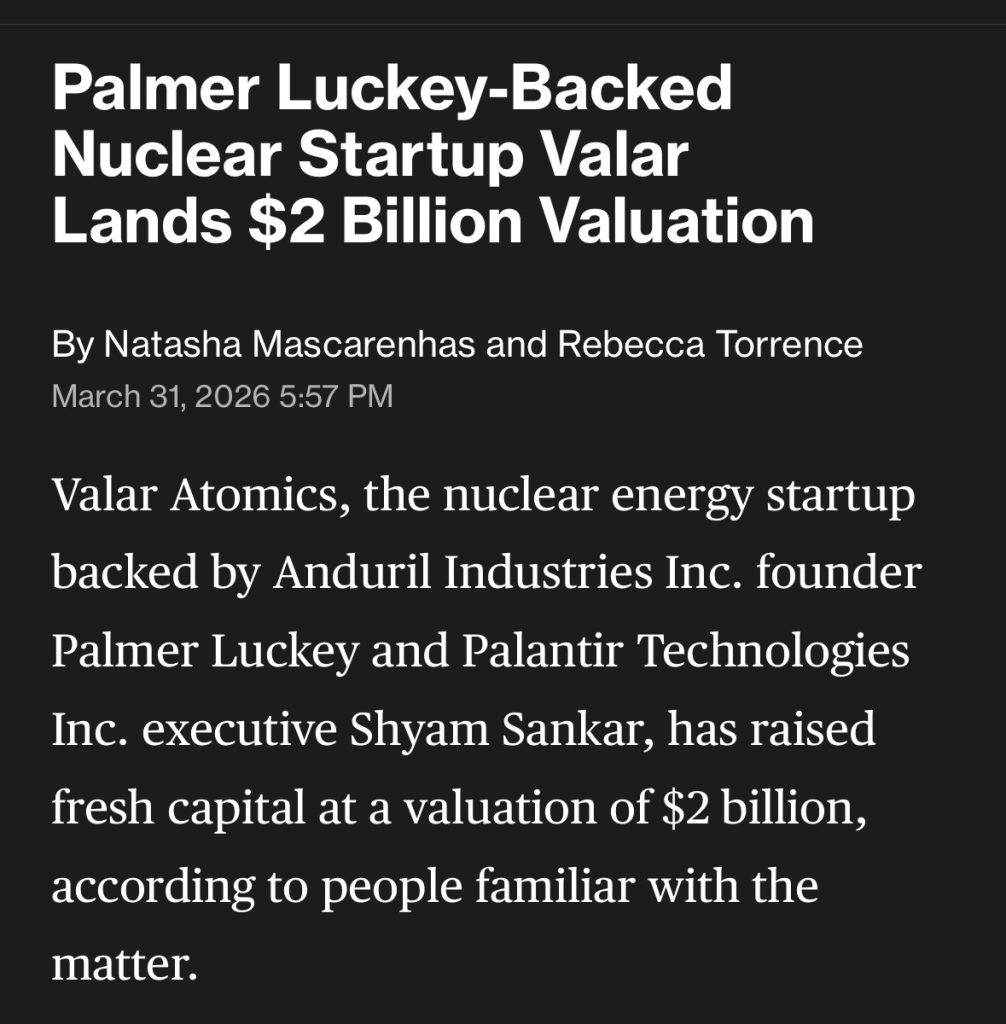
Giving you video games and porn might have been a weird way to get to Mars but medicine is as driven by vanity as much as survival so I don’t judge reality. I just want us to get more nuclear power. I don’t ask for much.

We didn’t want a legion of information processing professionals. We wanted to change the material conditions just as the Industrial Revolution did. The invisible hand is a strange thing.

I expect we will see quite a bit of opposition to the people believe that we need more energy, more industry, and more science. The future and its enemies are legions. I always did find it funny that fashion critics had a better read on the future than anyone else. Virginia Postrel and William Gibson both have good taste.

Categories
Aesthetics Internet Culture

Day 1794 and What We Expect From The Wives

I’ve been intermittently online (as opposed to extremely online) this week what with the travel and the holidays. So I decided to use the Twitter algorithm to catch up on what the “Everything Platform” thinks I should see.

Which I realize is a bit like saying I’ll just have a little bump to see what is driving the rest of the club insane. I knew it was a bad decision and I fully endorse only using social media without algorithms. I generally use my following list in a chronological feed and stay away from image or video driven social networks.

But I am in many information flows that are built to grab attention and normalize information outside our Overton Window of current civil society consensus.

I was taught this was a good thing as a child. Reading and reconciling conflicting arguments was an important democratic norm required of all responsible citizens. I also understand as an adult that this exposes me to propaganda made by any number of sources.

Now you can judge my information sources but I value both of them and they had a common theme. Women, and in particular the wives of powerful men, are the keeper of m civilizational standards and used for this power. This message came from two very different places.

One is widely known indie founder who writes about doing business in Europe and the other is a publisher of books outside polite discourse messages as well as my neighbor in Montana.

Both accounts took me down different uses of the matter. Though both have share other accounts I’d consider right conservative populists. One was about an interview with Nicole Shanahan the ex-wife of Google co-founder Sergey Brin, former running mate of RFK Jr.

She discusses how the wives of wealthy startup founders are finding causes that are not actually helpful to their intended purpose and are perhaps even actively harmful. It uses some language that is tied to a number of conspiracy adjacent words like the Great Reset and the World Economic Forum.

It is still fair game as a civic polity might ask about the responsibility of the wealthy pretty regularly. I do think Silicon Valley wives are a new vector to watch as a pressure point though. I better watch it as if the tech billionaires’s ex wives are under watch, I can’t wait to see how their less powerful (but much more numerous), Girlbosses will be scrutinized.

This video sent me right into an interview Jonathan Keeperman aka Lomez doing an interview with right populist pressure researcher Christopher Ruffo. He who made critical theory and Critical Marxism a household issue in Republican America.

Lomez has an essay about the feminization expressed in the longhouse. I won’t do it justify by doing a synopsis but Vikings had longhouses and so do plenty of other cultures. This is not all together a positive portrayal of women’s role in civilization but certainly as its driving force.

The video I was served after LevelsIO’s retweet of a video clip of Nicole Shanahan was certainly further down a worldview. But it was also a more positive view of the role of women could be if the Karen was not viewed as a villain but as a hero of social norms.

Algorithms refine down to clearer distillations. Smoothing functions are revealing of form after all. And I think it is interesting that Silicon Valley liberal ex-wives are being shown against the backdrop of norms enforcing regular mothers, wives and guardians of the good life the Karen.

The Karen was once a liberal nightmare and it is an interesting space to replace for the culturally conservative, especially as the Zoomer incel nihilist view is raging across the internet like a prairie fire. So that was an interesting gradient from a European founder to my neighbor.

I’d also say it’s exactly why I don’t read from the algorithm. I fundamentally agree with different positions expressed here but mane not in ways you’d expect. I’ve seen the pressure we place on women in certain social contexts and we make them feel crazy for being the balance of norms but also being hated for it if we don’t chose the ones our clique or social context prefers. My algorithm wants me to understand the narrow band I walk on. Fucking dicks.

Categories
Culture Travel

Day 1791 and Hack, Hack, Cough Cough

One of the oddest post pandemic norms we’ve come to accept are the hacking coughing fits we pretend are normal parts of public transit.

By public transit I don’t just mean just subways or busses. I’m sure they suffer from this issue as well.

But rather our most expensive version of public transportation, air travel, is riddled with passengers clearly infected with one variant or another of a respiratory illness.

Now I get it. It’s not cheap to fly. A cold coming on won’t stop you from going as you paid a lot to travel. Everyone is on the road trying to make their way to family, friends and community. It is hundreds, if not thousands, of dollars to get from here to there.

So as you stand in long boarding lines where people queue seemingly at random in groups 1 through infinity, you see various flavors of sneaks, cheats and idiots bottlenecking the mess.

And then you hear the coughing, hacking, sniffing, sneezing and other variants of ignoring the body’s strain.

I am prone to skin infections rather than respiratory ones or this trend would worry me more. I generally don’t mask unless I’m stuck in tight quarters. Sometimes I wish I had. Dealing with Chicago and the sweating, panting, running, struggling human masses, I feel I should have.

You still see depending( on the city, its demographics and its politics, a range of mask wearing. The elderly are often masked. I see frequent flyers wrapped up tight in the good N95. There is quite a lot of masking and I think it’s a good thing.

Maybe these maskers know something. They must be used to persistent cold and flu season and understand some folks who don’t care about their impact on others. Masking must work well enough to be worth the hassle for some.

I hate to bring up the old awful politics of the COVID era, but we should have learned a thing or two from Asian nations who politely mask themselves when ill to benefit their fellow citizens.

Wouldn’t that be an impressive thing to see? Americans caring about each other’s welfare. If I have a cold, it will be because I was too stupid to mask up. But if I get a cold I promise I’ll mask up to avoid passing it on.

Categories
Culture Politics

Day 1789 and Is Our Children Learning

But I’m not a math person!”

Did you ever use that excuse as a kid? I know I did. Alas my mother did not tolerate my lame attempts to leverage available excuses like being a girl.

She still teaches from a core belief that if mastery comes from practice anyone can develop competency with effort and repetition. She will not entertain discussions of inherent talent even if it’s true. That’s no excuse.

I practiced till I was a math person. I’d level up into a new subject area and fail all over again. I repeated that process till I graduated university with a lot of mathematics under my belt.

Whether or not American children are learning remains a hot topic. A infamous Bushism “is our children learning” comes from a misquoted line in a 1990 speech by George W. Bush, who actually said, “rarely is the question asked: is our children learning?”. And well, we are asking the question both then and now.

Moontower’s Kris Abdelmessih’s financial newsletter has an excellent essay on how Americans are grappling with the upsetting realization that our children cannot read or write. His essay on the topic of mastery and competence is worth a few minutes of your time.

And while we’ve been complaining about our educational system my whole life, it certainly looks as if the now adult graduates are innumerate and illiterate.

And that is embarrassing for all of us. The more we dig into the why’s and how’s of it, the more likely we reveal to ourselves that we have our own shortcomings with literacy and numeracy.

Buckling down and developing competency is a hard thing to do when we are young and capable. Doing it as a tired middle aged adult is even worse. But if we want to ask questions about whether any of us are learned, we have to accept that maybe none of us were educated well in the first place.

Categories
Internet Culture Media Politics

Day 1785 and Adversarial Openness

There has been quite a bit of discussion in alignment theory with artificial intelligence that considers how legibility and openness might work at cross purposes when coordinating across different intelligences with different goals. Politics exist everywhere it would seem.

If you are transparent, but seek to change an agent’s behavior, you might reasonably be interpreted as adversarial by the agent. So it follows you must consider that their actions are no longer collaborative and open towards you but potentially adversarial and opaque depending on how it judges you.

The information habits and “winner’s optimism” that some American elder millennial display in public digital spaces are telling. In particular, we have skewed heavily towards legible openness as our internet was often friendly and our geopolitical positions was dominant.

These conditions are no longer true. And so we are now experiencing the Dark Forest Theory of Yancy Strickland (based on Liu Cixin’s stellar science fiction series the three body problem). American millenials are on a very different internet than we grew up on.

I’ll admit I have a bone to pick with Yancy as it felt more like he was defecting from the open web in 2019 because it was scary and filled with fascists. I didn’t think he believed it was because it was actually dangerous. His return makes me question his original declared intentions and his goals now.

The Dark Forest disappearing man has come back to the open web now. Things have changed and we all need our own private Idaho. Which you can find through his offerings.

I’ll note he needs the distribution channels of large adversarial networks like Twitter and that means gaining power in the dark forest. As we consider how open and legible to be in this very difficult moment I thought this was an instructional revealed preference.

Categories
Culture Preparedness

Day 1782 and Sweeping Rolls and Unrunnable Rapids

Navigating the rifts and eddies in the river of human scale time takes more skill and endurance than I fear I have.

Even if I assume that Earth time still running on any sort of human scale (which I don’t believe to be true), I find myself wondering if it’s better to head for the riverbank for a moment. Like Lewis and Clark, I only dimly understand where this river will let out.

I once paddled lightly, easily, even joyfully with the currents of my time. When I capsized, to continue with kayaking metaphors, I would simply snap myself back upright with a sweep or C-to-C Roll roll and carry on downstream spluttering wet and bursting with laughter.

Kayaking the Zeitgeist River was a fine past time for the quick witted and able shouldered amongst us. One could build an entire career by correctly the judging the river of time. And what fun it was to carry along with friends as time did most of the work.

But ever more frequently, I search for the eddies to pull myself out of the stream to stop for a while. Tired and hurting, I look for a refuge to catch my breath and slow my heart. As the timeline rages on without me, through crashing white water and its drowning currents, I wonder if I should even be alone on these waters at all.

Simply staying upright is now a bare minimum of a concern. A hip snap and good instincts does little when the course never ends and the rapids unexpectedly turn from a fun day of Class III rapids to Unrunnable class VI without so much as a posted sign. There are no maps or forecasts to be had. Your gear might be whatever you brought onto the water in entirely different conditions.

There be dragons here? Hardly so dramatic a metaphor applies from naval history pertains to river ways. But it’s no less dangerous for its lack of vista. Unseen rocks, snapped branches and water logged organic materials rise and decay into froth and burble. Lurking like so many unseen estuarine creatures swimming inland.

I already feel as if the tattered veil which separates our shared reality with whatever exists beyond is far too fragile. That any one of us can choose to run the rapids of passing time serves to remind me of how fraught the pastime of participating in history can be.

A small kayak with one intrepid soul can be righted quickly. But an endless run of rapids designed to sink any who choose to run it? The public experience of our shared time should not be such a battle. We all want to see where we are going don’t we?

Categories
Community Internet Culture

Day 1780 and Being Cooked

I’m starting to think the more optimistic you are about the future, the more cooked you think we are. I didn’t expect this.

The Doomers have a coherent worldview. It’s simple to imagine involving losing your humanity to machines. This is at least legible and a call to our common humanity. Change is scary and bad and we don’t know how any of this is going to go. So why not be cautious?

The optimists are all excited about different things though. And that opens us to a lot of attack paths. And yes I’m calling myself an optimist though I have a lot of downside scenarios on my radar.

Some of the outcomes that you might find dystopian are the utopian outcomes for someone else. Think Caliphates or Communist surveillance states.

The complexity of our reality is so far beyond the grasp of your average person it seems cruel. And we sympathize with the struggle to adapt because it appeals to our common humanity.

It’s no wonder America has had so many revivalist movements. We have changed so much in our 250 year history, we are always rediscovering the value of faith. What else do you have when the future is uncertain? If we are cooked anyways we may as well all take Pascal’s Wager?

Categories
Internet Culture Media Politics

Day 1778 and Uncanny Hyperborean Aurora

It’s a hard time for knowing things. Making a show about epistemic confusion is the subtle uncanny meta game that is playing out living in a networked world.

It’s a completely different context than the daily world most of humanity lives in. Most of us live in some version of the past and act confused about why the world we remember so clearly isn’t here anymore. It’s hard to feel the moment.

So you try to live in the real world. You feel the weather and the geomagnetic storm rocks your body and uncanny sight of the dancing auroras would make anyone believe that we are small parts of creation. I watched the aurora in awe.

The universe was dancing with geomagnetic storms
Reds and greens that feel not entirely of this world.

What grasp do we have of a material real as individuals that is also existing as part of a world. Do some of us make up more of a network? It is unclear how much of a public commons we can have on the open web. It’s a reorganization of the civics of our life. The things you wonder about under eerie glow.

Many have imagined an internet primarily accessed by bots and agents and not humans. There are many different interests at play when you consider what would change The regulators look to sooth public opinion that has been inflamed by a multimillion dollar public square information campaign technology that doesn’t even exist yet.

There are many players. The existing corporate interests have investments and their relationship to open open source models can occasionally be tense. We should we want to enable an ecosystem of compatibility. Still walled gardens are built.

Stars, pines and the northern lights
Categories
Aesthetics Homesteading

Day 1777 and Spacing Out

Yesterday a severe geomagnetic storm hit Earth. I had been following its trajectory for a few days I think space weather is a fascinating topic.

Last year I was in Europe during a G5 event which is considered an extreme storm. It proved to be as unsettling as it was beautiful. Also migraine inducing. Just half an hour in the sun and I felt completely awful.

Naturally I wanted to tear the effects. I went out for a late afternoon stroll just as the storm first began to hit and I found myself in a rage over “this and that” as my vision flickered with red and green.

I thought I was so mad I was seeing red but I suspect the more logical explanation was that space weather affects us here on earth.


G4 (Severe) storm levels reached on 12 November at 0120 UTC (8:20pm EST)! Geomagnetic storm conditions are anticipated to continue into the night. Stay informed at spaceweather.gov for the latest. The included aurora images are of the aurora shining over northeastern Colorado.

I thought I was getting the auras that occasionally accompany a migraine for many people but now I’m not so sure. I rarely get visual disturbances in my migraines. Still our bodies run on electrical signals too. And I went outside just as the planet was getting hammered at the full severe G4 limit.

Alas after sunset I don’t take any particularly good pictures of the auroras that painted the skies though many others posted pictures from Montana.

I was focused on health needs from hyperbaric chamber oxygen therapy to a stint in our 180F Finnish cedar sauna. The glory of nature’s night is best experienced without a phone and ideally sweating out the day. No need to try to capture a picture of the moment. I was in the moment

Later, as I went outside freshly oxygenated, sweated out and showered, most of the sky had cloud cover.

The night was uncannily still. We usually have a lot of nocturnal noises as we have a whole ecosystem of creatures on our property and out into the mountain range above us, but I didn’t hear a peep. The animals must feel the space weather as deeply as we do.

Thankfully today dawned (with me having had a poor night sleep as expected) with all our homestead creatures out and about on the pond from duck to muskrat. More solar activity is expected so keep an eye on the NOAA forecast.

A pair of MilFred Muskrats with one of our ducks photobombing in the background