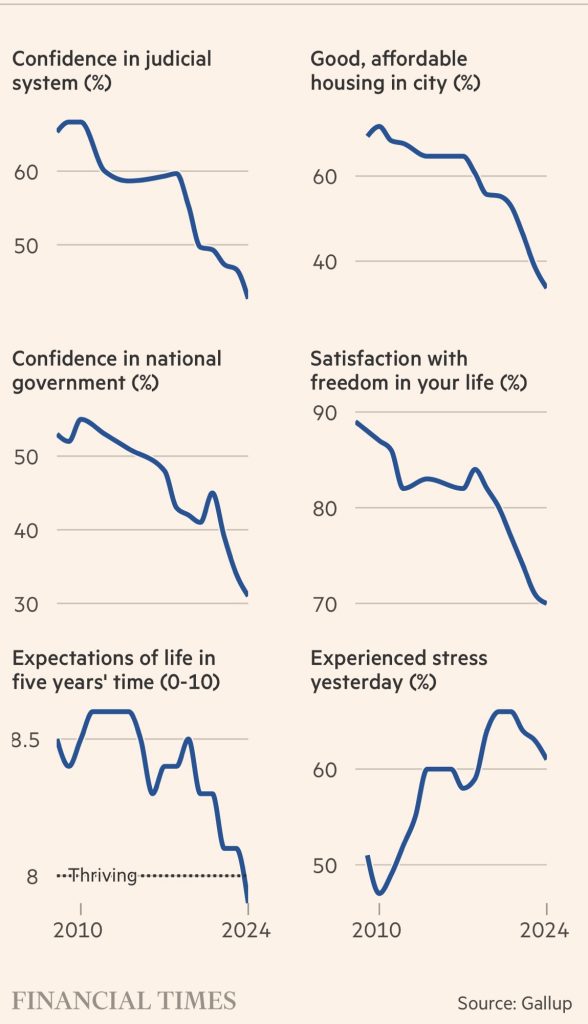
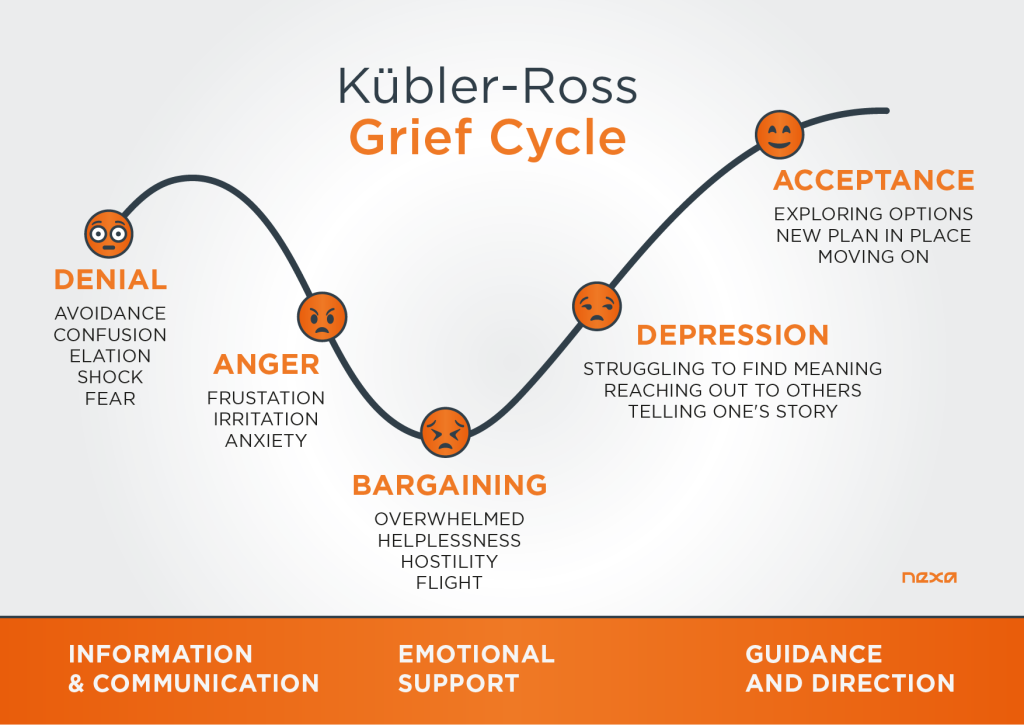
I’ve been very wrapped up in my own problems of late. I have plenty of good reasons to be focused inward. When you feel as if you are fighting for survival, physical or otherwise, you can’t see anything else.
As I’ve looked up from my issues, I am seeing countless others caught in their own reactive spirals. Many of them are even directionally correct in their diagnosis of the problems facing them and the world as we know it.
The apocalyptic bent is especially strong in America at the moment. From politics to artificial intelligence to cultural wars, Americans are on the edge of change.
If your world is ending you probably can’t see beyond the horizon of the issues bringing about its end. Your view is myopic. Let’s call this phenomenon “apocalypse narcissism.”
It’s understandable to be wrapped up in fear when faced with all kinds of mortality. Your life, your nation, your culture, your planet and even your species all face world ending questions at some point. Sometimes change is so great we can’t see it as anything but death. Even if something better rises from the ashes.
I enjoy my daily writing as it forces me to put my sensory apparatus to work at summarizing the inputs on my systems for the day. Being a human, my processing is laggy.
I came across this graphic from Hinterland’s Twitter. They created it show compression of the our body’s sensory inputs. A lot hits our mind and very little of it gets to conscious thought.
The human body sends 11 million bits per second to the brain for processing, yet the conscious mind seems to be able to process only 50 bits per second. – Britannica “Information Theory”
It seems to me we are not prepared for this moment of unprecedented complexity given the hardware we are working with.
Some of us may have slightly different software so it’s not all hopeless. It just seems like as a species the complexity of our environment relative to our baseline physiology is looking a little iffy.
I have a kind of optimism that we will find a way to meet the moment. Right up until we can’t?
I’m am looking to do whatever upgrades I can to hear the signal in the noise. But maybe a booming voice from the sky is easy to hear than the endless chatter of our world. Or maybe we have to find another way to achieve resonance and hear.
One of my Twitter friends John Konrad is a merchant marine captain and the owner of trade publication called Maritime News. I’m a nerd for a dozen different topics in his areas of expertise so I enjoy his perspective.
I’ve discussed my own theories of media like Thursday Styles Problem. Experienced media professionals know how narratives will play.
There is no media agenda as imagined in conspiracy theories. There is simply a consensus that emerges on what is happening and why. That consensus is malleable to certain incentives, which means it can be changed to fit different desired outcomes.
And if it looks like we are in pitched battle over raw power it’s probably because we are seeing growing concern over the America’s debt, monetary policy and inflation, and the changes required for us to continue as a nation.
I’d hope no one wants to destroy an institution if it could be reformed. The future of how we use our existing American institutional power and how we decide who it serves seems salient to all of us. No wonder it feels like war trying to keep up.
The Zoomers have so little institutional memory. They don’t remember the first Trump administration. Imagine having no memory of the pitched battles of institution versus ego. I envy them.
The Zoomers I talk to seem to have some memory of a good boom year but then their memories are strongly colored by the many traumas of the panic. Persistent online worlds with a global shutdown didn’t do right by them.
Now that we are back to the chaos of a Trump presidency I have no fond simulated idea of nostalgia for Trump for myself.
In 2016 our politics broke my assessment of what was possible and I did not like where the chaos would lead. I definitely could not predicted how much my own position on issues would change though. I still don’t know the best path but I have ironically opened my eyes to the scale of the issue. They used to call that being “woke” but like the term a lot has changed.
Being from the American West, and in particular being a townie of one of the land grant university towns, I have found we have two orientations to federal power in “real America” that can be contradictory.
There is extreme skepticism of how Washington inserts itself into everything fron local land issues to education & regulatory policy. Taylor Sheridan has made a whole cinematic universe out of these issues. The West doesn’t want the long arm of the law reaching onto our land.
But the West also has its own power base. We are tied to the wider industrial and defense power run by the blob by supplying manpower and resources. Land grant universities like CU-Boulder have trained a cadre of science and engineering workers who run important programs like NIST and NOAA.
Federal scientists and their work runs everything from the atomic clock to tide reports. This doesn’t even account for the Air Force Academy and Cheyenne Mountain. The military industrial complex and its funding of the sciences is well integrated into the American west.
It makes for some interesting politics as the land grant towns. They owe some of their wealth and economic base to the training delivered by a university system that is local and regionally powerful.
And yet funding for its surrounding apparatus relies on a complex set of funding arrangements from the Blob from science grants to defense contacts.
If the money is under threat I’d expect regular people are going to have a bumpy ride. And systems will certainly break. Maybe all the burbling in the Blob as it recognizes this threat an opportunity for the western states to assert their own independence. That is a more optimistic outcome than many expect.
I felt it was very important to get off the internet and soak in some restorative aesthetics. We are in a shock and awe moment almost anywhere you look from national politics to geopolitical technology competition. And everyone is jangling for narrative.
Extremism exist in some very weird bubbles. I am concerned seeing rationalist singularity cultists. But I’m also concerned about high frequency hedge funders who manipulate markets. We are in a great power competition and I’m sure we all have totally sensible opinions about open source artificial intelligence models. Right?
It’s all very cyperpunk. Manipulation of financial markets is as grey zone a tactic as sniping the telecoms pipeline from Helsinki to Tallinn. And we should be concerned about being competitive. We’ve been snowblind before
It’s a nuisance as neither you nor I have a clear line of view. Some of us maybe have a few months heads up. The lead feels less and less even as I am as much a part of shaping narratives as anyone. I was using DeepSeek in the fall.
When I was in fashion we had this website called “don’t believe the hypebeast” to mog those overly concerned with cool. Don’t get mogged. The same principle applies here. Don’t try to figure it all out.
Go read something with soul, listen to some Bach, and be with your family. Be frosty in the fog and exist in the real while you still can.
What I think is most useful to remember about media narratives is the Gell-Mann Amnesia effect. Coined by Michael Crichton of Jurassic Park fame it helps remind experts to not expect expertise from normal people.
Briefly stated, the Gell-Mann Amnesia effect is as follows. You open the newspaper to an article on some subject you know well. In Murray’s case, physics. In mine, show business. You read the article and see the journalist has absolutely no understanding of either the facts or the issues. Often, the article is so wrong it actually presents the story backward—reversing cause and effect. I call these the “wet streets cause rain” stories. Paper’s full of them.
In any case, you read with exasperation or amusement the multiple errors in a story, and then turn the page to national or international affairs, and read as if the rest of the newspaper was somehow more accurate about Palestine than the baloney you just read. You turn the page, and forget what you know.
Most of the commentary you will see on any given topic of media interest will be a fog of war mismash of competing narratives and ambitions.
Just remember that it’s wise to be wary of any certainty when it comes to what’s going on. What we know changes on what we know and it’s odd how easily we forget that.
The paper of record just doesn’t know what to make of a political constituency that it has been determined to view as a billionaire bad boys club. And so after almost a decade of hostility between media and Silicon Valley, it is clear the vibe shift has come in the house style at the New York Times as it is dedicating a lot of ink to “Tech Right” and how it views the world.
The editors appear to sense the shift of power. And with new beats come new talent. The Grey Lady has hired an opinion columnist James Pogue who actually does reporting with these elusive new right and tech right figures.
Old timer readers might appreciate that this new talent shares a name with a past technology columnist. Pogue. David Pogue reviewed gadgetsfrom 2000 to 2013.
Despite being millennial, James Pogue is an old school reporter. His popularity derives from his deep reporting. He picks up the phone and talks to people. He shows up to events and reports on what he sees. He does it with verve and style but lets his subjects speak for themselves.
If you enjoy learning how the media sausage gets made Isaac Simpson has an interview with James Pogue on his newfound status, his reporting style and how he ended up at the center of the political and cultural moment.
It is here I do full disclosure myself and say I’ve been interviewed by himtwice and we have social relationship that includes being on a very similar professional and social circuit. Because he actually goes to report on things in person we’ve seen a lot of each other over the years. A reporter grows with their beat.
If you are interested in what establishment media has to say about this new power base of new right, tech right and a rising counter cultural elite and prefer your news to be deeply reported then make yourself familiar with James Pogue and his work.
He has a nuanced understanding of the personalities, always his homework, and incredible access to his sources. I guess this is what happens when you ask questions and then let your subjects speak for themselves. If anyone has the secret to the media rebuilding its trust with readers my money is on James Pogue.
The one thing that really unites the American west, but in particular the Rocky Mountain West, is our independent streak. We take our rights seriously.
We don’t like being told what to do by the government. I hope to contribute to this tradition in my own efforts as a citizen. I’m pleased to support a bill that guarantees Montanan’s right to compute.
Sen. Daniel Zolnikov has officially introduced SB 212, the Right To Compute Act, to the #mtleg.
This bill will ensure Montanans’ rights to free expression and property are protected in the 21st century, in addition to helping position Montana as a world-class destination for AI and Data Center investment.
Here’s what it does:
1: Establish the Right to Compute: The legislature makes it clear that privately owning or making use of computational technologies for lawful purposes is protected as an aspect of fundamental rights to free expression and use of property.
2: Create a New Policy Framework: Restrictions on the ability to privately own or use computational resources must be limited to those demonstrably necessary and narrowly tailored to fulfill a compelling state interest in public health or safety.
3: Balance Interests: Provides mechanisms for policymakers to address real harms to public health and safety posed by the application of new computational technologies, while also ensuring that regulations do not excessively burden the Right to Compute.
I feel like I’ve been discussing this issue forever but in reality we are in the first innings of how artificial intelligence will change our lives. And it has real possibilities for making many aspects of our very human lives better.
I don’t want this technology (which is again just math) being restricted by the federal government or dominated by a handful of corporate behemoths who can comply with endless regulations. Compute is for the people.
Twitter has become an unmonitored Wild West of content. This is mostly good for those of us looking to understand the world “as it is” and not as we wish it to be, but requires a certain cognitive security not everyone is prepared to engage in. What was once kept to the dark corners of 4Chan splutters up.
We witness more violence than we did during its “trust and safety” years. Thanks to algorithmic chaos quite a bit of gore, pornography and death will regularly hit main feeds.
A friend of mine (whose line of work would put her in a position to know) has a theory that Zoomers will cross into physical world violence more easily than past generations. We have long debated as to why and how it will manifest but it’s already begun.
Being raised in digital always- online mobile environments means their reality is more malleable. And yes the internet is real life. We live, we love, we hate, we play and we work online. But what of violence? Are we prepared for that crossover?
Digital life has given them an immense sense of freedom to act without consequences because the virtual world is still sequestered from some consequences. And unlike millennials, whose sense of The Real and the Matrix, was anchored by a physical consensus reality, I’m not convinced this will be true for all Zoomers.
If you die in the Matrix you die in real life
We have already seen the maturation of bringing Internet identities to our regular life physical world. Violence has always been there lurking, but it is now bursting forth and I believe it will only become more prevalent.
Today I read news stories of two separate incidents of violence that I can only read as Zoomer Internet Identity Violence. Be warned they are both upsetting and confusing for non-internet natives.
If you die in the real world perhaps you live on in the Matrix of the infinite internet. But this is not an end that we should wish for our civilization or for our Zoomers. Be prepared to see more of this.