Categories
Aesthetics Preparedness

Day 308 and Apocalyptic Aesthetics

It’s a pretty open secret that I’m a prepper. And by secret I mean I’ve been quoted in The New York Times and the BBC for being a new kind of “socially acceptable” preparedness aficionado. That basically means I’m not a conspiratorial reactionary but a nice white lady with politics that aligns with the powers that be. I say things like being prepared is the socially responsible thing to do for your community if you are privileged.

I got interested in preparedness because my family has been through a few natural disasters. My brother was in Louisiana during Katrina. My parents have survived a few fire season scares in Colorado. I was in Lower Manhattan during Hurricane Sandy. Watching the power grid go out for ten days in a city like New York changes you.

Now granted I’m still a libertarian and I’m from the mountain west so I’m not too far off the mark of prepper aesthetics. I picked up a lot of shall we say “heritage” skills as a kid with farming, animal husbandry and lots of camping. So it didn’t seem too intimidating to act like a Boy Scout and be prepared. But compared to what the rest of prepper and survivalist universe gets up to I am probably one of its most palatable emissaries.

I’ve been refining some of my longer term preps recently as I’ve been making the transition from being an urban prepper to scouting for a sustainable homestead. That means I’ve been looking for inspiration on what to prioritize. And holy shitballs has the apocalyptic aesthetic gotten even weirder. I read a book called Black Autumn that started pretty normal with lots of practical details about grain milling & food storage. But maybe the the cover should have clued me in.
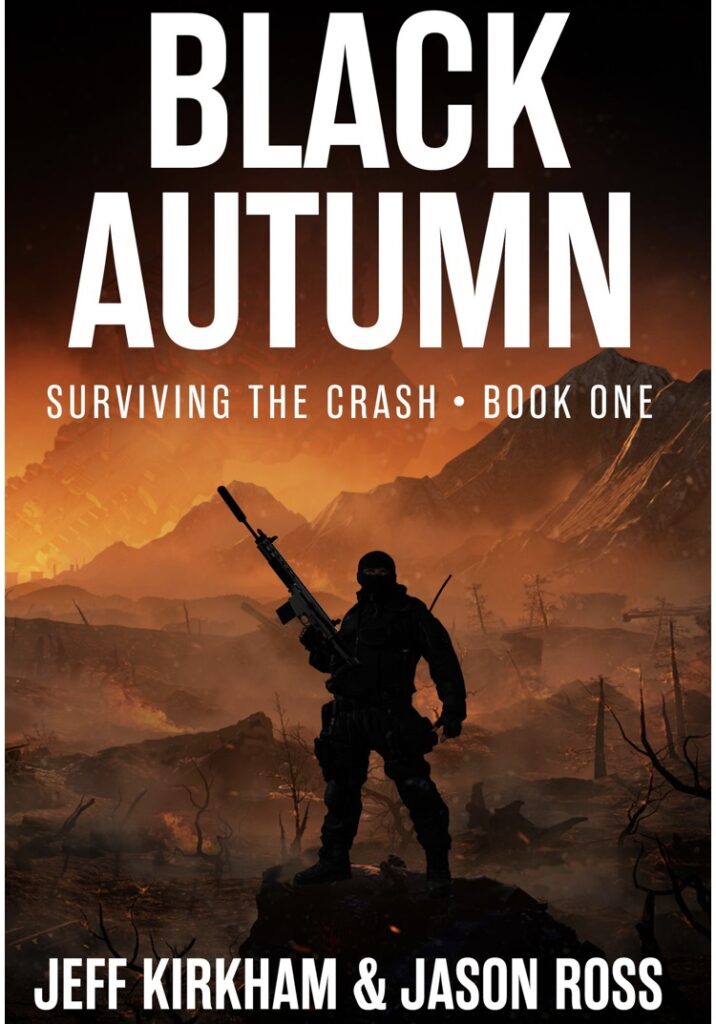
The damn book ended with, and I am not making this up, a war between illegal Mexican immigrant “gangbangers” and the nice white folk in the Salt Lake City adjacent homestead. It ended up being “operator” porn. If you don’t know what that is read this piece on Black Rifle Coffee and the aesthetics of marketing to conservatives. Americans have a hard on for the military even if they never served.

I’m kind of mortified this is now in my Amazon history. Folks in the analytics department are going to start marketing even more reactionary shit to me. And deservedly because I bought another book called Day 299 (in case you hadn’t noticed I label my shit by the day too) in which some white guy goes from generic conservative “the government is bad” to full blown only alpha male traditionalist reactionary. I’m a third of the way in and I’ve so far gotten exactly zero useful preps out of it. At least the racist operator porn gave me a good tip on a wood fired stove for my fantasy homestead in Montana.

Apparently there is an entire genre of apocalypse fiction and all the books covers are guns, country and God. Which are all things I value too but like let’s tone it down people. Preparedness shouldn’t be the province of one political affiliation. Natural disasters are happening more frequently whether you believe in climate change or not (if you don’t think the climate is changing well you can’t borrow my grain or my rifles). Being a prepper doesn’t mean you are a MAGA, a good ol’ boy, a conspiracy nut or a Christo-fascist neoreactionary. Hell you probably aren’t a blue lives matter bootlicker if you are also a staunch 2A small government type. But the aesthetics sure make it look like it. This Mark Goodwin dude must be really weird in bed.

Everyone needs water, food and shelter. And we’ve been skeptical of FEMA since the X-Files movie so it’s not exactly news that self reliance is critical. So if you write apocalypse fiction please convince your publishers to chill on the imagery. I get that sex sells but the aesthetics are cringe and that’s keeping people from being prepared.

Categories
Startups

Day 305 and Request for Founder

I was having an emotional conversation with a friend. They were giving me a piece of feedback that was truthful but hurt me. Because I feel psychologically safe with them, I was able to take the feedback in a receptive and open manner. I could incorporate it into my mental framework immediately because I trusted my friend. And I knew that their feedback was important and accurate.

One of the traits that I feel is most central to success in founding a company is the ability to process feedback effectively. Founders are constantly getting feedback. An average day might include angry customers with product complaints, a venture capitalist with heartfelt but partially useless advice, an unproductive strategy meeting where no one can seem to align, and a bunch of smart ass shitposters on social media with job advice for you.

A startup CEO gets a lot of feedback. Every day is a deluge of the stuff. And founders have to be gracious about it. Even when a lot of the feedback is useless, or even occasionally downright bad. You as a founder have to decide what to take and what to ignore. Because learning how to synthesize and integrate feedback; positive, negative or even profoundly unhelpful, is in fact your job. Being good at it matters. It’s the closest thing I have to a litmus test as an investor.

This is a trait I prioritize highly in founders. If you yourself are a founder that is working on improving your capacity for feedback processing, I want to hear from you. That mental flexibility is one of the core criteria I look for when I decide on an investment. Do I think you will be able to intake enough information about their market to get to product market fit? Will you be able to adjust your mindset and mental models quickly enough to outrun inertia? How emotionally strong are they that there can hear constant negative input and still hold their positive vision? But equally can you adjust that positive vision when negative feedback that actually matters presents itself.

These are the questions you need to have answers to for yourself. If you can drop me a line on Twitter DM. I’ve got an entire primer on now I like to get to know founders.

Categories
Emotional Work Startups

Day 296 and Under Budget

One reason I’ve been comfortable working in startups my whole life is I’ve never been a big spender. My biggest expense is probably takeout, as I find cooking to be a waste of time. As long as I can afford medical insurance (I’d get a job somewhere with socialized medicine if it came to that) I’m pretty happy with a one bedroom and Chipotle for dinner. Some people get used to their lifestyle as they make more money. I just haven’t yet.

If I go bankrupt (and sadly I lived through that emotional roller coaster as a teenager with my family) I could find a way to live within new means again. I don’t have to be in the top 10% to have a good life. I only need that for health care costs and sorry America but there are other options. I’ve got skills that could earn me stability if I wanted to make that choice. Hear that Canada I’m recruitable!

But I do need to learn to live comfortably with my current means. It’s alright to live within your budget. Sometimes budgets bigger and you can easily spend more on disposable income. And this was a year where my means finally got comfortable. And I’m still sort of afraid to use it. I had to really talk myself into a chair that that was functionally a workplace accommodation. Instead of just jumping at a chair that lets me work comfortably for longer hours I spent several years just not working as many hours.

This tendency to live under budget comes everywhere. I wanted something I considered fairly lavish for dinner. But I thought how ridiculous to spend an extra $15 on dinner. I got a little worked up trying to think of other options that I wanted as much and my husband said “fifteen bucks isn’t going to make a difference get the damn thing.” And so I did and it was fantastic. I’m super happy about my evening and the spending will have no impact on my total budget. Anyone who tells you that money or privilege can’t buy you happiness are lying. Happiness is a choice and it’s an easier choice when you can make the choices you want.

I had mental upper bounds on what I think it is responsible to spend for years. I ran an Airbnb side hustle out of an underpriced two bedroom in Chintatown while I had a six figure salary, because I wanted to live so far under my means I could take risks if I wanted. That under budget mentality let me save up 70,000. It’s also how I met my husband but that’s a different story.

That kind of thinking let me enjoy startup failures for the priceless learning that they are. But now I realize I’m afraid to live on my budget. Unless I’m living massively under budget I’m a little uncomfortable. So I’m going to try to let that one go. I can just live on budget.

Categories
Internet Culture Media Startups

Day 295 and Long Game

I think most people dislike media because it’s hard to understand where a narrative came from. If you aren’t in the business of telling stories the natural braiding of emotions, motivations and public opinion can seem foreign. It’s like the weather. It’s completely comprehensible how different patterns emerge but you cannot predict precisely how it will play out. There is a science but the specificity of the modeling isn’t so accurate you can predict the course.

This is why I encourage startups that work with me to think about the long game. Give context about your space and your opinion of how it will change and grow. Don’t be afraid to state clearly and in specific why something is the way that it is when talking to a journalist. No one is out to get you.

Journalists just want to show a story that makes sense to regular people. A cohesive truth that can be proven with outside and objective fact still matters to virtually everyone outside of very specific Murdoch outlets (never give a quote to the NY Post).

So much of being covered in the media is not about having a publicist or being trained but is rather about interacting with the 4th estate as if they are human just like you. A reporter will happily tell your story if you can make a case for why it’s true. And no one is coming to “gotcha” over some secret. The Internet may roast you but that’s just the crowds. No one has control over public sentiment. You too may one day become the main character on Twitter. But that’s probably your fault and not a journalist’s doing.

So if you want to live in public think through what the long game might be. And work on convincing others that the future you see is not only good but inexorable. And repeat it with conviction. It’s ok if you get some shit wrong, cancel culture won’t demolish you. Probably. I mean some of you deserve to be canceled but somehow it never seems to happen to the assholes who really deserve it.

Categories
Emotional Work Politics

Day 294 and Allowing Help

I’m extremely uncomfortable having help with my home life. I’d say this is the surest sign that I wasn’t raised in the upper class, but I did have a nanny when the first tech boom hit so I can’t claim it’s a new experience. It’s not as if I’m adapting to having the money to hire help for things like cleaning, cooking or household help. Twelve year old Julie had a lot of privilege.

In fact, I think it’s a great use of resources to have someone who is adept at these tasks do them instead of me. Everyone has different skills and abilities and mine are not logistics. People should absolutely trade their time in the ways that they prefer. Capitalism gave us labor specialization and I love the benefits. You wouldn’t want me running operations for anything.

No, the thing that troubles me about hiring out for help in the home is that I’m uncomfortable around other human beings for long hours. I know this sounds like some sensitive white lady shit. You can peg me for that. But it’s more than just being a soft bitch. I’m genuinely nervous around people in a way that I don’t think I’d normal.

Too much time socializing stresses me out. If I have to smile, make small talk, and be conscious of my interactions I find it draining. You’ll see it in my biometrics too. On a day where I go to a doctor or have an extended period where I am one-on-one with another person my resting heart rate goes up and my HRV goes down. My Whoop records a higher strain score. I want to blame this on the rational concern for physical health as I have an autoimmune condition that puts me at higher risk. But I think I’m just less capable with people than others.

This has made me reconsider the calculus of whether it’s always logical to outsource tasks to make time for work whose time value is dramatically better. That logic makes it clear that all activities can arbitraged for more value. But what if some things you suck at make you happy? What if some things you are bad at are less stressful than things you are good at. Some people move to cook but have no talent. Some people are amazing at jobs they hate. If I really find that people around people is using up valuable energy maybe I should do it myself.

I think it’s possible we might have so thoroughly skewed our human values to economic gain we aren’t even sure where to spend time for joy. Which I realize is a really ponderous way to look at paying someone to clean the kitchen. But aren’t we all reconsidering what valuable in our lives?

Categories
Emotional Work Internet Culture

Day 293 and A Good Cry

I’m a cryer. I hear the swell of trumpet from the Star Trek theme song and I’ll start welling up. I’ll read a poignant passage in a cheesy airplane novel and my chest will tighten with emotion. My eyes will tear up when I tell a friend that I’m proud of them. I’ve found myself sniffling over a set of emotional text messages. I love a good cry.

I think I’m a cryer because I bottle up my emotions otherwise. I’ll share feelings in public but the real deep down core emotions are harder for me to express openly. The fear and hurt and sadness that make up the core of my emotional unconscious take some coaxing and a lot of psychological safety to get out into the open.

One of the reasons I find social media so much fun is it is a cesspool of emotions. Much of shitposting is just rage and anger expressed with a joke. And the shitposts that are sad are often told with a kind of vulnerability that I more commonly associate with 12 step meetings or group therapy. Internet culture has become an escape valve for emotions we didn’t know we even had.

The more I see the negatives that comes with keeping emotions bottled up the more I appreciate ways to let them out. If it is a good cry then I’ll take whatever brings it on. If you need something stronger than I highly recommend a light dose of Internet emotions. Just don’t let it overwhelm. Ease into the shallow end with an anonymous shitposting account first.

Categories
Emotional Work

Day 291 and Self Control

Self control is a form of self abuse for me. Early in life I learned that I could control others by controlling my emotions. Instead of showing my feelings, I’d distort my emotions into whatever got me attention from adults. That’s pretty clever for a child, but is the road to misery once you’ve grown up.

Alas I’ve kept up the habit of self control. It might not look like it from social media or press narratives, but I self censor a lot. I’m often conscious of what others will like or dislike and I will edit my feelings if I feel it isn’t to my benefit. What can I say, I am still hurting from feeling like I wasn’t loved as a child by my father. Same old story that everyone has in their lives (well maybe for you it was your mother but same idea).

But it hurts to keep your emotions inside. Eventually it will turn into pain or sickness. Not that I’m saying all pain or illness is caused by emotions (that’s some bullshit) but the mind body connection is real. The point is it’s only hurting myself to exert so much control over my emotions.

I need to get more comfortable with being uncomfortable with other people and how they feel about me. The control I have is largely a fantasy. It’s not that it’s not possible to change how others perceive you. Hell I’ve picked professions where that’s practically the main skill set. I love the perception game. Public relations, fashion, even venture capital are all games you win by building a good reputation.

Having a good reputation doesn’t mean turning off honesty. If anything reputations are built on being trustworthy. And that generally means saying what you mean and meaning what you say. So I’ve got to stop abusing myself by choking off emotions I don’t think others will like. Maybe it’s a gender thing. I learned pretty quickly no one likes an angry woman. But sometimes I get angry. Whatever excuse I’m using for hiding unpleasant emotions has got to go.

Categories
Internet Culture Politics Preparedness

289 and Apocalyptic Aging

Millennials are aging, but that doesn’t seem to have kicked off the midlife crisis handwringing of popular culture yesteryears. The first millennial are edging towards 40 but it feels like no one is a day over thirty on social media. Maybe because it’s hard to feel like you’ve hit midlife when the traditional markers of stability like children and mortgages feel more like luxury status symbols.

Maybe no one is craving red sports cars and the open road because no one has the security of a home life from which to break free. A midlife crisis seems like an almost comically indulgent thing that our boomer parents did. Imagine having kids and a home and thinking that you wanted to go back to the insecurity of your twenties? And boomers have the balls to call millennials spoiled. You had to have have stability to throw it away first.

I’m an elder millennial and a reasonably comfortable even wealthy one at that. But I don’t have kids or own a house. I frozen my eggs when it seemed like having kids wasn’t financially feasible. My husband and I lived in Manhattan at the time and we both had early stage startups. It seemed like a wise idea to put off the decision at the time. And we never even considered buying an apartment. Tying up all that wealth into a one bedroom apartment was for trust funders not the professional class.

Now it’s clear we can afford children and a mortgage on a house, but it seems crazy to commit to either. No one has a clue what life is going to be like in ten years so why would you anchor yourself and innocent progeny? It almost feels immoral to consider.

I don’t really understand how one can age gracefully when so much of life feels casually apocalyptic. Maybe millennials aren’t acknowledging aging because we live in the stasis of the long now. If there is no future then we aren’t moving into it. Each passing year is just a lucky bonus when nothing builds towards stability.

Not being able to afford children and houses is a blessing if you don’t believe in the future will be better. We’ve rationalized that the basics of the American are luxuries only for the wealthy. The wealthy can afford to live with rising tides and six figure college tuitions. Everyone else is thrilled to have enough cash to buy prepper supplies and pay their health insurance deductible.

And in some horrifying sense it is rational. I don’t trust the political system in America. Which means I don’t trust we can solve pressing issues like climate change or rising debt. So when new and exciting issues like the pandemic destabilize life even further it makes committing to a future even less appealing. There is absolutely a part of me that stopped believing in the future sometime in 2016. Everything went Hobbesian. Millennials are aging but we aren’t growing into a future.

Categories
Biohacking Chronic Disease

Day 287 and Routines

I haven’t figured out how to incorporate my routines into my busier workdays. I feel like I’ve written this blogpost at least 3-4 times but somehow I never seem to find balance easily when I make big changes to how I spend my time.

All the self care efforts that has become comfortable rhythms go by the wayside as soon as I add in new obligations. And then my body gets pissed that I’m not taking care of it and I get into the same pattern of two steps forward and one step back.

You’d think after experiencing this issue multiple times I’d be better at ramping change slowly but I remain the sort of person that loves to dive into shit head first.

After much enthusiasm and progress I’m writing todays post from a physically mediocre places. My stomach is upset. I am fighting off a migraine. My muscles are tense. I’m anxious about all of these symptoms turning into a messy cascade. So I’m turning to my pharmaceuticals, taking a mess of prescriptions, and going to bed. Maybe tomorrow is another chance to find a better balance.

Categories
Media

Day 281 and Villains

This is a post that will have spoilers about the end of the second season of Ted Lasso. Do not read any further if you have not seen it. I’ll put an extra paragraph to keep it from your eyes and we can meet again tomorrow.

SPOILERS BELOW

The first season of Ted Lasso may be one of the most perfect seasons of television ever made. It’s like being inside the best session of therapy you’ve ever had. The kind where you have a breakthrough so profound that the hurt and agony of your worst childhood trauma suddenly feels not only bearable but also the reason to fully love yourself. It’s just that good on the emotional truth scale. The warmth and safety and growth is beautiful.

But season two leans into tropes and villainy where it used to rely on nuance and kindness. Rather than feeling the pride and hope of emotional truth that has been hard gotten (the truth will set you free but first it will piss you off), we are given the obvious end of Nate betraying Ted and Rebecca by going to coach for Rupert’s new team West Ham.

Nate makes a massive accusation that Ted abandoned Nate emotionally but we are given roughly thirty seconds to wrack our brains for these betrayals before it is revealed that Nate has chosen to abandon Ted. How do we feel about this? Wouldn’t we normally explore how both people contributed to the feeling? But nope it’s send Nate right into insecure narcissistic reactivity rather than mine for the potential nuance.

We could have been given a story where we see Nate and Ted equally participating in the traumas they each carry and how it affects their relationship. Ted with his fear of abandonment brought on by his father’s suicide very well may play out that pattern of abandonment on Nate. But that’s left largely unexplored. Perhaps it could have shown us how Nate intuitively sees that because of Ted’s unresolved pain with his father, Ted in fact isn’t fully there for Nate in his new role as a surrogate father figure coach.

The struggles of a young man coping with a new position and unexpected authority granted by father figure like Ted juxtaposed against Nate’s own issue with his father who doesn’t show him respect would have been an empathetic story in the hands of this show.

There was so much fertile ground for how each character could trigger emotions in the other and for how they could own and resolve these feelings. But instead it’s straight to villain don’t pass to don’t collect 200 dollars. By the end I wasn’t even sad about the loss. I’d resigned myself to the conclusion. But they could have done so much better by everyone. Even if Nate must experience his darker impulses we would have been wiling to see the full journey of how he arrived there and the pain other’s traumas has inadvertently wrecked on Nate.

I guess I’m not sad. I’m just disappointed. And that’s how you know it really mattered to me.