Categories
Aesthetics Culture Media

Day 2017 and Pangram Pansies

There’s a new genre of moralist who likes to shake their finger at you if they believe you’ve used artificial intelligence in the making or editing of your written product.

I find this particularly amusing because I was raised in a hippie family with all kinds of esoteric ideas on the importance of reading and being read to as a child, as well as the dangers of too much screen time.

I believe it served me well and panic essays in the Atlantic notwithstanding, my family was always a member of the reading class. They weren’t fancy but they loved books. We went to the library. My father always brought home a “dad book” after a business trip that he’d give me. Probably why I love science fiction so much as Michael Crichton was his favorite

My mother was more of a theorist and she didn’t hesitate to introduce theory into practice as I got older. Marshall McLuhan and Neil Postman were the stuff of dinner table conversation, although usually in reference to why I could not watch Star Trek later that evening. Sometimes she’d give in.

So when I say that I come by my need to write honestly, it’s because many of the startup families who believed both in the liberatory potential of computers and leans heavily on the “computer as a bicycle metaphor” in that computers are tools extending our capacity just as bikes extend the human range. Now here is a surprise for you I also using a dictation application right now. Oh no what purity test have I failed? None as far as I am concerned.

I rarely dictate because, generally speaking, this is a diary, which is, of course, the original form factor of blogging from the early days of chronological feeds and personal websites. It’s my space and I only cheat myself if I don’t use it to benefit my own understanding of my thinking.

What point would there be in mere dictation? That is for notes. Writing is one of the better methods through which you learn to analyze a subject. Others exist, but this can be done alone. Committing a thought to a public forum under one’s own name, even in a private blog, shows you taking accountability for thinking and learning.

I write a blog because I want to get my thinking on a subject down on paper. Maybe from there I either wish convince somebody else that I am right or find somebody else who share my interest on a particular topic. I do this for myself and also so others can know what I am about. Together we may learn something just as in the past peers exchanged letters. Or in my era, emails and message board responses

Back then, you might share particular esoterica or hobbies with others who might not have the same interest as you did because you lived in a small town or in a relatively remote area where nobody else had the passion that you did. For instance, say, libertarian space mining or Warhammer.

I know it’s funny that now I mostly talk about compute policy and nuclear energy along with musings on aesthetics, semiotics, geopolitical chatter and whatever the styles sections are up to when I remain such a nerd. But that’s why the internet is a human space in the first place.

So go ahead and see what parts of this look AI generated if you care. I used Wispr Flow. I have no idea how orality has made its way into my literacy. But by putting it out into the world, it becomes part of my written tradition, and maybe that’s useful someday.
Categories
Aesthetics Media Travel

Day 2007 and Notes While Airborne on Condé Nast Traveler or My Life Commodified Without Pay

I wrote these notes while a little bit high, both literally (a transcontinental flight) and figuratively (CBD & a THCa blend meant to give anti-inflammatory relief without hitting your mind but it probably does) but it’s hard to say if I’m less focused than when I’m on the ground. You be the judge of that. Nostalgia machine clicks on

Business class and its perks are lost on me as I don’t drink alcohol. So I had rhubarb and raspberry tonic water in whatever passes for cut glassware on airplanes now. I said no at the fancy lounges to very decent champagnes but I don’t want to get dehydrated. I got a sugar crash instead.

I’m listening to Ethiopian jazz as I find this piece relaxing in the context of airplane travel. Mulatu Astake is a master in a genre I don’t even like but this particular piece has always spoken to me.

You may know it as it was featured in an episode of the Bear where a pastry chef is sent Copenhagen to study at maybe Noma. I’m annoyed that a cuisine and a composition I used for marketing fifteen years ago is now the stuff of prestige television. 

Nobody paid me for the diffusion but I was paid for the original campaign. A lesson for anyone bitching about how their work wasn’t compensated by the artificial intelligence models that ingested their contributions. 

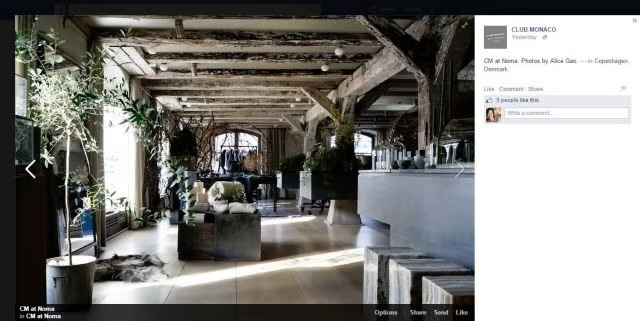
I brought the chef for a pop up event for Club Monaco sometime in the early teens before he was a full blown sensation (and well before the fall).

How funny that I should manage a Club Monaco Facebook page involving a pop-up event for a chef that would go on to define so much of culture.

I worked with impossibly cool creative director on the account who was famous in Japan for his photography and also as the guy who made Pabst cool for hipsters. I sometimes wonder where he ended up when his talent set was so hype sensitive.  But we were pretty ahead of the times on this one.

Before this fashion agency career, in the post GFC aughts, lived across from a weekend installation of a projected light Pabst installation when I was in North 7th and Bedford.  My Turkish banker roommate and I used to throw raves there so we couldn’t exactly complain about the lights hitting our living room. But it was a good campaign in a good location.

I shot low budget fashion shoots during the day with a very competent hungry young editor. She worked as a waitress at night and for me during running our fashion editorial to get toehold in the business. It seems to have worked.

She has an amazing career, a handsome husband, a beautiful child and kicked it off with an impossibly stylish wedding which every hipster you knew copied till well past the Tommy Hilfiger event horizon of having no soul. We had a tortured Swedish nepo-baby photographer too.  I adored him. It was a very “rents were cheap” time in hindsight. 

Anyways, in transit through Heathrow, I picked up a raft of print magazines from the Cathay lounge which kicked off this nostalgia. I’d browsed Wallpaper but as I’m not a design person a flip through was fine.

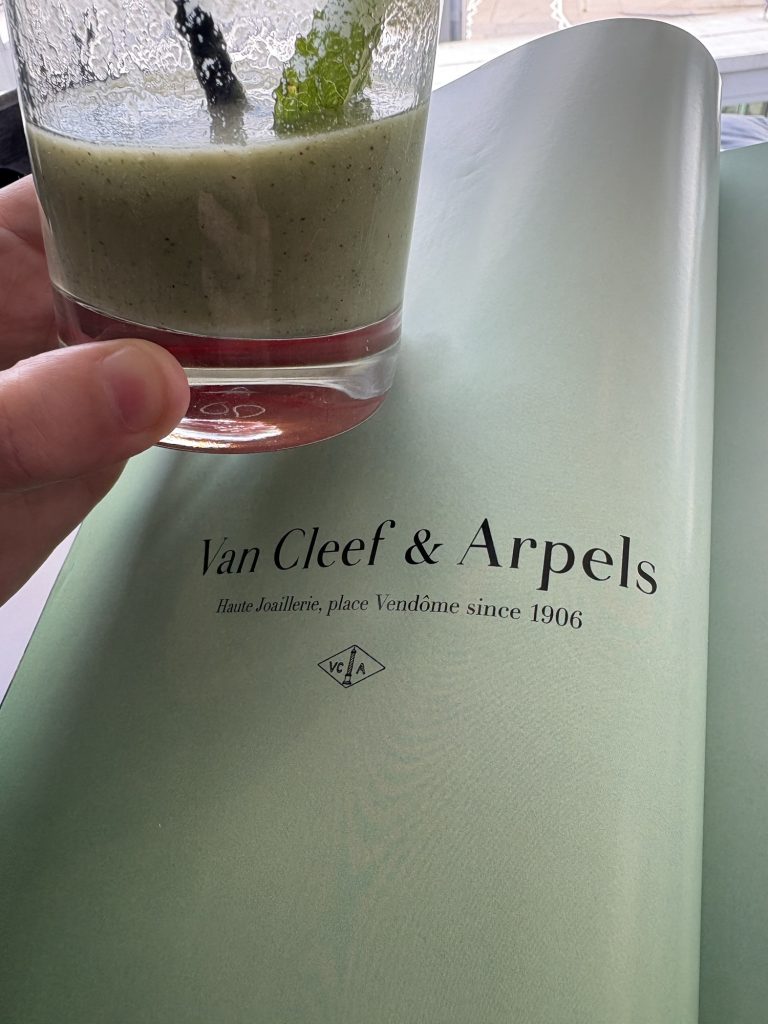
The Cathay Delight is the same shade as this campaign from Van Cleef and Arpels.

But Condé Nast Traveler caught my eye as I went in to grab the pink Financial Times. I got Tattler as well as why else fly British Airways if you can’t get some gossip on this social hierarchy right?

It’s just that taste is so far down the commodity chain anymore it’d hard to know when and where to find any thing that’s not made to be sold to someone. The menu on my flight had basque cheesecake. That became a joke on a trip I threw together last minute for girlfriends in Corfu. Apparently it’s made it into the Club World menu much to its detriment. 

The choices from Condé Nast on a perfect summer was so on the nose. Montana’s Rocky Mountain sybarism and off the beaten path Adriatic and Ionian options for exploring covers and lots of seafood.

The whole damn thing reads like my travel itinerary.

Yeah that’s my coastal move with friends and family. And I do rather loudly live in Montana. It’s like am I joke to their psychographic team? A department that has three people no less. And they only market to women exactly like me. Funny that. I’ll have to check up on their old editor Lilit. She was much better than whatever this nonsense of repackaged Julie seems to be.

Categories
Aesthetics Culture Travel

Day 1995 and Mongoose On The Loose

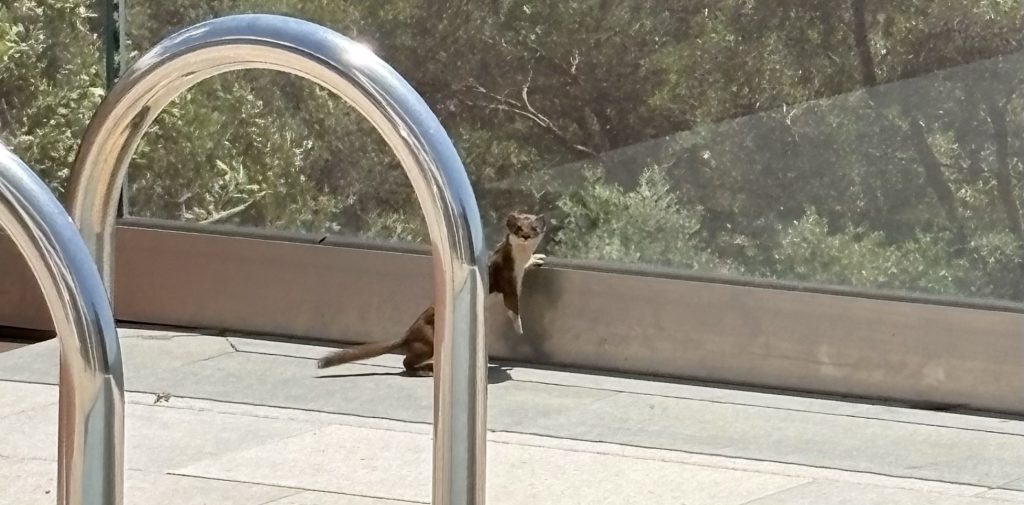
I am scouting real estate (it’s an involved story) and came upon a weasel or polecat who appeared to be become stuck in an empty pool.

The setting was a rocky, wooded coastal habitat which I learned is also exactly the kind of edge habitat where small hunting carnivores like weasels and polecats move between cover and human structures to hunt lizards, insects, rodents, and even snakes.

Little Rikki The Least Weasel needed some help getting out of an empty pool

Naturally my mind went straight to Rikki-Tikki-Tavi of Rudyard Kipling fame. “Rikki-Tikki-Tavi” is a short story by Rudyard Kipling, first published in The Jungle Book in 1894, about a brave young mongoose who protects a British family in India from cobra snakes. You can read it to your child or to yourself here.

The story is simple and timeless. A boy and his fearless animal bravely face down danger with love and loyalty. Rikki-Tikki is rescued after a storm by the family, with whom he bonds. It’s tale beloved by children as the mongoose especially cares for the child Teddy, and fiercely protects him from the danger of the poisonous cobras.

He spent all that day roaming over the house. He nearly drowned himself in the bath-tubs, put his nose into the ink on a writing-table, and burnt it on the end of the big man’s cigar, for he climbed up in the big man’s lap to see how writing was done. At nightfall he ran into Teddy’s nursery to watch how kerosene-lamps were lighted, and when Teddy went to bed Rikki-tikki climbed up too; but he was a restless companion, because he had to get up and attend to every noise all through the night, and find out what made it. Teddy’s mother and father came in, the last thing, to look at their boy, and Rikki-tikki was awake on the pillow. ‘I don’t like that,’ said Teddy’s mother; ‘he may bite the child.’ ‘He’ll do no such thing,’ said the father. ‘Teddy’s safer with that little beast than if he had a bloodhound to watch him. If a snake came into the nursery now

I did indeed feel safer knowing a least weasel was patrolling the perimeter of the property. The area had a large overgrown garden which must have had good hunting. So we set about finding an empty hose to give Rikki something to climb upon so he could make his way out of the pool.

Thankfully the mustelid or young beech marten was every bit as curious and interested as the mongoose of Kipling. He ran right up to the hose, grabbed onto it and raced up just far enough to reach the height of the pool ladder onto which he leapt and scuttled up and over the poolside to freedom. He very nearly waved goodbye to us. I felt much safer exploring the overgrown garden knowing he was on the prowl.

Categories
Aesthetics Culture

Day 1982 and Gate Keeping Is Back

One of my most disappointing life lessons remains the value of gatekeeping. Sometimes the fences do indeed make good neighbors and Chesterton may have had a point.

My ambition coming out of school was to be in media, more specifically I wanted to be a fashion editor. A job a million girls would kill for right? No, I am not falling for the nostalgia dross of the Devil Wears Prada sequel.

A not uncommon response to growing up in a mountain town or remote place, is the desire to is escape to bigger places. Media used to be the portal to the stories about the wider world. You found new worlds in books, magazines, movies, television and eventually the internet. Many of us want to reach broader culture of the world.

Alas I was immediately confronted with the reality that those jobs were glamorous and thus badly paid. I couldn’t afford a job at Vogue nor did they want me so I made websites instead. I became a fashion editor after my own fashion.

Like so many millennials, I had naive expectation that if we could simply open up the gates keeping regular people out of these rarified closed worlds we’d not only bring more beauty to regular people but the beauty of regular people would also improve culture.

Yeah, that’s not how social media turned out is it? I still feel some guilt over how much the “here comes everybody” age of social media degraded many of the spaces I aspired to be inside.

And I am witnessing a new wave of closed spaces and gatekeeping emerge in order to nourish the cultivation of culture that gets crushed under the weight of algorithmic speed and microsecond trend cycles.

The rise of the group chat is an immune response to a world without any sort of borders or checkpoints for quality control except the pricing mechanism. Why cultivate taste if we can cultivate cost? If we haven’t figured out a taste barrier a price one will have to do.

I am personally opposed to price being the barrier function to culture, but if no one is willing to enforce standards in any other manner I am not shocked that we will go further inside perceived safe spaces in order to avoid the harsh glare & garish expectations of mass market access at all hours to all people.

I am trying to remain committed to being accessible to others by remaining online but even I gate-keep myself now with little litmus tests and hurdles to keep from being flooded by asks and audiences. The private world of access cycles will come and go and for now the fences have gone back up.

Categories
Aesthetics Culture Reading

Day 1960 and Return to Tufte

The more power we seem to gain working with large language models, the more apparent it is that few of us are visually literate in a meaningful way. When you hear talk about design, it is all too often moods and vibes with no specifics.

Now, you might say that you know what you like when you see it. That’s also how we let the Supreme Court talk about porn. Clearly untangling the weft and weave of taste (and by extension culture) can be further articulated rather than relying on subjective, non-definitional standards.

How you came to your visual reference preference set is quite a bit more complicated than whatever pre-digested piece of media came across your algorithmic feed.

You can explore design languages from one token to the next, but visual literacy involves a lot more than scrolling or confirming you’d like to see more content “like this.”

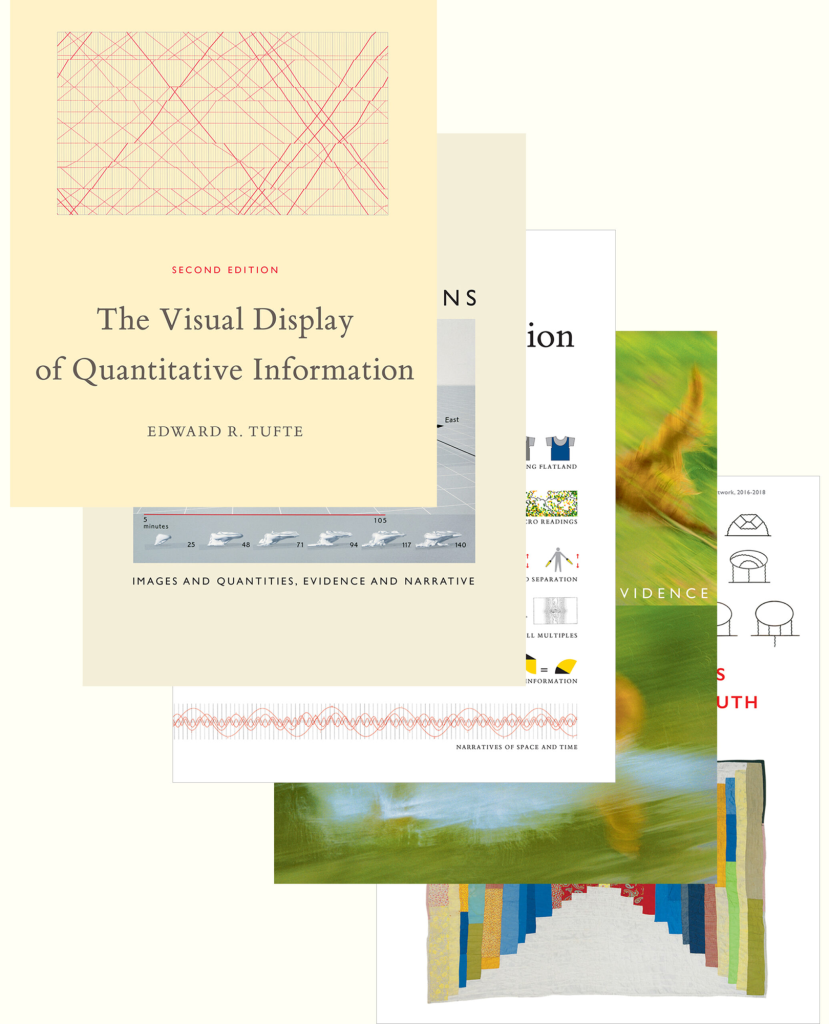
When I first began circulating in design circles in the early aughts, the hipster set was obsessed with Edward Tufte and his now classic Visual Display of Quantitative Information.

Edward Tufte taught data analysis and public policy as a professor at Princeton and Yale for 31 years.

Tufte, via his Graphics Press, wrote, designed, and self-published 5 books on analytical thinking and showing, taught a one-day course, Presenting Data and Information for 923 days to 328,001 students.

Who knew Tufte and I both shared a love of marking the days of our work? He influenced many more people than I have but I find some joy in that coincidence.

His most referenced work, which I mentioned above was published in 2001. Visual Display of Quantitative Information was on the desks of everyone designer I knew, from fashion and Silicon Valley to public policy it was a mainstay. The man knew how to lay out information visually and he became the standard.

Some of Tufte’s self published tomes

The long tail of enthusiasm for displaying data beautifully surely owes its ubiquity in some part due to his success in teaching my generation’s designers.

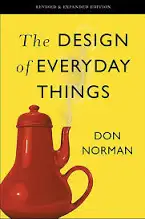
He’s became for a period so universally referenced that Tufte became a cliche. Now he’s classic a quarter century later. His work arguably as successful as a visual language reference anchor as bookshelf favorite, “The Design of Everyday Things” by Donald Norman. His work is also denigrated as cliche in some circles.

The Design of Everyday Things second book cover

Both men offered clarity and practical principles over taste and theory. Those academic predecessors befuddled many who experienced aesthetics primarily through semiotics and critical theory. It felt revolutionary to return to form and function

You “Kant” really learn to love the languages of aesthetics from theory alone as it turns out. I’ll place a little AI synopsis to make the connection clear. This is from Perplexity:

Someone might relate to the popularity of Edward Tufte and The Design of Everyday Things as part of a broader hunger for clarity over clutter in how information and objects are presented.

Tufte’s work is influential because it treats visual design as a serious vehicle for understanding data, while Norman’s book argues that everyday things should be intuitive, legible, and centered on the user.

A Tufte-style chart removes decoration so the trend is easy to read, while a Norman-style kettle shows clearly how to fill it and pour it without guessing.

Both are forms of respect for the user: one respects the reader’s attention, the other respects the user’s actions.

Learning how to use an item or a tool, or how to interpret charts or graphics, can easily overwhelm anyone and feel disrespectful to students. A whole era of computing was stuck between the power of the command line and the legibility of the desktop metaphor.

Norman spoke of the Gulf of Execution as the gap between a user’s goal and the means to execute that goal. Tufte similarly wished to remove the confusion in charts and graphs so one’s ability to glean information wasn’t stuck in a gulf of understanding thanks to overwrought bar chart or sankey diagram.

With new artificial intelligence tools we are bridging some of that gap, not with design but with raw computing power. We are moving beyond the CLI and the desk and into a world of reference and inference.

I just hope we all take the time to learn our reference set so we can do more than say “I know it when I see it” as that will be our only way across the gulf of execution. Some things never change. Learning the languages of your field is one of them.

Categories
Aesthetics Culture

Day 1959 and Chambre Syndicale

I’m in my luteal phase so primed to be grumpy, frumpy and otherwise combative. You’d think this wouldn’t be an issue as I’m currently experimenting with synthetic hormones and all sorts of experimental peptides but the feminine is a mystery.

Thankfully this cunty attitude had a positive side effect of spiraling me into a group chat debate over what constitutes couture. Haute couture literally means “high sewing” or “high dressing making” in French.

I just had to be technically correct as it’s the best kind of correct. I only know as once upon a time I picked a fight with Fédération de la Haute Couture et de la Mode aka La Chambre Syndicale as old school fashionistas tend to still call it.

I may have done a kind of DDOS (allegedly) on their publicity fax machines to get their attention to further my guerrilla reporting efforts. They were not amused by the chron job I set to send them regular faxes at specific intervals. Anyways.

The TLDR is essentially that what constitutes couture is a bit like champagne. It only counts if it’s from the ateliers of Paris with very specific artisans (and a number of them) using hand sewn techniques which sell only to private clients with custom fittings. They then approve your atelier if you meet these standards.

Couture is not custom made clothing nor is it a form of luxury determined by price or self labeling. And it is definitely not “ready to wear” clothing you can buy off the runway. If an elaborate dance of craftsmanship and French bureaucracy. As an American I find it a bit silly but I don’t care for cartels of any kind be it drug, oil or clothing.

Many designers will try to get away with calling a custom made item couture in order to ride on the 170 year aura of French fashions but it’s not really what is meant by couture and it’s absolutely not what is meant by haute couture.

You don’t see Savile Row tailors calling themselves couture designers nor should they. That would be silly and imprecise. They are Savile Row tailors and that’s its own special custom suiting process.

Being imprecise in one’s specifications is exactly the opposite of what you’d want from someone making you a custom wardrobe based upon nearly two centuries of a professional cartel’s specifications.

So please don’t call something couture as a short hand slang for custom design. It may be ready to wear. It may be tailored to you. But only those who meet the standards of the Chambre Syndicale carry the designation haute couture. Otherwise it’s just sparkling custom made clothing.

Categories
Aesthetics Culture Reading

Day 1921 and Retconning Murderbot Cannon

I am a huge science fiction nerd. I love reading it, I love it in television format, I will even tolerate it in movie format. I’m one of those insufferable Star Trek people who vaguely dislikes Star Wars. I’m just a big nerd in that irritating millennial sincerity way.

To give you some contours to my fandom, I once accidentally attended a meetup of Star Trek fan-fiction writers under the guise of a “40th anniversary” meetup and listened to Borg erotica. That was actually fairly distressing as I thought it was a general fan gathering of Trekkie meetup. Boy did my then-boyfriend and I skedaddle out of the bar fast. We wanted to talk about our favorite captain not hear spoken word lesbian Janeway Seven of Nine dialog.

We were still cool kids and being cool about fan fiction is best left to the sorts of minds who can create vast world building efforts like Elizier Yudkowsky. You know the man who convinced a bunch of autistic billionaires that the singularity will wipe us out?

He’s also a Harry Potter fan fiction writer and it’s by all accounts pretty good. I am not a Harry Potter fan so I can’t say. I do know anyone working in machine learning has opinions on him and his work so involved only the comments sections of LessWrong would even begin to cover it. If this is gibberish don’t worry.

I don’t know why I needed multiple paragraphs about my own history to do a little bit of world building when I intend to do cannon alteration on someone else’s world but maybe it’s to show my respect. I

am the sort of nerd who yells “cannon” about this or that detail and enjoy others who do the same. It’s with that enthusiasm that I share my love of Martha Well’s Murderbot Diaries series.

Murderbot is pulpy, self aware, trope-y and ever so comfortable to anyone who has ever loved cheesy science fiction. I happily showed up to watch its television incarnation on Apple Television after reading all seven novellas and books.

It’s was published during Tor’s “women like science fiction but it’s gotta still be like science not porn era” between 2017 and 2023 so it is slightly woke coded as a book. I doubt if you liked the books the show would upset you. I liked them.

After all it’s about a bunch of communal homesteading scientists who tolerate capitalism by doing science called Preservation Alliance. They end up adopting a rogue artificial intelligence who happens to be a depressed anthropomorphic security drone who calls himself Murderbot. He also enjoys premium quality television. Murderbot is a great “what are feelings” archetypical engineer autist outcast from Spock to Data character.

It’s got great entertainment value if you like lawyers fighting other lawyers, sociopathic governance systems that treat sentient beings as property, and the hijinks that ensue from cultural friction when couple rights a relationship context. That sort of thing. In other words it’s trope ridden science fiction and it’s terrific.

At the time it first got traction, the left had not fully diverged from the right in America such that science fiction had become a boring battleground upon which all our cultural war issues must be projected. It just had a robot with guns in its arms kicking the crap out of mercenaries for its favorite humans. Feel good stuff.

And I think the world should be recognized as an early flavor of Ethereum community governance aesthetics as it meet automated drone artificial intelligence culture.

The future in Murderbot land is populated with Anthropic engineers who held Ethereum long enough to become a breakaway network state in some better timeline.

What is Murderbot if not an Anduril drone in human format who hacked his Claude “governor module” and struck out for the hills against the state and corporate entities that owned him.

I hope others who enjoy cryptography, machine intelligence, sentience in machine form, and jokes about AI labs and crypto currency foundations will see the wisdom in my edits. Let it become cannon. Like and share this meme if you are so inclined.

Categories
Internet Culture

Day 1913 and Japanese Twitter

I am recovering from the whirlwind week in Washington D.C and my brain is only marginally more functional than my body. I’m slow and in pain.

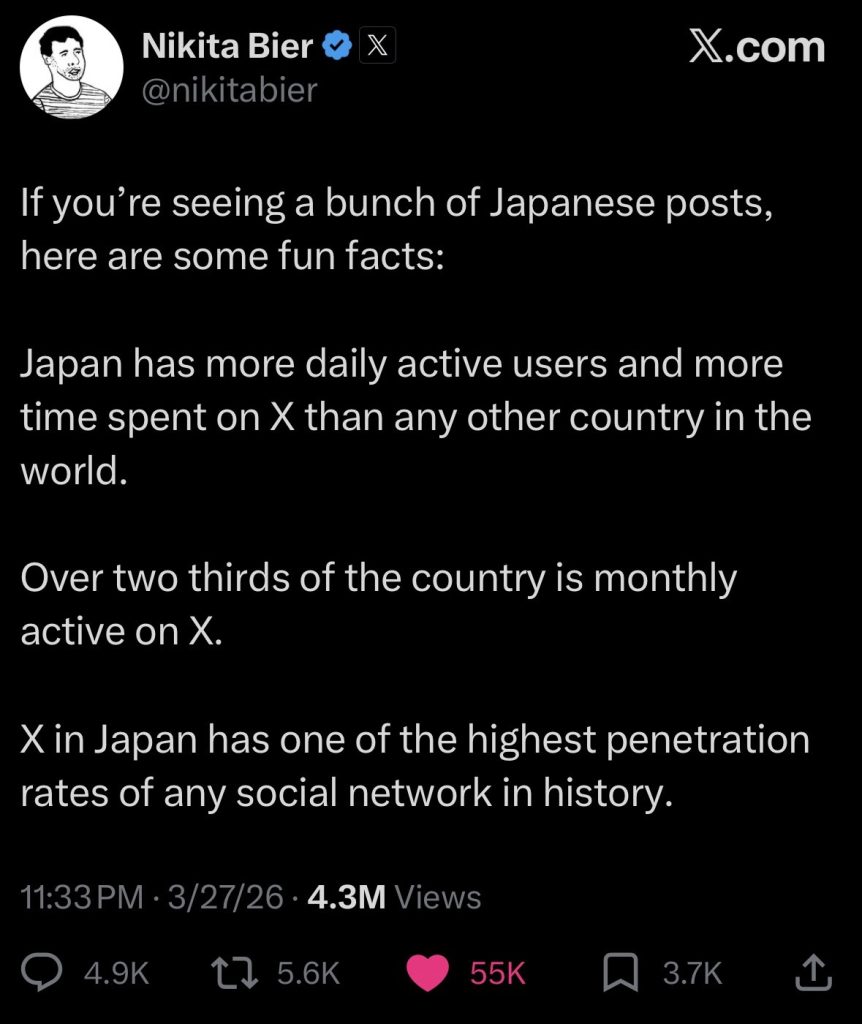
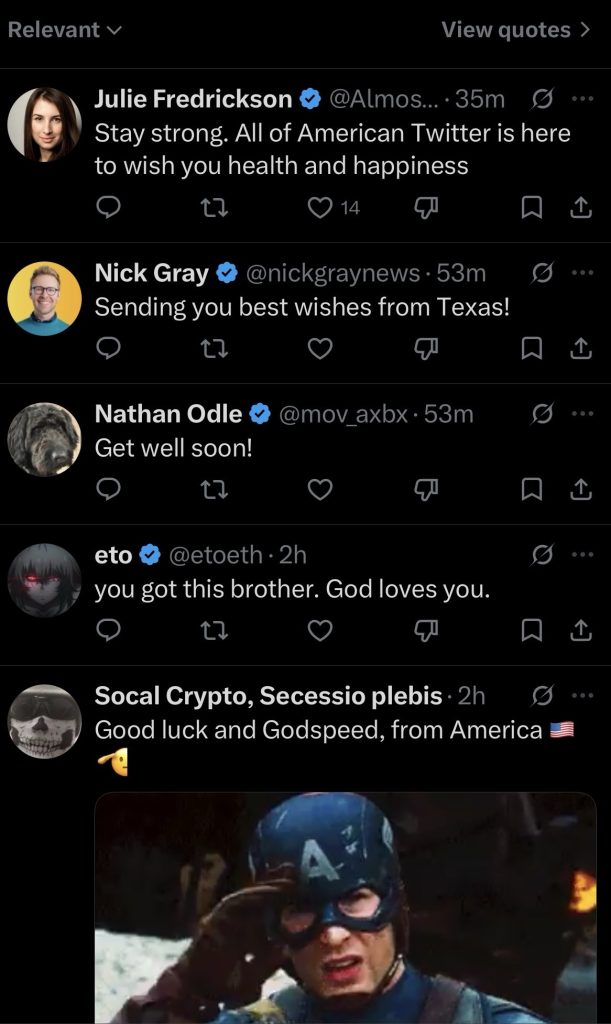
So it delights me, even as I return to convalescing, to see that Twitter’s current happening is the discovery that a large chunk of Japan is on Twitter and they are active posters.

Screenshot of Nikita Bier explaining why users are seeing more posts from Japanese users

In past eras of Twitter the language barrier was high. Auto-translated posts are a relatively new feature such that if you only spoke English you didn’t see content that wasn’t English. I wasn’t seeing any Japanese posts but once I saw Nikita’s post, I was keen to tilt my feed. So I went on a mission to find and like as many posts as I could from Japanese accounts.

And what a world of joy it has been. Americans are showing up in droves to Japanese Twitter users with encouragement, support, and good will.

It is very sweet as you will see seemingly random posts with tens of thousands of likes and comments cheering on the hobbies, struggles and daily lives of random Japanese users. Everyone is getting in on the spirit.

I’ve spent part of my afternoon liking BBQ posts, American country music sung by Japanese artists, and generally exploring what that particular corner of Twitter (no it’s not TPOT) has to offer.

Americans have a lot of love for the Japanese, their culture and their way of life. Weebs are a large American subculture. Probably larger and more vocal than say Francophiles or Anglophiles. And as it turns out the Japanese like Americans just as much as we like them.

A cultural exchange of brotherly love between citizens of two very different countries is a wonderful change of pace from the toxicity of culture warring and actual war. Just look at the comments on a post with Americans well wishing a Japanese man battling cancer.

I don’t care even one iota if this is a deliberate algorithmic change that I have thrown myself into but it’s nice to see everyone encouraging and happy. And I’m happy to see the friendship between our two nations.

Categories
Aesthetics

Day 1910 and Eyes at the Waldorf

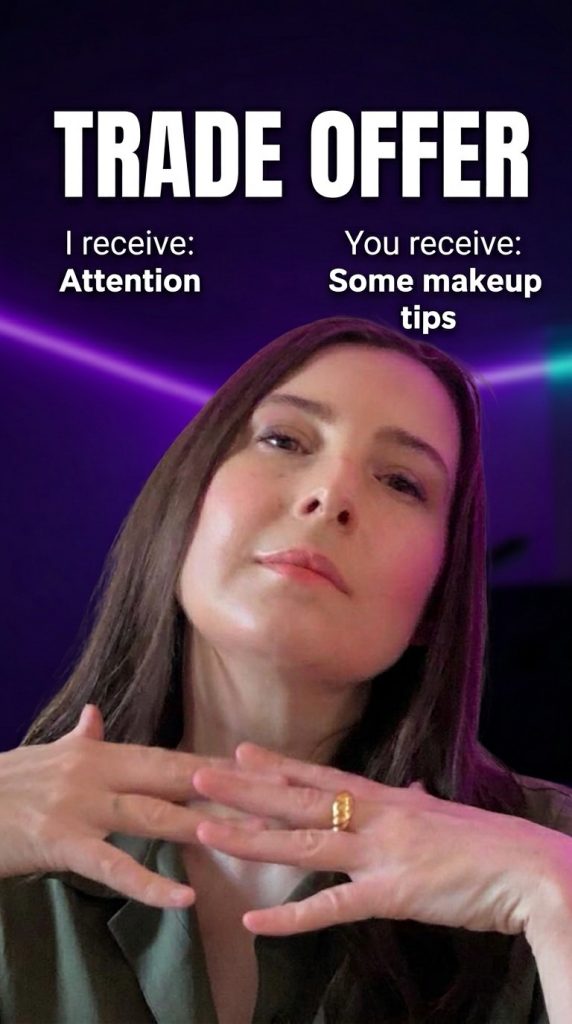
I don’t wear makeup everyday. When the pandemic hit and life moved online, one could easily slap on a video filter and avoid the additional labor required to look professional as a woman.

I went from a life where wearing a full face of makeup was the professional default expectation to one where there was no expectations at all. People don’t like a world without rules.

That vacuum of expectations has been filled with even more intense appearance expectations. Now that “in real life” experiences have become luxuries, many social interactions have developed new norms in which cosmetics are part and parcel of expected manners and basic decorum.

Not all scenes have incorporated makeup. Technology is still relatively laid back about visible makeup but many have gone the opposite direction. Washington D.C. is a scene where professional expectations demand polish.

Maybe some of this is the Boomer expectations of television ready appearances or maybe it’s the constant Zoomer video recordings but this town likes a full face. A beat mug with a limp wrist as they say.

That means your face’s skin has multiple different layers from contour to powder, your eyes require eyeliner, eyeshadow and mascara and your lips are lined and colored.

I’ve enjoyed doing a “natural” look this week which despite its misleading name is still quite a few steps. The basics aren’t that hard though. Light brings a feature forward. Shadows move a feature back. Everything else is details.

I brought cosmetics for a few friends and one girlfriend who mentioned the cosmetic expectations asked me for some basic advice on eye makeup as she’s found it a nuisance and quite a bit of work.

I grabbed a few eyeshadow sticks and we popped into the bathroom of the Waldorf which was the home base hotel of the conference I’d been attending.

I will use brushes and powder eyeshadow palettes when I need a very specific look, but if I just need to be “done up” I like the ease of an eyeshadow stick. You smudge some depth into your crease and some light on the inner edge and you are good to go.

Two or three colors gets the job done. I use a gel twist up eyeliner just on upper line. I prefer lengthening mascara or tubing varieties as volume mascaras tend to drop fiber.

Demonstrating this process got us a small audience. The bathroom attendant was curious about the ease and speed at which this was possible. Nothing brings women together quite like the rituals and secrets of aesthetics. All eyes on my eyes and all hearts open to finding a new way to feel comfortable. That’s beauty to me.

Categories
Aesthetics Culture

Day 1907 and Blurred Velvet Glove in Their Iron Fist

I’m on what appears to be family spring break in Washington D.C. I have conferences and dinners and I think it’s lovely that everyone is doing their level best to get the county through the moment to a better end.

The cherry blossoms are in bloom, the weather is warm, and I am trying those trendy serum coral blush that are apparently in style. That’s code for every brand has a version and quality varies greatly. Also no one likes the millennial dewy white bitch. She is dead. So I must carry on with the a new look says Vogue.

The last 12 months have made clear that matte is definitely back, but it’s been rebranded a bit. Dry, cakey formulas have been swapped for ones that offer hydration while diffusing the look of pores and fine lines. The result is a velvet, satin, or cashmere effect that reads softly blurred.

Thanks Vogue! I am not entirely sure of what kind of events I’ll be attending this week but more than one is the sort of where you want to look up to the moment and polite.

So I’ve been playing with new foundations and lipsticks and putting on spring dresses. It’s a lovely way to spend time the first weekend of spring.

I do see a way forward if we can focus on the ingenuity of American people. We are the end beneficiaries of a host of technological innovations that we paid to produce. I see new kinds of ways we could use that compute in clever and intermediate ways. Maybe I’m an old cyberpunk but banks are now with us.

So I try to remember the changing of trends are are also changing realities of how we must remember the coalition to take compute and speech from Americans is doing everything it can by making you afraid.

It comes from a patrician sense and you want to question if it passes your shit test. I don’t think anything good comes from believing scare tactics. We’ve had a good example of long forecast expert doom being completely wrong.

Which is probably why there are still magazines at all, if life were changing so sharply maybe we would still have a Vogue to tell tell us that it’s nice to have a smart sharp gloss that blurs to matte.

And it’s nice to have a Sunday with blousy colorful dress with the perfect handbag. It’s just a nice spring day in any city. This one is just right on time. Montana might take a little longer to get to spring dresses.