I pulled into Nazareth was feelin’ about half past dead. I’m not actually in Nazareth, but I am feeling the weight of my travel and I do feel half past dead.
Laying in bed I’ve got The Weight’s classic on repeat along with remixes and algorithm recommendations. For what it’s worth Buffalo Springing is a mood that leads to Jefferson Airplane for me.
So I quote my way through today and encourage feeling my moods as I try to come down. There’s something happening here but what it is ain’t entirely clear. It was true then and it’s true now and I know it’s hard.
You can put the load back on me and go ask Alice if you need. But if you go chasing rabbits and you know you are going to fall, remember what the dormouse said.Feed your head.
Logic and proportion have indeed fallen sloppy dead. And I am working to feed my head. But maybe Alice would encourage feeding my heart if any of us had thought to ask. So I am taking a load off. And I’ll put the load right on you. We can make it if we all stick together.
As I continued my journey through southern Europe yesterday, I encountered one of the most striking protests I’ve ever seen. At every major intersection and city limit there were hundreds (if not thousands in instance) of tractors lining the streets.
From enormous modern combines to Jeremy Clarkson style esoteric speciality vehicles, I saw more tractors yesterday than I think I’ve seen in my entire life. It was majestic. And it continued for my entire drive through the country from border to port to border.
Mind you I drove a tractor before I drove a car, and I live in farm country so trips to the local John Deere dealership are a monthly ritual for us. And I’ve never seen such a variety of tractors. It made quite the spectacle and was deeply emotional seeing so many of them empty and lined up in a row in quiet dissent.
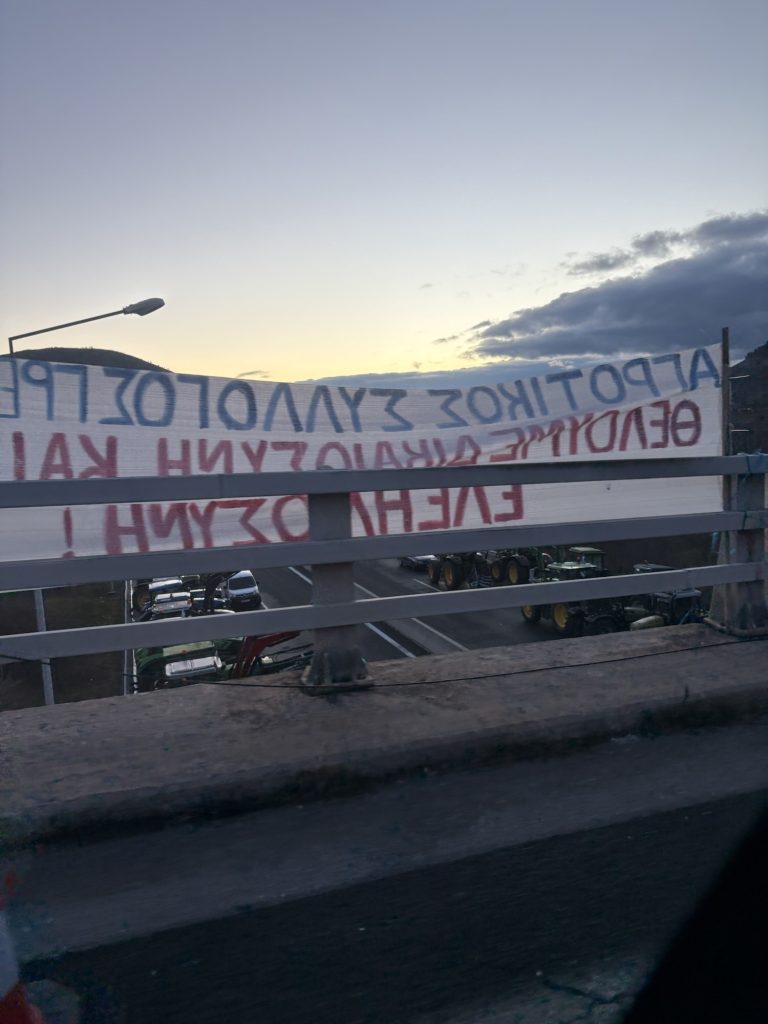
Crossing an intersection over Greek Farmers protesting the Mercosur trade deal
The tractors flew flags and banners indicating their disapproval of the signing of the EU-Mercosur Trade Deal. The European Union will be trading with the Mercosur bloc consisting of Argentina, Brazil, Uruguay and Paraguay. It is set to create the world’s largest free-trade area covering 700 million people.
European farmers are not happy about it. Yet the protestors did not disrupt traffic at all. The roads were open and passable. A blessing given that in many areas it either snowing or had recently snowed and the temperatures were below zero.
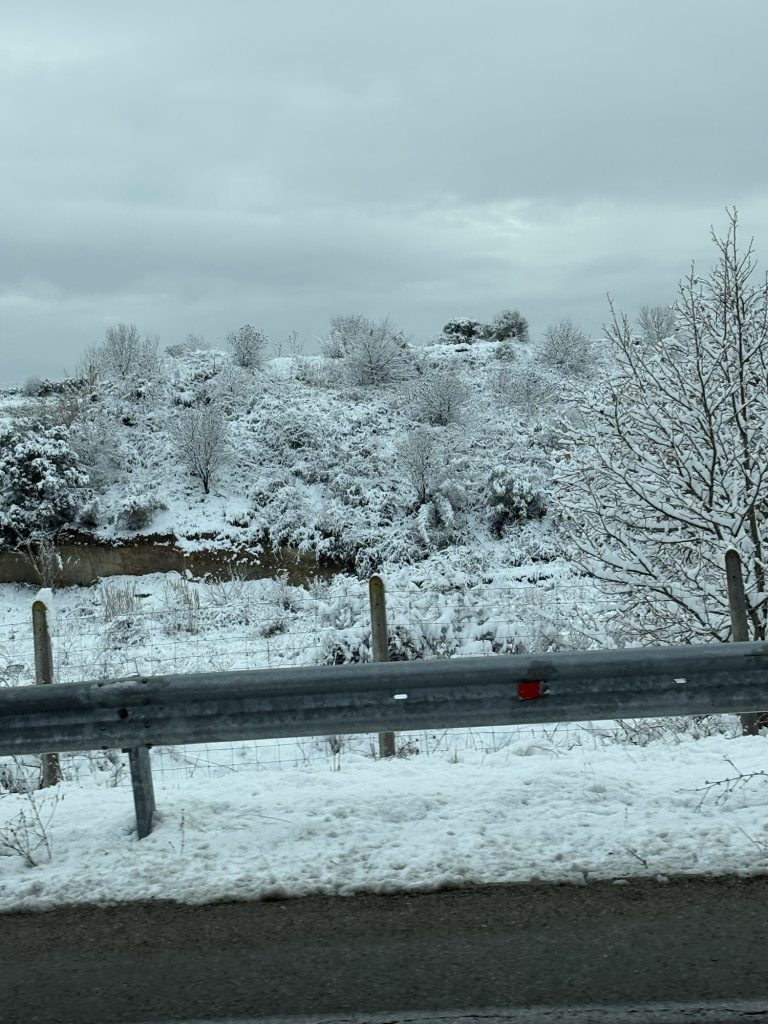
Mediterranean olive land covered in snow on January 11th.
The snow is not a very common experience for an area that farms olives and grain. And yet on top of changing weather patterns, the Greek farmers I saw protesting (along with 27 other European countries who are signatories) must now contend with farmers in 4 Latin American countries that do not have their standards or rules.
Economic collaboration and global ties were touted in all the press from Brussels as they condemned America’s retreat from trade. And the part of me that is a committed free trader wanted to agree. But the part of me that struggles with illness and the American food system was on their side.
And yet Europe is saying damn their own farmer’s opinions, stick it to America and our government’s trade wars. Ursula von der Leyen will let in Brazilian fruit and glyphosate saturated grains come to Europe.
I am no stranger to protest movements from the Battle of Seattle to EarthFirst! I picked up Alinsky’s Rules for Radicals as a child. I remember the era where organizations like the WTO were criticized and concerns about trade and agriculture were front and center. We forgot along the way and the politics went horseshoe theory but the problems remained.
I don’t farm or ranch, merely keep chickens, garden and maintain our land in Montana, but my husband’s beloved electronic free Deere is practically a family member. We are sympathetic to farmers and care about topics like soil earth, permaculture and the endless glyphosate lawsuits.
I’d rather America be trading with Europe than Europe be trading with Latin American countries. The land some of them work is meant to be rainforest not grain fields.
I’d be furious too if I were a Greek, Irish or French farmer under restrictions my competitors didn’t face knowing that they produced a better product on land cared for under high standards and almost impossible conditions. They know what they yield is destined to move on their ports somewhere. Thats what their ports do. But protest they must.
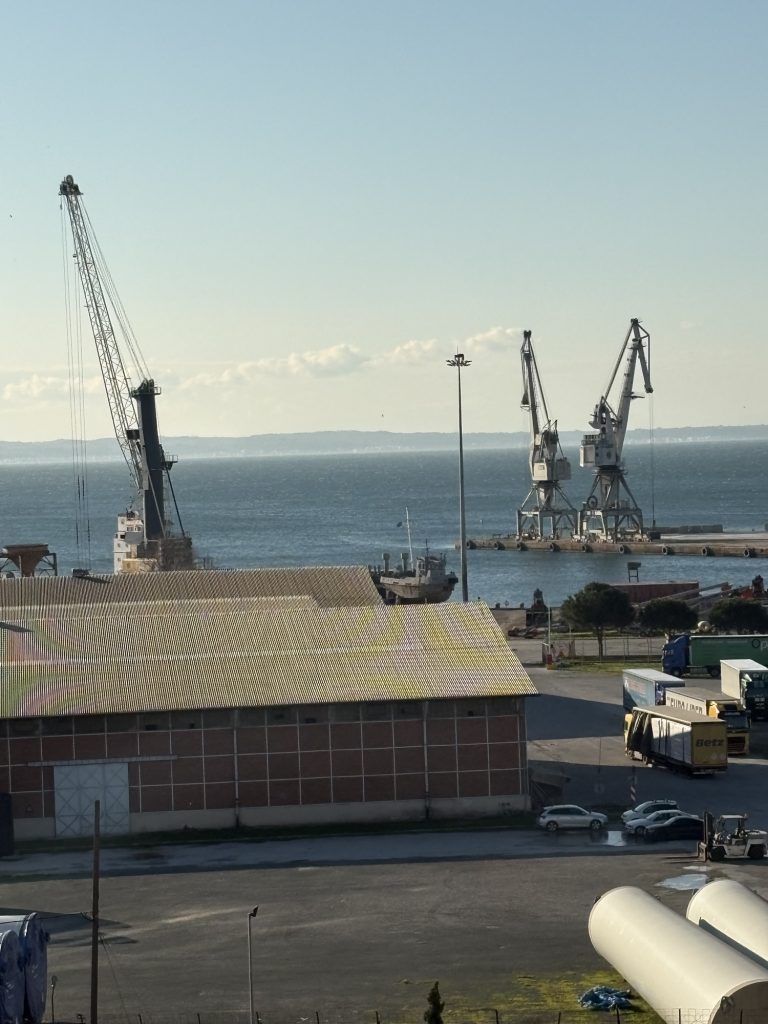
The Thesolonikki Port as seen from a hotel
And yet here the farmers were, placing their precious equipment on the roads silently condemning the entire lot of politicians who care neither for the people or the land.
Seeing like a state means we are just numbers to them. I couldn’t count all the tractors I saw. There were too many. At every crossing I saw there were more. And that’s the point. It will affect all of us in the local and global balance of the land and the people it feeds.
The land and its stewards ultimately don’t matter where no matter what Brussels says. Neither does America’s politicians and their economic foibles. It’s all a numbers game.
So the farmers showed them their numbers every where I turned. I noticed them. And I hope others do too. What we can do is not for me to say. I see them and am sharing so you can too.
And I got to about May and realized I didn’t feel like I needed to put more into the organization. I had 4 medical procedures involving surgery. My father died. My best startups all raised rounds to scale. You can find your own way from there. It’s been a hard year despite the wins.
Much as it amazes me, I have written a public post every single day without fail for five straight years. I’ve not missed a single day.
I’ve written so many posts and essays, it honestly astonishes me. I didn’t expect to have this kind of longevity when I began but the world changed a lot in this past half decade. I am a woman of habits & routines, this blog helps me manage the chaos and instability that surrounds us. And hopefully I’ve become a better thinker (and writer) for this habit.
So now it’s time to think about year five of the experiment. 2025 was a hard year for me even as it contained incredible wins. Going into it, I wondered how could year five top the past four years chronicled here? It both does and it doesn’t. Life, and the time we spend living it down, isn’t getting any easier. Life is barely human at all anymore. I feel the struggle in myself as I am still very much human.
It’s easy to feel as if I’ve not accomplished as much as my own written records show I did. If you ever feel like you get less done than you’d like, I encourage you to keep a log or journal as it helps show how much can do and how much does get done. Plus if you publish it online you’ll contribute to a wider humanistic understanding as our digital life becomes more mechanistic.
Another facet of this writing experiment has been fighting a chronic disease in my personal life that has no cure. Managing disabilities during with the pandemic years as it overlaid civilization shaking political and technological changes has been hard. I want to work and live as if I am healthy and it isn’t likely to ever be true. I work smarter because I can’t work harder.
I don’t always write about my investments in these posts, but I see how my thesis of chaos has forced us all into requiring more decentralization, compute and power. My once weird ideas are now common knowledge. Now everyone agrees with me.
The end of the neoliberal consensus and the beginning of the artificial intelligence buildout would have been hard on anyone. I’m proud that I was able to turn this change to my advantage.
I realize I’ve written quite a bit about the experience of these years where I wrote daily without showing off the last year of posts.
Since I’ve got one more day before 2025 officially ends, perhaps I’ll put the round up of posts tomorrow as I’ve given an overview of the experience of half a decade of daily essays today. What’s one more day among thousands right?
I get out of America with as much frequency as I can manage. I juggle this with an intense patriotism not only for America but for my home biome in Rocky Mountain west. I am proud to say I am from Montana when I am abroad.
My interest in being regularly abroad began as an effort to source deals and understand different technical ecosystems, but has ended up being my barometer of what reality is being played for what channels. Deals get done where the founders are and it will remain so.
Yet if I didn’t see other economies and live outside of the news ecosystems of America I’d have an understanding of reality that was incomplete.
The projections of your interests as an American are in constant tension with the ex monica and cultural attacks on it from its adversaries. America has quite a few and it is extremely dangerous now to be blind to their impacts.
I don’t think our world will be as open in the future and this saddens me. When I visit a young formerly communist city in Europe I mostly see enterprising young people who see an. American and have positive associations.
The vibes Zoomer Eassyerj Europeans have towards a middle aged American from Montana is surprisingly positive. I am feel lucky that is their emotional connection to America.
And we shouldn’t take that good will for granted. We want America to be a good friend to them. Capitalist Zoomers who experienced totalitarianism and socialism are good friends to Americans.
Before the pandemic turned preparedness into a global obsession, being a “prepper” wasn’t seen in a very positive light. We’ve really lightened up the idea of thinking ahead.
Now everyone preps. Americans love shopping so this isn’t a surprise. Who doesn’t love avoiding hard work when you could be buying shit instead?
Being a quirky gearhead or having a momma bear mindset is maybe a bit cringe but everyone saw the upheaval of a global pandemic first hand.
Even if we didn’t experience the pandemics consequences evenly. It’s hard to ignore reality. Sometimes you should have a little extra on hand.
The last few days before a major holiday like Thanksgiving or Christmas is always a crazy time to be shopping from this perspective. Christmas especially is one of the few times you really experience the full force of the entire world trying to be prepared for everyone wanting to buy at the same time. And we still can’t quite get it right.
I went grocery shopping today and the crowds of people, even with a week to go before Christmas were astonishing. Even independent of weather events, the traffic jams and throngs of shoppers felt intense.
When everyone needs to get ahead of a day off it’s clear our system is capacity constrained. And we all know the date is coming a year ahead of time. Imagine what happens when you don’t have notice of something?
Most people don’t have the luxury to do much to harden themselves against the cruel nature of life. I on the other hand can buy prosciutto and almonds without a care in the world. A very merry and very prepper Christmas indeed when eating cured meats and calorie dense nuts.
We’d all better get used to being lost in the crowd of the polycrisis. It’s full time political and economic instability, weather volatility and varied consequences of our current material conditions. Bring an extra bag and get in line right?
Maybe if we all put more energy into thinking about what we do next, we can better focus on meeting our collective demand a bit better. Coordination problems are hard. They are a challenge when trying to plan to buy a ham let alone GPUs or transformers.
Without getting into too much detail about my travel schedule I will say I’ve visited a few places with a lot of construction this year.
I’m talking about cranes on every corner level construction. If I did a full rotation as if I were Michael Bay getting an action shot, I’d see a half dozen cranes putting up major construction projects.
In some European cities (not the western ones) I saw entire neighborhoods being rebuilt from old multi-family buildings to massive mixed used developments. Cute streets and courtyards be damned, the millenial families want Instagram housing from Tallinn to Tirana.
Their elders are confused but new families need new condominiums. Let’s just hope they remembered to plan for water, power, and other infrastructure needs like new roadways. I’ll admit I’m skeptical in many cases. Maybe it’s good that they are just building willy nilly as it’s not like we get infrastructure investment without the pressure of new families demanding it.
Americans don’t see this amount of construction regularly and it is both inspiring and also a mess of pollution from debris to noise. It’s pretty miserable if you happen to enjoy walking. It is also miserable to live with.
It almost makes me sympathetic to the whines of older residents who want their homes to be worth more and use the chaos of new developments as a cudgel to stop new housing from being built.
There was a time in New York City when I first arrived there when it felt like new buildings went up all the time. You’d complain about jackhammers, trucks, and the ugly protective sidewalk sheds that are meant for safety.
I even knew a venture capitalist who left his job to make a classier sidewalk shed as the damn things almost never come down in a city under constant improvement.
I went through ULURP or Uniform Land Use Review Process hundreds of times in just a few years as an appointee in the community board system.
All anyone can do is complain about the lack of new building and construction. And who can manage to overcome the slog to build let alone turn a profit. American processes for building are more “cranky man tells at clouds” local meeting hell than Robert Moses.
Maybe the YIMBYs (I myself am a yes in my backyard sort) are barking up the wrong true with red tape reform efforts. The strongmen cut the Gordian knot of land reform by simply not giving a shit about process.
The Zoomers are ready to rage for radicalism with their reactionary political entertainment industry. It’s unclear to me if those types would remember to incorporate waste water treatment in their plans. It’s not hard to go from bullshitting to being covered in shit. So that’s worth considering too before we get too excited about a new round of futurism.
As much as I’m trying to salvage the end of my year by taking it slow, I’m still keeping myself plugged in. There is no unplugging in our hyperreality.
I’ve accepted this is a part of being human for the time being. I don’t struggle with internet addiction even if understand how it can be for others.
So here I am keeping an eye on various market movers like central bank rate cuts and earnings calls. It’s a shame I didn’t go into banking as it’s a lovely hobby I just happen to enjoy it watching the data go by.
The intake of long insight and slow instincts interplays with short data and animal spirits if you can stomach it. For me at least I don’t make moves based on any given day.
I find impossible to make much sense of the here and now, so the best I we can do (at least those suitably complex situations) is make very long plays or extremely short ones. I wouldn’t want to plan for a middle distance. Pity the politicians operating on two year schedules.
I’m glad I make long plays if it’s a choice between long and short. I wouldn’t want to edge out small gains in the algorithms like my quant friends do. Too much is out of distribution and nothing is ever really priced in. Cliff Asness is right. Markets have become less informationally efficient. Information becoming free made insights almost impossibly expensive.
For me it’s silly to make grand claims of sensemaking as we bumble from “so over” to “so back” by the hour. I’ll never compete with that.
What do we need over the next decade? How about two or three? That’s my plan. Anything else risks tip toeing between hyper tulip mania and the deepest depths of the Great Recession trough. I’m amazed we’ve shaved off volatility as long as we have. Apres Boomers, le deluge? Reality feels like hyperparameters are deliberately set to dumb.
And so Wendell Berry is now percolating up not just through the permaculture hippies, Monsanto fighting eco-terrorists and nouveau TradCaths but in the feeds of my design hipsters too.
Williamsburg taste by way of pastor parents has found its way back to the Kentucky poet. Back to the land didn’t take for the Boomers but maybe this time it’s different. (Only if you are landed gentry).
Any other software developers out there remember the mythical man hour? It comes from Fred Brooks’ classic book The MythicalMan–Month which argues that adding more people to a late software project often makes it even later. This is also known as Brooks’s Law.
The man‑hour is “mythical” when tasks are not perfectly partitionable and require significant communication, shared context, and integration.
I think in the age of artificial intelligence we need to be revisiting this classic complexity insight as it applies across a world where we understand even less about how the time of input drives its notional value.
Measuring productivity in hours is a relic of a past labor era. And most workers have little incentive to improve output when they aren’t paid for it.
If we had quiet quitting during the pandemic where jobs could be done in minimal ways without getting fired, in this new artificial intelligence roll out we see another type of value capture mismatch between input labor and firm.
Innovation happening through employee adoption of new technologies that is opaque to management doesn’t get counted and workers are reticent to be transparent.
the reason ppl hide their AI use isn’t that they’re being shamed, it’s that the time-based labor compensation model does not provide economic incentives to pass on productivity gains to the wider org
so productivity gains instead get transformed to “dark leisure”
Except it’s been generally existentially freeing up to this point. Anyone who has used commercial large language models on healthcare can attest to that. So why are hiding its use?
Even coders are doing it. And who can blame them. It’s a lot less fun for some folks to coordinate a swarm of agents than it is to write code for a living. If you wanted to be a product manager, well you’d already be one.
The boss makes a dollar and I make a dime so that’s why I prompt on the company dime!
We are seeing the early artificial intelligence era take off collide with industrial-era systems of management that are no longer relevant in age of increasing complexity.
We’re putting intelligence into systems designed to measure hours and surprised when there is a misalignment. A Twitter mutual has a theory of consciousness systems they believe makes this is a form of time violence.
Human beings can tolerate NP hard moments of complexity, but cannot survive continuous low-grade complexity
The gap between human adaptability and systemic inertia is now wide enough to generate an entirely new form of harm: time violence
We just cannot keep up with the varieties and types of complexities that are arising, so any advantage that can be used is being used. And you’d want to hide that advantage as long as you can. Sharing it has no rational basis. I find that disappointing.
I’d rather we not vice signal artificial intelligence as it only harms us. The value capture won’t always match up, but the gains to be made are worth having so keep using it where it works for you.
The temptations to build an investing case around a historical parallel cannot be avoided. Americans love their booms and busts. And we love grand television dramas about them.
Julian Fellowes is the stage name of a conservative British peer, actor and dude who gets BAFTA award for making television about aristocratic families familiar to adapt and Americans bailing them out.
Then he went on to make a period drama about righteous industrialists in America called the Gilded Age which isn’t as iconic as as it’s not as personal since obviously a British peer won’t understand American mores.
It’s just a little weird to think that we’ve already made the Silicon Valley drama about the last boom and bust moment and it didn’t get written by a British conservative peer but by a Gen Xer Mike Judge.
Maybe in another generation on Netflix we will get a sweeping historical drama about a polycule group house in San Francisco as the next Downton Abbey.