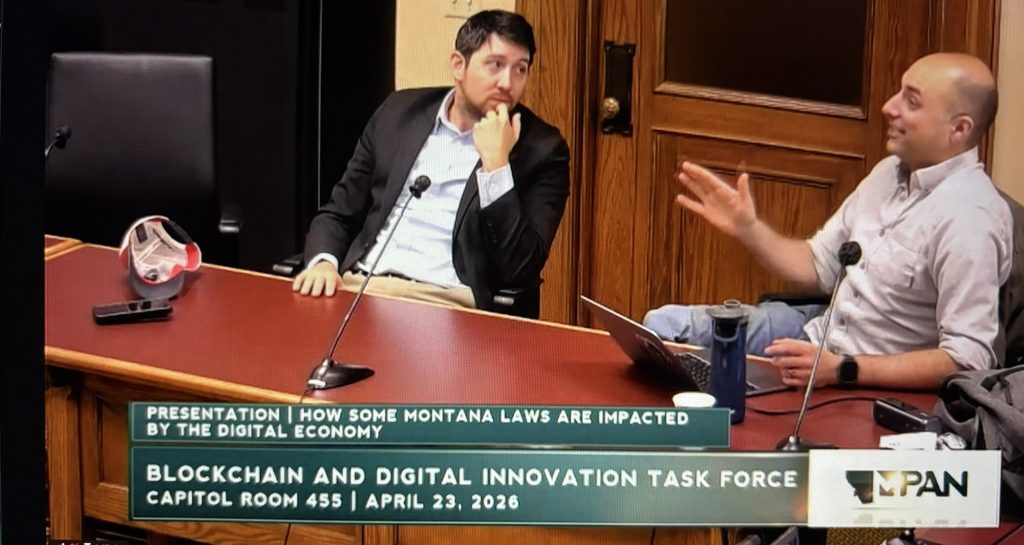
Today has been a very gratifying day for a very strange intersecting set of reasons. You may know that I have spent several years working to pass a “right to compute” law in Montana. It was signed into law in August of 2025 by Governor Gianforte.
I was so grateful that a campaign I initiated became not only become a bipartisan policy but a law supported by many Montana citizens & legislators. Now to see it go national not only model policy for the American Legislative Exchange Council but now have a second state, New Hampshire, pass it in their house, gives me indescribable joy.
Just forty eight more states to go. Though I believe it’s going to be an uphill climb as the topic of artificial intelligence has well and truly become politicized which makes stating simple cases of shared values much harder.
Except this isn’t really about artificial intelligence. Compute is a much broader and bigger thing than AI. It’s the stuff of the modern world. But that doesn’t mean we can’t apply what we know to be core American values as the lens through which we see it. Indeed it’s crucial we do.
Last year people could easily see that this was a sensible law that reflected our American values. Because of this sensible approach “the right to compute” is a winning coalition. It was bipartisan. So naturally it became a culture war.
I urge you not to adopt that frame. The right to compute speaks to American’s most cherished beliefs. Recognizing that it is not a novel legal theory. It is the application of the Constitution’s oldest commitments—to expression, to property, to liberty against government coercion
Even if you do not understand how all of its parts work, most understand that the entire digital world, in its constituent parts, is mathematics executed on physical hardware.
When government restricts computation, it does not merely regulate an industry. It restricts the tools through which people think, express themselves, and make use of their own property. Through that lens it’s clear we as Americans decide ourselves how to use it.
I hope we can remember this as the world changes and political actors look to change your mind. I do expect this to become a very complicated and uncomfortable position to have staked out.
Yet I feel confident that we will be able to make the case that this is not only the most American way of handling our future challenges, but is also practically the best way to bring abundance in a chaotic world. America is a land of reinvention that changes material conditions. We need not seek doom.
I believe that I have articulated that vision over the last five years of writing and investing so you can see my revealed preferences. I called our fund chaotic.capital for a reason. It’s hard, weird, difficult and scary but it’s also possible to be a lot better in the digital world such that we can use those gains to make the material world better. We can be more than productive primates with jobs
From nuclear energy to compute, this is what I believe and where I have put my time and money. We are organizing our world of atoms through the power of compute. And that can bring about a materially better world for everyone. Which I want.
I have been thrilled to see so many different people come together around the basic premise that we are empowered to do things.
We can lean in to the accelerating changes, all while holding fast to the reins of the values that built America, so that we may steer ourselves to material success.
Travis Kalanick of Uber may be among the best founders to have ever played the venture startup game. Today he has espoused our thesis & reinforced the work of my friends & founders. To see a cultural program written by a big coalition be part of his return to startup life (though he was never gone) is validating. We’ve found a rallying call.
The way forward is through the application of math on real problems. We can dramatically reimagine outcomes and the pace at which we do it. It’s scary and will look different but our grandparents lived through a lot of change too. Their grandparents as well. It’s the human condition.
I believe all of this is grounded in a philosophical foundation that is a recommitment to America’s core constitutional values. We are free to make things. And sometimes, when we apply ourselves, the world really does change.
If you are a canny socialist thinking look at this useful idiot for capital, I am honestly surprised that dialectical materialism has become so disliked by its own movement. If states with conservative libertarians can see that culture only changes when material conditions improve why don’t you want to improve them? Please feel free to copy our work as we have studied yours. You can find model policy here.