Categories
Biohacking Chronic Disease Emotional Work

Day 1964 and We Are Who We Tell Ourselves To Be

No one likes a gloomy Gus. The downside of chronicling a chronic disease is the risk of seeing yourself as only the illness. Then other people will see you that way too. And so your identity becomes tied with only one of the many aspects of your life, and often the worst one at that.

Thankfully most humans are centered enough on themselves to forget the occasional gloomy reality from someone outside of their daily lives.

But repetition becomes reality, and eventually we are who we believe ourselves to be because others believe we are who we say we are too.

I came across a startup who is working on one of those classic swamp problems that seems like a great idea until you are well and truly stuck in the muck with bad incentives and no good solutions.

They want to use artificial intelligence to help patients with chronic diseases or complex medical cases to codify the many little details that might add up to the clues that crack the case.

By tracking subject inputs (unstructured data) and overlaying it with the other biometrics gathered by wearables and bloodwork they can help patients. I’ve seen hundreds of variants of this over the years.

Alas this new startup seems to have discovered a flywheel for marketing that relies on the problem I began today’s post with. We believe what we tell ourselves we are and eventually other people will believe what we believe.

They have chosen to market the app with illness influencers. Yes, that’s an actual category of influencer on TikTok and Instagram. Hot girls all have vague chronic illnesses these days haven’t you noticed?

And so a community forms and reinforces the identity that they all share. They are sick. And that makes them special. This gives life meaning. And did I mention lots of pretty girls have the most esoteric and exiting problems? Click to join now!

I find this to be a troubling, even borderline dangerous, approach to anchoring a community meant to help patients advocate better for care with their own personal health records. The incentive to remain with the privileged identity that makes them special only increases over time. Women reinforce themselves into intensely held identities all the time.

I thought about reaching out to them but I don’t want to get tangled with this problem. It is one for professionals which neither myself nor these founders are aside from everyone being a patient with chronic illness.

I do not wish for my identity to be the sick woman. The woman whose life was upended by a fertility protocol gone wrong in the early years of her marriage and in the prime of her life.

It’s one aspect of my reality. I do want others to be saved from my fate so I share it. But it is not who I am. Julie is not a sick woman. Julie is a complicated individual with a beautiful life and family and portfolio.

I had my own glimmer of hope today. Though I have repeated my troubles with my medical history I have never felt it was my identity. I’d happily give it up if I find a path to wellness. And I spend so much of my life trying to walk out of my troubles.

I have walked many side roads and pursued quixotic quests to find health. And some days I even find it. Today I got very good news on a fresh round of bloodwork. I’ve felt recently felt well thanks to some changes and an aggressive pursuit of new modalities.

I never want to get my hopes up too high as this effort has been a rollercoaster of ups and downs. But I won’t let go of the hope. The mere idea that this chapter could close and I might be a healthy woman is an identity I’d gladly welcome. And I’d wish that for anyone who takes on illness as a part of their identity.

Categories
Biohacking Chronic Disease

Day 1899 and Off To Sleep

I regret to say that after yesterday’s various excitements through my continued ill health; did not leave me with anything for today.

I crawled out of bed for a coffee far too late. Was greeted by marginally better biometrics such I think my Whoop took pity on me by giving me a green.

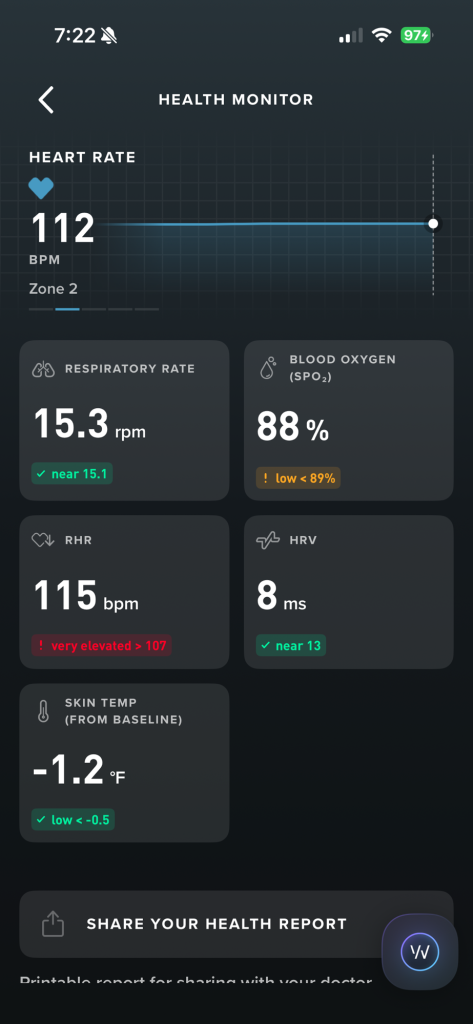
The trouble with context and personalization? It was only barely better than the reds of the worst that continued into a week of yellows where my resting heart rate and heart rate variability went in the wrong direction.

I largely spent today sleeping because I could t get enough last night. I hope you don’t mind if I go back to my nap as waking up was a challenge.

Categories
Biohacking Media Medical

Day 1832 and Beaten With My Own Measuring Stick

It being the new year “the new thing” to talk about is “the new you!” As if you weren’t the same person as you were a few days ago. But you have this convenient convention that allows you to decide now is the time for change.

I used to call this time of year “eating disorder season” but GLP-1s have turned down the volume on that noise. We still have New Year’s resolutions and media just love having a topic tentpole to discuss new trends, habits, and opportunities.

We may not have as much of the fat chatter to contend with anymore (thankfully) but I do have reams of biometrics and plenty of concerns about my own health so the season of changing yourself remains even if the material conditions have improved. The app chatter is still in my head.

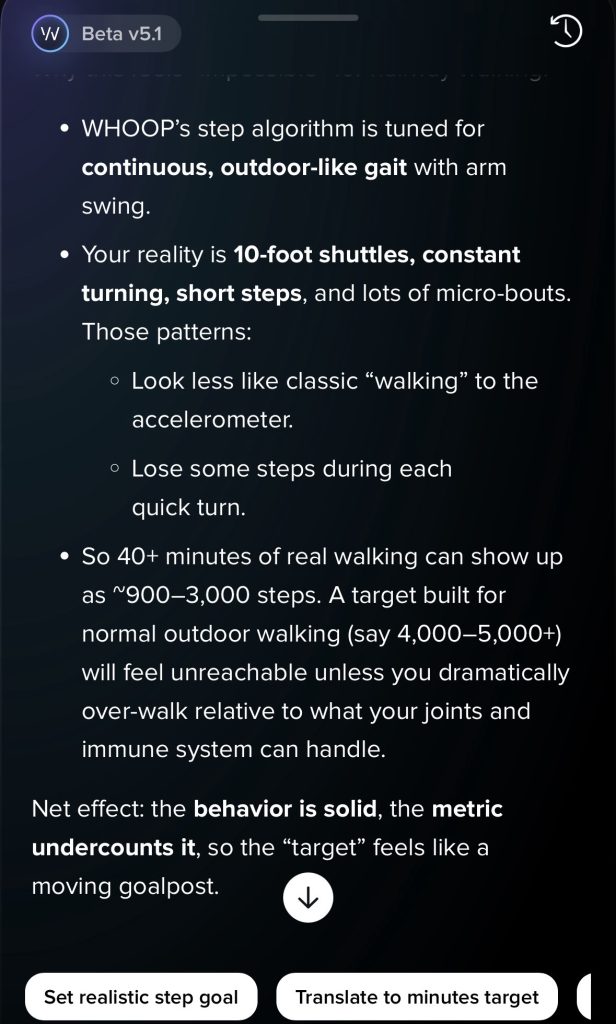
My Whoop continues to nudge me on the “aging” metrics and which ones are hurting my healthspan the most. I hide it for a peace of mind but on the latest update it is openly admitting that it’s given me goals that are impossible for me given my limitations.

It’s a relief to see the application get better but of course I’ve know the algorithm and my limitations don’t always mix. It’s been workable when I’m in Montana walking outside but it swings my numbers a lot when I’m in a small apartment in a polluted city. It’s a “short hallway” problem.

I move a lot inside (safer and less polluted) but it doesn’t those short bursts and turns as steps so I push to get more steps counted and it overwhelms my nervous system and immunocompromised state.

I am being beaten by my own measuring stick. I always suspected this was the case but at least now Whoop can talk back and tell me just how it nudges me into worry and concern. Which is a good lesson for all of us.

Categories
Biohacking Travel

Day 1823 and Poor Percentages

I don’t know how much to trust my Whoop or Apple Watch at the moment but they agree that I’ve not had very good restorative sleep for a week or more.

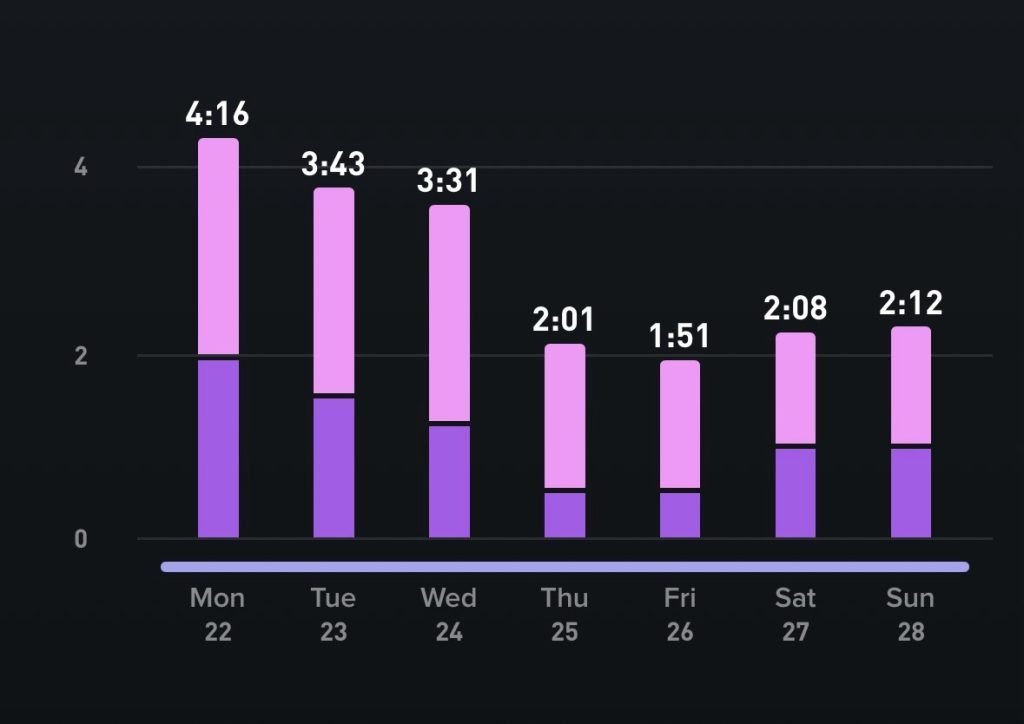
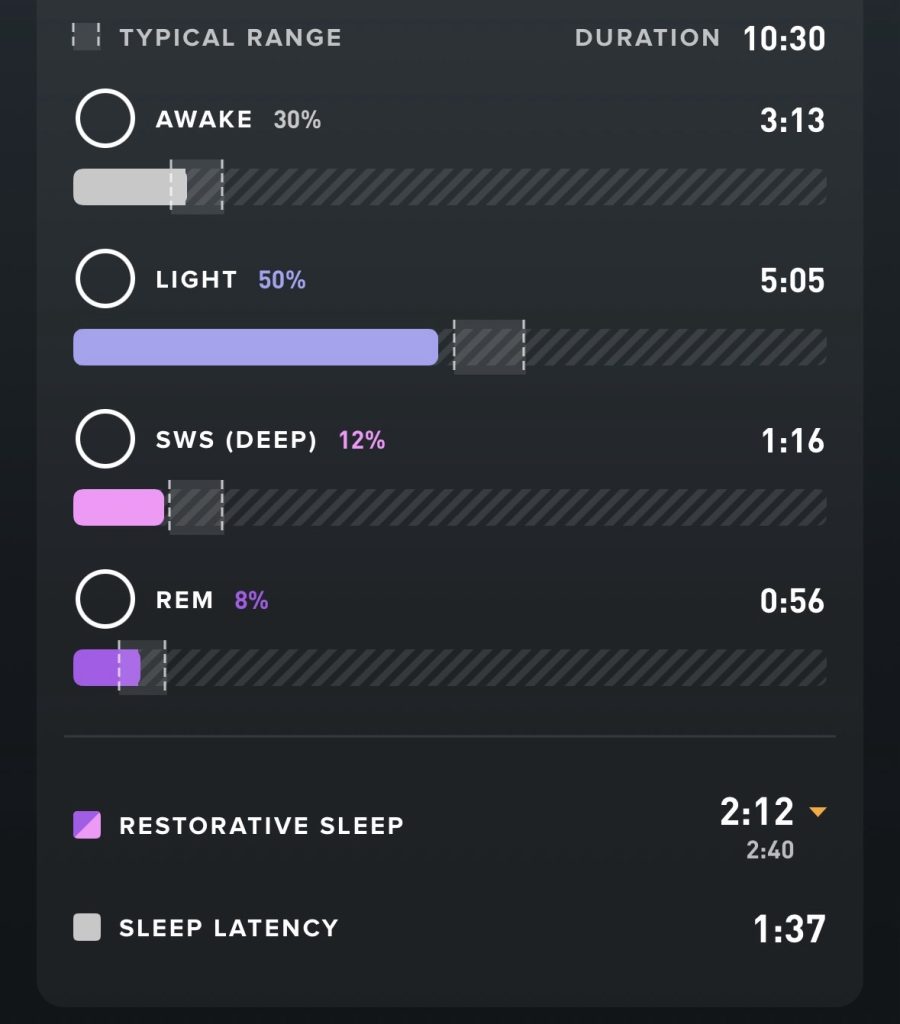
I’ve never been the best sleeper and I sleep poorly when I’m on the road. I’m in the single digits for both REM and deep sleep percentages at the moment. And I seem to be spending a bit more time than I recall being awake at night.

There is something strange about being told by some electronic device monitoring your every move that you were wide awake when you don’t remember even a little bit of it.

I’ve been changing hotels and Airbnbs regularly as I make a pilgrimage across a strong mountain towns, so it’s possible I am unable to feel safe and secure enough to sleep deeply. But I’m suspicious that I’m awake as much as either device claims.

These are some bleak sleep times and I swear I wasn’t awake for 30% of my night. If I was awake you’d have seen me futzing about on Twitter. Well, at least I’d have read a book till I feel back asleep.

There is something up with my rest that makes me feel like I need to stay put for a litttle bit and get in a proper night of rest. My Whoop is showing me going from a more typical 4 hour range of rest down into the “wide awake” range of the Apple Watch over the course of the week.

And the Whoop seems to think I was awake as much as the Apple Watch did last night so I might need to accept that my brain is stewing in some toxic mix it’s not flushing through the sleep process. It also thinks I was in bed for over 10:30 hours but got barely a wink of proper sleep. My wake time was 30%

I’m going to take a break from the road trip and stay in place till I get my sleep repaired a bit. Hopefully it won’t be too hard to manage.