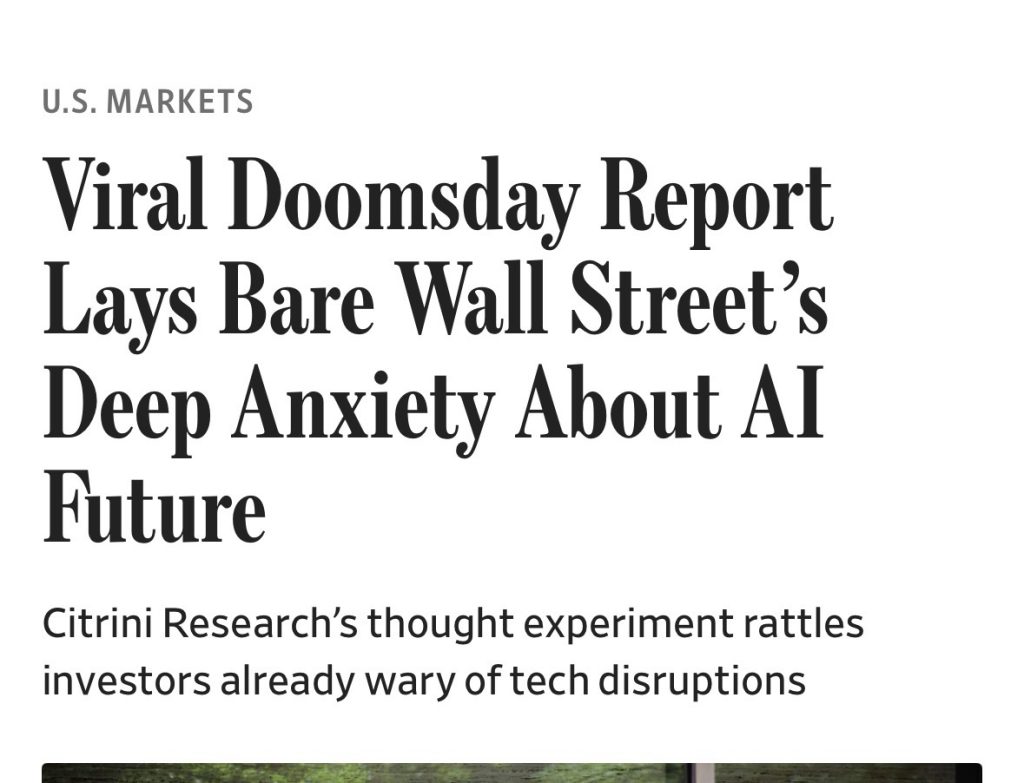
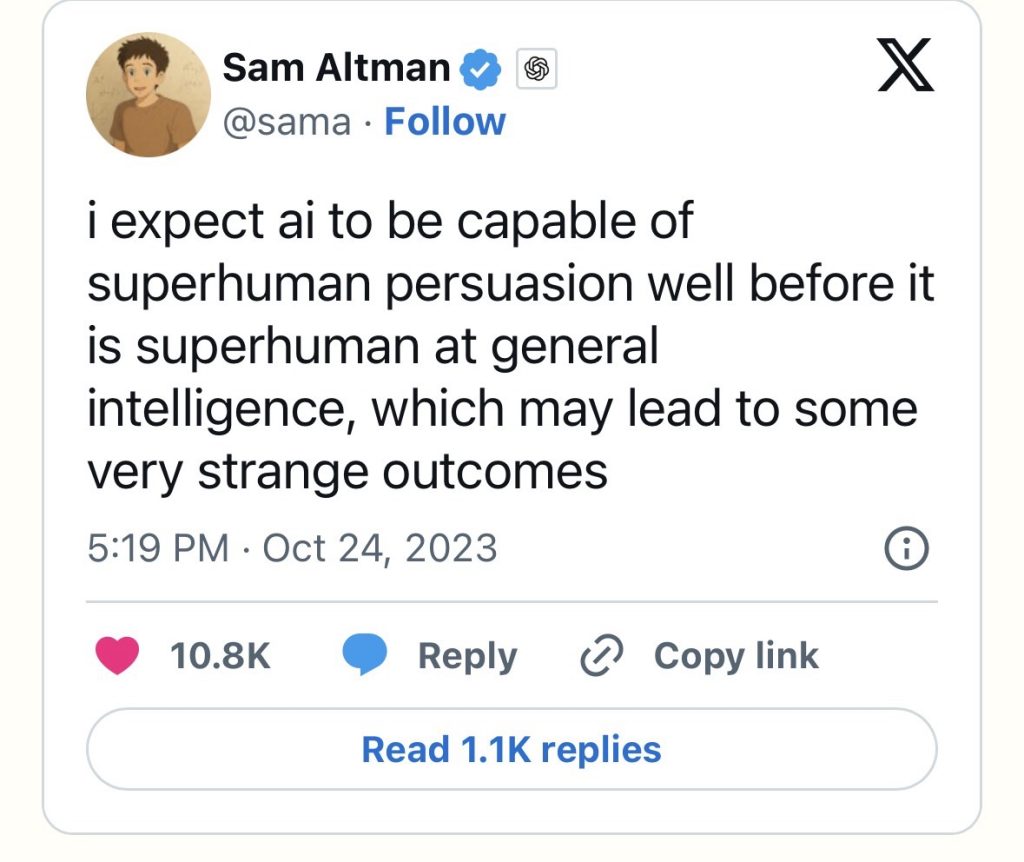
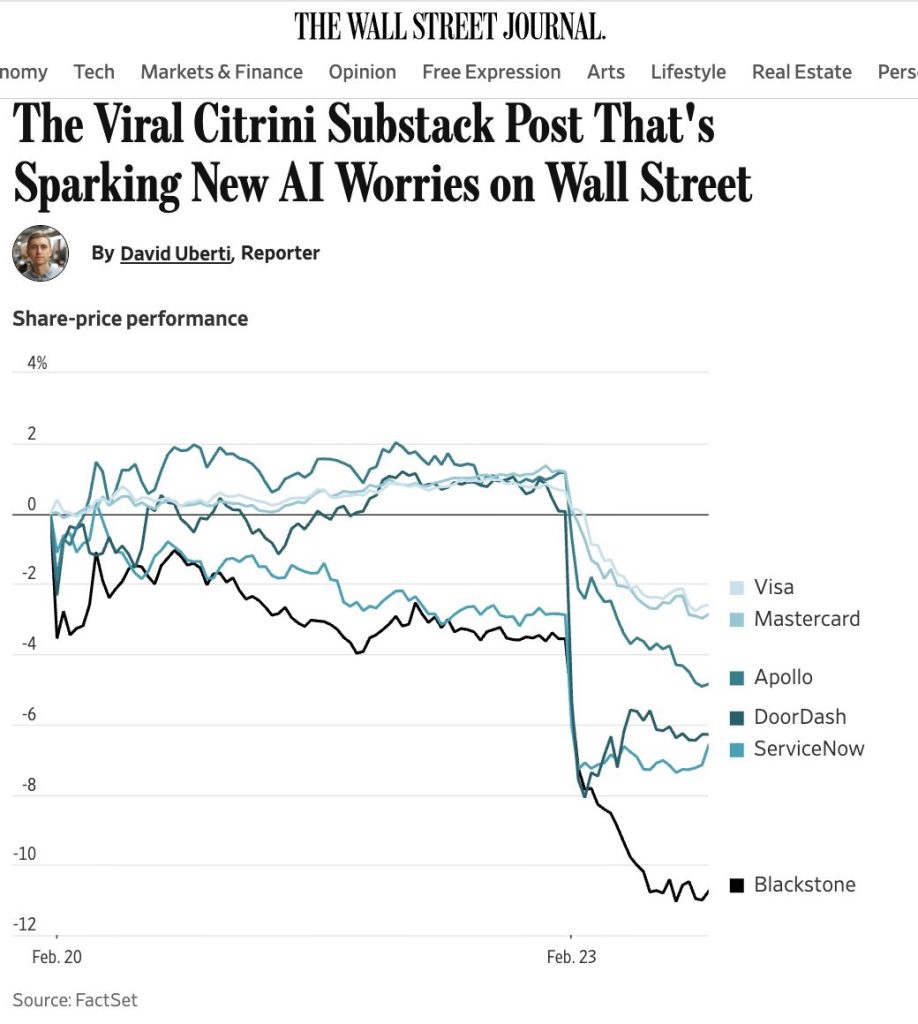
Citrini is capable of super human persuasion before AI reached super human general intelligence and it has been strange.
As the market sell off was playing out, a flood of “Contra Citrini” essays emerged immediately from players as varied as Joe WiesenthalJohn Loeber, Will Manidis, even proper economists like Alex Imas. The co-author Alap Shah went onto TBPN. Fun fact he was Sheel Mohnot’s roommate in college.
I am unclear if white collar workers are in a frenzy about are doing their existing jobs or if they have even noticed the danger. As a real time update from a fellow investor had us both laughing. An intern couldn’t manage a basic research task. The intern asked them how to get to the Founders Fund’s website.
We may need the bull case for AI, as the bear case for white collar workers acquiring any intelligence in their education process is rather unconvincing.
For some reason “how do I get to the founders fund website” started me singing an old tune sung by Dionne Warwick “Do you know the way to San Jose?”
Do you know the way to San Jose? I’ve been away so long I may go wrong and lose my way Do you know the way to San Jose? I’m going back to find some peace of mind in San Jose
LA is a great big freeway Put a hundred down and buy a car In a week, maybe two, they’ll make you a star
Weeks turn into years, how quick they pass And all the stars that never were Are parking cars and pumping gas
The song was used in another completely different “science fiction story goes viral”context. Maybe it’s in my mind as automated virology lab unleashing apocalypse, is a AI doomer staple also recently in the discourse.
Do you know the way to San Jose? Or if Helix is available for download.
In 1968 you could return to San Jose from Los Angeles and start a relatively normal life as one of the stars who never made it. Pumping gas and parking cars. If we get too close to the sun of artificial intelligence success we don’t have a San Jose to run to. You can’t get away there as it’s filled with just the part of technology folks peddling dreams as unrealistic as the ones down in Hollywood.
I spent most of yesterday on an airplane. I flew nearly 12 hours along the polar routes to go from Heathrow to America’s west coast. I flew British Airways and was disinclined to spend the many pounds for internet access.
Alas this meant I missed the rollout of the joyful flight of one of my favorite investments. Valar Atomics began its journey from California to Utah just as I too was flying. Me and the reactor I angel invested in were both up in the air like bluebirds and sunshine.
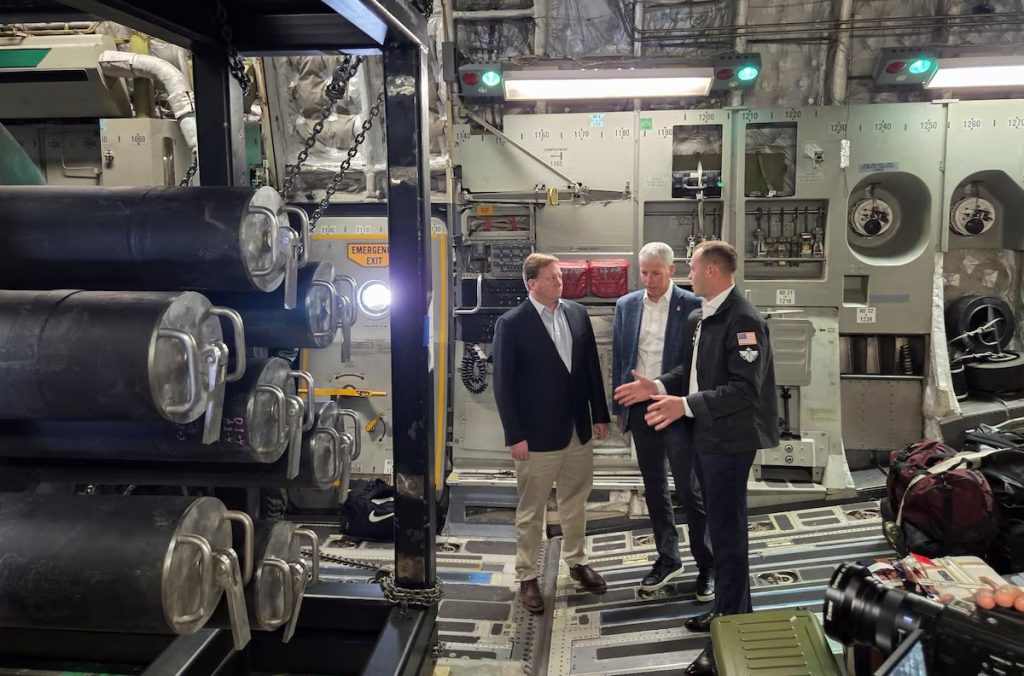
HILL AIR FORCE BASE, Utah, Feb 15 – The U.S. Departments of Energy and Defense on Sunday for the first time transported a small nuclear reactor on a cargo plane from California to Utah to demonstrate the potential to quickly deploy nuclear power for military and civilian use.
The agencies partnered with California-based Valar Atomics to fly one of the company’s Ward microreactors on a C-17 aircraft — without nuclear fuel — to Hill Air Force Base in Utah. Via Reuters
I tear up just thinking of the incredible accomplishments of millions of people coordinating together across centuries that these technologies represent.
It’s easy to think of ourselves as being small in the vastness of time and space. I almost cannot believe I was handed such gifts in this life, but I can claim a small but early part in Valar’s story.
U.S. Energy Secretary Chris Wright and U.S. Under Secretary of Defense for Acquisition and Sustainment Michael Duffey on board a C-17 cargo plane that transported Valar Atomics’ Ward nuclear microreactor from March Air Force Base in California to Hill Air Force Base in Utah, at the Hill Air Force Base in Utah, U.S., February 15, 2026. On the right, with the American flag and the Valar logo on his jacket is our CEO Isaiah Taylor
Just a little over three years ago I sent Isaiah a message on Twitter. We had a lot in common and I felt a kinship with this young entrepreneur. It was before he had even begun the incorporation work on Valar. He was working on something else, but I trusted his quiet intelligence and admired his humble inquisitiveness. We kept in touch as he mapped out his path.
His lack of ego instantly marked him as special, as it meant he could hear even the hardest criticisms. His fortitude was clear. He could incorporate what was necessary into his mission, a skill usually developed much later in life.
It’s rare to build trust so early on, and yet we both did. I told him I’d back anything he did so long as he was the CEO. Little did I know just how lucky I would end up as his very first backer.
You might think you will have doubts in high risk early stage investing. But I’d be lying if I said I didn’t believe in him from day one. I knew he was on a mission bigger than any of us. I knew it and he knew it. For God and country as they say.
That faith was required, as it was tested in rapid succession again and again over the next three years. Chewing glass is part of every startup. Even when you go as rapidly as Valar has gone, there are harsh conditions, brushes with death, and moments of utter joy in between.
Not only did we write a first check in the angel round, but in tight spots before the seed closed we wired follow on within minutes when a concern about a cash flow question arose. We put together special purpose vehicles. Nothing could jeopardize this mission. I’d invest more if I could.
We weren’t always the ideal investors as we struggled to showcase to bigger and better firms our conviction. Not too long ago it was all about being asset light and software as a service. Thankfully the execution always outshone the skeptics and we were ahead of the times. And while the skepticism was fierce, Isaiah never wavered. Neither did I.
And you can better believe that I am looking forward to July 4th this year. We promised the president we’d be turning on the reactor, so there is much to be done between now and then.
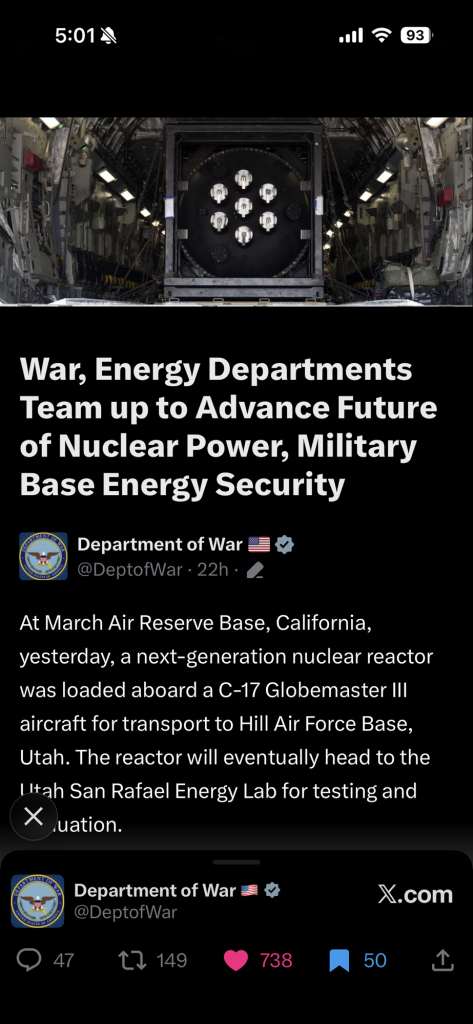
Even the Department of Defense (War?) is writing swan songs about Valar from the Pentagon Twitter account
At March Air Reserve Base, California, yesterday, a next-generation nuclear reactor was loaded aboard a C-17 Globemaster III aircraft for transport to Hill Air Force Base, Utah. The reactor will eventually head to the Utah San Rafael Energy Lab for testing and evaluation.
The Ward 250 is a 5 megawatt nuclear reactor that fits into the back of a C-17 aircraft could theoretically power about 5,000 homes.
For military use, such a reactor could provide energy security on a military base ensuring the mission there need not depend on the civilian power grid, and in military operations overseas, such reactors would mean U.S. forces could operate without concern that an enemy might cut fuel supplies.
A reactor such as the Ward 250 also means greater energy security for the entire United States. It is firmly in line with President Donald J. Trump’s executive orders to reshape and modernize America’s nuclear energy landscape.
The president signed four executive orders designed to advance America’s nuclear energy posture, May 23, 2025. Those include “
Michael P. Duffey, the undersecretary of war for acquisition and sustainment, said the partnership between the War and Energy Departments is critical to advancing the president’s nuclear energy initiatives.
“It’s clear to me that advancing President Trump’s priority on nuclear energy depends on close coordination between the Department of Energy and the Department of War,” Duffey said. “This partnership ensures advanced nuclear technologies are developed, evaluated and deployed in ways that strengthen energy resilience and national security.”
The future of warfare is energy-intensive, he said, and includes AI data centers, directed-energy weapons, and space and cyber infrastructure. The civilian power grid was not built for that, and so the War Department will need to build its own energy infrastructure.
“Powering next generation warfare will require us to move faster than our adversaries, to build a system that doesn’t just equip our warfighters to fight, but equips them to win at extraordinary speed,” Duffey said. “Today is a monumental step toward building that system. By supporting the industrial base and its capacity to innovate, we accelerate the delivery of resilient power to where it’s needed.”
Secretary of Energy Chris Wright said that with small reactors like those transferred from March Air Reserve Base to Hill Air Force Base, the United States is aiming for a nuclear energy renaissance.
“The American nuclear renaissance is to get that ball moving again, fast, carefully, but with private capital, American innovation and determination,” Wright said. “President Trump signed multiple executive orders that have unleashed tremendous reform of all the things that stopped the American nuclear industry from moving.”
Part of that effort, he said, will mean that by July 4, three small reactors will be critical — or running smoothly.
“That’s speed, that’s innovation, that’s the start of a nuclear renaissance,” Wright said. By
The crazier the informational world gets, the more inclined I am to tune it all out. The flows of information are fun sure but it’s only useful to financiers, degenerates and the global management class. I really only rate into very bottom of one. No, not the degenerate class.
As 2026 has become the year of repositioning for “whatever is coming,” I am unsure of much I wish to return from the hinterlands into the flow. Being inside the flow looks enticing but it’s Thor the only way to do business.
The thing is that I began my own career by participating (in a small way) in what Will Manidis calls The Flow. Being inside has its perks and I saw a lot which enabled me to make some very good investments.
What is the flow? It’s a metaphor for a 24/7 club of information, a formal and informal circuit of social and business obligations, and series of social & professional inputs that sometimes generate spectacular output.
It’s no wonder people think investing looks like gambling when you put it that way. It takes a lot of shrewd social manners and access to resources to be inside the flow and those are distinct barriers for anyone outside the global ten percent.
So where to go if you are an American? Well, stay put somewhere you can be stable and secure. Sure the middle powers will tell you that they can save the liberal order but in reality it’s all state capitalism by strong man and technocrats. And I’m not either and I’d wager most truly new things that will matter won’t be easily secured by old mechanism of power.
What Manidis rightly points out in his Flow essay, is that you can build businesses and make good money for investors and limited partners outside of the flow. You can focus on your unique insights and build something great.
I hope I offer some proof of that myself. I flash the codes for my odd little node and traffic occasionally routes through me. I found crypto winners and the future of atomics outside the flow. And I think I’d rather like to spend my Sundays seeing what’s happening outside the nightclub of financial flows.
If you want to be outside you can be. I just might be already. You can find me in the proverbial parking lot of the Flow (the open internet) yapping, chilling, lighting and fighting with the cool kids. You will always know where to find me. I’ll be one DM away.
My husband was joking with me that he’d been arguing, in the way that men do, about what the state is or is not obliged (or allowed) to do about the movement of the capital class and where they keep their resources.
Capital flight and asset diversification are not just individual decisions but increasingly society ones as well. And it’s not just the wealthy who are worried.
• Gold ran to roughly 5,600 USD/oz before sliding 7–10% in a day, still leaving it massively higher on the month. • Silver briefly traded above 120 USD/oz, then fell 15–20% and is now back under the 100–110 area, which technically puts it in a short‑term bear move after a parabolic rise
These actions were stirred up by debate on Federal Reserve independence (ameliorated somewhat by the new chair Kevin Warsh over Kevin Hassett), China’s buying patterns (both official & wealthy retail) in precious metals and what these two interconnected news items might mean geopolitically for regular people. See this on buying in Australia and on China’s flows for more context.
Obviously it has been a combustible mix. And thus we see renewed interest in decentralized assets and hard commodities. And then, of course, there has been the trial balloon floating in California of a wealth tax. What should we do about our most moneyed citizens and what do they owe. We tax income not wealth and that change is likely to have huge repercussions.
It seems perfectly sensible that anyone who has dollar denominated assets might be concerned about where that currency is headed, who is benefiting from the changes, and what on earth the Chinese are up to both as a people but also as a nation with unclear monetary goals and tensions between its leader and its military.
Ultimately though this is an incident about the dollar, its long term value, who will oversee it (and which Kevin was meant to have the gig) and where wealth can and cannot go to deploy itself in an era where the rules based order and Bretton Woods are no longer a given.
We’ve had a couple of market trading days to adjust to the new world order being “absolutely no order” and it mostly seems fine. American can capture cartel leaders/heads of state that she dislikes. Weird but so far fine.
The only metaphors are crude puns (see what I did there) and Marco Rubio does every job memes. From the Golden Era of Iran-Contra to Manuel Noriega, it’s never been a better time to have an opinion on the Monroe Doctrine or a LatAm portfolio. Did you know Ollie North married his former secretary this summer? Fun!
Yellow face being racist, perverting the Monroe Doctrine into a pan-Asian accent inflected Capote character is definitely cancel worthy but if you can’t imagine it I’m sure generative AI would oblige.
What’s worse is that my stupid inner monologue mimicry made me I wonder if Xi Jinping has enough of an accent when speaking English for Donroe Doctrine to be amusing. Americans never know these things. Neither does Reddit
Being profoundly American, this is all upsetting except where it is amusing, because the chaos era is firmly here and it’s hard to make any predictions, first derivative included.
I used to do more victory laps about how my own investment thesis is predicated on increasing chaos. Now I’m just reminded of how much I didn’t want to be right about my own thesis when I started.
Hopefully that hasn’t affected my capacity to stay ahead of the game. The numbers look good but the final score remains to be seen.Because as they say, “hate the game, not the player.” I’m playing to win.
As if we don’t win at making better technologies that stabilize our world then we all lose. I am a progressive when it comes to investing in new technologies that improve material conditions.
We won’t look at Uncle Yud as fondly as Uncle Ted when it’s time for eulogies. We will conclude that Chesterton’s Fence included a bit too much in the enclosure even if strong fences make for good neighbors.
Being a reluctant conservative makes it worse that I love being first. I am a hipster in an era without use for hipsters except the knowledge of what is about to make money. Hipsters are a useless bunch except as fashion editors or as capital stewards.
I happen to own the domain chaotic.capital. You’d think this would be proof positive of being a progenitor or originator of this investment thesis, but it’s such a common sense worldview now it’s about as useful as an NFT after the 2022 crashes.
I have bragging rights and my own metrics page inside AngelList. Which isn’t nearly as much fun as I expected it to be. It’s not bad having some financial flexibility from making good calls, but my primary problems remain health not talent so it’s less enjoyable than I presumed. Thankfully that means I will continue at it based on my own pace and instincts. Good luck out there!
Without getting into too much detail about my travel schedule I will say I’ve visited a few places with a lot of construction this year.
I’m talking about cranes on every corner level construction. If I did a full rotation as if I were Michael Bay getting an action shot, I’d see a half dozen cranes putting up major construction projects.
In some European cities (not the western ones) I saw entire neighborhoods being rebuilt from old multi-family buildings to massive mixed used developments. Cute streets and courtyards be damned, the millenial families want Instagram housing from Tallinn to Tirana.
Their elders are confused but new families need new condominiums. Let’s just hope they remembered to plan for water, power, and other infrastructure needs like new roadways. I’ll admit I’m skeptical in many cases. Maybe it’s good that they are just building willy nilly as it’s not like we get infrastructure investment without the pressure of new families demanding it.
Americans don’t see this amount of construction regularly and it is both inspiring and also a mess of pollution from debris to noise. It’s pretty miserable if you happen to enjoy walking. It is also miserable to live with.
It almost makes me sympathetic to the whines of older residents who want their homes to be worth more and use the chaos of new developments as a cudgel to stop new housing from being built.
There was a time in New York City when I first arrived there when it felt like new buildings went up all the time. You’d complain about jackhammers, trucks, and the ugly protective sidewalk sheds that are meant for safety.
I even knew a venture capitalist who left his job to make a classier sidewalk shed as the damn things almost never come down in a city under constant improvement.
I went through ULURP or Uniform Land Use Review Process hundreds of times in just a few years as an appointee in the community board system.
All anyone can do is complain about the lack of new building and construction. And who can manage to overcome the slog to build let alone turn a profit. American processes for building are more “cranky man tells at clouds” local meeting hell than Robert Moses.
Maybe the YIMBYs (I myself am a yes in my backyard sort) are barking up the wrong true with red tape reform efforts. The strongmen cut the Gordian knot of land reform by simply not giving a shit about process.
The Zoomers are ready to rage for radicalism with their reactionary political entertainment industry. It’s unclear to me if those types would remember to incorporate waste water treatment in their plans. It’s not hard to go from bullshitting to being covered in shit. So that’s worth considering too before we get too excited about a new round of futurism.
As much as I’m trying to salvage the end of my year by taking it slow, I’m still keeping myself plugged in. There is no unplugging in our hyperreality.
I’ve accepted this is a part of being human for the time being. I don’t struggle with internet addiction even if understand how it can be for others.
So here I am keeping an eye on various market movers like central bank rate cuts and earnings calls. It’s a shame I didn’t go into banking as it’s a lovely hobby I just happen to enjoy it watching the data go by.
The intake of long insight and slow instincts interplays with short data and animal spirits if you can stomach it. For me at least I don’t make moves based on any given day.
I find impossible to make much sense of the here and now, so the best I we can do (at least those suitably complex situations) is make very long plays or extremely short ones. I wouldn’t want to plan for a middle distance. Pity the politicians operating on two year schedules.
I’m glad I make long plays if it’s a choice between long and short. I wouldn’t want to edge out small gains in the algorithms like my quant friends do. Too much is out of distribution and nothing is ever really priced in. Cliff Asness is right. Markets have become less informationally efficient. Information becoming free made insights almost impossibly expensive.
For me it’s silly to make grand claims of sensemaking as we bumble from “so over” to “so back” by the hour. I’ll never compete with that.
What do we need over the next decade? How about two or three? That’s my plan. Anything else risks tip toeing between hyper tulip mania and the deepest depths of the Great Recession trough. I’m amazed we’ve shaved off volatility as long as we have. Apres Boomers, le deluge? Reality feels like hyperparameters are deliberately set to dumb.
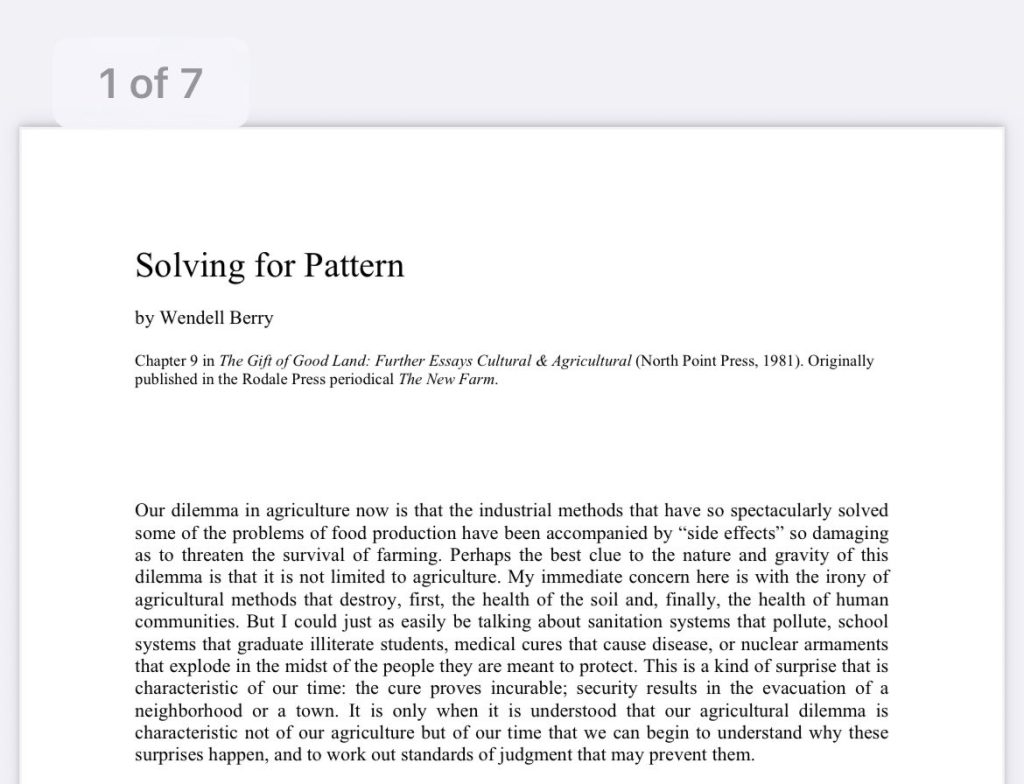
And so Wendell Berry is now percolating up not just through the permaculture hippies, Monsanto fighting eco-terrorists and nouveau TradCaths but in the feeds of my design hipsters too.
Williamsburg taste by way of pastor parents has found its way back to the Kentucky poet. Back to the land didn’t take for the Boomers but maybe this time it’s different. (Only if you are landed gentry).
The temptations to build an investing case around a historical parallel cannot be avoided. Americans love their booms and busts. And we love grand television dramas about them.
Julian Fellowes is the stage name of a conservative British peer, actor and dude who gets BAFTA award for making television about aristocratic families familiar to adapt and Americans bailing them out.
Then he went on to make a period drama about righteous industrialists in America called the Gilded Age which isn’t as iconic as as it’s not as personal since obviously a British peer won’t understand American mores.
It’s just a little weird to think that we’ve already made the Silicon Valley drama about the last boom and bust moment and it didn’t get written by a British conservative peer but by a Gen Xer Mike Judge.
Maybe in another generation on Netflix we will get a sweeping historical drama about a polycule group house in San Francisco as the next Downton Abbey.
I have been catching up on Odd Lots which is the one podcast I listen to with any consistency. As all discussions about economics boil down to great power discussions as of late. The times they are indeed a-changing.
I noticed that both hosts brought up their collegiate studies of international relations across two back to back episodes. First on the Thanksgiving episode with Graham Allison of Thucydides trap fame.
I just caught up on it today and then the subsequent interview with Ray Dalio on his five forces episode. Joe and Tracy brought up international relations studies in both episodes as it does seem to be the current mood.
Dalio is always an enjoyable listen but I’m much more interested in Professor Allison as (to prove the joke Joe made) in the introduction that “a substantial portion of our listeners are really into ancient Greek history”
And indeed Joe is right. I’m a huge Thucydides fan, I went on a Peloponnesian War tour and am a regular visitor of the Balkans and its ancient Mediterranean and Roman history.
So naturally I have followed Allison’s work on rising power and its threat to established ones.
The US and China are in a “Thucydides Trap,” whereby the risk of war is heightened when an established power is threatened by a rapidly rising power. This is the framework that’s been popularized by Graham Allison, the Douglas Dillon Professor of Government at Harvard University. Professor Allison has been writing about China and the US-China relationship for decades
I guess all millennials grew up thinking we’d study these historical concepts in an eternal Pax Americana only to find the end of history wasn’t here to stay and we might fall into the trap. It’s just hard to imagine America feeling threatening to anyone at the moment.
As I listened to the episode, I happened to be walking through a neighborhood on the outskirts of a city that is keen to tear down some of its older homes to make way for new roads and denser apartment buildings. Much of those changes were clearly already in motion, as I saw cranes and construction crews.
The older homes looked multi-generational, but not in that wealthy polished way, so much as the middle income stalled economy compromise.
And yes you see it even in first world nations. In America and Europe, many conditions would benefit from more of a longhouse “in it together” approach. As elders stretch on in years and millennials go into middle age with few markers of adulthood. You’d think we’d want more of these style of homes.
I wondered if a city carving out the old construction through imminent domain tactics and buyouts, would make this outskirts neighborhood more vibrant. It would certainly bring in new buyers of condominiums. Consumption must go up.
I wondered about the families inside of the homes that looked more like multi home construction. Gates and other obstructions made it hard to tell, but the impression I got was more middle income local maxima family compound trap.
China rising, while the first world learns it may be more second world than it realized, makes me wonder if we’ve got it all wrong. More of the planet is in the middle income trap than the World Bank realized.
What if there is no Thucydides trap to fear as other powers sputter and stall. We long for an artificial intelligence boom to launch the globe into a high earning high efficiency world.
Sociologist Salvatore Babones and political scientist Hartmut Elsenhans call the middle-income trap a “political trap” as economic methods to overcome it exist. However, few countries use them because of their political situation. They trace the causes of the trap to the structural problems and the inequalities generated in the early development process.
According to them, the wealthy elites then follow their interests by bargaining for a strong currency which shifts the economy’s structure towards the consumption of luxury goods and low-wage labor laws, which prevents the rise of mass consumption and mass income. Via Wikipedia
That sure sounds like a lot of the problems we see in America and Europe. All we are doing is getting gummed up in Baumol’s Cost Disease as we try to reinvent new ways of living that consume what remains of the old without the new going as fast as is needed.
But old multi-generational homes blocking the expansion of a city won’t get anyone to mass affluence. So it’s time to bulldoze old neighborhoods and make luxury boxes in the sky.
Not sure that ended well for China either. They popped their real estate bubble. And they wisely tamp their currency to export all their consumer goods. They might be stuck in a local maxima middle income trap too. Maybe Thucydides isn’t the framework here. Or maybe war is the only reset humanity knows.
I myself am hoping we choose to go to space instead but the South China Sea sits waiting. The only currency that matters in this strange moment is GPUs and that’s a different trap entirely.
I’m not new to the boom and bust cycles that have defined not only technology startups, but American herself. Most millennials have opinions about their malign status in an economy designed to borrow from the future for a dubious present.
Much of the world is in a state of panic over “the churn” of the old rules changing and the new ones not being quite clear. But it’s really not clear what happens next.
I enjoy speculating as is the fashion. Do I think corporate debt financing of data centers is some time bomb in private credit? Not really, no. I think it’s way more likely that don’t understand the full demand case for coordination in a mediated world.
I don’t know if we can meet the demand to be perfectly honest. I will say I am way more worried about us not meeting the moment. Changes to our cultural environment are as hard as our material ones.
If I had to read sentiment, I’d say that everyone is absolutely sick of having their attention used like a fiat currency. We cannot inflate our capacity for focus as easily as we can inflate the dollar. And we will demand simplicity by any means necessary just to exist. And artificial intelligence will smooth our world to manage with what we’ve got.
I think running a decentralized world will prove to be far too complex for most humans and it will be mitigated by layers of choices in governance that will probably not always maximize for the freedoms we’v come to expect from the liberal world order.
And yeah I think we will need a lot of data centers for that coordination effort. That the state might be the ones with the most demand seems a little rich though. Every individual on earth will want to be on the right side of the ratings. That’s more network state than state and it will be a longtime horizon.
I know it doesn’t sound great on its face. And yet I think it has had upsides. The demand for real businesses that operate in some world of efficiency has never been higher.
And to some extent, I believe that was always the entire point of computing. Make things so much better and cheaper we move on to bigger projects.
Giving you video games and porn might have been a weird way to get to Mars but medicine is as driven by vanity as much as survival so I don’t judge reality. I just want us to get more nuclear power. I don’t ask for much.
We didn’t want a legion of information processing professionals. We wanted to change the material conditions just as the Industrial Revolution did. The invisible hand is a strange thing.
I expect we will see quite a bit of opposition to the people believe that we need more energy, more industry, and more science. The future and its enemies are legions. I always did find it funny that fashion critics had a better read on the future than anyone else. Virginia Postrel and William Gibson both have good taste.