Categories
Aesthetics Culture Reading

Day 1960 and Return to Tufte

The more the power we seem to gain working with large language models, the more apparent it is that few of us are visually literate in a meaningful way. When you hear talk about design, it is all too often moods and vibes with no specifics.

Now, you might say that you know what you like when you see it. That’s also how we let the Supreme Court talk about porn. Clearly untangling the weft and weave of taste (and by extension culture) can be further articulated than through subjective, non-definitional standards.

How you came to your visual reference preference set is quite a bit more complicated than whatever pre-digested piece of media came across your algorithmic feed.

You can explore design languages from one token to the next, but visual literacy involves a lot more than scrolling or confirming you’d like to see more content “like this.”

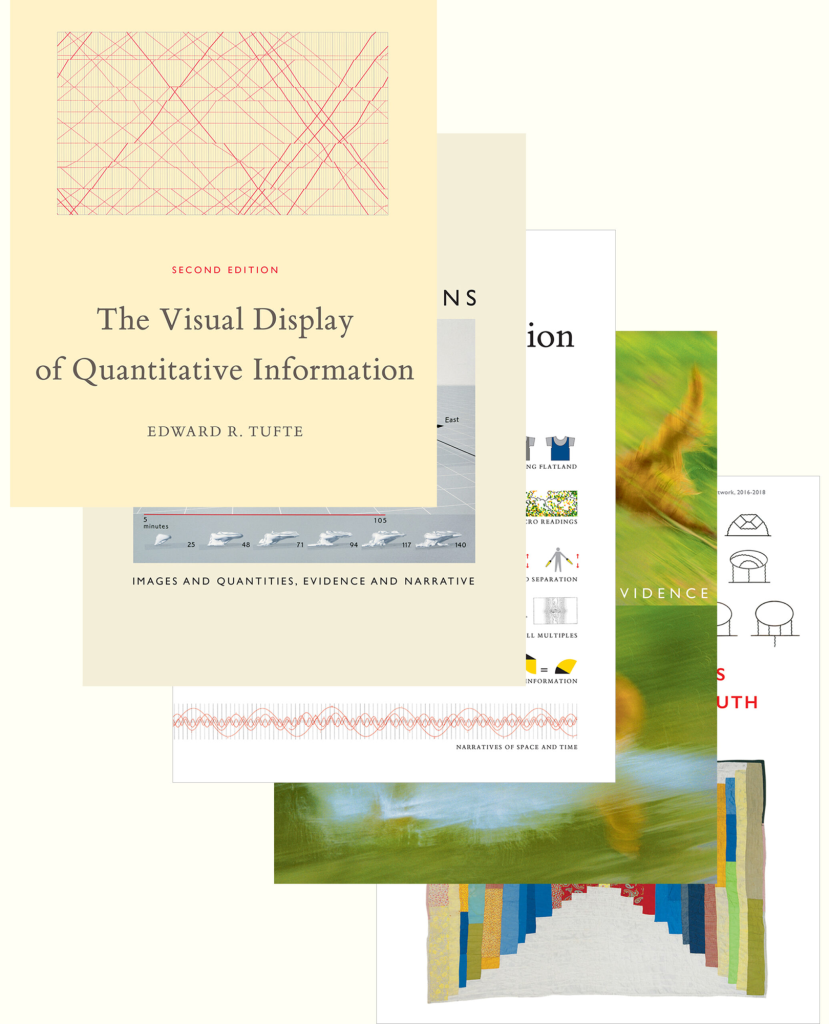
When I first began circulating in design circles in the early aughts, the hipster set was obsessed with Edward Tufte and his now classic Visual Display of Quantitative Information.

Edward Tufte taught data analysis and public policy as a professor at Princeton and Yale for 31 years.

Tufte, via his Graphics Press, wrote, designed, and self-published 5 books on analytical thinking and showing, taught a one-day course, Presenting Data and Information for 923 days to 328,001 students.

Who knew Tufte and I both shared a love of marking the days of our work? He influenced many more people than I have but I find some joy in that coincidence.

His most referenced work, which I mentioned above was published in 2001. Visual Display of Quantitative Information was on the desks of everyone designer I knew, from fashion and Silicon Valley to public policy it was a mainstay. The man knew how to lay out information visually and he became the standard.

Some of Tufte’s self published tomes

The long tail of enthusiasm for displaying data beautifully surely owes its ubiquity in some part due to his success in teaching my generation’s designers.

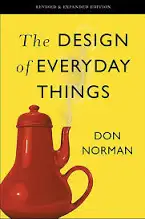
He’s became for a period so universally referenced that Tufte became a cliche. Now he’s classic a quarter century later. His work arguably as successful as a visual language reference anchor as bookshelf favorite, “The Design of Everyday Things” by Donald Norman. His work is also denigrated as cliche in some circles.

The Design of Everyday Things second book cover

Both men offered clarity and practical principles over taste and theory. Those academic predecessors befuddled many who experienced aesthetics primarily through semiotics and critical theory. It felt revolutionary to return to form and function

You “Kant” really learn to love the languages of aesthetics from theory alone as it turns out. I’ll place a little AI synopsis to make the connection clear. This is from Perplexity:

Someone might relate to the popularity of Edward Tufte and The Design of Everyday Things as part of a broader hunger for clarity over clutter in how information and objects are presented.

Tufte’s work is influential because it treats visual design as a serious vehicle for understanding data, while Norman’s book argues that everyday things should be intuitive, legible, and centered on the user.

A Tufte-style chart removes decoration so the trend is easy to read, while a Norman-style kettle shows clearly how to fill it and pour it without guessing.

Both are forms of respect for the user: one respects the reader’s attention, the other respects the user’s actions.

Learning how to use an item or a tool, or how to interpret charts or graphics, can easily overwhelm anyone and feel disrespectful to students. A whole era of computing was stuck between the power of the command line and the legibility of the desktop metaphor.

Norman spoke of the Gulf of Execution as the gap between a user’s goal and the means to execute that goal. Tufte similarly wished to remove the confusion in charts and graphs so one’s ability to glean information wasn’t stuck in a gulf of understanding thanks to overwrought bar chart or sankey diagram.

With new artificial intelligence tools we are bridging some of that gap, not with design but with raw computing power. We are moving beyond the CLI and the desk and into a world of reference and inference.

I just hope we all take the time to learn our reference set so we can do more than say “I know it when I see it” as that will be our only way across the gulf of execution. Some things never change. Learning the languages of your field is one of them.

Categories
Aesthetics Culture

Day 1925 and The Road to Nora Ephron

Yesterday both my husband and I were quite sick. We had very different symptoms but my worst one was a fever which added additional pain to the usual autoimmune nonsense. Naturally I subjected myself to more pain by spending the day on the internet. There is a lot going on and my brain was foggy in the wilds of the open internet.

Thankfully my fixation on consumer packaged goods’ price risk coincide with the arrival of a fresh round of skincare as well as a number of grim stories on the K shaped economy. Southeast Asian is rationing fuel while in Harper’s Bazaar wanted me to know that K-Beauty was coming for my neck. .

I don’t write headlines but I thought it was a bit on the nose to suggest fashion magazines are vampires. I clicked though.

It turns out there is a lot you can do for your neck but be warned the skin is thinner so promote collagen growth and be aware fewer sebaceous glands means it is dryer and more prone to irritation when exposed to actives like retinol. Useful information reinforcing my recent experiment with using Medicube’s PDRN Pink Niacinamide Milky Toner on my neck.

The beloved director of romantic comedies Nora Ephron m released a book in 2006 about the trials of womanhood. One essay was dedicated to how her neck was giving away her age. At the time I don’t even know one could be anxious about one’s neck but I filed it away as a to do in the endless list of feminine expectations.

“Short of surgery, there’s not a damn thing you can do about a neck. The neck is a dead giveaway. Our faces are lies and our necks are the truth. You have to cut open a redwood tree to see how old it is, but you wouldn’t have to if it had a neck.” – Nora Ephron’s “I Feel Bad About My Neck: And Other Thoughts on Being A Woman

I Feel Bad About My Neck illustrates book cover

Now maybe back in 2006 there wasn’t as much you could do about your neck when you’d smoked, tanned, and I will presume maybe occasionally enjoyed m drinking or other substances. But her Boomer fears encoding their neurosis into my generation was not in vein. I did none of those things.

Now that my fever has broken, I’ve been able to enjoy simple pleasures like the arrival of a box of skincare for myself (and also Alex because obviously I help him out) and ponder that I can feel anxiety about risk in the petroleum derivative markets like consumer packaged goods and also I can worry if my neck isn’t aging well.

I imagine I won’t get to enjoy that luxury forever. We have it very good in America with access to the best French pharmacies and South Korea plastic surgery clinics have have produced. I slathered on a milk toner and then topped it with hyaluronic acid water cream and a few drops of a Matrixyl peptide to boost collagen and elastin production.

The Internet as we know it is under new pressures from artificial intelligence as automation washes across digital spaces once populated by humans. The pressures in the market for technology private debt as it reconciles old Internet companies with cash flow against changing terrain.

It’s not just creative destruction in software businesses. Storied luxury families like the owners of Puig and Estee Lauder are discussing a merger. Price inputs are a killer when share prices are under pressure. Thats more of a geopolitical risk worsened by consumer struggles. The top 20% of the market does 80% of the spending is the new horror metrics.

So much for the lipstick indicator eh? Maybe I’ll look back and be glad I stocked up on serums, creams, drops, peptides and other petrochemical packed Swiss and Seoul laboratory style miracles. There is always shea butter and beeswax.

Categories
Politics

Day 1922 and Toilet Humor

I’d like to have something positive to say today about the Artemis II mission, going further than we have traveled into space than ever before but it’s much too hard to pay attention to expensive achievements by NASA when your pale blue dot seems set on imploding itself, fourth turning style. But I’m always here for a joke about how we can’t engineer a toilet for zero gravity.

All anyone in finance can talk about is the short seller research firm Citrini that sent analysts to the Strait of Hormuz, only to discover via the mysterious analyst 3 that actually plenty of shit is getting through as long as you pay a toll to the militants holding it hostage, which plenty of people who are desperate for oil are absolutely doing. I am SHOCKED well not shocked exactly.

Meanwhile the Easter Bunny stares into the middle distance as an old man threatens another gerontocracy with obliteration. Not to put too fine a point on it but everybody is going to suffer no matter how this turns out.

And we wonder why Zoomers are all reactionaries. Gee, their older millennial siblings couldn’t possibly have any experience in these matters, could they? Doesn’t matter. They aren’t going to ask us even if we have actually lived through this entire charade once before.

Incidentally has anyone checked in on Condoleezza Rice recently? Seems like she might have something valuable to add here.

Categories
Politics

Day 1867 and Rage Against What Exactly

I feel a struggle to continue this writing experiment. I feel a struggle to continue on at all in a public fashion online as the world is refolded and restructured around us.

I am just so tired and I fear an early death as the life and treasure of my generation is squandered on the perpetuation of systems that no longer work. I was texting with my mother about her husband’s third knee surgery (ain’t Medicare great) as enormous protest raged outside my window. I am in the capital of a European nation where this is quite common.

This is the third large demonstration in the space of three weeks for an opposition party that is mostly made up of technocratic stooges trying to hide the sins of wars no one remembers except those who deployed in them. I happen to know people who did deploy in them or I certainly wouldn’t know that the opposition is made up of the siblings, children and social circle of a former dictator.

Every time they protest the roads are blocked and then it gets out of hand. Water canons are set on the fires the protestors set and then tear gas is thrown out and no one can get through the city center. I assume this is some flavor of controlled opposition as America and the EU both support the existing government.

This time there were drones above the entire affair and much of the rally seemed to be music that was a mix of Catholic liturgy and electronic dance music. A famous priest DJ performed in the city over the weekend so maybe it was him. Who knows.

Nothing is weirder than hearing O Fortuna played over riot dispersal water cannons. We don’t have that kind of cinematic drama in American protests. Honestly everyone here seems sick of it. Most of all the hotel staff and the diplomats that live in it.

I watched it unfold from a vestibule with a Ukrainian woman who said she hoped I’d stay safe. I told her I wasn’t worried as I’ve seen this before.

She was understandably more concerned than I was being a refuge in a country that no one would have thought would be more stable than Ukraine a generation ago. Socialists holding off nationalists is not a terribly equilibrium if you can afford it. America can’t but it seems plenty of Europe still can.

Categories
Internet Culture Media

Day 1183 and Not Personal

If you aren’t familiar with the term “parasocial” I’d encourage you to dive into the term and its impact on our culture.

Parasocial interaction (PSI) refers to a kind of psychological relationship experienced by an audience in their mediated encounters with performers in the mass media, particularly on television and on online platforms.

A parasocial interaction, an exposure that garners interest in a persona,[6] becomes a parasocial relationship after repeated exposure to the media persona causes the media user to develop illusions of intimacy, friendship, and identification.

Wikipedia Parasocial Interactions

Because so little in daily life feels personal or reciprocal as intermediation and automation split us off from past norms of one-to-one relationships, parasociality is on the rise.

You and I are likely to be in some kind of parasociality in this blog post. It’s not a new phenomena having been theorized as far back as 1956, but social media’s ubiquity has now put all of us into varying degrees of parasocial interactions with each other. We have opinions about personas from movie star celebrities to niche Twitter accounts.

We don’t seem to have these parasocial relationships just with humans. There was a an era of corporate brand marketing (that seems to be fading) where we interacted with brands like as friends. I followed all sorts of Twitter accounts for brands that acted like personalities in the golden era of “funny” Twitter.

Yet as more and more people are becoming brands it seems that the old school idea of a brand as a an amorphous corporation is disappearing.

Perhaps it’s because we encouraged the cultivation of personal brands as a professional marketing necessity. Millennials leveraged carefully manufactured profiles to climb the last remaining rungs of the old career ladder.

Naturally this strategy has some drawbacks. During the Great Awokening/Weirding we saw inexperienced humans cope with the ramifications of having a reputation that extended far beyond work, family and community. Now we loosely call it cancel culture though it took years for the term to become less contested.

I’d like to encourage more people to not take things so personally. It’s not bad for be in parasocial relationships. In life we have varying degrees of intimacy and boundaries in even our closest relationships. No one is exactly one person or even persona. Next time you get really upset at someone else’s behavior try to remember it’s not about you. If someone gets upset at you recall that this still applies.