I try to give my own slight biological grey matter processing power a run every day through this writing habit.
I try to move my own body with walking, weight lifting and other condition so it can stay a somewhat workable machine. Tuning my body requires more work than tuning my mind as my brain rarely gives me issues but my tissues are always in some stage of revolt.
I have other assets behind my mind and my body. I’ve purchased a car. Precisely once and I have looked into buying others and shied away. My home doesn’t need to do work beyond housing me and my “disposable and durable” goods which range from a tractor other home appliances. A few of them do produce things for us like keeping our land and our laying hens.
We’ve got a gorgeous solar grid that generates electricity we can barely use. It goes into Bitcoin mining and stacking and running utilities but I’ll admit in a little lax about putting my our existing compute to work.
I’ll admit this is pretty stupid as we invest in crypto, we invest in hardware and energy, and we have invested in compute and inference networks. So why am I not doing more for passive yield on this?
Humans have been working as inference machines since we decided to keep records with something beyond the digits on our hands and the foot of our feudal lord.
Counting and abstractions being necessary for all sorts of engineering feats from cathedrals to graphical processing units. And now we have inference tokens just waiting to be brought down in cost as we bring networks online. So I am setting up my compute to be a part of those networks because sometimes it’s good to focus on little resource allocation problems to take your mind off tbh fe.
I have mentioned I’m a fan of Star Trek a few times. I am a genuine fan of the original series, the Next Generation and Deep Space 9 as well as many of the movies.
Gene Roddenberry pitched it as space cowboys but it’s become a template for entire generations for what competence in the face of the unknown should look like.
I’ll happily take either side in the Captain Picard versus Captain Kirk debates, because just as that fashion editor in Devil Wears Prada said about two superficially similar belts, “it’s hard as they are just so different!”
We are facing quite a bit of the unknown right now. Old hierarchies and expectations have changed. Or at least been revealed for what they are. We must ask what we owe each other and how we should expect ourselves to commit to a common cause.
I find myself considering the incredible competence both personally and professionally of the crews. I named this post NCC-1701-D for Picard’s Enterprise as that crew is famously a collaborative and high trust crew. Each one well developed with expertises professionally but also everyone was always trying new things and exploring new skills.
One of my friends accused me of having nerd “stolen valor” as I couldn’t have suffered for my affection for interests like Star Trek. Maybe it’s true girls don’t experience it the same way. Maybe I didn’t notice. I don’t think I cared. I’ll always be someone who sees 1701 and thinks “that’s the Enterprise!”
We often talk about solving “pain points” when doing product development and market fit work for startups. We have popular metaphors in this vein. Start a company that sells painkillers not vitamins is so ubiquitous a piece of advice I can’t even locate its original source.
I’ve been thinking a lot about how much I personally apply this motto to the pain I’ve experienced in my own life. I’ve had personal pain points (travel and miniatures cosmetics sounded small but the market proved itself out) and now I am working on a medical spa concept as a side project in our barn in Montana.
The two growth areas in America, and soon I imagine the world, is artificial intelligence and healthcare for aging populations. I’ve been particularly interested in complex chronic diseases and the holistic approach required to treat them as I myself suffer from one.
If I experience a problem my instinct is to solve it for everyone. So I figure if the data coming from Jackson Hole is to be believed I should find a way to integrate what I know well (technology and complex disease management) and use that experience help our elders age with less pain. Literally painkillers perhaps in some cases.
I found this listicle in some dreck of an SEO bot optimized website so apologies to any original bloggers but it’s a decent list of how to think through why we like this metaphor. Skip if you just want my human written personal content. I’m just experimenting with including extra content from AI for my own recording keeping.
The Reality Test: Do users actively seek solutions, or do you need to educate them?
• The Money Test: Does budget appear instantly, or do they “need to think about it”?
• The Urgency Test: Do they want it this month, or is it “maybe next quarter”?
• The Solution Test: Are they actively looking for alternatives?
• The Decision Test: Do deals close in 1-2 calls?
• The Value Test: Can they quantify the cost of the problem?
• The Team Test: Does the whole team being sold on it want it?
I’m a mess and somewhat scared. This abcess saga has grown from dismissive preventative care visit (which I did did out of an abundance precaution) and ended with me meeting a general surgeon at a Turkish medical tourism hospital tomorrow to discuss labs and my ultrasound. It’s my second time this year so that’s quite an endorsement as a revealed preference.
I was afraid she would be a box checking paper pusher afraid to give an opinion. But maybe younger doctors are afraid to treat that way given our system. I needed to know is it worth getting a clearer diagnosis before it is a crisis? Is imaging necessary? I have a set of drugs I take with these specific side effects. Given that risk profile and nuance at hand needed the interpersonal relationship that would guide me.
I do endorse SkincareMT’s cosmetic practice, and Addison in particular is fantastic, but their healthcare wing is clearly designed to extract maximum Medicare dollars from Montana seniors.
My failure to get an ounce of prevention means I’m flown to Istanbul to attempt to get a pound of cure. Don’t worry I was already in the Mediterranean. Not in the way way some think though.
Yesterday we found out by pulling teeth that I had a problem. It’s clear I need this excised and quickly. The ultrasound is gnarly. Drainage, removal of the foreign object, and potential curratage to make sure the walls of the cyst are removed forever are what is needed.
The sprawling medical tourism complex in Istanbul is amazing and I trust them more than any other system or talent pool on the planet right now. What they have built is an incredible achievement and in challenging conditions.
Doctors who listen, who educate you on your options, and most importantly are up to date on current research and global innovations so don’t give you glassy eyed stares when you mention a new medication like a next generation IL-17 inhibitor it’s exotic side effects. American doctors like that are rare and their hands are often tied by our horrific mess of state failure and lack of market innovation.
I’m relieved to have choices like “general surgeon or gynecological surgeon” and texting discussions with my case lead (a full time liaison for you and your family on the entire case) on how we will handle excision and culture pathology.
It does feel like I’ll have good choices. But it also seems like I booked less time than is necessary and I don’t know how I feel about that. A week of waiting on labs in a hotel while in pain is scary. Sure I can work and be productive and maybe even do some tourism but I just want this shit sliced out, an IV of the right antibiotic that will work and some sleep.
I’ve been doing some crazy bi-phasic sleeping as the Mediterranean is hot as hell from noon to 10pm. So I’ve been doing a bit of staying up late and sleeping in to avoid the heat. It’s not clear how much it’s messing with me yet because I’ve got all these odd infection fever doctor nonsense. A quick surgery and some answers can’t come fast. Thankfully I’m at the crossroads of empires.
I’m fairly well branded as a doomer, so I hate to break ranks with my preparedness brethren, but I’m absolutely sick of the powerful using fear as a tool to control people.
It isn’t a new problem. This is the go-to tactic our species has used insofar as we can verify with written history.
Any time we experience a change of circumstance, material reality or technology, we hear the braying of the old guard and the panic of the precarious.
People complain for two basic reasons. If you are doing well why change a system that benefits you? If you aren’t successful but equally aren’t comfortable with change, then you resent anyone who benefit from change. Fear and resentment are the shadows of the human soul. Envy is the sin of our time.
I personally feel I’ve invested a lot in doing my part to educate people on risks from climate to currency and compute.
I am politically involved in crypto policy as well as fighting fear in artificial intelligence. I helped pass the only piece of AI legislation in the world focused on liberty. I want people to have a choice for how they engage in a virtual future.
I’m not just a nerd about being prepared either. I’ve done my wilderness first responder certification. We left Colorado for Montana for a host of reasons but top of them was a better and freer climate both literally and figuratively. We live this way because it’s a great way to live and when change happens we are hoping to be resilient.
Having all that in mind I was offline for the 4th of July long weekend as it has been a busy year on all of those fronts. So I was sleeping it off. To come back and see a spate of conspiracies over cloud seeding technology was like a punch to the gut. And I’m already feeling like I’m on the outs with some community when it comes to technology and my intentions.
I’ve only met Augustus Doricko of Rainmaker a handful of times but his circle of young technical Christians dedicated to building solutions to our modern problems are why I remain optimistic in fighting for technology and the people who build it.
These kinds of communities of builders exist in an archipelago of anarchic communities across digital and physical worlds that interlay across many systemic problems. These places will succeed no matter the future we face because they understand it’s necessary to build. That is will.
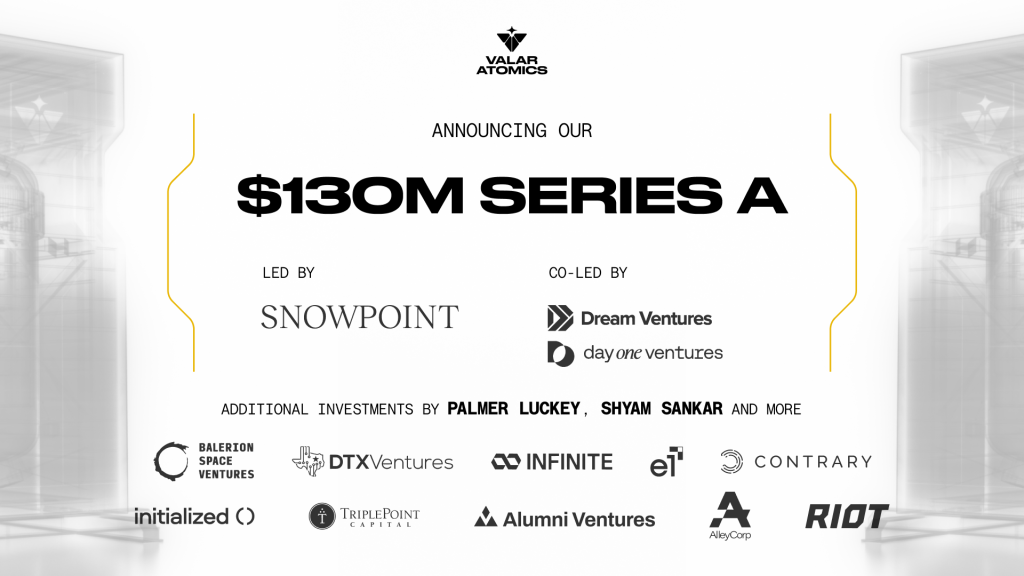
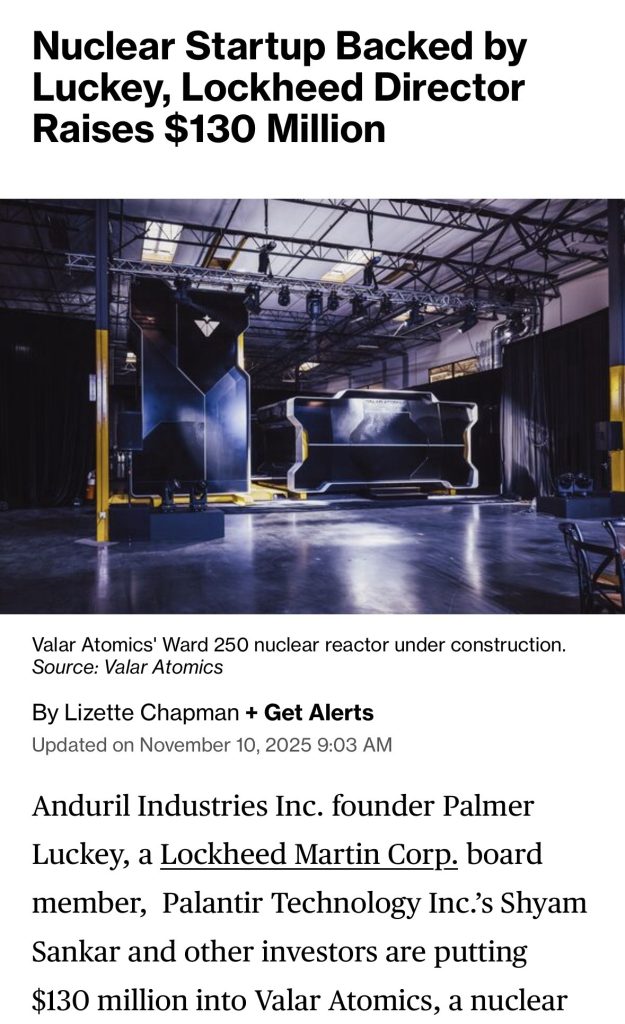
I’ve been lucky to have been the first investor in Isaiah Taylor’s Valar Atomics. He is a part of this builder world and of a part of a clan of physical builders. He faces decades of fear with a cheerful heart. I believe in his vision for energy abundance.
Nuclear energy was buckled under an old environmentalisms that was a proxy for a fear of a future whose risks, however minimal, were too scary to embrace for those in charge and the public they controlled.
I believe in a vision of a better America (and a better ecosystem and a better economy) because we embrace change to build materially better conditions.
I have frankly seen too much pessimism from older generations and cynical power brokers to be silent. The complicit rancor is slowing us down and there is nothing Christian at all about standing in the way of delivering better conditions to our fellow man.
Paradise is lost. In a fallen world we work to do what we can. It isn’t the end of the world. It’s already lost. Now we work because we must. We aren’t building an eschatology to replace the Lord. We build because that is what we are called to do by him.
It is a poor craftsman who blames his tools. Much as I’d enjoy going on a sidequest exploring ethnographies of man and his use of tools, I have an agenda. My honor has been impinged.
At a gathering of eccentrics in Wyoming, myself & a friend engaged in an hour long discourse with our audience on the use of artificial intelligence and how one might practically understand these tools. The talk was more linear algebra than immanentizing the eschaton.
Our explicitly stated goal was to understand the technology stack and its capabilities so the audience could decide for themselves how to use or leverage this tool. The blurb I wrote introducing the topic.
Concerned that artificial intelligence will be a panopticon of horror? Afraid of nerds immanentizing the eschaton? Jon and Julie have your back. Artificial intelligence is neither God nor imminent utopia but merely tools built by the hand of man. A practical discussion of how you can use these new compute tools to concretely impact the work & insight you need in your everyday life. Come prepared with questions, projects, and ideas as it will be interactive.
Our focus was on how these tools are built, what they can do and what they cannot do, and a firm stance that mathematics and compute are not imbued with divinity or demons but reflections of what we bring to them.
Indeed, we have never had more freedom than we do now to shape the weights and biases of these topological models. Our words on the public internet carry weight thanks to availability of fast compute and open source models. Our bigger issue is maintaining the capacity to supply energy and grid capacity. The real problems are human and social, much as we may wish to scapegoat a piece of code.
We were not suggesting a world ending chaos nor were we endorsing its use. We were discussing it as a piece of software and what it could do.
In a surprise to both myself and my co-speaker, the keynote of the evening spent a significant portion of his talk discussing how foolish, misguided and demonic we both were. Now the event has Chatham House rules for outside content or do I’d go into more detail.
However inside the event, the speaker could have done us the courtesy of saying our names when he made the suggestion that we are working towards evil ends.
He did not ask how we related to his positions and how we’d defend our word. At no point did he name us or address us. He merely cast aspersions.
Frankly I had no idea why he thought we were avatars for some kind of suicide squad as I doubt the gentleman is aware of MIRI or the myriad internal fights inside Silicon Valley. It was however insinuated to be true that we are the bad guys. It’s what we do.
I find this to be a cowardly position. If one holds such strong views that one would call two humans with honest intentions demonic at least say our names. We were in the audience listening intently.
So I will protest. In a past era, I feel that these heavy accusations would have been grounds for demanding satisfaction.
I am of the belief that the only way we manage the effects of adopting any new technology that impacts our culture is rigorously debating the merits from engineering to impact.
We are not asking you to trust us. We are instructing you in how to master this tool if you so desire and if it brings value to your life. We share many of the same concerns.
Alas (thankfully?) you are not summoning any demons that were not previously installed on the operating system of your soul. The shadow of humanity can be seen quite clearly in how we engage with the artifacts we call artificial intelligence.
I will continue to insist that insulting our positions without naming us or calling us to account in public is grandstanding. It was clear we were the targets of the criticism. It is poor form.
I’m an American so our manners may be different than others, but we do have them. So put some respect on our names when you say them in your real life subtweet.
We’ve asked to discuss it with him further through our host but he has declined. I frankly am delighted to find that I’ve had such an impact that I cannot even be named when raging against that machine.
One hopes a parlay possible. But it sounds like he would prefer to avoid us. This is of course fair on his part. I am however prepared to defend my positions. We all must be prepared to defend our actions in this age of change.
I was hit hard by a week of poor health which meant I missed a policy gathering in Helena today which I was really excited to attend. One of the topics was autonomy and choice in medical care and health.
He is an excellent public speaker and has a rare gift for clarity which benefits the entire software ecosystem. And we are an industry who disproportionately see the value of sharing in real time the changes we are seeing as we build. This generation built the networks and seeded the data with our content that enabled these models.
I saw in the talk the long lineage of technical cycles, access expansion and autonomy expanding that I have been a part of since my childhood. I’ve seen a few development and deployment cycles to use the theories of Carlotta Perez
Each cycle granted more power to sharing. The excess value generation of making our tools open to more external use has proven itself. And that has generally made for cycles of innovation that are shared mid deployment by the people as it happens.
And yet we still struggle with the right way of interacting with the tools. Math is fairly abstract. Your average human doesn’t much care for conditionals. We developed mathematics over such odd timeframes that it’s somehow easier to think it’s not in tandem with a culture and a commercial environment.
Maybe some only look at the industrial or military applications for tools and they care little about how they were made. The level of autonomy and control and abstraction that is enabled by software baffles. The more accessible something becomes the more we need to think of the user of the tool. Specialists can use special tooling and need not be so accessible. When it becomes a tool for masses things change. And we are in a changing moment for software as a tool just as the world has the highest expectations for them. Because we are perhaps at the edge of the great buildout.
Karpathy said that working with LLMs can feel like using the command line. It’s an intuitive framing for many programmers. He believes we have not yet found the graphical user interface for this era even as we are perhaps building new operating systems.
A screenshot from Karpathy’s YC Startup School 2025 talk
That change in access built enormous businesses and was the stuff of nasty backstabbing in the commercialization processes and the competition was very sharp in personal computing era. My father sold software through an old school reseller called Ingram and I gather it was a pretty wild time in the eighties.
But the fresh paradigm is always beyond reach. It’s there waiting to upend your entire world.
We were all off the Batch, and on the Command Line, interface now—my very first shift in operating system paradigms, if only I’d known it.
We are in an operating system shift now and we don’t know what to think about it it’s structure. It’s modeled on humans so it has all the same problems we have. It has cognitive deficits just as humans do. This annoys normies who don’t understand how it’s built.
We are interfacing with a new kind of compute output and it will slowly change everything around it as the abstraction layers bring more people into the effort.
We don’t really know what it looks like at this order of magnitude but the change is here and we get to make it. It frankly seems exhausting to ponder and a much much much harder problem set for power than generalized intelligence.
How does this relate to medicine and autonomy? Well, it’s become clear that medicine will be one of the areas that benefits from new access.
I care about the way we develop tools for the entire stack of medicine from pharmaceuticals to patient data. I don’t want another era of regulatory capture. The way we build applications affects how much autonomy and freedom we can give both doctors and patients. I know don’t want to be stuck with what we’ve got. More people should benefit from the changes ahead.
Attention is a currency with an exchange rate so volatile even a hardened ForEx trader would find it exhausting.
There is a new set of younger founders who are taking the attention trade to new heights. Rate baiting marketing is to the 2020s what growth hacking was to the 2010s. Now a startup like Cluely could be the new the new Dollar Shave Club with its viral success. Or could go the way of Clinkle.
Because who cares how you widen the top of your funnel as long as you are getting enough such that down in the trenches of conversion you have enough leads.
Surviving as a startup isn’t easy and you should grab the opportunities you are given. Yet I imagine you end up with the Glen Gary Glen Ross “the leads are weak” kind of situation, but does management care? Probably not.
And so we continue to coarsen our shared business environment but who cares right? Always be closing.
A lot of people do care though. I care quite a bit. Because it is a trade you are making. Something may work but are you sure you can live with the trade? I am with my anon friend here.
attention whoring founders with mediocre goals actually do drive us deeper into cultural nihilism. technology is powerful, and the preservation of healthy culture among technologists is critical for civilization.
opportunity cost is real. the more skilled you are the more it matters. metrics do not matter. what happens to people, to the world, matters. everyone is responsible for upholding standards. every VC hungry for a multiple, every pair of captive eyes, everyone slightly more willing to run toward defecting plays while chasing fool’s gold- Bayeslord
I’ll never begrudge a market. I believe we should have more markets. Go ahead and make concrete your implicit assumptions about the world and humanity. Own it. Show the revealed preference.
But it’s worth knowing how we do that price discovery on these attention trades. In this world we have grounding validity for all kinds of disappointing facts. The world is made up of many noble lies. We all decide how we want to make our trade with reality.
And as to attention whores? Well, the oldest profession surely knows a lot about the soul of man. I’m sure we all share a desire for a greater spirit of man and aspire towards something greater. But sex sells.
I am sympathetic utopian communities of all flavors. I myself have many dystopian worries because I’d prefer those utopias. I believe we are capable of more when we work together. America is a strange coalition even when we strain at the boundaries of pluralism.
It feels so hard to do this right now as we come up against our alienation from each other. Everybody is in pitched battles for control of the narrative of our future while so many of us battle individual nightmares in the here and now. We can do so much better in reaching for a future for each other but it’s all politics up and down.
The podcasting tech right are three years late to the effective altruists versus effective accelerationist meme wars (EA vs e/acc) as we we are subject to yet another round of Anthropic fear mongering over its potential power as a developer of artificial intelligence. Screaming its the end of white collar jobs tends to rattle.
If I had 3 billion in revenue, the horniest model on the planet and some weird Benthamite fetish I’d probably say less catastrophic shit personally but Anthropic is battling the eye of Sauron SaaS brotherhood of OpenAI’s aggressive financialization needs.
Meanwhile even the most determined of religious nationalist Rod Dreher is experimenting with transhumanism. Or he let an artificial intelligence write an essay in his style responding to the New York Times. Or that is how much he respects David Brooks. The professional pundit class might be listening to the doomers but they experimenting with optimism.
This is a funny way of getting into the New York Times having a panic attack as an institution as its way through various forms of nationalist and revanchist thought.
I myself am not very sympathetic to many veins of nationalist thought I was intimidated to be seated on a panel with Deneen this spring as he is a formidable scholar. Speaking on the aims of technology he is much more of the academy and the Citadel than I am.
I feel I have an obligation to engage with all types of political thought as technologists have found themselves with power in America on where. We have to consider how we build and to what benefit. I feel in some way that technologists (especially the optimists) are a political constituency but also a worldview and we coexist among others.
The diverse array of opinions and different constituencies in America are battling over what constitutes the good. America is the land of some degree of diversity and we cannot only serve a narrow band of interests. I am often afraid of the other parties in that debate because I do understand that it is power at stake but I engage because we all have the power to do so. Even if it seems ridiculous sometimes.
Bozeman is host to The Montana Festival this week. Alex and I are small donors to the festival as we are neighbors of one of the organizers Padden Guy Murphy. It’s a celebration of Montana’s many industries and people as we work together to build a better future.
Montana Festival is an annual celebration bringing together the top entrepreneurs, architects, business leaders, startup operators, innovators, artists, investors, culture creators, designers, community builders, movers, shakers and policymakers from across Montana and around the world to forge new friendships and catalyze Made in Montana ideas, projects, companies, and policy solutions to positively shape our shared future.
It has alas been raining to beat the band since the event started. At the welcome party last night literally the sound of the rain beat the sound of the band. This didn’t stop the band or anyone else from having a lovely time. Just raise your voice and have a good time.