One consequence of consistent writing is having a large number of data points on my past predictions. I can go back and see how often I am right.
There is predictive value in back testing is clear. And in five years of writing I have lots of opportunities to apply my current dilemmas and compare them to what I’ve seen. If you’ve not heard of back testing here is a little summary from my Claude query.
Backtesting is a form of retrodiction—a special case of cross-validation applied to past time periods, used across finance, meteorology (where it’s called “hindcasting”), and other modeling domains.
In investment contexts, the underlying logic is that if a strategy performed poorly historically, it’s unlikely to perform well going forward, and vice versa.
The year 2026 has gone pretty well for me. I’ve made some good calls even as other situations globally look very chaotic. I feel like I’ve largely published my predictions and taken my shots and this is working out for me. The more I can look back on where I’ve been the better I get at acting on my calls.
I do continue to wonder how much anyone is paying attention to anything even as a huge amount of attention is being paid to manifestations that are only being seen as secondary or tertiary effects of bigger geopolitical and monetary events.
I don’t know if going into the future this corpus of guessing and noting and committing to thinking on the issues of the day will matter. Or might make life worse. But tomorrow on day 2027 maybe I’ll learn something new and put it into action and continue turning myself with the tides.
In the post, I said I planned to keep writing the manual old fashioned way on this blogs and so I have. I appreciate the value of a process where one thinks, occasionally plans, writes, erases, writes some more and occasionally deviate wildly from the plan as you learn what you want to write about. I learn something from every attempt even the shitty ones.
Fun fact, that is the day I met Isaiah Taylor of Valar Atomics. I believed so much in the coming demand for energy and compute that I backed him. He’s doing very well. And I am excited that I look intelligent and am rewarded for it.
And while the tools the AI labs have delivered, I am still writing by hand with little machine intelligence involved in the act of my own thinking my writing philosophy.
The tools help me achieve more in other areas of life from passing policy to running silly experiments to aiding my own health journey. But I still write daily. That’s my present.
Sure every thought involved some research which is much easier now. I can search for a link I only remember in context much faster now. I may post a synopsis from an LLM for information conveying purposes (always labeled) but I’m generally on here to think for myself and not to convince an audience.
I do think being accountable to ones thinking can involve public debate, statements of belief and revisions of past opinions as information changes.
I am excited that others see the value in working those muscles. It’s always been the norm of startups to chronicle things publicly in the hopes that your answer might help someone else. It’s our way and I hope to take that from present day to near future.
Maybe these heat death statistic needs to include the general quality of life dip that comes with a hotter climate. If we once went inward in to our psyche in winters and enjoyed summers of slightly crazy hot joy that life is passed.
Maybe the long now of the perma-weird has cast a shadow of stuck culture which that I see more clearly when life becomes unlivable outside. If you keep living out in the world things do move forward. It’s less pleasant to touch grass when it’s dead and a fire hazard. And so the summer slows us down enough to see inside ourselves
I spend more time inside in the summer than I do in the winter. And given that my home is in Montana, you’d probably expect it to be reversed. Thankfully we only have two months where the weather gets into the “indoors between 9am to 9pm” heat risk. Other lower latitudes have more troubles than we do and blessedly our power comes from our own solar grid so I never worry about running air conditioning.
I’ve got to remember to keep tissues in my purse. I’m prone to crying when I’m proud. I am a crier by nature and the experience of pride and awe is becoming distressingly common. Woe is me right?
My very early bet on Valar Atomics (I wrote about it on Day 1145 but met Isaiah closer to day 900 early 2023) is paying off years, if not decades, ahead of my expectations. Never did I expect arguably the hardest operational bet in my portfolio to be such a fast breakaway hit. And I owe it to an executive order from Donald Trump and the efforts of patriotic Americans committed to regulatory reform. Which is crazy.
As it turns out, if the government gets out of the way of talented people, nay, if it demands that our state institutions help them, the impossible becomes possible in shockingly short order. The reports of America’s death are greatly exaggerated.
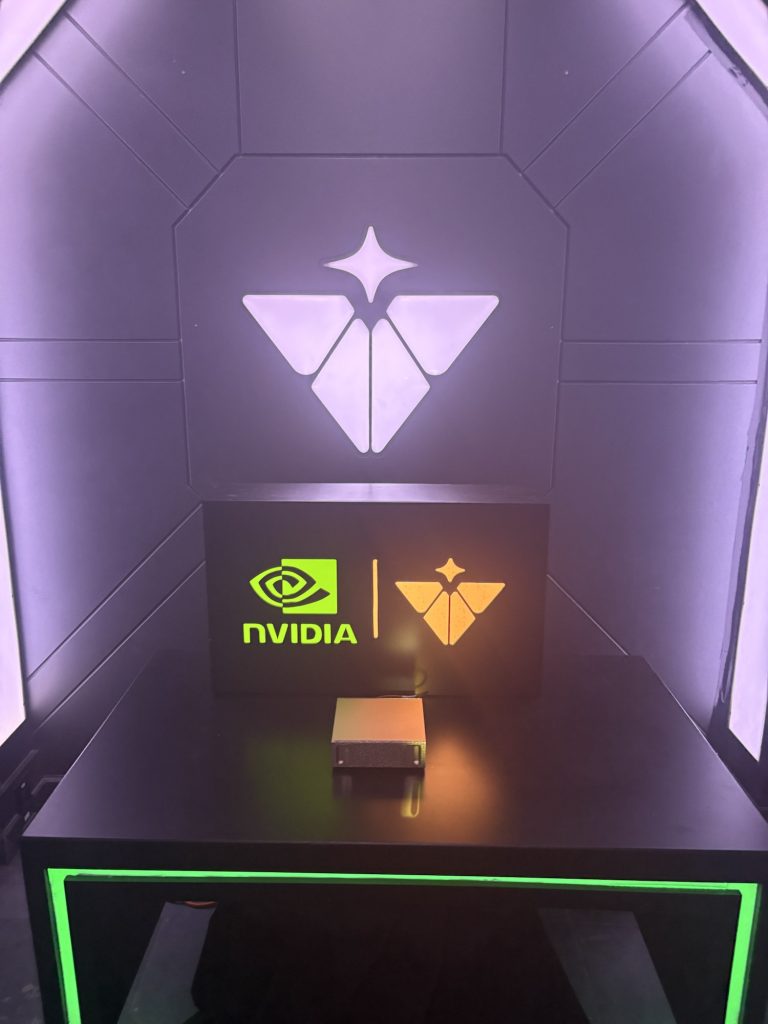
Today in front of a crowd of hundreds of current and potential investors, employees, Orangeville community members, government officials & scientists and most importantly our family members, we watched a reactor (that might not even exist without my first check), power an Nvidea Blackwell chip.
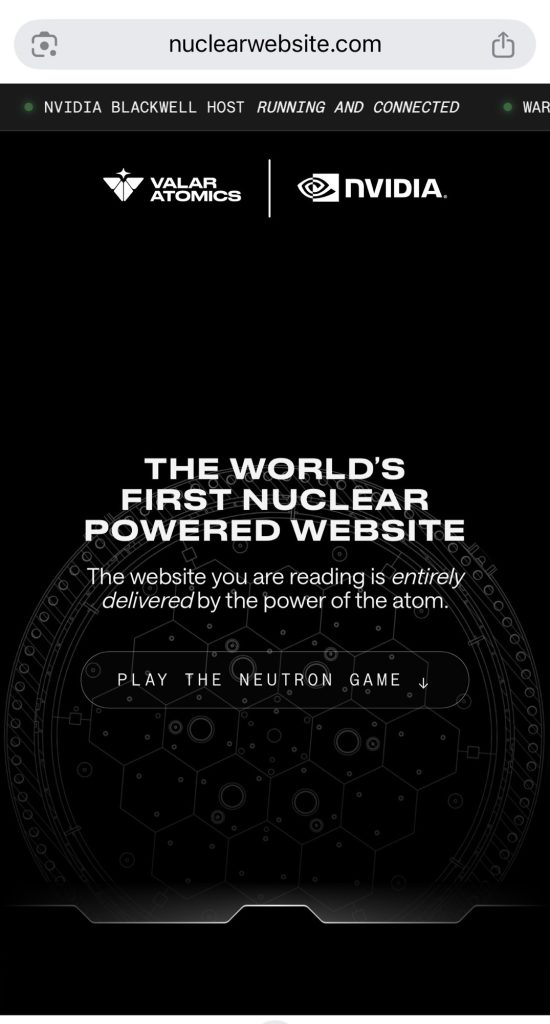
In a demonstration rivaling the greats (Ballmer, Jobs) Isaiah brought up NuclearWebsite.com and asked the audience to load it with him.
“Oh no it’s not loading?!!?” What’s happening? Do we have any electricity on site? Quick someone run the GPUs to the nearest electricity! Go go we can’t disappointment all these people!
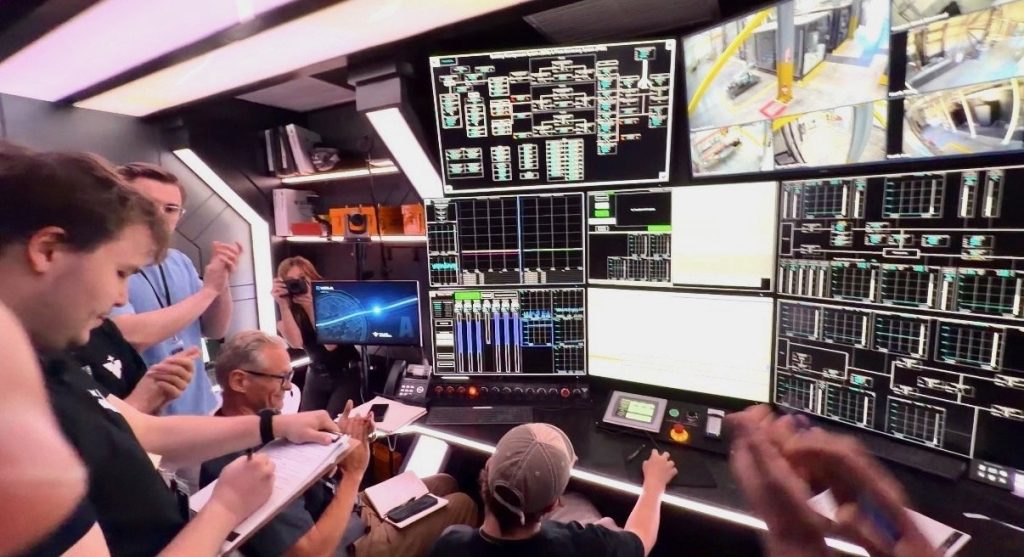
And then the Blackwell is rushed into the Ward250 reactor. In real time the chip is run to the control room, gets hooked up and boom the website loads.
The first entirely privately funded nuclear startup was critical, stable, producing electricity and powering state of the art silicon.
We actually did it. The mad lads and ladies of Valar Atomics swept ahead of the competition in a frenzied year of progress (Day 1510) from seed round and Ward Zero to producing electricity to power GPUs.
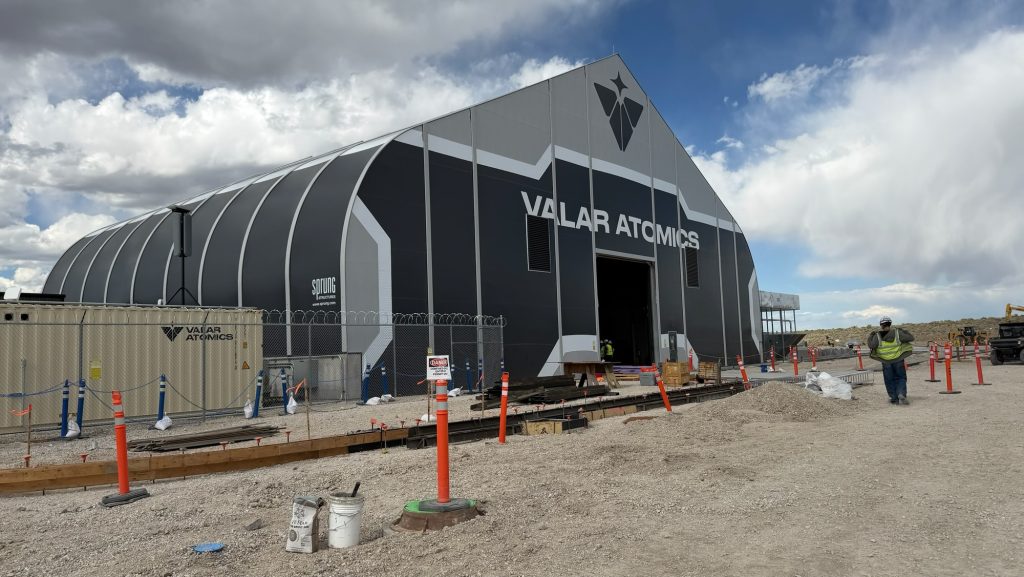
After a twenty four hour travel marathon to get from the Ionian in the Mediterranean to the southern Utah desert, being back at the Valar Atomics reactor facility for a demonstration of this magnitude felt surreal.
Just a few weeks ago (Day 1969) the reactor was days away from being shielded and then fueled. We’d driven down to see her before she was wrapped up in shielding.
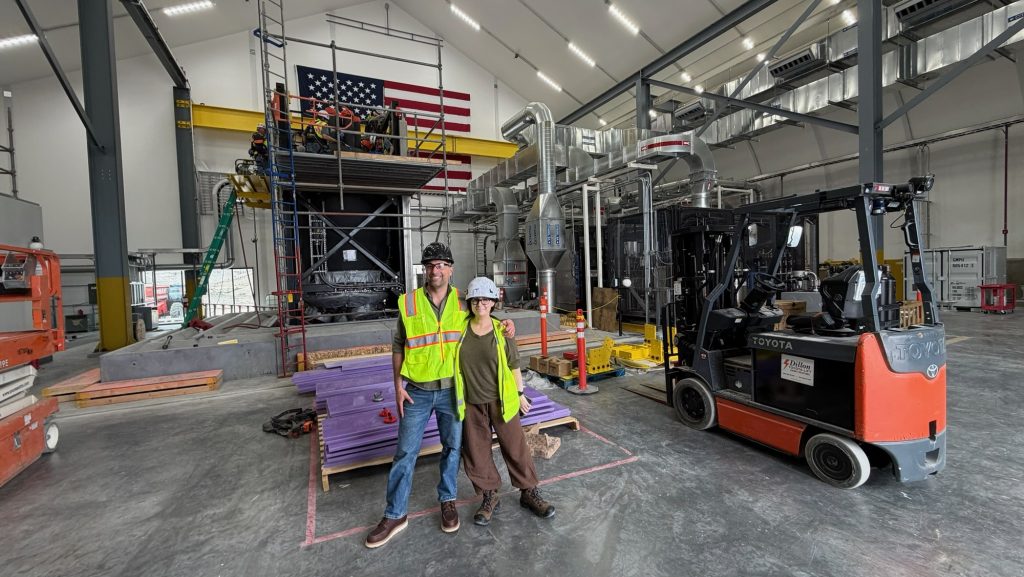
Proud first investors in front of Ward 259
Now not only has she gone critical (Day 1996) but I was able to walk into the running reactor room and see the live reactor for myself. The operator Ben (a former naval nuclear operator) seemed surprised and happy to see me. “Julie! Hi!” He exclaimed as me and the other early lead investors piled in for a tour.
Jason Calacanis (also a master of the live demo) never lets anyone forget he invested in Ubers seed round. I get to brag I wrote Valar’s very first check
And while success has a thousand fathers and failure is an orphan, I’ll always enjoy the satisfaction of being the very first to take a chance on a long shot no one thought had any business even trying. And well they were wrong. And I was right. Not just right but really fucking right. I backed the long shot dark horse (somewhere around day 950) because my gut told me that the kid had the right stuff. And wow did he.
I only had a dim hint of exactly what we’d be seeing today as the invite said “Watts Next” cohosted by Nvidia and Valar. Clearly a number of us connected the dots because it was packed. The atom would power the compute and we’d get to see it live.
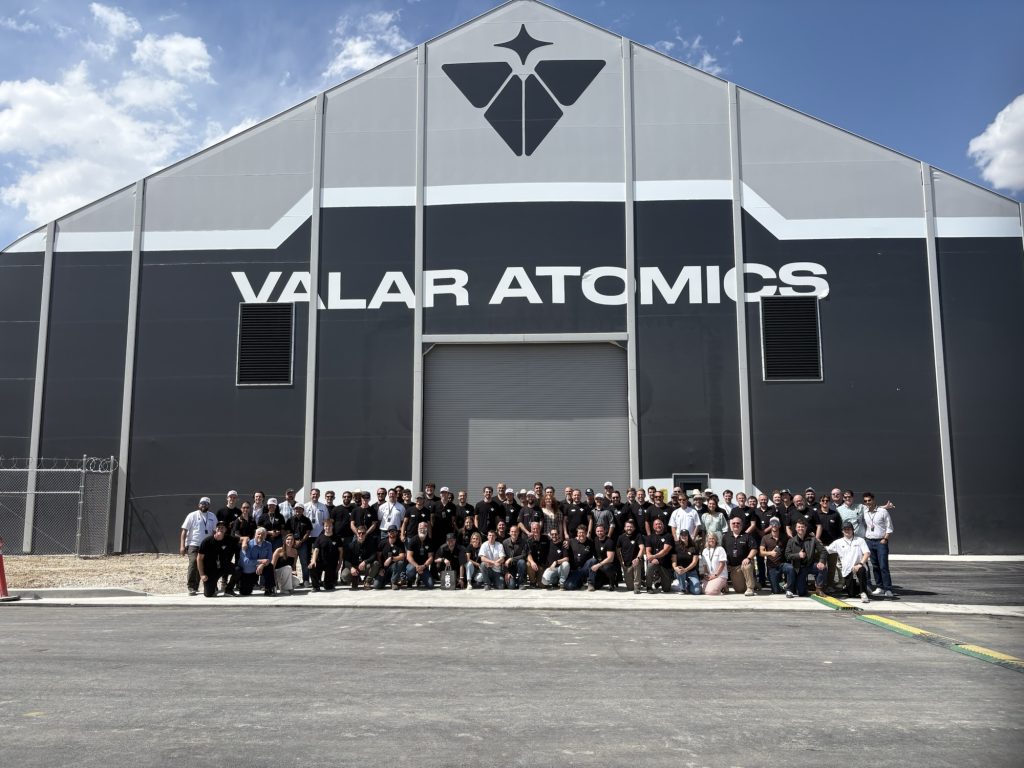
The team after the demo
Every existing investor, and quite a few later stage firms, came out to the middle of nowhere to see if these longshots had really done it. And indeed in just three years the impossible became reality. I’ve never felt prouder to be American. And clearly everyone around me felt the same.
And most importantly, it was a win for the team, led by the indomitable spirit of Isaiah Taylor. Their long nights and constant doubt paid off. The road ahead is long but no one is likely to doubt that we are serious contenders anymore.
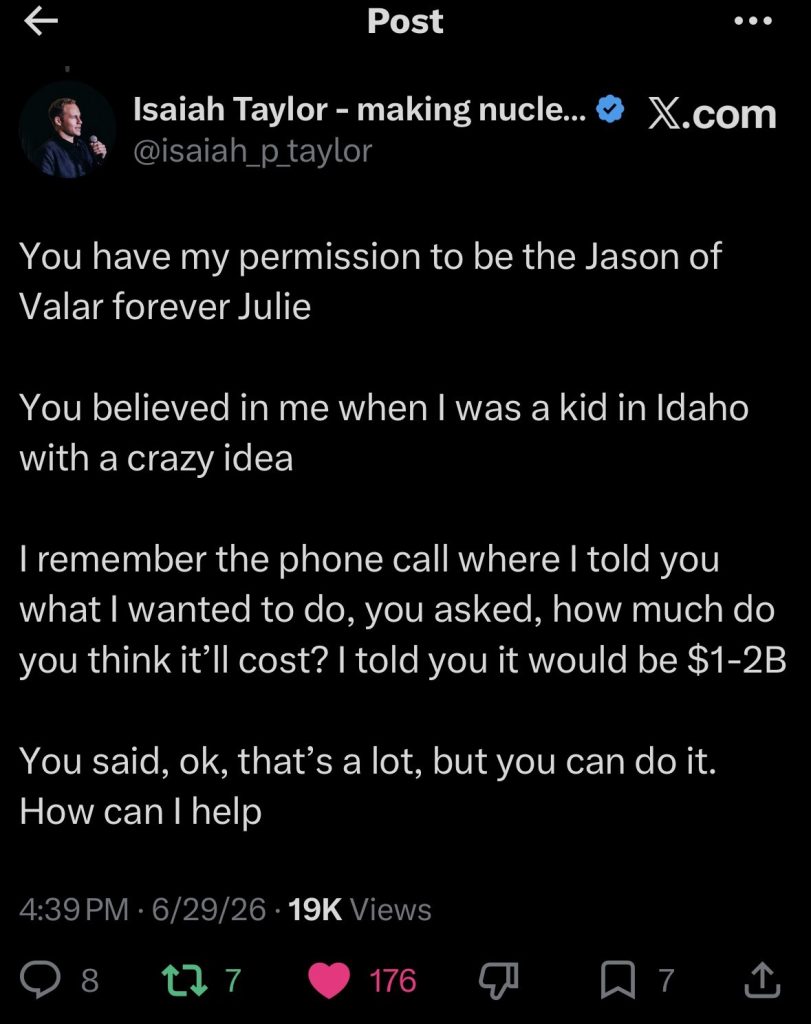
I always say there was never a doubt in my mind. I had faith. Isaiah joked he had moments of doubts. I say I’m blessed that I got to be that first believer to say “I think you can do it and I’m going to help.”
And whenever he doubted that we’d make it (there are always near death experiences in any startup) it was my privilege to remind him that doing the impossible is just what we humans do.
Like Captain Kirk, I don’t believe in no win scenarios. I hope you consider joining me for more impossible long shots. Because sometimes taking the shot is worth more than anything else you will ever do.
Want to run your compute on clean renewable cheap American energy?
I’m in a private terminal in a tier three European capital, as I begin the long transit back to the remote regions of America’s effort to reboot our lost industrial capacity. I am ready to celebrate our 250th birthday.
All this can be yours if you pay a few backs to cut the line in the former eastern block
You will find me in the desert trying to convince anyone who will listen of the many industrial and environmental benefits of nuclear energy. Might you be interested in particular of the learning we gain from repeatedly making thousands of small modular nuclear reactors? Scale baby scale.
I’m team Valar Atomics or bust, but I know it won’t be a bust as we have just had a race to criticality that half a dozen companies will meet for July 4th. And what better birthday present to give Lady Liberty?
“When you have the will of federal policy and the will of the people, these things can absolutely happen.”
The artificial intelligence intelligence revolution pretends we still have the height of America’s wartime Industrial & Management Revolution capacity for the build out still available within America’s heartland.
We don’t but I believe despite the bread & circus it might be possible. Lord knows we are trying to get back up and going. Just look how quickly we got our nukes back up in just one year.
Yes we got algae bloom sabotage on the bloom in DC, UFC fights on the White House lawn and some bizarro corruption but at least we aren’t having a Flamingo Revolution of Zoomers rebelling against oligarchs skimming too much from corrupt socialists who need to revamp their attitude. The Geopolitical Cousints get what I’m saying right Marko?
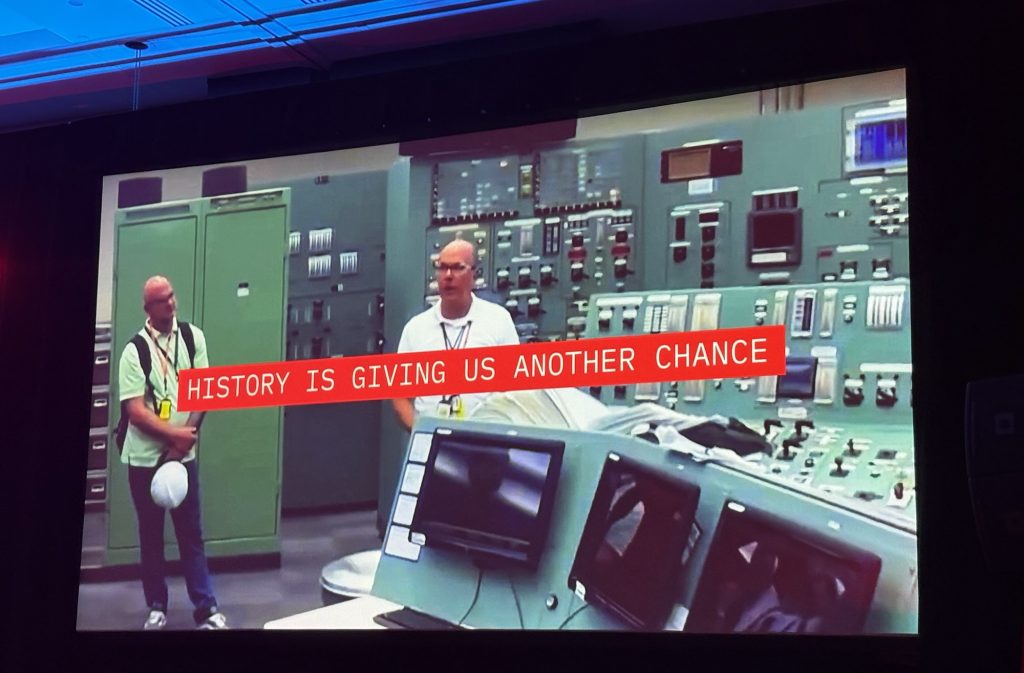
I rewatched season three & four of Apple’s For All Mankind alternative history of the space race as a hype effort to remember that we did indeed have other options for our near future and as the Abundance Institute reminded us all mere month’s ago history is giving us a second chance.
The Blue Sphere Transmission” is an electronic, modern-disco track by MelodiZenith that blends nostalgic 80s Eurodance rhythms (reminiscent of Bad Boys Blue) with deep house and synthwave.
Line dancing Euro-Disco Italian Pop on Mars? Now that’s a future I can get behind powering with SMRs by Valar
A vast somewhat intimidating vista is stretching ahead of me between two thousand days of writing every day and the possibility of reaching three thousand days of writing every day. One day and one post at a time right?
So like any sane woman setting out on a long journey, I ate a salad, had some protein and checked myself into a spa for a massage. No reason to start a long journey exhausted right? I need to pace myself.
I got a pedicure to immediately turn restoration to grooming necessities, but one can’t keep pool blue toenails all summer. Not every day is spent on the Ionian. Some days are spent at nuclear facilities in steel toed boots. Other days are spent in kitten heels inside conference rooms.
Just in case anyone does need to see my toes after those scenarios, I try to maintain a tidy nude set of nails. Isn’t it strange what expectations we have for women?
I may work remotely, at odd hours and in odd locations that allow the occasional eccentricity, but at any moment I might need to be on an airplane headed to parts unknown. You only get to be so weird when you have big goals.
In this case, next week I’m headed to a desert town and then a state capital. That’s state is becoming a more regular occurrence in my life. That’s a pretty big privilege for me.
Being a supporting player in a number of larger endeavors gives me the chance to add additional gravity if and when I might be useful. Even if it is just showing up as a cheerleader. I love trying to convince smarter, better capitalized and better connected players than me that indeed it is my startups are the winners in the grand game of macro-cycles.
I wrote that the world was getting to be a lot more chaotic when I first started this writing journey. Now that’s common knowledge. Then and now, I care about adaptability to this increasing complexity. This has turned out to mean compute, energy and decentralization.
The strength of your network is in the flexibility and foresight of its nodes. And I hope I remain a trusted node at the forefront of our long journey as a species for as long as I serve us well. I’ll carry on this Odyssey till then.
Well I’ve done it. I have written and published to the internet a blog post every single day for two thousand days in a row. So I am going to toast myself to a job well done.
In earlier milestone posts, I was always surprised I’d made it, but now the harder thing to decide is if or when I’ll stop, not if I’ll keep going.
Half a decade goes by a lot faster than you think. The accomplishments actually do add up if you keep yourself pointed in the right direction.
In a personal capacity, we got ourselves to Montana, set up a life that let us live the way we’d always dreamed and invested in the future we wanted to see.
From a civic perspective during that time we helped pass meaningful reform in housing, testified for crypto rules of the road and worked to ensure Montanans have a right to compute.
From an investing perspective, we have been first in Solana’s most crucial infrastructure player Squads. Because yeah crypto is going to matter a lot in an artificial intelligence age. We have stuck to our core mission of adaptation by backing the tools needed to benefit from our new AI speed run.
And yes we care about open source. From vector databases to inference labs to experimental dueling models, we have snuck into some strange experiments. And oh yeah we were the first check in a small modular nuclear reactor that is winning the atomics renaissance race (at least this week having achieved criticality).
There have been a lot of failures in those years though oddly not investments or policy. I have battled health issues and fought to not just maintain working capacity but to gain back the capacity I thought I’d lost forever.
I did woo woo whacky things from PEMF and HBOT to peptide stacks and traditional biologics. Thanks to the horrors of hormones and steroids I was early to GLP1s and made some good investments there too.
Maybe I’ll tag all of this more cleanly later but I do think it’s important to remember the days are long but the years are short.
Get on the airplane. Go meet up in person. Buy that dream house. Build a solar array and a sauna. Do wildly romantic things and go to galas. Say yes to more.
And open your heart to the heroic efforts others are also putting into making our lives and our world better. We live among every day heroes. And yeah lots of bad shit has happened in this time too. My father died. We failed for five years straight at getting a visa for a close family friend.
I am aware of the shitty compromise we all make to survive. But you have got to hold on to that feeling. So yeah on day 2000 I think I’ve earned the right to be corny as hell. Don’t stop believing.
It’s been a busy quarter. As we sometimes say in my friend group “accelerate” because going fast is the best way to defeat entropy. That doesn’t mean being sloppy or running rip shod but rather that slow is smooth and smooth is fast.
Things have been proceeding slowly day over day to be sure we can smoothly succeed at the goals we have set. Fast forward a few years and you can see that the smooth progress has indeed been very fast. From day zero to criticality in three years is just insane.
My body has been under some significant strain from the many hats I wear (policymaker, investor, cosmetics expert, wife and also full time disabled chronic illness haver) and I won’t lie that I just want some quiet stability for a few weeks. Alas life is happening awfully fast so I don’t know if it will happen. But phew what a ride.
I am going to be scattered and long winded so please excuse my exhaustion and joy, as I have used up all of my focus in the excitement of a truly incredible moment that represents years of work.
Moments ago, Valar Atomics took Ward 250 critical for the first time. This fulfills President Trump’s EO 14301, which called for 3 advanced reactors to go critical by July 4th.
This is our second criticality as a company, and an important step toward our goal of power by July 4.
This is a historic moment and the culmination of two years of work on the part of the Valar Atomics team. This is the most hardcore, intelligent, and driven people I’ve ever had the privilege of working with; which will be seen as we begin power ascension in the coming days.
Our mission at Valar Atomics is to make abundant energy for all mankind. The best way to make energy 10x cheaper today is to mass-scale nuclear fission. We began our mission by creating WardZero, our fully functional thermal prototype. Next, we took the NOVA core critical.
Today, we took the next step: criticality in the Ward 250 test reactor. Ward 250 is a TRISO-fueled High Temperature Gas Reactor (HTGR) designed for simplicity and scale, and is the first nuclear reactor ever air-lifted by a C-17.
We’ve been honored to be become part of the community in Orangeville, Utah, the home of Ward 250. Many thanks to all of our government partners who made this possible: hundreds of individuals across the Trump administration, the DOE, the DoW, and the government of Utah.
The list of individuals who have spent their time and energy and talents to accomplish this feat is too long to list in one post, but I am incredibly grateful to all of them.
I am one of those individuals who spent their time, energy, talents and capital to accomplish this incredible feat. Investing in Valar may well be the greatest accomplishment of my life.
You see I am Valar’s very first investor. Yes I mean I wrote the very first angel investment check from my small venture fund.
Crazy but possible makes complete sense to me. So I said he’s. And we chewed glass for a few years working towards the possible, while everyone told us it couldn’t be done.
Through the magic of Twitter DMs, I met Isaiah before he had even started Valar. He was working on another startup I didn’t love but I knew immediately that I loved him as a founder.
I was so impressed with his intelligence and his capacity to learn quickly. He had that ineffable “it” quality that all founders possess in some measure. He took feedback well but had a firm backbone. He listened to one piece of advice I gave him and based on that decision alone, I told him I’d back anything he did in the future and I meant it. I’ll admit I didn’t expect it to be “I’m building a nuclear reactor” but I am true to my word.
We’ve been there for every step of this amazing journey. It was an objectively insane thing to invest in. Yet the more time I spent with Isaiah the more convinced I was that he was a generational talent. The best part of being first is the opportunity to spend lots of time with a founder before anyone else learns of their genius. I learn as much from them as they do from me. And Isaiah is a quick study.
I wrote the check and went about the long grueling process of convincing others they should invest alongside me. It wasn’t easy. We got told no a lot. Failure lurked around every corner. People ranged from outright hostility to tempered skepticism. There were moments when defeat felt very close.
There were hard times. A lot of glass chewing. I never wavered in my belief that Isaiah would get it done. Alex and I were blessed with the opportunity to invest more and gladly wired in additional capital when others couldn’t see as far as we did. This may well be a career defining investment for me. I intend to keep putting in whatever Isaiah will allow us to invest.
And to everyone who said it couldn’t be done, or that it was too early or too risky to invest in something as crazy as nuclear, please let me invite you to join us now. There is much more to be done. We will need all the talent and capital we can get to win this bright future for America and for humanity.
I am getting closer and closer to a big milestone on here. Day 2000! I’ve been writing for two thousand days in a row and hitting publish. Five years and five months (almost six at 5.7 months) or 285 weeks of daily journaling in public.
I began in the height of the pandemic, and one can hardly recall just how bizarre those years were now. The great weirdening which began long before the pandemic arrived for almost everyone sometime in those long years.
Static and yet unstable. A long horizon of the long now, keeping us in semi-stasis as the institutional bulwarks cracked, and then crumbled, and then began accelerating into change. Everyone is holding on tight and pretending like it’s not a white knuckle era.
We are over the vibe shift, the Vibecession, and another vibe change after that and who knows what is coming next. I feel the same sense of being unmoored as I did when I started.
This despite having built a stable and thriving family and investing career. The biggest problems I had when I started (children, visas, family abroad) remains the same problems I have now. The temptation to simply change how we live is ever present. We escaped from some of flatland but more can be done to build communities and nations that are capable of thriving in the ceaseless change.
I still feel like I don’t know what’s coming, even as the future I sensed has come into being at an alarming right. But the perpetual not knowing can drain hope and energy if you are not careful to replenish. It’s exhausting physically too. The energy to understand what’s coming gets harder day by day and so we must get stronger ourselves.
I’ve probably put over a thousand hours of writing into this (maybe closer to 1500 as it runs from 20-45 minutes of time on any given day) so I’m a better writer but I don’t know if I’ve become a more palatable or appealing one. I don’t care too much as this is for me more than it is for any audience.
Most humans seem to prefer smoothed algorithmic writing over hand crafted artisanal human writing. Which is fine by me, as I don’t necessarily want to change my personal spaces to pander to anyone.
I was on a podcast recently where I reiterated my hope for being a node in the future. I want us to hope for the best by seeing clearly about the worst. That focus on solving problems is replenishing for the soul.
I’ll remain a little under the radar as a specialty node broadcasting to my oddballs. I’ll feel better about broadcasting know that is the long. The longevity posting, the nuclear posting, the odd travels and strange people posting will continue. I will try to broadcast on the pirate wires of the human web.