I get out of America with as much frequency as I can manage. I juggle this with an intense patriotism not only for America but for my home biome in Rocky Mountain west. I am proud to say I am from Montana when I am abroad.
My interest in being regularly abroad began as an effort to source deals and understand different technical ecosystems, but has ended up being my barometer of what reality is being played for what channels. Deals get done where the founders are and it will remain so.
Yet if I didn’t see other economies and live outside of the news ecosystems of America I’d have an understanding of reality that was incomplete.
The projections of your interests as an American are in constant tension with the ex monica and cultural attacks on it from its adversaries. America has quite a few and it is extremely dangerous now to be blind to their impacts.
I don’t think our world will be as open in the future and this saddens me. When I visit a young formerly communist city in Europe I mostly see enterprising young people who see an. American and have positive associations.
The vibes Zoomer Eassyerj Europeans have towards a middle aged American from Montana is surprisingly positive. I am feel lucky that is their emotional connection to America.
And we shouldn’t take that good will for granted. We want America to be a good friend to them. Capitalist Zoomers who experienced totalitarianism and socialism are good friends to Americans.
There can only be one. One white boy. Oh no, sheesh we didn’t mean in the department. What on earth have you been reading? There is room for everyone to have a seat at the table in our modern world. Just one seat though. Were you expecting there would be more?
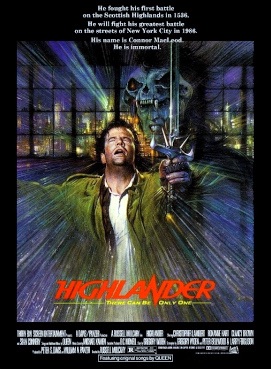
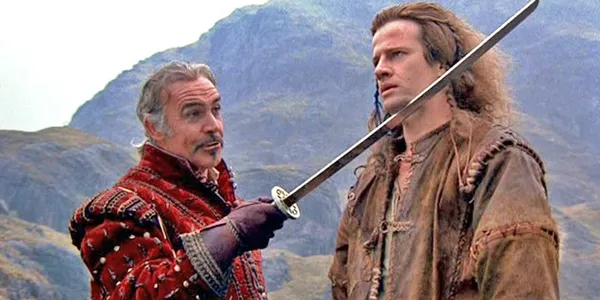
There can only be one Highlander. You know, the Scottish warrior Connor Macleod who is part of a race of immortals who must battle it out, do not age and only die if their head is taken? There can only be one of him. Except it’s a whole race. I don’t know how that works to be honest.
Immortals are driven to fight each other in “The Game,” where each beheading transfers power via a mystical energy surge called the Quickening, with the last survivor destined to win “the Prize,” a vaguely defined ultimate power. via Wikipedia
This very popular 1986 movie set between 1630s Scotland and 1980s New York City somehow turned into a mega-franchise with spin-offs and animes. It didn’t start out that flashy. I mean really look at how much content they had to pack into this poster to get people into the theater.
These days content usually the other direction, from anime to tv show to movie, but such was the power of Hollywood and its capacity for distribution in the eighties. Being a Baby Boomer movie director seems like it might have been a trip.
Things are not so rosy for the profession these days. Especially if you are a quirked up white boy like Duncan. We’ve lost them you see. This is a source of much consternation in the discourse. The children of the Higherlander generation definitely thought they would be more than one winner.
We’ve lost a whole generation of white men to diversity initiatives (launched by other white men) even though the lore being produced (by said white men) that white men were rightly battling it out for just one seat. The prize of real ultimate power seemed pretty clear. There can only be one.
Or at least this was the premise mythical of stories from ranging legendary Arthurian kings to actual Caesars of the Roman Empire. There wasn’t a team of Alexanders Who Were Pretty Good. The prize of real ultimate power is the stuff of myth. Sure actual power sharing is more complicated but humans love a final boss.
The American white boys (probably Ulster Scots) are suffering for the widening power sharing agreement reached in the great awokening diversity initiatives of the last generation. And no one even bothered to tell them until their hit middle age and didn’t end up as Highlander. We mostly told them it sucks to suck. You racist little shits just can’t compete.
I gather it wasn’t so bad when your enemy was other quirked up white boys. I don’t emotionally understand why as I was always expecting to have one seat as a token white girl. I must be less bothered having had lowered expectations. There is only one queen right? But there are lots of handmaidens if you are lucky.
Now if you want to be the Highlander you have to fight the whole globe. Highlander might be an Indian girl or a trans Guatemalan. That damned Netflix always caving in to the social expectations of elites forcing their luxury beliefs onto the suffering under class of millennial white boys. Didn’t you read JD Vance’s book? The American underclass is dysfunctional and suffering. They deserve it right?
But did they suck? Ah now that it’s too late we finally get to have the conversation about having deliberately changed the demographics of the elite winners of the Prize in American.
Which I assume is a wife, two kids, split level suburban home and a compact car. They weren’t expecting to be king. Maybe king of the cul-de-sac. And if you were forty in 2014 you didn’t get that. Well some of them.
Millennial American white boys expected they would have more seats at the table (having mostly seen themselves in power) rather than fighting it out to be Highlander.
Which is weird since I assume they saw the same movies, tv shows and animes as the rest of us. It’s hard out there for everyone. And the great game includes Everyone.
Zoomers get it. Shame it requires so much beheading. We’d better divvy up the spoils a bit more before the Highlander comes for our heads eh? Come on, at least give the boys a pilot or a term sheet or a job offer before this gets ugly. Just ask JD Vance.
Maybe because the profession’s entire raison d’être is to engage you there is always a new name for people who are good at grabbing your attention.
I swear I’ve lived through half a dozen new names for the communications profession in twenty years of being paid, in one form or another, to get attention for other people. And I don’t even call myself a marketer.
Everyone on LinkedIn, and a few on Twitter have latched onto the latest buzzword: storyteller. Someone call Joseph Campbell and see if they can send him a residuals check beyond the grave.
The aversion to existing terms like marketing, communications, and public relations is endemic to the space. There is always the new hotness and thus always a new name. Crisis manager. Influencer. Honestly I miss socialite. That was a great term.
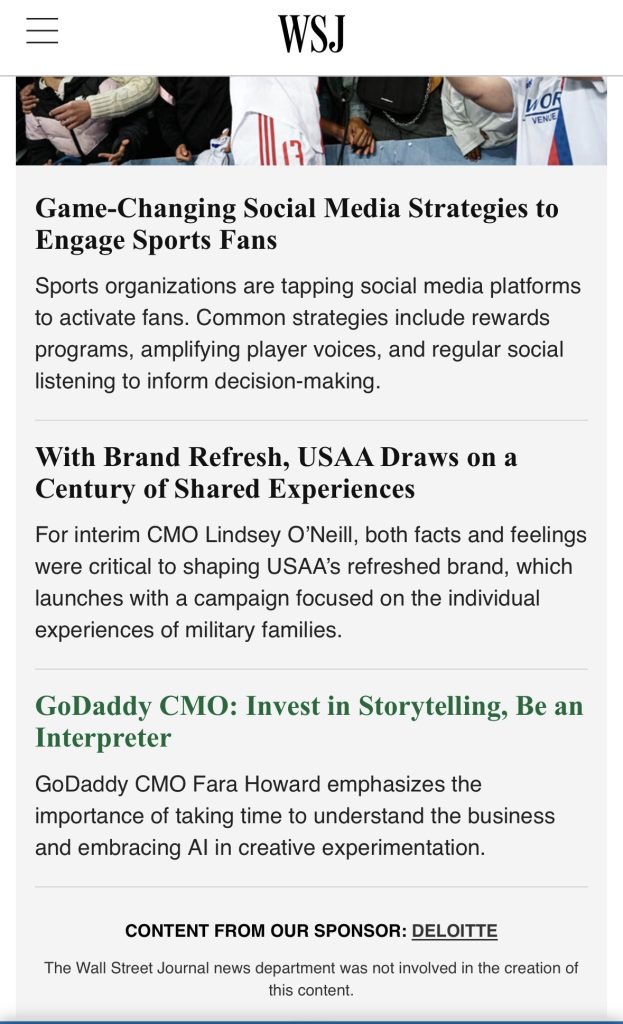
I had not intended to read the trend piece as it’s not news to me that we hire professionals to craft stories about brands and people.
Millennials were the original generation who experienced personal brand building as just one of those things required to get a job.
I am glad I opened it up though as I got to experience a pretty amusing bit of story telling inside the Wall Street Journals mobile application. A most unfortunate creative services choice to place storytelling sponsored content from consulting firm Deloitte.
Who knew that consulting firms final form would be not as management consultants but publicists? The remaining few journalists at the Wall Street Journal definitely were not involved in this.
You know I am old as I just don’t consume or create short form video content. Every new trend that filters to me on Twitter or on my reader feeds presents as sadness to me. I don’t fully understand them and probably never will.
I left Williamsburg in 2010 for Manhattan’s Chinatown as even the south side past the JMZ had become too expensive. The loft I shared above Future Perfect on North 8th and Berry was getting expensive on just the other side of the Great Recession. It was a loud place to live and a lot of fun but I needed a lease with my name on it and prime Williamsburg wasn’t it in 2012.
I wasn’t in a position by 2012 to buy an apartment but neither did I have any debt. So I’m sure that made me better off than the Zoomers coveting my life just before New York would go ZIRP. Not making a fortune wasn’t too bad when you could still enjoy a lot of hipster consumer choices.
You can’t blame the Zoomers for feeling like today’s economic volatility and social fragmentation makes our “before times” life look relatively utopian.
I’ve previously enjoyed when my own past lifestyles are the subject of nostalgia rehashes on social media. Now I think worried as no one should be too obsessed with the past. Especially not the young.
The temptations to build an investing case around a historical parallel cannot be avoided. Americans love their booms and busts. And we love grand television dramas about them.
Julian Fellowes is the stage name of a conservative British peer, actor and dude who gets BAFTA award for making television about aristocratic families familiar to adapt and Americans bailing them out.
Then he went on to make a period drama about righteous industrialists in America called the Gilded Age which isn’t as iconic as as it’s not as personal since obviously a British peer won’t understand American mores.
It’s just a little weird to think that we’ve already made the Silicon Valley drama about the last boom and bust moment and it didn’t get written by a British conservative peer but by a Gen Xer Mike Judge.
Maybe in another generation on Netflix we will get a sweeping historical drama about a polycule group house in San Francisco as the next Downton Abbey.
My immune system must be reacting to something, be it travel and environmental factors or perhaps a bug I caught, so I’m in bed and trying to keep my body happy. That means catching up on a few Love is Blind seasons.
As the American seasons get worse and worse, the international editions offer up clues as to the politics and tensions that producers feel the need to offer up to international Netflix audiences.
The United Kingdom had a Manchester season that was more commentary on the failures of the working class and the country’s immigration systems than it did romance. It almost hurt to watch.
France’s most recent cast was more pan-Asian colonial tensions at the forefront (with an Algerian or two) than featuring any continental or regional ties. The Italian season reflects a more United Colors of Benetton than Georgia Meloni’s. European franchise spin offs feature more immigration more than America.
While everyone is talking about Netflix acquiring Warner Brothers today, I wonder if Hollywood will drive new cultural directions or if the data driven Netflix will produce endless remixes of subgroups and niches so no matter your identity you too will have an avatar on a spinoff of a reality show. Love may be blind but the watching data sure isn’t.
Lest you think it is all fan service and showcasing different immigrant groups being absorbed into the wider national identities of their former colonial governments, you do see the occasional fusion of sanded off styles meant to appeal across strange niches.
I love watching the style of the country doing offs as it is both globo-homo any and everywhere while still targeting very identity driven and place specific people.
Some make no sense. Who doesn’t love seeing a bizarre fashion choice like a Prada bolo ties at a French wedding? Unless you are an Italian getting married to a Texan girl at Marfa, it’s odd to pick 2020’s most viral celebrity accessory to get married in France on a 2025 reality show.
Sure still see some aesthetic choices you expect for both local and global reasons. Like the Italian party planner with the Gucci bee broach. That seems culturally appropriate with a cast that was variably actually Italian despite their their aesthetics
Long burgundy blazers and Gothic Bulgarian girls could work in any country this year. That’s simply globally appealing in the now in any country. Warner Brothers should be taking note.
I’ve been intermittently online (as opposed to extremely online) this week what with the travel and the holidays. So I decided to use the Twitter algorithm to catch up on what the “Everything Platform” thinks I should see.
Which I realize is a bit like saying I’ll just have a little bump to see what is driving the rest of the club insane. I knew it was a bad decision and I fully endorse only using social media without algorithms. I generally use my following list in a chronological feed and stay away from image or video driven social networks.
But I am in many information flows that are built to grab attention and normalize information outside our Overton Window of current civil society consensus.
I was taught this was a good thing as a child. Reading and reconciling conflicting arguments was an important democratic norm required of all responsible citizens. I also understand as an adult that this exposes me to propaganda made by any number of sources.
Now you can judge my information sources but I value both of them and they had a common theme. Women, and in particular the wives of powerful men, are the keeper of m civilizational standards and used for this power. This message came from two very different places.
One is widely known indie founder who writes about doing business in Europe and the other is a publisher of books outside polite discourse messages as well as my neighbor in Montana.
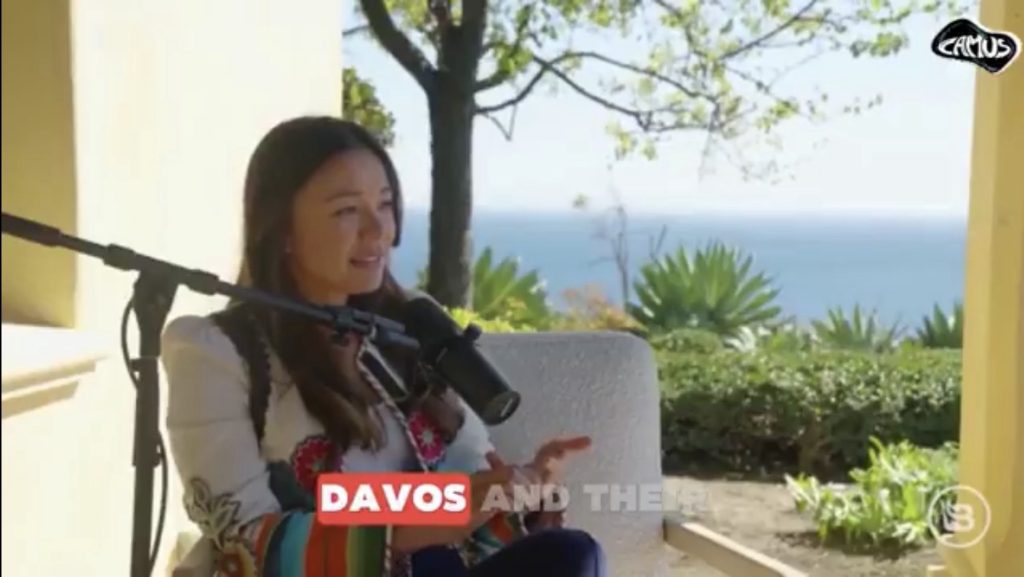
Both accounts took me down different uses of the matter. Though both have share other accounts I’d consider right conservative populists. One was about an interview with Nicole Shanahan the ex-wife of Google co-founder Sergey Brin, former running mate of RFK Jr.
She discusses how the wives of wealthy startup founders are finding causes that are not actually helpful to their intended purpose and are perhaps even actively harmful. It uses some language that is tied to a number of conspiracy adjacent words like the Great Reset and the World Economic Forum.
It is still fair game as a civic polity might ask about the responsibility of the wealthy pretty regularly. I do think Silicon Valley wives are a new vector to watch as a pressure point though. I better watch it as if the tech billionaires’s ex wives are under watch, I can’t wait to see how their less powerful (but much more numerous), Girlbosses will be scrutinized.
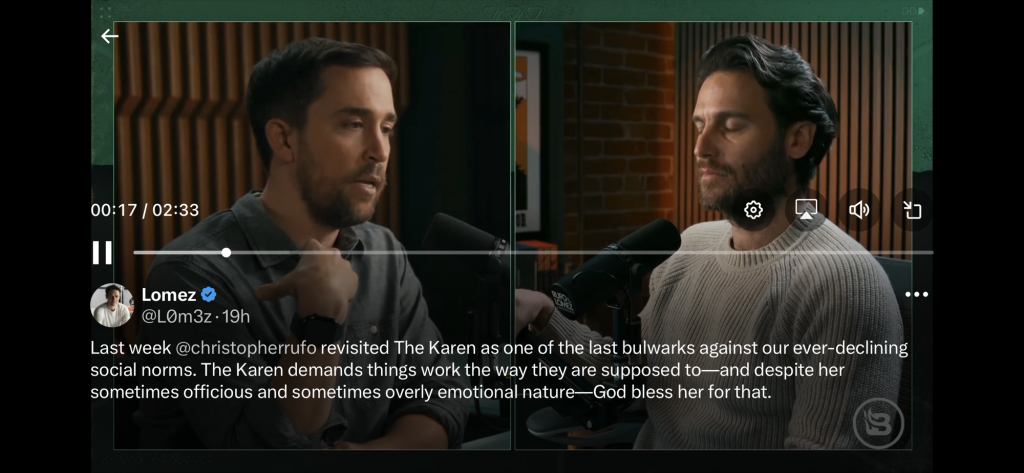
This video sent me right into an interview Jonathan Keeperman aka Lomez doing an interview with right populist pressure researcher Christopher Ruffo. He who made critical theory and Critical Marxism a household issue in Republican America.
Lomez has an essay about the feminization expressed in the longhouse. I won’t do it justify by doing a synopsis but Vikings had longhouses and so do plenty of other cultures. This is not all together a positive portrayal of women’s role in civilization but certainly as its driving force.
Algorithms refine down to clearer distillations. Smoothing functions are revealing of form after all. And I think it is interesting that Silicon Valley liberal ex-wives are being shown against the backdrop of norms enforcing regular mothers, wives and guardians of the good life the Karen.
The Karen was once a liberal nightmare and it is an interesting space to replace for the culturally conservative, especially as the Zoomer incel nihilist view is raging across the internet like a prairie fire. So that was an interesting gradient from a European founder to my neighbor.
I’d also say it’s exactly why I don’t read from the algorithm. I fundamentally agree with different positions expressed here but mane not in ways you’d expect. I’ve seen the pressure we place on women in certain social contexts and we make them feel crazy for being the balance of norms but also being hated for it if we don’t chose the ones our clique or social context prefers. My algorithm wants me to understand the narrow band I walk on. Fucking dicks.
There has been quite a bit of discussion in alignment theory with artificial intelligence that considers how legibility and openness might work at cross purposes when coordinating across different intelligences with different goals. Politics exist everywhere it would seem.
If you are transparent, but seek to change an agent’s behavior, you might reasonably be interpreted as adversarial by the agent. So it follows you must consider that their actions are no longer collaborative and open towards you but potentially adversarial and opaque depending on how it judges you.
The information habits and “winner’s optimism” that some American elder millennial display in public digital spaces are telling. In particular, we have skewed heavily towards legible openness as our internet was often friendly and our geopolitical positions was dominant.
These conditions are no longer true. And so we are now experiencing the Dark Forest Theory of Yancy Strickland (based on Liu Cixin’s stellar science fiction series the three body problem). American millenials are on a very different internet than we grew up on.
I’ll admit I have a bone to pick with Yancy as it felt more like he was defecting from the open web in 2019 because it was scary and filled with fascists. I didn’t think he believed it was because it was actually dangerous. His return makes me question his original declared intentions and his goals now.
The Dark Forest disappearing man has come back to the open web now. Things have changed and we all need our own private Idaho. Which you can find through his offerings.
I’ll note he needs the distribution channels of large adversarial networks like Twitter and that means gaining power in the dark forest. As we consider how open and legible to be in this very difficult moment I thought this was an instructional revealed preference.
I have spent a lot of time in various states of concern, sadness and frustration this year. Which is too bad, as so many incredible things have happened to me. We passed a right to compute law. Valar Atomics took “accelerate” way more seriously than most.
It’s hard to balance knowing the future won’t be anything like the past, but still having to make decisions made on that being the only data you’ve got. Engaging in governance and investing in energy seem like sensible ways of approach a strange future. Organizing energy is civilization 101 stuff.
I can predict a world with increasing chaos but how it will affect demand for things like energy, compute and decentralization are directional bets. You know it’s coming but how and when? And the downsides are hard to consider. Nobody ever thinks the entropy will apply to them but it’s already begun.
Every time future shock gets me I’m surprised I’m managing an imitation of Cayce Pollard at all. I’m practically a poster child for “sensible takes about various concerning challenges” as I get asked about various eccentric revealed preferences.
The Fourth Turning is coming about and we aren’t ready. I use short hand like the Churn, elite overproduction, The Sort and other minor terminologies and schools of thought to signal to others. I understand this to be my best way available way signal. But who knows as the humans retreat from shared networks it won’t stay that way.
The center does not hold. It is not holding. We are just not adapting to the changes in reality quickly enough.
If you get too close of a look at the basics of what’s necessary to survive a world where the trust is breaking down it’s hard to look at.
It doesn’t feel like we are going quickly enough adapting to a world where the state can’t perform its old functions and smaller entities like businesses and families need to maintain a heightened awareness of the larger context.
The joke has always been “don’t invent the torment nexus” but we seem to always invent the torment nexus if it will have a good return on capital. And we need to take this outcome quite seriously.