Just a hundred more days of writing and I’ll have two thousand days of consecutive writing published on this humble website.
Nineteen hundred days is a little over five years. It is a lot of writing and a testament to my own capacity to keep going. Every threshold I cross requires asking if I should keep going.
Day 2000 will towards the end of June. And what then? On July 4th hopefully I’ll be celebrating America’s 250th birthday with a crew who built a working nuclear reactor that I funded. The near term has goals and milestones. The long term is much fuzzier. Scarier. Murkier. Beyond my sight.
I’ve covered a lot of life in half a decade. There was lot of work and lot of investments and a lot of change. I’m glad I have such thorough records of my thinking. As more rupture, dislocation and chaos emerge from the acceleration how do I best hang on? Can I steer?
I can use this material to provide context on my mental model and worldview. This was intended both for myself but also the many other models built on content from humans on the open internet. I contributed a lot to training artificial intelligence models just by showing up.
Now that the models have shown up how safe is it for individual humans to show up? Remaining visible and human seems quite risky. When you strip the niceties of civilization and my place in it realism rears its ugly head. I am little more than frail woman in a dangerous world.
Maybe the sooner I stop showing up publicly the safer I’ll be. I am almost certain that is that will be true. I doubt it is the good, the beautiful or the righteous thing to do.
Today has been a very gratifying day for a very strange intersecting set of reasons. You may know that I have spent several years working to pass a “right to compute” law in Montana. It was signed into law in August of 2025 by Governor Gianforte.
I was so grateful that a campaign I initiated became not only become a bipartisan policy but a law supported by many Montana citizens & legislators. Now to see it go national not only model policy for the American Legislative Exchange Council but now have a second state, New Hampshire, pass it in their house, gives me indescribable joy.
Just forty eight more states to go. Though I believe it’s going to be an uphill climb as the topic of artificial intelligence has well and truly become politicized which makes stating simple cases of shared values much harder.
Except this isn’t really about artificial intelligence. Compute is a much broader and bigger thing than AI. It’s the stuff of the modern world. But that doesn’t mean we can’t apply what we know to be core American values as the lens through which we see it. Indeed it’s crucial we do.
Last year people could easily see that this was a sensible law that reflected our American values. Because of this sensible approach “the right to compute” is a winning coalition. It was bipartisan. So naturally it became a culture war.
I urge you not to adopt that frame. The right to compute speaks to American’s most cherished beliefs. Recognizing that it is not a novel legal theory. It is the application of the Constitution’s oldest commitments—to expression, to property, to liberty against government coercion
Even if you do not understand how all of its parts work, most understand that the entire digital world, in its constituent parts, is mathematics executed on physical hardware.
When government restricts computation, it does not merely regulate an industry. It restricts the tools through which people think, express themselves, and make use of their own property. Through that lens it’s clear we as Americans decide ourselves how to use it.
I hope we can remember this as the world changes and political actors look to change your mind. I do expect this to become a very complicated and uncomfortable position to have staked out.
Yet I feel confident that we will be able to make the case that this is not only the most American way of handling our future challenges, but is also practically the best way to bring abundance in a chaotic world. America is a land of reinvention that changes material conditions. We need not seek doom.
I believe that I have articulated that vision over the last five years of writing and investing so you can see my revealed preferences. I called our fund chaotic.capital for a reason. It’s hard, weird, difficult and scary but it’s also possible to be a lot better in the digital world such that we can use those gains to make the material world better. We can be more than productive primates with jobs
From nuclear energy to compute, this is what I believe and where I have put my time and money. We are organizing our world of atoms through the power of compute. And that can bring about a materially better world for everyone. Which I want.
I have been thrilled to see so many different people come together around the basic premise that we are empowered to do things.
We can lean in to the accelerating changes, all while holding fast to the reins of the values that built America, so that we may steer ourselves to material success.
The way forward is through the application of math on real problems. We can dramatically reimagine outcomes and the pace at which we do it. It’s scary and will look different but our grandparents lived through a lot of change too. Their grandparents as well. It’s the human condition.
I believe all of this is grounded in a philosophical foundation that is a recommitment to America’s core constitutional values. We are free to make things. And sometimes, when we apply ourselves, the world really does change.
If you are a canny socialist thinking look at this useful idiot for capital, I am honestly surprised that dialectical materialism has become so disliked by its own movement. If states with conservative libertarians can see that culture only changes when material conditions improve why don’t you want to improve them? Please feel free to copy our work as we have studied yours. You can find model policy here.
Despite persistent efforts to mitigate the downsides of my various medications, as well as maintaining dedicated wholistic lifestyle routines for my chronic diseases, I am not making adequate progress. I’d go so far as to say today it feels like I am sliding backwards.
But that is partially a function of luteal phase acute migraines and not the full picture on the ground. Yes, it’s true multiple metrics have gotten significantly worse over the 15-month span of my IL-17 inhibitor experiment with Bimselx and I am preparing to make the decision on what to do next. Many biometric markers are much better but the trade-offs are severe. It just feels like I can’t overcome them right now because I feel awful.
Nevertheless it’s important to remain grounded in the here and now. I think part of my trouble may be I am adjusting both to a new time zone and my normal altitude. Maybe I’m overly concerned by data points that will get smoothed out over time but it feels very spik.
Alas there is little room in life for downtime or bad days. Portfolio companies are fundraising, politics is getting uglier by the second, and one key blocker in my life has remained unsolved now for years.
I’ve never experienced a blocker quite so persistent as the American State Department’s handling of visa and immigration work. And yes that includes being disabled and chronically ill. That’s how bad state capacity is right now. My years-long attempt to get visas for family members to come help has not seen an iota of success.
But we keep going. There is much to be done, both practically and at higher levels of abstraction, and I am being whipsawed by hormone migraines over the last 48 hours. It is not an ideal time for weakness in one’s body.
Yesterday the best I could do in terms of writing was some rambling about my irritation with new retail sales cadences at Sephora feeling down market. Not that I necessarily need this space to be filled with decent content but I know that I am not running at even 10% capacity.
We all have to contribute our talents to this moment in time and there are projects that I wish to commit more time and energy to, even though it feels like it may be the death of me. But if not me then who? It’s a question we should all be asking ourselves and I hope more of us rise to the challenge.
If you watch me closely (which would be weird but I make it easy enough) you have surely noticed I spend much of my life traveling.
I’ve got no training in psychology but it sure seems like a certain personality type takes their childhood traumas and does exposure therapy till it becomes enjoyable.
I had intended for another trip to the general Mediterranean area in the spring to see family and work undisturbed by the American media timezone distractions. Now I am unsure if that will be feasible.
I am guessing that the sort of people who go to Sicily, Santorini and Cyprus to soak up the sun may find this Iranian conflict putting a wrench in their island hopping. Where will they go instead? Cartel wars bleed into the Caribbean and Bitcoin zillionaires setting up economic zones might make other things tricky. And oh the fuel costs will be ruinous.
War certainly makes me reconsider standard air bus style flying near any seas that connect to conflict areas but not too long ago I sat in a Turkish airport where “final boarding for Damascus” went over the loud speaker so maybe I’m making too much of it. Though I’m glad I enjoyed Istanbul over the winter as anything bordering Iran is now unnecessary risk.
If we do make it through the Jackpot to the other side of the singularity, or just through this regional war situation, I would bet humans will find ourselves getting back to status hierarchies and power games.
If all our consumption needs are met, there will always be hierarchies. Wait your best friend summers in Block Island too? Or are those the Finnish slides from the Comme des Garçons show? Let me just call up “insert social scene’s patron billionaire” as everyone is headed to Big Sky for fresh powder this weekend.
If we can have anything we like, then taste becomes finer and finer grained. The rich know this already and the rest of us just might find out if we survive to an abundance era. And as I’d like to do that maybe I be reconsidering heading out to sea. Caribbean, Ionian, Bosphorus or otherwise.
As the “monitoring of the situation” reached whole new levels, I took some time to touch grass today. I don’t think I opened more phone more than a dozen times before writing tonight.
So many mutuals are teaching themselves automation skills by building situation monitoring boards that maybe the Department of War doesn’t need Claude. It was charmingly easy to keep up. Which is a very distorted and dystopian way of living out the hard realism of kinetic power in real time.
If America is backstopping Loyld’s of London shipping insurance, then to repeat a Keanu Reeves meme style. Yeah I’m thinking that America is back. But I’m getting to old for this shit. It’s all TV tropes now as we unmoor in the propaganda. Which is run by an honest to goodness critical theorist who trained with Jurgen Habermas.
So instead I stared out over the horizon as the wind gently brought fresh air in from across a wide open vista. I enjoyed my friend’s company as we talked about jhanna meditation and compute pricing. We saw a seal winning along the shoreline. I put on sunscreen twice as we stayed out in the sun.
How luxurious is it I had long leisurely in-person time with a friend. Not all of my business is with friends but I cherish the ones with whom I do.
We walked and talked and broke for lunch and discussed problems from the most abstract to the most precise. Having given the world so much access to all of human creation and taste, did the market provide an original version of the driftwood horse decoration or has there only ever been the mass market design? Neal Stephenson fans get it. Baudrillard too.
Fashion people and technology people worry about these questions of taste because they are questions of control and tooling. The source culture of engineering culture shared context. How abstract is too abstract? What is enough to enable the builder to use your tool?
It was good to be outside in the sun with someone and talk. That activity needs no shared context beyond humanity. We have missed it in the hubbub.
Isn’t it funny how just as the internet is losing its humans, the humans who met only thanks to the marvels of the network are finding new offline systems? The network can reprogram itself.
I have dear friends and successful investments that I have spent hardly a single moment commingled in time and place with. I imagine that age is either just beginning or just ending and I am not sure which. So today I was outside in the sun talking. I don’t know if we made any progress but maybe I’ll only know in the far future.
I don’t feel terrific so I’ll keep this as a ramble but with some links. I fear some sort of Rubicon has was crossed, which we will only recognize in hindsight, in the fight for property rights in America versus the tyranny of failing state capacity.
I am referring to the contract dispute between foundation model developer Anthropic and American Secretary of War Hegseth that boiled over on Friday night as some sort of Murderbot surveillance subplot parsed only by lawyers, policy wonks and anyone who remembers the patriotism of Chelsea Manning.
Right before America and Israel went all Epic Fury on Iran over the weekend, somehow it was felt a messy public fight between defense contractor and the civilian oversight of our military was ok? Good thing everyone is too distracted to care.
The best writing on this so far has been Dean Ball (who worked in this Trump administration on its AI position statement not so long ago) who feels that Hegseth took an approach on renegotiating a contract with a frontier AI model developer that has consequences.
Loosely and I am missing much Anthropic had its previous contract to parse classified documents in the Department of Defense (now the Department of War) negotiated by the prior administration. Some aspects of this contract wasn’t going to work for the Trump administration. Anthropic didn’t want to change it and Hegseth threatened to call Anthropic a supply chain risk unless it complied. They didn’t and Sam Altman signed a deal.
Anthropic is essentially using the contractual vehicle to impose what feel less like technical constraints and more like policy constraints on the military
This is all complicated by the model developer having wishes for frontier AI development to be nationalized and for their work in particular to be safeguarded by a different political administration. It has become a right versus left thing as it was bound to do.
Now Anthropic gets to enjoy the full throated defense of its industry peers and even conservative policy makers like Dean, because our current state capacity is not what I’d call excellent when it comes to our civilian government capacity. Honestly our military still seems to be crushing it.
Secretary Hegseth looked a bit like he was over reaching in his command that he get his demands met. Americans are very touchy about surveillance of if’s citizens and much less touchy about autonomous weapons so it’s natural to be a bit suspicious if you are a millennial who remembers the Global War on Terror. If you are Zoomer who doesn’t know who Chelsea Manning is please go ask Claude.
However it’s not at all clear that Hegseth’s original negotiations were out of hand as of course it’s the state who decides legal use not the private company and we are meant to have laws, judicial process and all the rest. It’s just that we don’t. So what on earth do we do about it? Trust me bro is not a policy.
I have more than one founder in my portfolio who has struggled with basing their businesses in America because U.S. Citizenship and Immigration Services is barely functional. My own family has been affected on the personal front.
I’m proud America is so desirable a destination. But we can’t be such a dysfunctional one. That makes me feel shamed. I want us to bring the best and brightest here to build.
I’ve never felt such patriotism as we begin to invest in industry and energy again. The America that makes it to its 250th birthday is at another turning point. When hasn’t she been?
My phone showed me memories of the last big birthday trip we took with my father for his 80th. He passed this year. Smiling photos of my brother and I and our spouses with my father a little bemused but happy to be in Puerto Vallarta.
It was cheap boomer luxury provided by a Costco vacation plan. Today the Costco in Puerto Vallarta is on fire. Cartel infighting they say. That detente is done
The last time I saw a Costco on firemy hometown lost a third of its housing stock in a freak prairie fire. In a sick twist of fate those homes housed scientists who did work on weather stations and forecasting work for NIST, NCAR and NOAA.
One of my friends owns an Airstream which they use to go from job to job. They park it in front of their home. A elderly neighbor called in a complaint.
Despite many destitute disorderly trailers and tents on sidewalks, now my friend is the one to get ticked and towed from his own parking spot. A simple ordinance broke and now it’s a fight with the city.
Rentals sit in an uneasy tension with elderly populations sitting housing wealth. They rent their second homes whose property taxes haven’t been reappraised for decades to those of us who might appreciate an opportunity to arbitrage one home’s desirable location for ski season for a break in the winter.
Freedom to transact with one’s own property in an era where property tilts to the elderly feels uncertain. The struggling homeless can’t be moved, but the legal tenant can’t park his van in front of his own home. In Airbnbs they don’t want you to stay more than 14 days. I guess that’s when you get squatters.
I want our institutions to function. I want a viable state capable of doing the business of its citizens. Instead it’s renter classes and public employee unions and right outside (and inside too) our borders we see corporations, crime syndicates and subsidies for the thee and not me for me. Normalcy bias until the Costco is on fire. And then we forget all over again.
When Uber first hit San Francisco, most of the hype in my circles was that it was finally possible to go out at night like New Yorkers always had. In Manhattan hailing a cab was simple. One was always going by.
San Francisco was neither so dense nor so populous, so maybe you got lucky; but mostly you called cab companies and waited outside of parties for for ages just to be sure someone wouldn’t steal your ride.
Talking to your taxi driver was more interesting in New York. It was the quintessential immigrants job where one worked their way up to a taxi medallion. Different neighborhoods had different demographics. You’d learn a lot about the American dream.
Now that ride sharing and piece work contracting applications are entrenched in our social fabric, the relationship between customer and provider is entirely different.
Using an interface that cuts down interaction is a big part of the appeal. Maybe no one wants to hear about hopes and dreams anymore.
Except that I do. I am one of those chatty Cathy types who wants to let the conversation roam. Uber and Lyft drivers (and whatever other delivery services they may also pick up) tend to be intermittent workers looking to patch up the cracks in the drivers budget or circumstances.
I’ve had a number of veterans (as in military not as in experienced drivers) on my recent trip. This is also a typical demographic in Montana where it’s either former military or college kids looking for extra money.
Times rally must be changing as I’ve not had a prototypical immigrant driver in America for some time now. It’s largely white native born men looking to make ends meet.
New York probably still has that old school style of driver but working class Americans of all stripes are now thoroughly integrated into application intermediary work flows.
Odd jobs used to be paid in cash and maybe some didn’t get reported. Now you’ve got 1099 income from every piece work source of income imaginable. No one is all that reasonable to anyone else.
The companies are just the layer between customer and provider. I’m sure the governments must love this (despite protests to the contrary) as it makes it very easy to collect the taxes.
It’s just clear that some people are enabled to bigger, better and faster output thanks to rapidly advancing tools coming from the foundation model companies.
Will Manidis is on hot streak of essay writing (aided by artificial intelligence in the best way) and has produced thought provoking writing at a great clip. I love nothing more than seeing an exited founder feel free to express their views at their fullest. I’ve written about his essays in the past and suggest following him.
“I left with an unsettling feeling that I had seen a vision of the future that I wasn’t supposed to see. A country that had gotten extraordinarily wealthy but stayed coherent to its pre-industrial identity—a country that didn’t turn into a museum, didn’t paralyze itself in amber, but became a modern, functioning, wealthy nation that did not feel like it had been strip-mined of itself by the money.
In the West, we really have convinced ourselves there are only two options for our post-economic future. You can be Shenzhen or you can be Athens. … Shenzhen is the city that chose money over place so completely that it deleted itself.
…Athens is the opposite failure, and I say this as someone who is at least Greek enough that I feel like I won’t offend anyone. Athens chose place over money so totally that the city itself is a mausoleum”
A photo from Will’s tweet essay on visiting Oman
I don’t know much about Oman and I make no claims to understanding its politics or histories but I too think about what we lose without a sense of place but am also fascinated by the liminal zones of the hyper future set against a past we are actively forgetting. And no nation is immune from this process.
I do however have two books to recommend if the topic of place, continuity and the future interests you. One is a work of fiction and one a photography compendium whose forward was written by my favorite author.
Photographer Greg Girard’s work documents Asian cities in transition, especially Shanghai and Kowloon, was closely associated with William Gibson, who wrote the foreword to Girard’s book Phantom Shanghai. Gibson is the father of cyperpunk. And I contend that his near future fiction gets quite a bit right about how close the dark past is to almost arrived future. These images were shot in 2007 and yet the outlines of the super cities was already energy
The premise follows a protagonist’ traumatic life as a a radicalized agent of terror preyed on by different foreign influences living in a refuge camp in what was once Georgia.
It rhymes with both Will’s essay and with William Gibson for me. In a review of the book, they quote Faulkner “the past is never dead. It’s not even past.” And as these examples all show us, cyperpunk was born in Some Dark Holler
I spent most of yesterday on an airplane. I flew nearly 12 hours along the polar routes to go from Heathrow to America’s west coast. I flew British Airways and was disinclined to spend the many pounds for internet access.
Alas this meant I missed the rollout of the joyful flight of one of my favorite investments. Valar Atomics began its journey from California to Utah just as I too was flying. Me and the reactor I angel invested in were both up in the air like bluebirds and sunshine.
HILL AIR FORCE BASE, Utah, Feb 15 – The U.S. Departments of Energy and Defense on Sunday for the first time transported a small nuclear reactor on a cargo plane from California to Utah to demonstrate the potential to quickly deploy nuclear power for military and civilian use.
The agencies partnered with California-based Valar Atomics to fly one of the company’s Ward microreactors on a C-17 aircraft — without nuclear fuel — to Hill Air Force Base in Utah. Via Reuters
I tear up just thinking of the incredible accomplishments of millions of people coordinating together across centuries that these technologies represent.
It’s easy to think of ourselves as being small in the vastness of time and space. I almost cannot believe I was handed such gifts in this life, but I can claim a small but early part in Valar’s story.
U.S. Energy Secretary Chris Wright and U.S. Under Secretary of Defense for Acquisition and Sustainment Michael Duffey on board a C-17 cargo plane that transported Valar Atomics’ Ward nuclear microreactor from March Air Force Base in California to Hill Air Force Base in Utah, at the Hill Air Force Base in Utah, U.S., February 15, 2026. On the right, with the American flag and the Valar logo on his jacket is our CEO Isaiah Taylor
Just a little over three years ago I sent Isaiah a message on Twitter. We had a lot in common and I felt a kinship with this young entrepreneur. It was before he had even begun the incorporation work on Valar. He was working on something else, but I trusted his quiet intelligence and admired his humble inquisitiveness. We kept in touch as he mapped out his path.
His lack of ego instantly marked him as special, as it meant he could hear even the hardest criticisms. His fortitude was clear. He could incorporate what was necessary into his mission, a skill usually developed much later in life.
It’s rare to build trust so early on, and yet we both did. I told him I’d back anything he did so long as he was the CEO. Little did I know just how lucky I would end up as his very first backer.
You might think you will have doubts in high risk early stage investing. But I’d be lying if I said I didn’t believe in him from day one. I knew he was on a mission bigger than any of us. I knew it and he knew it. For God and country as they say.
That faith was required, as it was tested in rapid succession again and again over the next three years. Chewing glass is part of every startup. Even when you go as rapidly as Valar has gone, there are harsh conditions, brushes with death, and moments of utter joy in between.
Not only did we write a first check in the angel round, but in tight spots before the seed closed we wired follow on within minutes when a concern about a cash flow question arose. We put together special purpose vehicles. Nothing could jeopardize this mission. I’d invest more if I could.
We weren’t always the ideal investors as we struggled to showcase to bigger and better firms our conviction. Not too long ago it was all about being asset light and software as a service. Thankfully the execution always outshone the skeptics and we were ahead of the times. And while the skepticism was fierce, Isaiah never wavered. Neither did I.
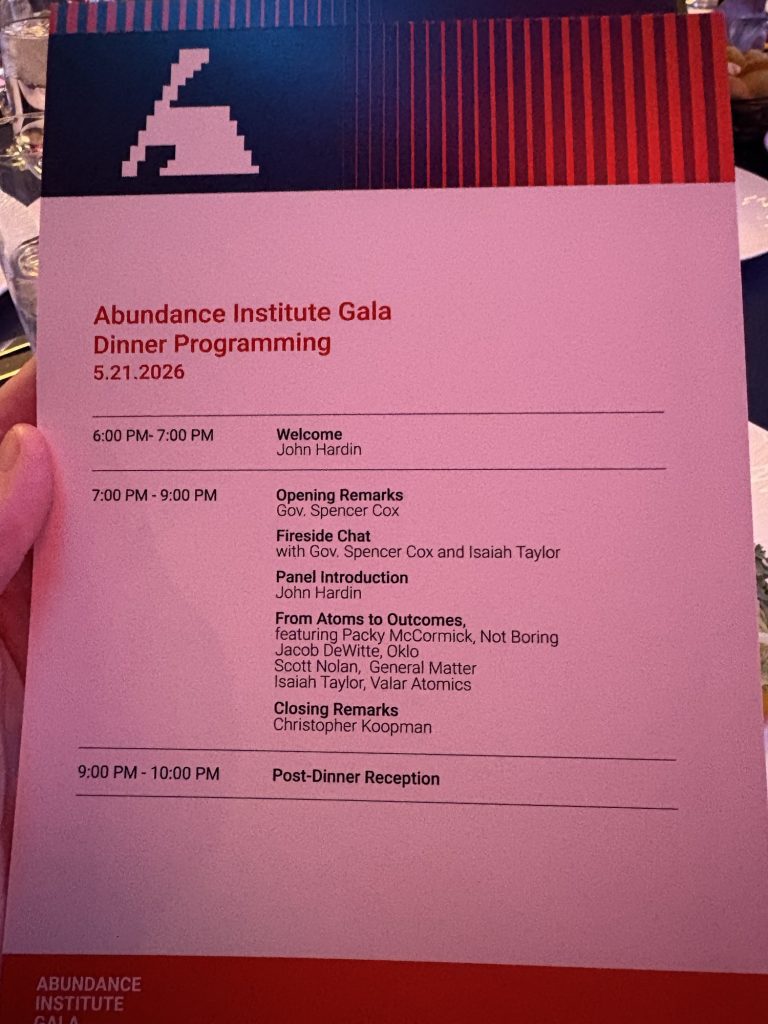
And you can better believe that I am looking forward to July 4th this year. We promised the president we’d be turning on the reactor, so there is much to be done between now and then.
Even the Department of Defense (War?) is writing swan songs about Valar from the Pentagon Twitter account
At March Air Reserve Base, California, yesterday, a next-generation nuclear reactor was loaded aboard a C-17 Globemaster III aircraft for transport to Hill Air Force Base, Utah. The reactor will eventually head to the Utah San Rafael Energy Lab for testing and evaluation.
The Ward 250 is a 5 megawatt nuclear reactor that fits into the back of a C-17 aircraft could theoretically power about 5,000 homes.
For military use, such a reactor could provide energy security on a military base ensuring the mission there need not depend on the civilian power grid, and in military operations overseas, such reactors would mean U.S. forces could operate without concern that an enemy might cut fuel supplies.
A reactor such as the Ward 250 also means greater energy security for the entire United States. It is firmly in line with President Donald J. Trump’s executive orders to reshape and modernize America’s nuclear energy landscape.
The president signed four executive orders designed to advance America’s nuclear energy posture, May 23, 2025. Those include “
Michael P. Duffey, the undersecretary of war for acquisition and sustainment, said the partnership between the War and Energy Departments is critical to advancing the president’s nuclear energy initiatives.
“It’s clear to me that advancing President Trump’s priority on nuclear energy depends on close coordination between the Department of Energy and the Department of War,” Duffey said. “This partnership ensures advanced nuclear technologies are developed, evaluated and deployed in ways that strengthen energy resilience and national security.”
The future of warfare is energy-intensive, he said, and includes AI data centers, directed-energy weapons, and space and cyber infrastructure. The civilian power grid was not built for that, and so the War Department will need to build its own energy infrastructure.
“Powering next generation warfare will require us to move faster than our adversaries, to build a system that doesn’t just equip our warfighters to fight, but equips them to win at extraordinary speed,” Duffey said. “Today is a monumental step toward building that system. By supporting the industrial base and its capacity to innovate, we accelerate the delivery of resilient power to where it’s needed.”
Secretary of Energy Chris Wright said that with small reactors like those transferred from March Air Reserve Base to Hill Air Force Base, the United States is aiming for a nuclear energy renaissance.
“The American nuclear renaissance is to get that ball moving again, fast, carefully, but with private capital, American innovation and determination,” Wright said. “President Trump signed multiple executive orders that have unleashed tremendous reform of all the things that stopped the American nuclear industry from moving.”
Part of that effort, he said, will mean that by July 4, three small reactors will be critical — or running smoothly.
“That’s speed, that’s innovation, that’s the start of a nuclear renaissance,” Wright said. By