I didn’t feel like writing yesterday. That’s a weird way to start a commitment to a sixth year of writing every single day in public on this blog. I do intend to keep writing daily.
Maybe I should restart. My life was so full on the last day of the year, that the writing I had intended on doing on the last day of year five I simply couldn’t do. I fell asleep. It’s alright I had a beautiful synopsis of the emotions of the experience even if the links didn’t get passed may.
I felt the urge to sleep come on so strongly I wrapped up with a few “oh that happened too” sentences and I was out. Poof! Exhausted. Thankfully fireworks woke me up at midnight so I could ring in the new year.
I was midway into May doing a “best of” round up review by hand when that sudden “consciousness loss is imminent” feeling hit me. I’ve been driving the Dinaric Alps on an adventure that ended up in Sarajevo. I am sure I’ll write about the experience soon.
But now I have a meal and some unpacking to do. My 2026 is off to an interesting start. I’ve crossed three borders today. You can see how I might be tired.
There can only be one. One white boy. Oh no, sheesh we didn’t mean in the department. What on earth have you been reading? There is room for everyone to have a seat at the table in our modern world. Just one seat though. Were you expecting there would be more?
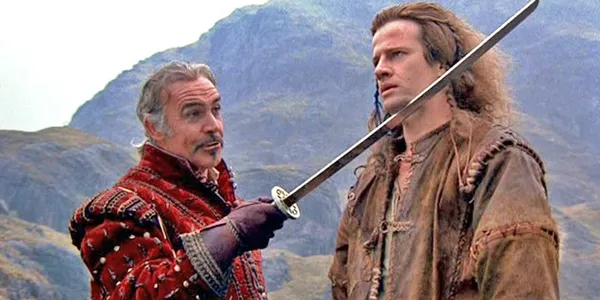
There can only be one Highlander. You know, the Scottish warrior Connor Macleod who is part of a race of immortals who must battle it out, do not age and only die if their head is taken? There can only be one of him. Except it’s a whole race. I don’t know how that works to be honest.
Immortals are driven to fight each other in “The Game,” where each beheading transfers power via a mystical energy surge called the Quickening, with the last survivor destined to win “the Prize,” a vaguely defined ultimate power. via Wikipedia
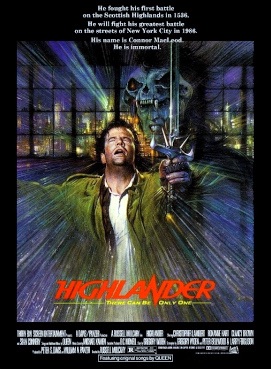
This very popular 1986 movie set between 1630s Scotland and 1980s New York City somehow turned into a mega-franchise with spin-offs and animes. It didn’t start out that flashy. I mean really look at how much content they had to pack into this poster to get people into the theater.
These days content usually the other direction, from anime to tv show to movie, but such was the power of Hollywood and its capacity for distribution in the eighties. Being a Baby Boomer movie director seems like it might have been a trip.
Things are not so rosy for the profession these days. Especially if you are a quirked up white boy like Duncan. We’ve lost them you see. This is a source of much consternation in the discourse. The children of the Higherlander generation definitely thought they would be more than one winner.
We’ve lost a whole generation of white men to diversity initiatives (launched by other white men) even though the lore being produced (by said white men) that white men were rightly battling it out for just one seat. The prize of real ultimate power seemed pretty clear. There can only be one.
Or at least this was the premise mythical of stories from ranging legendary Arthurian kings to actual Caesars of the Roman Empire. There wasn’t a team of Alexanders Who Were Pretty Good. The prize of real ultimate power is the stuff of myth. Sure actual power sharing is more complicated but humans love a final boss.
The American white boys (probably Ulster Scots) are suffering for the widening power sharing agreement reached in the great awokening diversity initiatives of the last generation. And no one even bothered to tell them until their hit middle age and didn’t end up as Highlander. We mostly told them it sucks to suck. You racist little shits just can’t compete.
I gather it wasn’t so bad when your enemy was other quirked up white boys. I don’t emotionally understand why as I was always expecting to have one seat as a token white girl. I must be less bothered having had lowered expectations. There is only one queen right? But there are lots of handmaidens if you are lucky.
Now if you want to be the Highlander you have to fight the whole globe. Highlander might be an Indian girl or a trans Guatemalan. That damned Netflix always caving in to the social expectations of elites forcing their luxury beliefs onto the suffering under class of millennial white boys. Didn’t you read JD Vance’s book? The American underclass is dysfunctional and suffering. They deserve it right?
But did they suck? Ah now that it’s too late we finally get to have the conversation about having deliberately changed the demographics of the elite winners of the Prize in American.
Which I assume is a wife, two kids, split level suburban home and a compact car. They weren’t expecting to be king. Maybe king of the cul-de-sac. And if you were forty in 2014 you didn’t get that. Well some of them.
Millennial American white boys expected they would have more seats at the table (having mostly seen themselves in power) rather than fighting it out to be Highlander.
Which is weird since I assume they saw the same movies, tv shows and animes as the rest of us. It’s hard out there for everyone. And the great game includes Everyone.
Zoomers get it. Shame it requires so much beheading. We’d better divvy up the spoils a bit more before the Highlander comes for our heads eh? Come on, at least give the boys a pilot or a term sheet or a job offer before this gets ugly. Just ask JD Vance.
Without getting into too much detail about my travel schedule I will say I’ve visited a few places with a lot of construction this year.
I’m talking about cranes on every corner level construction. If I did a full rotation as if I were Michael Bay getting an action shot, I’d see a half dozen cranes putting up major construction projects.
In some European cities (not the western ones) I saw entire neighborhoods being rebuilt from old multi-family buildings to massive mixed used developments. Cute streets and courtyards be damned, the millenial families want Instagram housing from Tallinn to Tirana.
Their elders are confused but new families need new condominiums. Let’s just hope they remembered to plan for water, power, and other infrastructure needs like new roadways. I’ll admit I’m skeptical in many cases. Maybe it’s good that they are just building willy nilly as it’s not like we get infrastructure investment without the pressure of new families demanding it.
Americans don’t see this amount of construction regularly and it is both inspiring and also a mess of pollution from debris to noise. It’s pretty miserable if you happen to enjoy walking. It is also miserable to live with.
It almost makes me sympathetic to the whines of older residents who want their homes to be worth more and use the chaos of new developments as a cudgel to stop new housing from being built.
There was a time in New York City when I first arrived there when it felt like new buildings went up all the time. You’d complain about jackhammers, trucks, and the ugly protective sidewalk sheds that are meant for safety.
I even knew a venture capitalist who left his job to make a classier sidewalk shed as the damn things almost never come down in a city under constant improvement.
I went through ULURP or Uniform Land Use Review Process hundreds of times in just a few years as an appointee in the community board system.
All anyone can do is complain about the lack of new building and construction. And who can manage to overcome the slog to build let alone turn a profit. American processes for building are more “cranky man tells at clouds” local meeting hell than Robert Moses.
Maybe the YIMBYs (I myself am a yes in my backyard sort) are barking up the wrong true with red tape reform efforts. The strongmen cut the Gordian knot of land reform by simply not giving a shit about process.
The Zoomers are ready to rage for radicalism with their reactionary political entertainment industry. It’s unclear to me if those types would remember to incorporate waste water treatment in their plans. It’s not hard to go from bullshitting to being covered in shit. So that’s worth considering too before we get too excited about a new round of futurism.
It’s getting harder to ignore the crumbles. Everyone on the internet is furious about everything. And everyone offline is just trying to keep their heads down.
I should probably have the good sense to do so as well, but I’ve made my bones being accessible and not at all sure I know what happens in a post-human Internet. I want it to be a human directed future.
2025 as a year has been particularly challenging even though we’ve had some positive moments. More and more things are breaking and it’s just impossible to ignore no matter your insulation from reality.
And quite obviously, I have done more than average to move us as far from the center of Empire as is feasible. We moved to Montana.
Part of me thinks it’s well past time we really took a hard look at the hell in a hand basket direction we are headed in. Things are going haywire everywhere. The brief moment in which it felt like we might accelerate through the turn naturally goes splat if you don’t commit to the bit.
And part of me says fuck’em all. The shit that was done to me in the service of extracting my life force for what, pensions and healthcare costs for a generation who broke all social fabrics? It’s literally Saturn eating his son levels of disgusting.
It’s quite canny of Peter Thiel to be ahead of it and it’s a better look than insulting the spiritual leader of the Catholic Church. And I’m not a notably sympathetic person when it comes to institutions like the Church (being a Protestant and all). I’m more of a direct communion with the Lord type.
However when a man well versed in scapegoat theory puts out a sympathetic hand & his most significant rival makes the tactical error of insulting the Pope, you know the tilt-a-whirl is in full spin and there is little space for any of us to cling.
We are on the highway to hell, & I was promised a handbasket but there are none to be had as they’ve been hoarded. The fourth turning is about to show us that even the liberals get the boot. There is little doubt that I am mere scraps of elite overproduction that refused to fuse to my intended spot. I’ll find my own place to stand.
Shit just doesn’t feel right. That’s been true for a long time but the edginess of the moment seems nastier, grittier, closer and uncomfortably liminal. It feel like things are changing but into what I could not say.
Whatever we are phase shifting into as a species, or at least one with a shared reality, seems hopelessly fragile. We are coming apart and historical precedents don’t seem to be very helpful. Is this the furthest down the simulation we’ve come?
That is a pretty grandiose way of saying that America’s current troubles are accelerating and it’s hard to ignore how much stress this is causing.
Being on any portion of the internet is like being inside a tense family situation with billions of people who have poor impulse control. And no one is in charge.
Which to some extent means the planet wide project of nation states and the liberal capital system, is buckling under the weight of the network.
We can see too much of each other and the past rationalizations we’ve used to keep our world in check feels ridiculous.
Nothing feels rational to anyone, but only because the complexity of all our lives is now mapped across an enormous overlay of individual players which we can sense beyond our immediate daily lives. And it’s too much man. People are going offline and with it a contraction is happening.
I know more not only about my own country but can feasible access billions of other human players through the data that I have access to at any given moment. And it’s like watching every layer of Dante’s hell as your feed goes up and down the layers of a Hieronymus Bosch painting in an elevator. Except it’s not a metaphor.
Just the mechanics of global human scale seem insane. Player versus player at billions of players seems impossible. I didn’t sign up to be a character in Civilization. I don’t even think I’d like playing Civilization on God Mode.
I studied economics at University of Chicago in another lifetime. An institution started by an industrialist. That investment by one of the richest men to have ever lived did go on to educate minds. And while splitting the atomic changes the course of our societies, so did unleashing number of economists onto unsuspecting countries.
Eventually I realized that all our models are at best approximations, and every input is entirely reliant on mere maps of the actual terrain. Maps made by people just like me. I went to seek my fortune in the markets as a rational actor. Centralized systems did not seem to work.
I’ve got no idea where we are headed. I am intaking information as a totally irrational actor only aware of the hubris of any prior certainty. Is it irrational to behave rationally in an irrational system? Let us all smack into that paradox. Let us just consider that we are all trying to get through it changing as best we can.
Today was a pretty big news day. It was a FOMC meeting with a cut, Jerome Powell gave some forward guidance that a cut in December is not guaranteed (cue market upset), and NVIDIA became worth $5 trillion.
This is apparently 16% of our GDP and without investment in artificial intelligence related build-out, our economy would have only grown by 0.6%.
Without Magnificent Seven spending, GDP would have grown at a mere 0.6% annualized rate instead of around 1.1%-1.2% – Fortune
So America would be looking about as gnarly as Europe without the Magnificent Seven and AI infrastructure build-out spending.
About 92% of GDP growth in the first half of 2025 was driven by investment in data centers, AI infrastructure, and information processing, with NVIDIA as a primary contributor Yahoo Finance
Which is a scary large amount for any corporation, but is somewhat rational in the logic of a civilizational technology changeover akin to the Industrial Revolution.
For some comparisons, Standard Oil at its height represented about 5-6% of the total U.S. stock market value at the time and 1.5% of America’s total GDP. AT&T’s Bell Systems were worth about 3-4% of America’s GDP at their asset peak in 1984 so not entirely an unprecedented situation though Nvidea’s percentage is a very networked era problem.
How afraid should we be about the potential for a market bubble in artificial intelligence? That is a questions for Carlotta Perez
Having lived through both the dot-com crash and the global financial crisis, I have some fears, but also this feels about as rational as any of the other ways we’ve handled valuations and value in past boom-and-bust cycles.
There is significant revenue from very real demand. It is just hard to see the demand as it’s industry demand not consumer. And the consumer demand we have is likely coming from professionals who are more enabled in ways we can’t count. I couldn’t have answered half the questions I had for this post before the LLM age.
And that demand for efficiency was coming and needed to be addressed over some time horizon, no matter what.
As different industries cope with their extreme lack of efficiency in the face of other industries who are efficient and in demand wages rise everywhere and basic needs like education & healthcare get more expensive despite not being delivered more efficiently.
So we still need those inefficient industries but what do we do? We have to find solutions.
Because we were going to need to build out the infrastructure for diversified energy transition. Much of this is being spent on build-outs for things that we genuinely need.
We need nuclear. We need power grids that aren’t from the dark ages. We need the efficiency for compute as government services have gone full runaway Baumol accelerationist. Unless we do the hard work that’s going to take 10 to 15 years, most liberal economies will collapse under the weight of the social safety net.
So we need to do a fairly thorough job of investing in the future, independent of whether it’s artificial intelligence driving our future or developing an industrial policy of, say, going to war with China. Necessity is the mother of invention and I’d rather the need be capital growth than war to drive industry.
I don’t know why this “facts of budgeting life” works people up so much. Booms and busts and bubbles build real things and we really need more efficient energy, healthcare, and education.
The economy is a nutrient gradient and money moves to where it gets fed. Right now the promised efficiency of a solution to unsustainable spending is paid for by gains in areas which did get more efficient. That is just the whole game. Grow faster and bring along anything that isn’t for the ride.
I was ordered into bed for a couple of days by not one but two doctors. As I mentioned yesterday, a small incision for testosterone pellets must have let in a small amount of bacteria.
Maybe we didn’t pick the correct antibiotics (or maybe it was an inadequate dose) so what looked like healthy healing turned into a subcutaneous infection just as it was all look well which needed managing and cause me a bit of trouble.
So I’ve been catching up on costume dramas like The Gilded Age about the 1880s boom times in America. I’m on the third season of it and while not quite done but I’m enjoying it.
No matter the era or the people involved, humans will always find new ways to organize themselves into hierarchies that reflect changes in technology and material conditions.
As eager as we may be to unravel past cultural ways of organizing our status and importance, we always find new ways to set new standards of who matters and why and the same human nature finds a way to creep back in.
Position, birthright, inheritances and other ways of marking nobility and aristocracy manage to find a way to accommodate wealth and power lest they lose all status.
And who has wealth and power in this century whipsaws so fast, it feels like change is as seasonal as the weather. Even if in reality, society changed little if at all. Money and birth still matter quite a bit no matter how many followers someone has on the latest attention gathering platform.
The Gilded Age attempts across the seasons to show that our society is always changing with subplots about rising in society through invention, intellect, political organization and sheer force of will.
Gilded Age’s director Julian Fellows also directed Downton Abbey which famously showed a British aristocratic family struggling with money, social change and war.
Both shows may show ways of changing one’s position in society but the skeptics exist at every turn. Even Fussell has Class X in his guide who exit rather than participate in what he calls the charade of meritocracy.
Fussell argues that it is essentially impossible to change one’s social class —up or down — but it is possible to extricate oneself from the class system by existing outside the system as a X person. Wikipedia
I find this particularly funny as we have entire institutions dedicated to deciding how we see and experience class and their luminaries hate how society organizes itself as much as anyone. The New York Times’s infamous columnist David Brooks finds Fussell’s book a “caustic and extravagantly snobby tour through the class markers of its time” which strikes me as especially funny as he once dedicated a column to worrying if he’d put his assistant into an awkward spot by presuming she wouldn’t know how to order in “gourmet” Italian deli.
Bourgeois bohemian that Brooks was, it never occurred to him that an Italian deli might actually be a lower class marker for plenty of people. American Society being filled with semiotic markers in America to ever really manage a static set of signifiers for all that long.
We may have some room for improvement technique with it so I am encouraged if the is as bad as it gets. I am not seeing any benefits from it yet and ugly bruising and a bit of an opening on an incision isn’t so bad.
A lot will depend on how well I recover and how much the hormone actually helps when I’m not healing. I’m also in the luteal horrors phase where my hormones are most ridiculous so I’m curious to see the curve.
The best part of this remains that I have a world class treatment for skin wounds on hand. Hyperbaric chamber oxygen therapy’s best research has been in wound management from burns to slow healing diabetics. So if I have to nurse a wound doing it with oxygen at pressure is actually pretty baller.
And to make it even more on theme, I spent most of my time in there writing out a column on skincare and the Great Male Renunciation of Appearances as part of my beauty shopping column and excuse to write about the secret history of appearance and its power.
It’s been a weird week. I’ve kept a slight distance to the logistic of it for sanity, but my father’s memorial is being held tomorrow. He passed over the last long weekend of summer. I found out by voice mail.
It is a complex family dynamic and I am not (insofar as I can tell) invited to event. I know it sounds odd to be unsure, but given how the information has flowed, who has been prioritized, and the reactions to condolence communication I’ve done my best to keep a respectful distance. My grief isn’t the most important grief.
Neither of my father’s children nor his previous wives will be in attendance. It’s not necessarily our choice, or even our place, to have an opinion as he had a third family who welcomed and loved him and I am grateful for their generosity. He had no further biological children but he had another family.
We’ve spent the last few weeks doing a comical amount of legwork with the help of kinds souls, friends and my mother to acquire the ideal floral arrangement and make sure it arrives alive and healthy.
Two Venus fly traps carefully placed in a cardboard box for travel from Colorado Springs to Boulder
In an age where Miss Manners would find few remaining social mores, a respectful but symbolic floral display seemed the most likely to be acceptable and held the most meaning for me and the father I remembered.
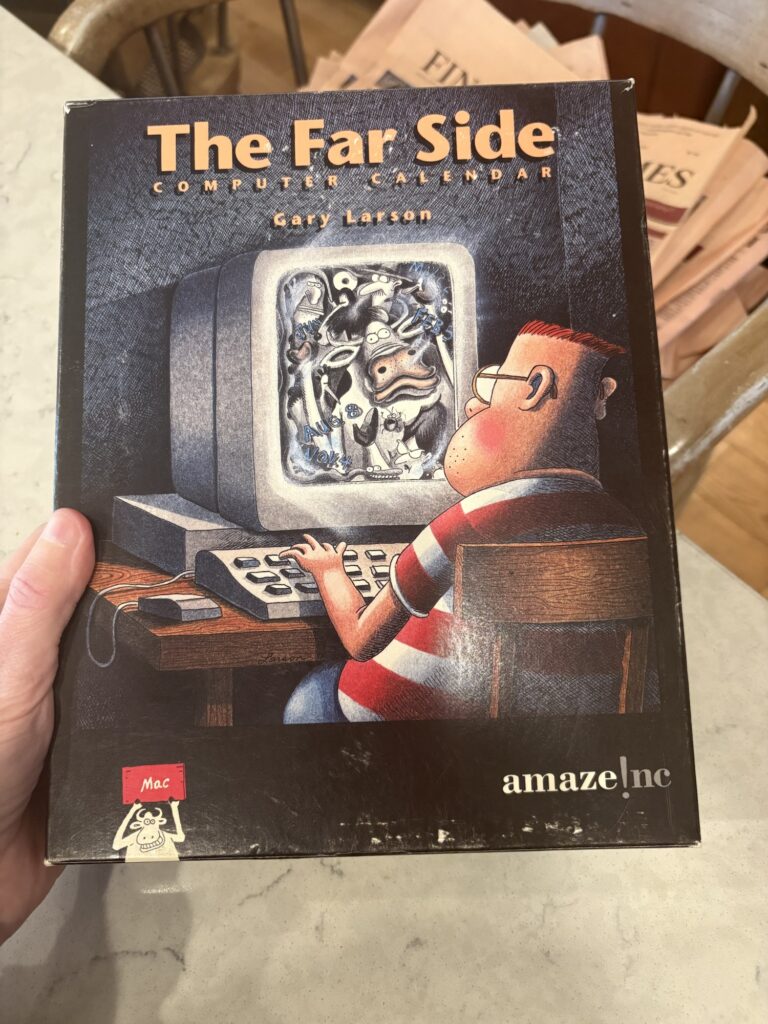
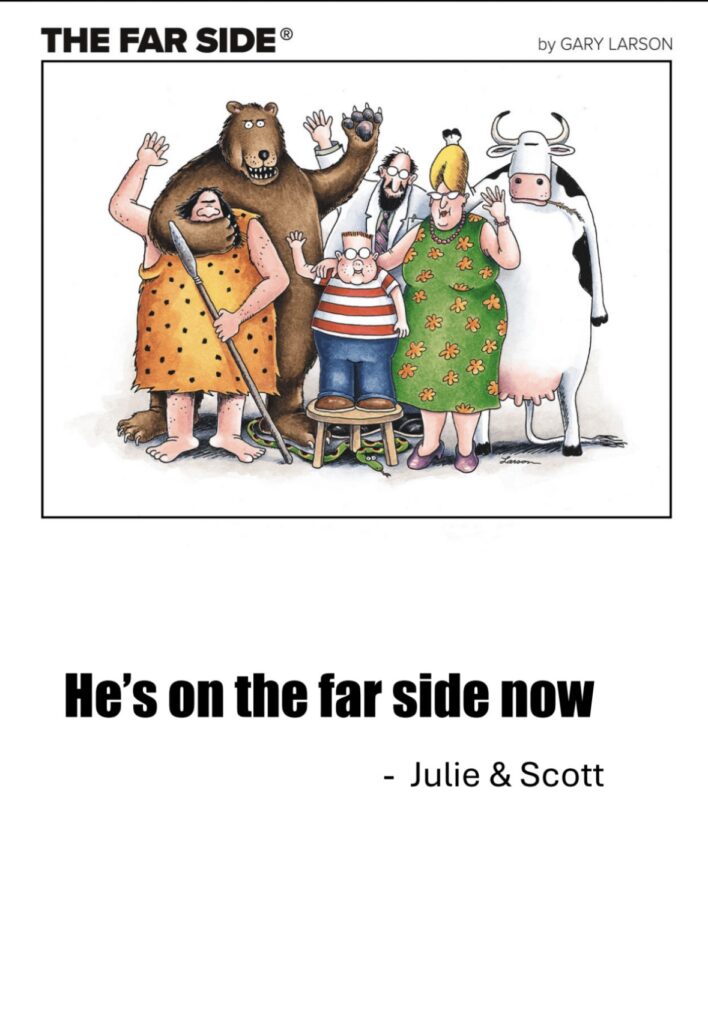
He loved Gary Larson, and in the early nineties convinced him, through a bouquet of carnivorous plants to participate in calendar application for Macintosh. Gary decided the Internet wasn’t for him later but that early desktop computer program and its genesis remains a favored family story. A creative and bizarre tale of making something happen.
The Far Side Computer Calendae
Alas it’s not all charming anecdotes. Yesterday a large box arrived with a return address in Big Fork Montana. That is where my father had retired so we knew it was likely from his estate. Part of our hopes in moving here was to be closer to family.
Inside was a mess of the broken glass, old picture frames and hundreds of photograph of a life that my mother, my half brother and my father lived quite happily for a time.
Hiking, fishing, skiing, my first golf lessons, and horse back riding photos filled out the details of a childhood between spectacular eighties family portraits.
Little evidence of the hard years of poverty in tiny apartments was included. It was entirely the glory years of boom times. They were happy memories.
There were also glamorous soft core pictures of my mother in lingerie or swimwear which my father had apparently taken himself. I was initially quite shocked.
Nigh professional grade photos of my mother posed like a pinup are not exactly what one expects in an estate dump of memories. Especially as she is very much alive and well.
My mother’s has given me permission to discuss the images, though she was a bit shocked to learn they still existed.
She swore she had them destroyed but I’m glad they were not as I enjoyed seeing her beauty and vitality. Everyone deserves to remember the years where they were at their physical peak.
My father was a man of many talents and interests and he loved to learn new skills on the latest gadgets. I just didn’t expect to learn he was that sort of artist.
I hope the flowers and our card will be accepted tomorrow. I’ve been reeling slightly from the photo dump and its unheralded arrival. It felt like one last piece of unkindness when magnanimity would have been simpler.
I don’t know if anyone will understand the story behind the flower, so we have made arrangements for the plant’s well being if they are not. It is an imposition to send a living thing and it was my hope to do as little imposing as possible that might cause distress.
My grief is my own. A whole life was in that box and I have no idea if anyone will remember or recall any of it as anyone who was there isn’t invited. But I remember and I will treasure it. He’s on the far side now and free of petty concerns. I love him and I always will.
There are many benefits to a networked world but there are many destabilizing aspects to opening up the world to all of us. I’ve been slogging through Vladislav Zubok “Collapse: The Fall of the Soviet Union” which refutes the widely held belief that the collapse was inevitable.
He argues that Mikhail Gorbachev’s reforms, aimed at modernizing and democratizing the Soviet Union destabilized the country.
Now as an American I might see that in a somewhat positive light but imagine America being broken up and you can see why it’s worth studying. It is worth understanding that with scale and access, a networked system has risks that we have not previously encountered in a political or economic system.
The last time we experienced a modern collapse at large scale, we had a fraction of the networked infrastructure that we do now.
Artificial intelligence becoming the current bugaboo belies just how little the general public really understands the nuts and bolts of our information rich world.
The complexity of how it operates obfuscates how easy it is to tilt the cart and upset fragile hierarchies and understandings.
I wish I could persuade more people to this viewpoint. The strange bedfellows of professional misunderstanders are constantly infighting with murky agendas of state and corporate preferences.
We are all useful idiots to someone. An alliance between orthodox Christians and a rationalist sex cult is the sort of “only in America” marriage of convenience that fights for very particular reasons.
The technocrats having lost the battle with modern complexity (and along with it the Mandate of Heaven) are in the process of playing whackamole with uprisings of paranoia that is a pox across every type of community. And that sucks as sometimes the paranoids are actually right. We just are never quite sure when.