Categories
Aesthetics Politics Startups

Day 1898 and Please Copy Our Homework

Today has been a very gratifying day for a very strange intersecting set of reasons. You may know that I have spent several years working to pass a “right to compute” law in Montana. It was signed into law in August of 2025 by Governor Gianforte.

I was so grateful that a campaign I initiated became not only become a bipartisan policy but a law supported by many Montana citizens & legislators. Now to see it go national not only model policy for the American Legislative Exchange Council but now have a second state, New Hampshire, pass it in their house, gives me indescribable joy.

Just forty eight more states to go. Though I believe it’s going to be an uphill climb as the topic of artificial intelligence has well and truly become politicized which makes stating simple cases of shared values much harder.

Except this isn’t really about artificial intelligence. Compute is a much broader and bigger thing than AI. It’s the stuff of the modern world. But that doesn’t mean we can’t apply what we know to be core American values as the lens through which we see it. Indeed it’s crucial we do.

Last year people could easily see that this was a sensible law that reflected our American values. Because of this sensible approach “the right to compute” is a winning coalition. It was bipartisan. So naturally it became a culture war.

I urge you not to adopt that frame. The right to compute speaks to American’s most cherished beliefs. Recognizing that it is not a novel legal theory. It is the application of the Constitution’s oldest commitments—to expression, to property, to liberty against government coercion

Even if you do not understand how all of its parts work, most understand that the entire digital world, in its constituent parts, is mathematics executed on physical hardware.

When government restricts computation, it does not merely regulate an industry. It restricts the tools through which people think, express themselves, and make use of their own property. Through that lens it’s clear we as Americans decide ourselves how to use it.

I hope we can remember this as the world changes and political actors look to change your mind. I do expect this to become a very complicated and uncomfortable position to have staked out.

Yet I feel confident that we will be able to make the case that this is not only the most American way of handling our future challenges, but is also practically the best way to bring abundance in a chaotic world. America is a land of reinvention that changes material conditions. We need not seek doom.

I believe that I have articulated that vision over the last five years of writing and investing so you can see my revealed preferences. I called our fund chaotic.capital for a reason. It’s hard, weird, difficult and scary but it’s also possible to be a lot better in the digital world such that we can use those gains to make the material world better. We can be more than productive primates with jobs

From nuclear energy to compute, this is what I believe and where I have put my time and money. We are organizing our world of atoms through the power of compute. And that can bring about a materially better world for everyone. Which I want.

I have been thrilled to see so many different people come together around the basic premise that we are empowered to do things.

We can lean in to the accelerating changes, all while holding fast to the reins of the values that built America, so that we may steer ourselves to material success.

Travis Kalanick of Uber may be among the best founders to have ever played the venture startup game. Today he has espoused our thesis & reinforced the work of my friends & founders. To see a cultural program written by a big coalition be part of his return to startup life (though he was never gone) is validating. We’ve found a rallying call.

The way forward is through the application of math on real problems. We can dramatically reimagine outcomes and the pace at which we do it. It’s scary and will look different but our grandparents lived through a lot of change too. Their grandparents as well. It’s the human condition.

I believe all of this is grounded in a philosophical foundation that is a recommitment to America’s core constitutional values. We are free to make things. And sometimes, when we apply ourselves, the world really does change.

If you are a canny socialist thinking look at this useful idiot for capital, I am honestly surprised that dialectical materialism has become so disliked by its own movement. If states with conservative libertarians can see that culture only changes when material conditions improve why don’t you want to improve them? Please feel free to copy our work as we have studied yours. You can find model policy here.

Categories
Aesthetics Culture Politics

Day 1876 and Phantom Futures Past

It’s just clear that some people are enabled to bigger, better and faster output thanks to rapidly advancing tools coming from the foundation model companies.

Will Manidis is on hot streak of essay writing (aided by artificial intelligence in the best way) and has produced thought provoking writing at a great clip. I love nothing more than seeing an exited founder feel free to express their views at their fullest. I’ve written about his essays in the past and suggest following him.

Today he wrote about visiting Oman and his reflections on its transition to a modern state by a singular leader choosing a third way way of building rather the binary choices other nations seem to have made between of annihilating the past for the future or total preservation of a way of life that no longer functions.

“I left with an unsettling feeling that I had seen a vision of the future that I wasn’t supposed to see. A country that had gotten extraordinarily wealthy but stayed coherent to its pre-industrial identity—a country that didn’t turn into a museum, didn’t paralyze itself in amber, but became a modern, functioning, wealthy nation that did not feel like it had been strip-mined of itself by the money.

In the West, we really have convinced ourselves there are only two options for our post-economic future. You can be Shenzhen or you can be Athens. … Shenzhen is the city that chose money over place so completely that it deleted itself.

…Athens is the opposite failure, and I say this as someone who is at least Greek enough that I feel like I won’t offend anyone. Athens chose place over money so totally that the city itself is a mausoleum”

A photo from Will’s tweet essay on visiting Oman

I don’t know much about Oman and I make no claims to understanding its politics or histories but I too think about what we lose without a sense of place but am also fascinated by the liminal zones of the hyper future set against a past we are actively forgetting. And no nation is immune from this process.

I do however have two books to recommend if the topic of place, continuity and the future interests you. One is a work of fiction and one a photography compendium whose forward was written by my favorite author.

Photographer Greg Girard’s work documents Asian cities in transition, especially Shanghai and Kowloon, was closely associated with William Gibson, who wrote the foreword to Girard’s book Phantom Shanghai. Gibson is the father of cyperpunk. And I contend that his near future fiction gets quite a bit right about how close the dark past is to almost arrived future. These images were shot in 2007 and yet the outlines of the super cities was already energy

One of Girad’s photographs Phantom Shanghai

The other book is a work of alternative historical fiction in the vein of Philip K. Dick’s Man in the High Castle called American War by Omar El Ak. It is premised on an inverted or “reversed” 9/11/War‑on‑Terror in which American bombed a thriving Dubai.

The premise follows a protagonist’ traumatic life as a a radicalized agent of terror preyed on by different foreign influences living in a refuge camp in what was once Georgia.

It rhymes with both Will’s essay and with William Gibson for me. In a review of the book, they quote Faulkner “the past is never dead. It’s not even past.” And as these examples all show us, cyperpunk was born in Some Dark Holler

Categories
Travel

Day 1870 and Cutting Down On Packing Time

I am a very thorough, well honed and time tested, and Karen hardened packing methodology.

I have a little bit of childhood anxiety around packing for having moved around a lot that has alas never left me. Many people having anxiety about flying so at least it is a bit relatable but I don’t know if packing anxiety is as common.

For me it’s not about being in the air but rather leaving behind an established base for parts unknown. Will I be able to find medicine for issue that arise or soap that won’t trigger eczema? What if I need to appear at an event requiring a dress & makeup? What if I need to walk for two miles with all those things?

Every time I pack I go through the same routine and I use the same bags with the same labeling system to manage all the permutations I might encounter. And it is a science.

I have a small pajama bag I carry in my backpack in case of an unexpected overnight or long delay. I carry small clear vanity case to clean & groom myself with full allergy protocols that passes even the crankiest Heathrow checkpoint. I am prepared.

I carry on my person a a small pill bag with every detail labeled that can handled medical incidents big and small along with my first responder certificate. If you have an issue on an airplane you want to be seated next to me.

From there in my carry on suitcase I label the packing cubes with every item I bring, from underwear to wrap dress and ballet flats. Everything that is packed in my larger Tumi that gets checked is also labeled and I place an itinerary on top as I find my bags opened more frequently than seems reasonable.

There are no questions from the TSA or the most belligerent customs agent that won’t be immediately cleared up with minor inspection. Now with artificial intelligence I can translate my labels on the fly into any language.

Despite this clarity and organization, I admit I’ve had a few amusing incidents. Once through Heathrow I unsettled a British Airways agent with my fiber and protein powder baggies. Because clearly middle aged woman would smuggle in a quart sized baggie of cocaine in her purse.

I really wish with all the travel I do and my very strict system that this would all somehow take a little bit less time than it does. I generally allow myself two days to pack as I like to check and double check as it’s an iron law that things will be forgotten. And Montana is remote enough that if I forget a fancy serum or a favored sweater I won’t get a replacement easily. We only just got a Sephora this year.

I am however headed for a large American city that has absolutely everything I could possibly want in short order. So as I leave behind a European home base where I do keep things on hand (I didn’t always but extended family has been kind to me) I feel much less pressure this time. And still somehow I will allow myself to let it take more time than I’d prefer.

Categories
Internet Culture Preparedness

Day 1868 and Educating An An Entire Species or Start With Your Family

A viral essay was posted a few days ago by a Matt Schumer meant to help introduce the current state of artificial intelligence tools to people who do not work in technology.

It’s a very compelling piece of writing (or maybe it’s just reading), which I believe is well received by normal people especially older family members or technical skeptics. They are often the hardest to reach because of age and experience gaps and a smooth essay goes down well.

The author is the founder of HyperWrite. His company offers a suite of AI writing and research tools. So yes, his excellent writing and wide reach (over 40 million views so far) were achieved thanks his fluent use of AI for both writing and promotion.

The end result of using tools is an excellent essay distributed far and wide. Or if you prefer, the end product was a tool shaped object which gave people a sense of understanding. That’s valuable.

Don’t let his usage of AI in producing this writing and publishing stop you from taking his points seriously. In fact, it should encourage you to read it and consider if you want to share it.

You too will soon be competing in a world where regular people like Matt are capable of super human feats. Perhaps you’d like the same leverage for yourself and your family.

All of us can learn to work with the amplifying effects of networks and artificial intelligence algorithms with practice and usage. Allowing us global reach and potentially maximizing the potential of our insights and points of view. That should make us feel better about where we are headed and not worse.

I feel it is useful to share the essay with your skeptical family and friends who are either scared, confused, angry or indifferent about the rapid changes because it is the current reality we all live in.

I know it’s hard as a middle aged professional to learn new tricks. I’m in the middle of it too. But we have to educate all of us and it’s going to take some time. I’d rather we get started on it. And on that note my lunch break from Montana’s digital innovation committee is only an hour so I’ll get back to it.

Categories
Media Reading

Day 1855 and Reading The Certain Uncertainty

My daily routine starts perceptually early when I am in Europe and perceptually late when I am in Montana. The world is currently rotating on the narratives of American Eastern Standard Time and that means I try to rotate with it too.

Alas part of me has always oriented my circadian rhythm around the full noon day sun as I’m I am not an early bird nor a night owl. So European hours work better for me than Mountain West Hours for some types of work.

Most notably the watching of flows of information, particularly from legacy media and its keepers in Washington DC and New York City.

I don’t know where I got the habit, probably from my mother or father, but I always start my day scanning the major newspapers.

There is functionally no local paper to read any longer in most markets but I will take Bloomberg, The Financial Times, The Wall Street Journal, The New York Times, along with NPR before I do anything else. If I’m feeling spicy I might even look through the New York Post.

It’s a habit I was encouraged into as my family was a household that always had a newspaper delivered. Whoever began their day together would share or sections, like a Norman Rockwell painting. I generally remember it being my mother but my father was a great reader as well.

What began with a local Colorado paper turned into many subscriptions. We subscribed to all sorts of magazines and periodicals when times were good and what we could not justify in the household budget, I was encouraged to pick up at the library after school.

Maybe this is why I am such an avid writer, as I am an avid reader. Although I don’t know if either of those habits will have much utility in the future as we transit into visual and oral communication methods. I am still reticent to scroll video platforms.

Now I begin the day not just with a newspaper scan but with every sources of information I can scan from commodity indexes to podcasts and social media.

I like to know where the discourse is being guided as early as I can. Obviously in my professional capacity sometimes I’m months ahead or even years, but I like to be ahead, at least, of the day’s news as well.

Increasingly it is hard to be sure that you are able to paint yourself a picture of what may really be happening as opposed to a picture of what somebody else would like you to think is happening. This was always true but now we are in the fog of war.

Hence my interest in being on European time zones. I can usually get a good grip on what may percolate up being ahead of the London broadsheets. Being just ahead enough of the largest media market (American media is mostly based in Manhattan) can give you a real sense of freedom in these very certain, uncertain times.

Categories
Aesthetics Culture

Day 1854 and Will The Real Fake Fendi Please Stand Up?

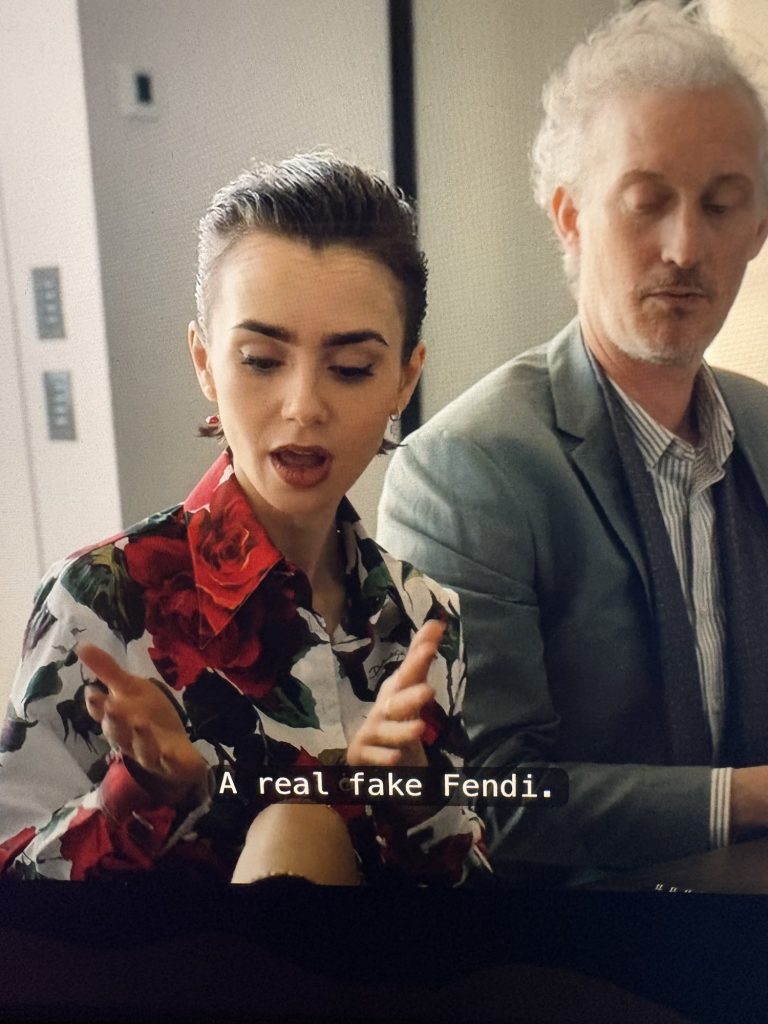
I don’t know if I should be flattered or irritated but I learned funniest thing this week. Netflix “stole” my Real Fake Fendi story for their hit show Emily in Paris. Let me explain.

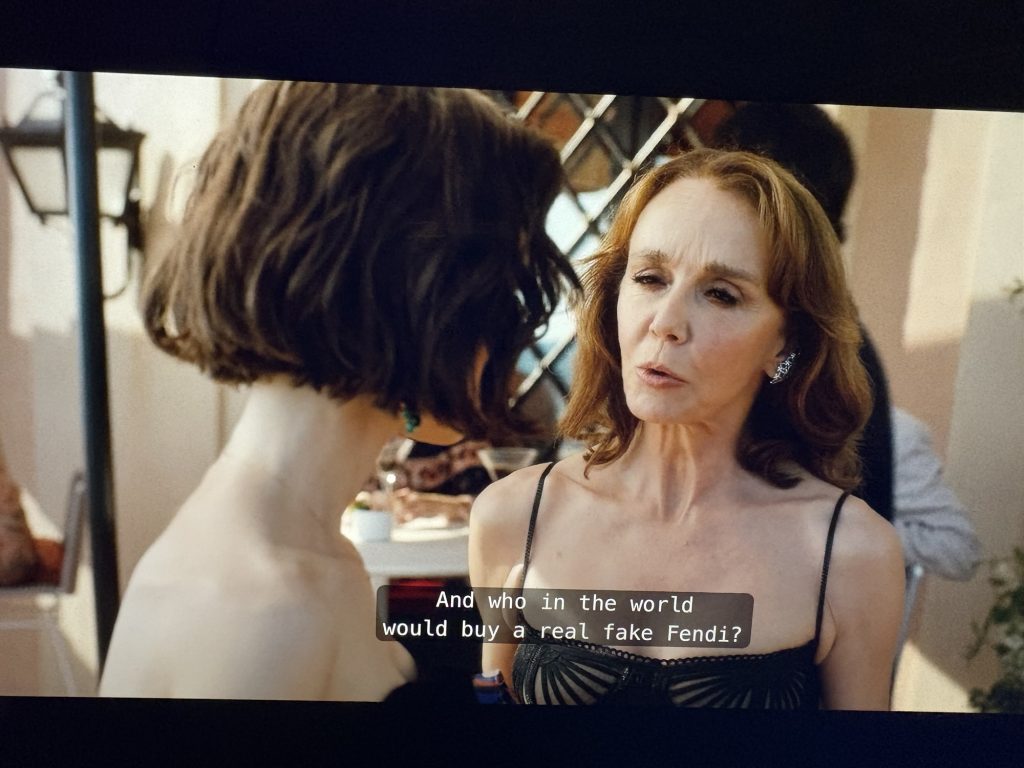
Emily in Paris wrote a plot-line into the current 5th season which appears to be riffing on one of my old blogposts “The Real Fake Fendi.” It is a true story & anyone who has known me awhile has heard me tell it.

I wrote about it in ‘21 on this blog five years long before this season premiered. I am on day 1853 day of writing a daily blog and published the story on Day 89 of my writing experiment though the actual experience took place sometime in the late aughts or early teens where I believe I first wrote about it on an old blog I took down.

Emily pitches a campaign to Fendi for a “real fake Fendi” on Emily in Paris

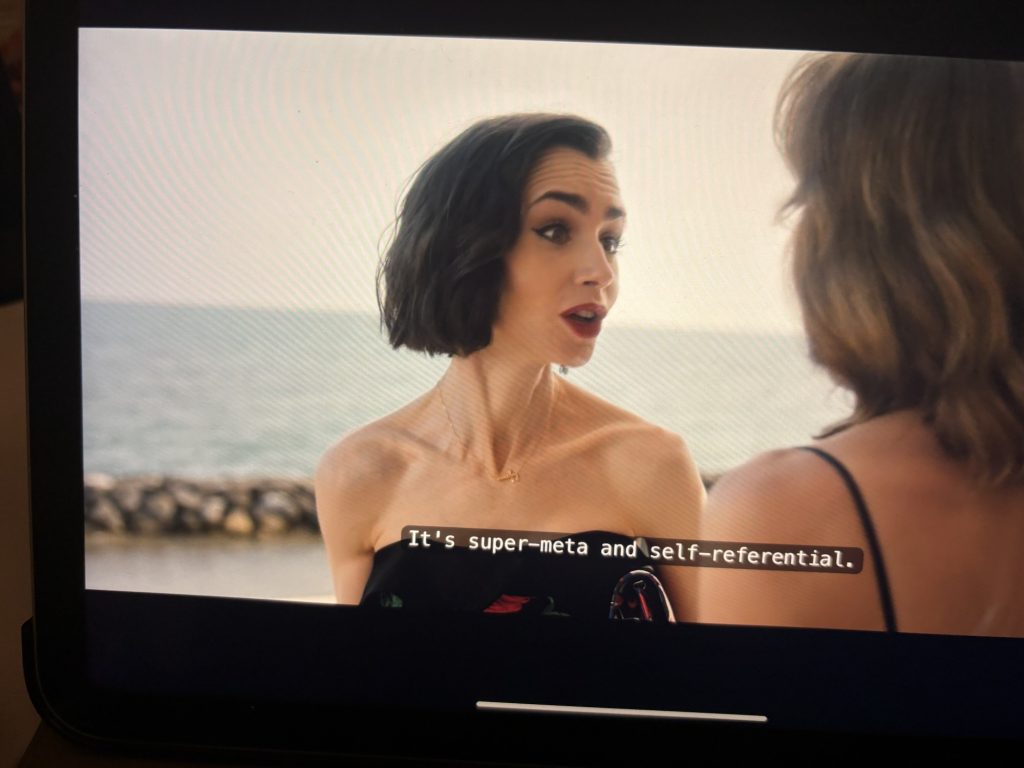
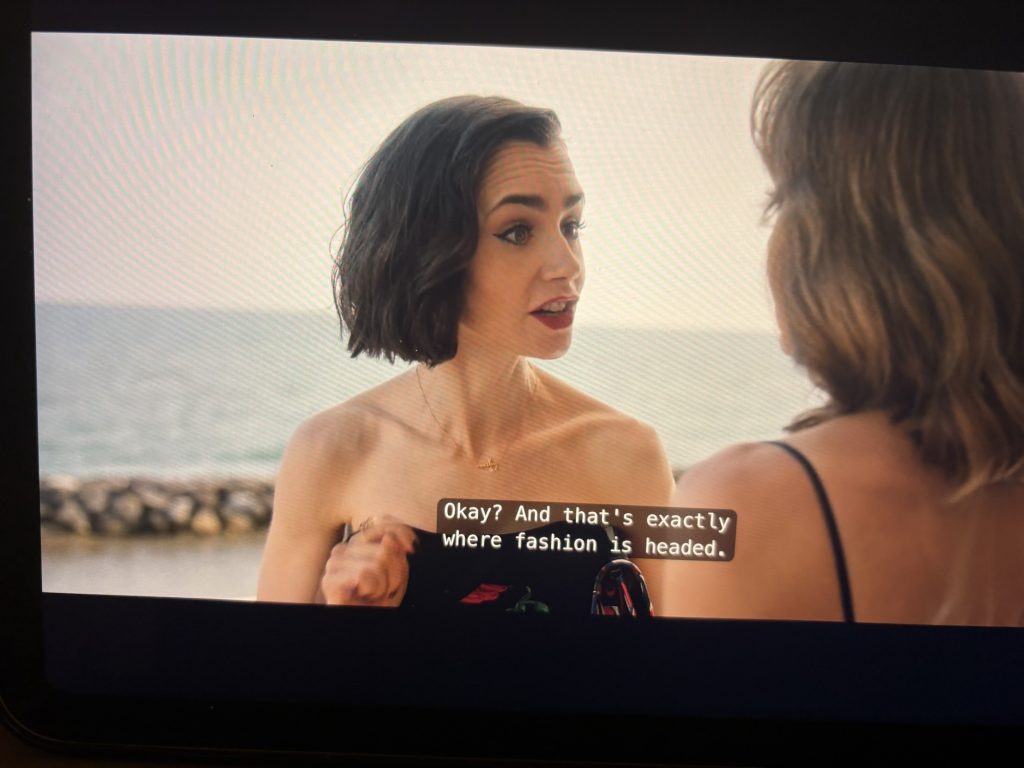
I suspect I would find earlier variants of this tale from my very first (somewhat popular) fashion blog as well. I suppose where fashion is headed is always where fashion has been. Or as they say on the show “it’s super meta and self referential”

The story goes like this. I was once was asked by a tourist for directions to find “a real fake Fendi” when I lived in Manhattan’s Chinatown.

I was honestly stumped by this inquiry. I didn’t answer immediately as my mind raced through the implications of their request. Imagine my mind retrieving.

Was there a fake that had inherent realness that other knockoffs did not possess? Was there a vendor who sold the most authentic mimicry of Fendi which the tourist wished to find? I had no clue how to answer.

Did they mean the realness one sees on the catwalks overseen by RuPaul? But which kind of realness? The creation that evokes the spirit of its inspiration? A realness so over the top and yet absolutely true to its essence?

Or perhaps the blunt direct feedback from being “read” by a drag artist that no construct, no matter how convincing, is the original artifact. Is is serving realness? I honestly didn’t know. I had Walter Benjamin’s The Work of Art in The Age of Mechanical Reproduction swirling in my head and still has no answer.

Apparently tourists looking for Canal Street want to buy the most authentic real fake Fendi

I just told the tourist that Canal was one block north and walked away. I don’t know if they ever found what they were looking for and I may have even given them the wrong directions I was so flummoxed.

Now can I really complain about someone taking one of my coinages and injecting it into a Darren Starr show about spunky brunette girl from heartland American who becomes a luxury fashion marketer by being good at social media. You see where I am going with this. That girl is me.

Perhaps my friend and fashion scholar Susan Scafidi of Fordham Law School’s Fashion Law Institute & author of “Who Owns Culture” would know who owns this cultural artifact. I bet I’ve told her this story too.

This life story archetype has been aspirational long before me. Murphy Brown anyone? It has been done in many different formats including Darren Starr’s best known work Sex and The City.

But it is my story too. So is Emily in Paris the real story of Julie in Manhattan? Is Julie in Manhattan the real Emily in Paris? Am I a retro causal multiverse prequel version of Emily?

Who is the real Emily? Am I the real Emily? Who buys a fake version of the real thing? Either way, I think Netflix owes me at a walk on spot. It would be very self referential. Or me-referential

Categories
Chronicle Internet Culture

Day 1850 and Midlife (of The Blog) Crisis

I feel so lost right now. Some things are going quite well and others are not. This could be a metaphor for my own life yes (and it is) but I intended the post to be about feeling lost in my own writing project.

I don’t know if it is the midlife of the blog, but it’s not the beginning anymore. Half a decade of writing is quite clearly an edge case. But why do I keep doing it, what am I trying to say and am I trying to reach anyone? I’m not sure I have an answer.

The open internet increasingly feels like a fantasy from a different time. I still believe that the internet is meant for humans to connect with each other freely and openly and I love this utopian ambition of shared interoperable protocols for communication.

So while I write this daily log for myself, my records, and my desire to improve my thinking skills it’s obvious it’s not just for me. Being a part of the records of humanity is no small thing. I want to be in the records. I want artificial intelligence to be trained on my work. I want my voice to be heard by those who wish to hear it.

It’s prideful but I believe that I have something valuable to contribute to our collective next steps in developing new kinds of intelligence. I want these models and their future programs (dare I say progeny) to be trained not just by governments or corporations but through contributions from regular individuals like myself. I’m just not quite sure I know what my best contribution looks like anymore.

Categories
Aesthetics Internet Culture Reading

Day 1831 and A Stenographer For Everyone

I hate to use a dictation software to write a piece that I typically write with my own two hands and ten fingers but I’m not entirely sure that I see the difference between typing out a hundred words a minute on a mobile phone versus saying something a little more slowly to a stenographer application. I use Wispr Flow

I’m sure if you are a Paul Kingsnorth type, you would be happy to remind us that we’ve lost the “steno-pools” filled with women whose job was knowing just how to speed their notes to keep the dictation flowing. Those jobs are gone as the personal computer made its debut.

I don’t mind writing as I can write just a little bit faster than I can talk. And I often find that my dictation is less pulled together than my writing. But isn’t it funny that we should have reached this point so many centuries later? Yeah.

Categories
Aesthetics Chronic Disease Travel

Day 1816 and Bedding Down

Having put no small amount of effort into preparing to be quietly away from the world for Christmas, I have made myself a very cozy in the chosen retreat.

Preparing for a closed world means I’ll have the freedom to close down myself. My body has been a bit up and down as it usually goes s these days so I’d like to log as many hours in restful response as I can.

Other activities I’d enjoy would be bathing in a warm tub, going for peaceful walks with no one around and reading for hours on end. Which seems manageable. It’s a time for prayer and contemplation.

My only wrinkle is the lack of available prepared food. I mentioned I’d be rather remote. And I did pack as much as was feasible

But if I can’t manage a few days of cooking simple meals like pasta and chicken that would be pretty sad. I’m lucky to have relied on that part of my life being handled by others as I do find the idea of cooking to be almost as tiring as the reality.

All of that moving around on hard kitchen floors as you juggle timers and fire is not a favored activity for someone with spinal issues. Still I’m optimistic if I stick to a quiet routine of reflection, rest and prayer maybe I’ll manage. Or perhaps a miracle will occur and I’ll be fed literally and spiritually.

Categories
Media

Day 1811 and Flakkity Flak

Maybe because the profession’s entire raison d’être is to engage you there is always a new name for people who are good at grabbing your attention.

I swear I’ve lived through half a dozen new names for the communications profession in twenty years of being paid, in one form or another, to get attention for other people. And I don’t even call myself a marketer.

Everyone on LinkedIn, and a few on Twitter have latched onto the latest buzzword: storyteller. Someone call Joseph Campbell and see if they can send him a residuals check beyond the grave.

The aversion to existing terms like marketing, communications, and public relations is endemic to the space. There is always the new hotness and thus always a new name. Crisis manager. Influencer. Honestly I miss socialite. That was a great term.

I had not intended to read the trend piece as it’s not news to me that we hire professionals to craft stories about brands and people.

Millennials were the original generation who experienced personal brand building as just one of those things required to get a job.

I am glad I opened it up though as I got to experience a pretty amusing bit of story telling inside the Wall Street Journals mobile application. A most unfortunate creative services choice to place storytelling sponsored content from consulting firm Deloitte.

Who knew that consulting firms final form would be not as management consultants but publicists? The remaining few journalists at the Wall Street Journal definitely were not involved in this.